
In Monaco, an Exhibition of Chaumet’s Historic Jewels Weaves a Tale of Powerful Women, Royal Intrigue, and Unsolved Mystery
This summer, over two centuries
of regal extravagance are on display in the subterranean halls
of Monaco’s Grimaldi Forum, where tales of love, intrigue, and
imperial power are the subject of an exhibition titled “Chaumet in
Majesty: Jewels of Sovereigns Since 1780.”
For the show, which opened last
month and runs through August 28, Chaumet gathered 250 pieces of
jewelry, paintings, and artifacts to tell the fascinating stories
behind some of the ornaments that the Parisian house has produced
since its founding in 1780, and the sovereigns who owned
them.
“The principal focus of the show
is women of power and the tiaras they wore as witnesses of their
destinies,” said Jean-Marc Mansvelt, chief executive of
Chaumet.
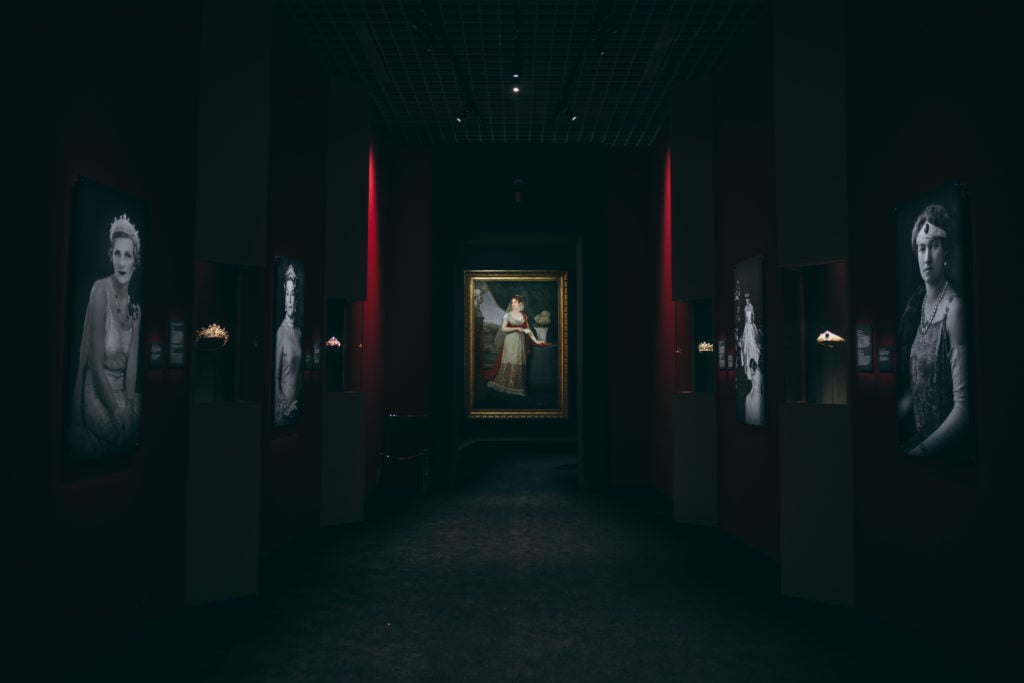
A view of the exhibition’s scenography.
Photo courtesy Chaumet.
Tiaras are a specialty of
Chaumet. Of the 50 splendid examples presented in the show, a few
have vanished in the chaotic throes of history, but are brought
back to life thanks to faithful reproductions and archival imagery.
Others, guarded in private collections until now, are shrouded in
mystery. And some were simply remodeled. Whatever their historical trajectory, the
tiaras’ restored magnificence is enhanced by the exhibition’s
artistic scenography, which plays light against shadow to dramatic
effect in the dark, velvet-lined halls of the
space.
One of the more spectacular
tiaras on view—the legendary “Diadème Soleil,” or “Sun Tiara”—once
belonged to Princess Irina Alexandrovna Romanova, a relative of
Nicholas II, the last czar of Russia, whose family was among the
jeweler’s clients in the early 20th century. Princess Irina was married to the
scandalously decadent Felix Yusupov, whose exploits included
plotting the murder of the court advisor, Rasputin. Before going
into exile for that crime, the Yusupovs hid their jewels inside a
wall of their home in Moscow, leaving them behind when they fled
the country some years later after the Russian Revolution of
1917.
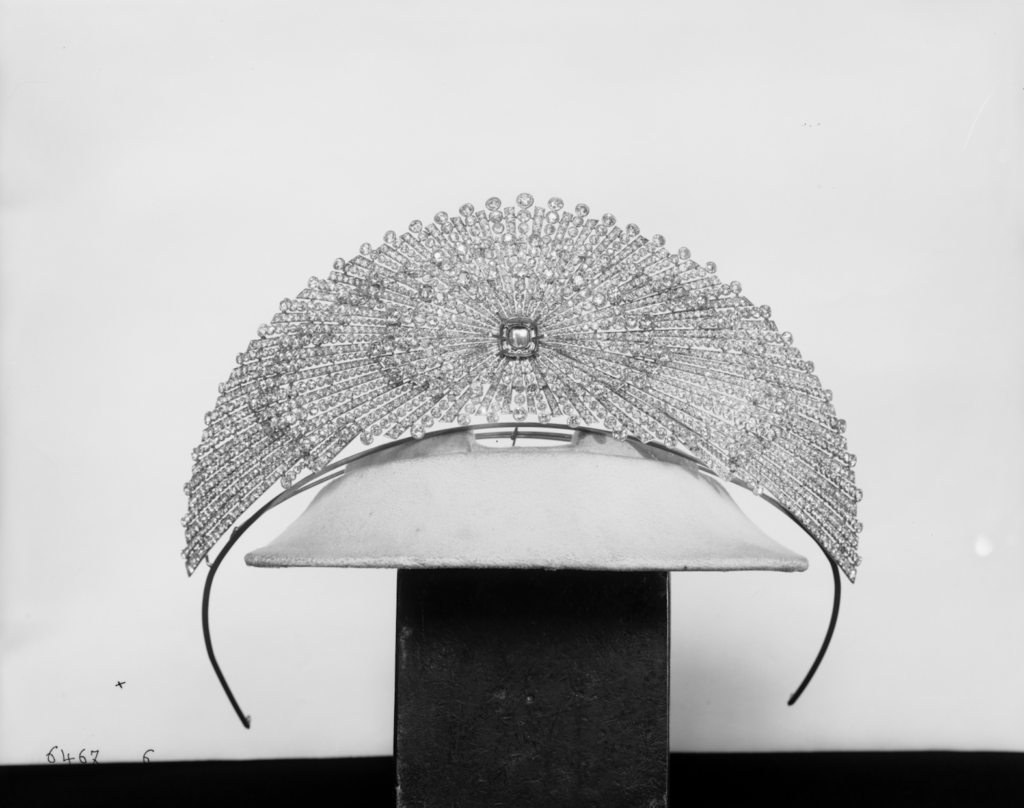
A photo of Princess Yusupov’s Sun Tiara
from Chaumet’s archives. Photo courtesy Chaumet.
In 1925, while examining cracks
in a wall of the princely Yusupov palace—which the communists had
turned into the Museum of Military History—a museum employee
stumbled upon the Yusupovs’ treasure trove. A black-and-white
photograph, included in the exhibition, shows a group of Soviet
experts examining the precious cache, and sheds light on the
jewels’ fate: after they were found, they were declared state
property, broken up, and sold off.
That is how the Sun Tiara
disappeared, its delicate design on view for all to see in a 1914
photograph of the princess before all traces of its former
splendor—and the piece itself—were lost. “The very nature of
jewelry is such that it is transformable,” said Mansvelt,
explaining that historic pieces are often altered or taken apart
over time. “It takes a lot of research to determine what a piece of
jewelry looked like originally, and what transformations it went
through.”
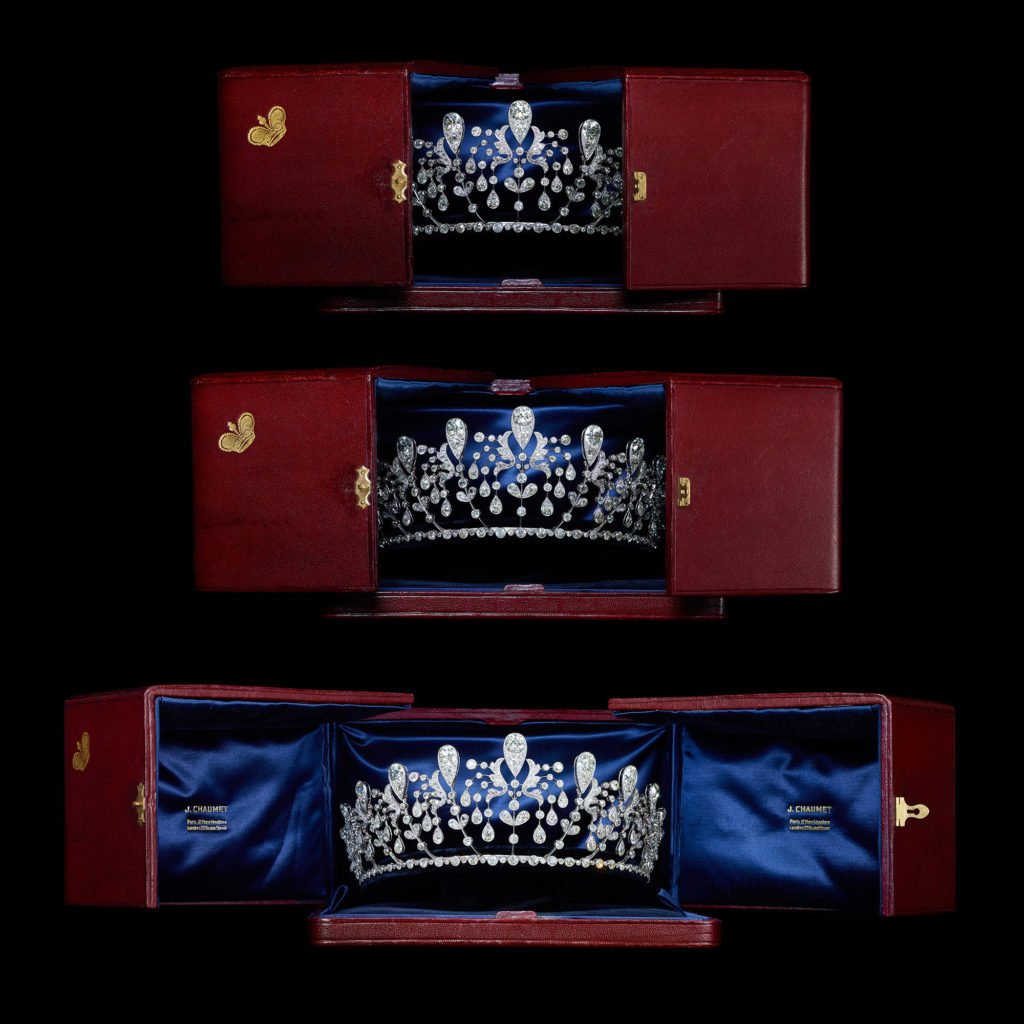
A tiara that once belonged to Princess
Hedwige of Bourbon-Parma. Photo courtesy Chaumet.
Much of that research was
conducted by Chaumet’s team of curators, royal-history expert
Stéphane Bern, and jewelry historian Christophe Vachaudez, who were
able to secure loans for the show from 16 museums and some 50
private collections, including that of Prince Albert II of Monaco,
the patron of the exhibition.
The show also explores various
symbolic uses of the tiara throughout history, including as an
instrument of political power by Joséphine and Marie Louise, the
successive wives of Napoleon. “Joséphine
had made the tiara fashionable, but it also became a tool in the
service of the emperor’s political agenda,” Mansvelt said. “It was
a symbol of love that became an emblem of the legitimacy of the
emperor’s reign.”
A number of paintings in the
show also place the jewelry in the context of the epoch, and
illustrate Mansvelt’s point. An 1808 painting attributed to the
Baron Gérard, for example, depicts Joséphine in her imperial
regalia. Another from 1810 by Georges Rouget depicts the marriage
ceremony of Napoleon and Marie-Louise, her ladies-in-waiting
adorned with tiaras made byMarie-Étienne Nitot, founder of Chaumet.
“Imperial protocol required all the ladies to wear tiaras at
official ceremonies,” Mansvelt said. “Thanks to the art of the
epoch, we can see the design of the jewelry and understand its
purpose.”
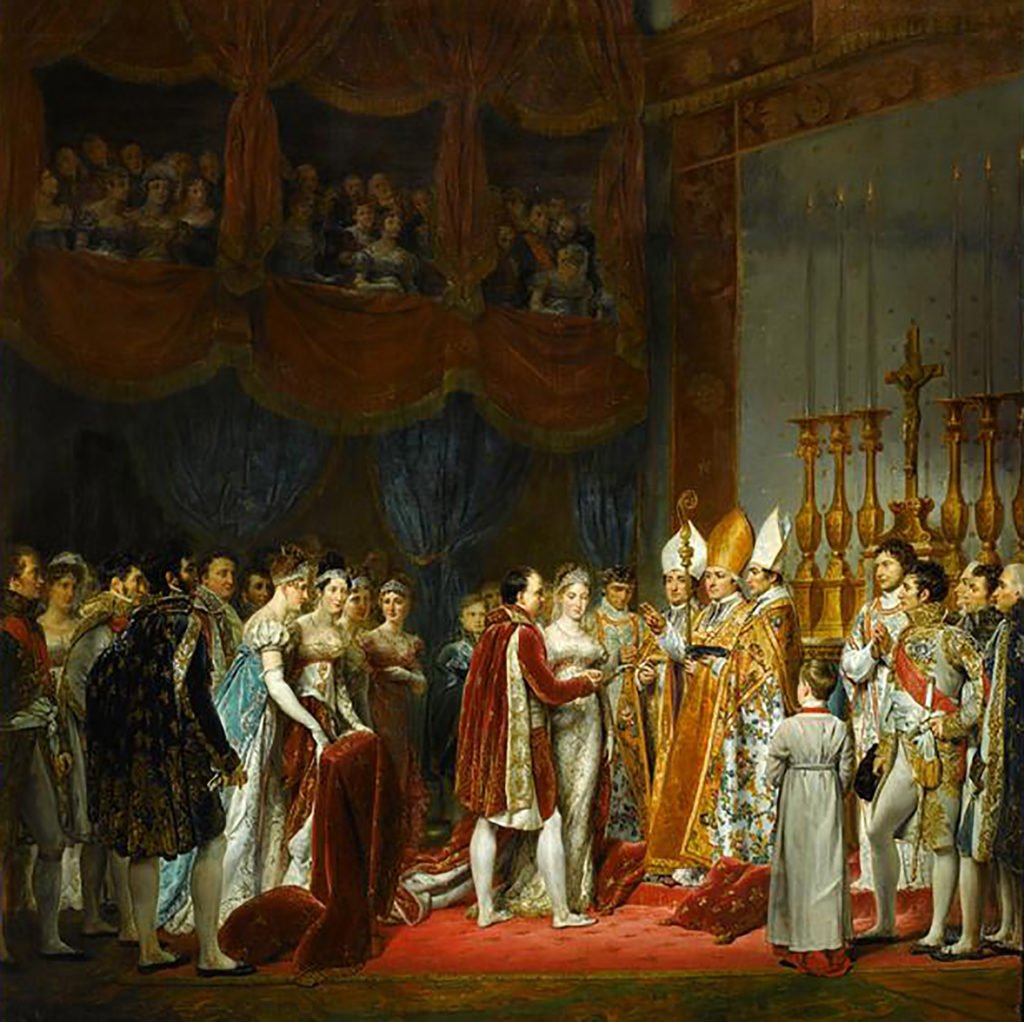
Georges Rouget, The Religious
Marriage of Napoleon I and Marie-Louise in the Salon Carré at the
Louvre (1810). Image courtesy Chaumet.
But tiaras are not just relics
of the past—many continue to be worn today by members of European
aristocratic families. The “Diadème Art Deco,” made in 1926 for the
Grand Duchess Charlotte of Luxembourg and on a rare loan from the
“Grand Ducal” collection, is a strikingly modern piece. Worn as a
headband featuring a stunning 45-carat central emerald, the tiara
sits low on the forehead, and is still used today by the Grand
Duchess Maria Teresa of Luxembourg.
Other tiaras in the exhibition,
meanwhile, have hazy and tortuous backstories that lend them an
enigmatic air. The most valuable piece, for instance, was first
commissioned around 1900 by Count Guido Henckel von Dennersmarck, a
German aristocrat. Its 11 pear-shaped emeralds are believed to have
once belonged to Empress Eugenie, the wife of Emperor Napoleon III,
who was forced to sell her jewels when she went into exile. Today,
the tiara and its mesmerizing emeralds belong to the royal family
of Qatar.
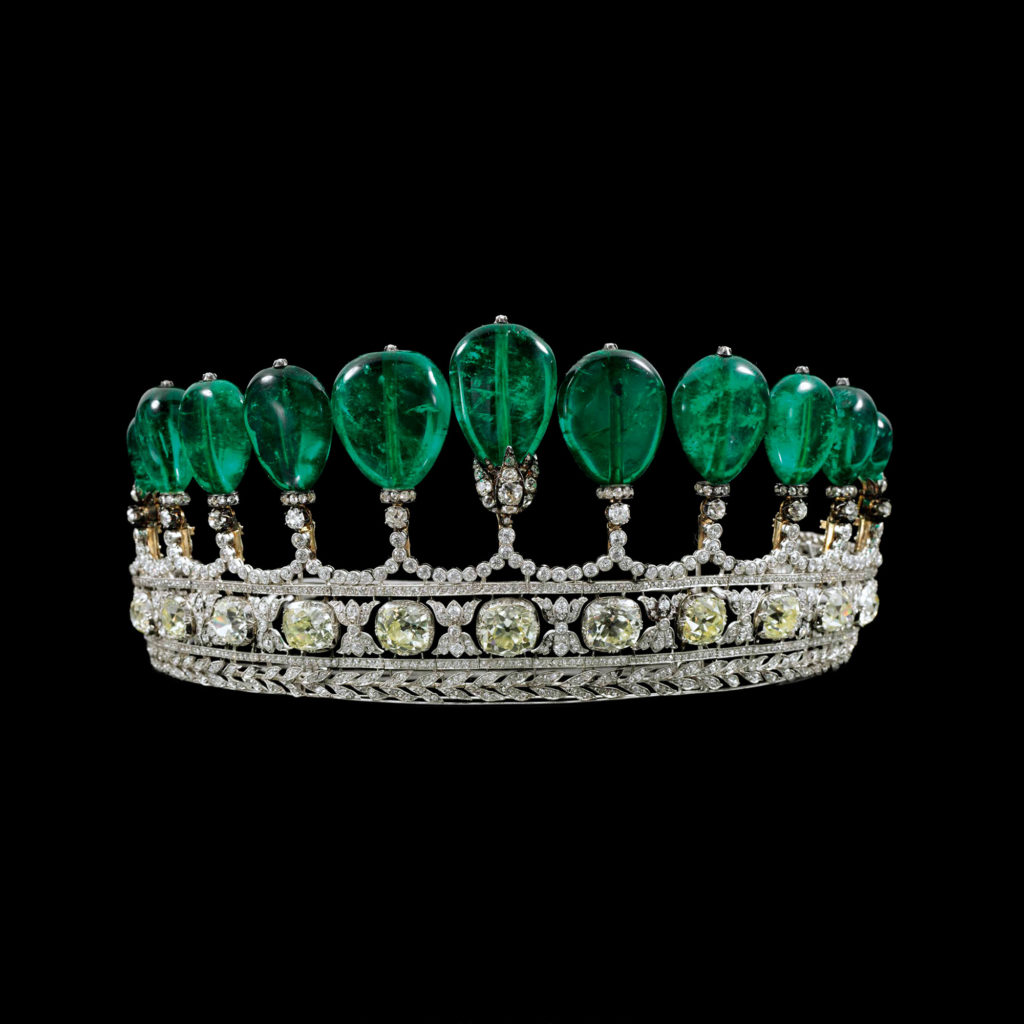
Princess Henckel von Donnersmarck’s
emerald tiara. Photo courtesy Chaumet.
Jewelry, according to Mansvelt,
can reveal so much about society and a woman’s place in it,
especially when one examines the records of “who chose the jewels,
who ordered them, and who paid for them.” To shed light on the history of each piece,
Chaumet has meticulously preserved its records since its
founding—“20 tons” of them, Mansvelt said—and plans to digitize
them while its flagship boutique on the Place Vendôme is closed for
renovation this year. “A digital database can be an invaluable tool
to research the history of Chaumet’s designs, and tell us what our
clients purchased and how they wore their pieces,” Mansvelt said.
“It will open a new chapter in the history of
Chaumet.”
“Chaumet in Majesty: Jewels
of Sovereigns Since 1780″ is on view through Wednesday, August 28
at the Grimaldi Forum Monaco, 10 Avenue Princesse
Grace, from 10 a.m.–8 p.m. daily.
The post In Monaco, an Exhibition of Chaumet’s Historic
Jewels Weaves a Tale of Powerful Women, Royal Intrigue, and
Unsolved Mystery appeared first on artnet News.
Read more https://news.artnet.com/art-world/chaumet-majesty-exhibition-monaco-1619320
Further reading


Leave a comment