
In the Wake of Devastating Floods, It’s High Time the Art World Rethinks Its Relationship to Venice
As the Venice Biennale drew to a close last month, art handlers
and gallery assistants sloshed around in knee-high boots. This
year, stormy weather and the seasonal high tide, known as “acqua
alta,” combined to cause devastating flooding. Venice’s mayor did
not mince words, tweeting that the high
waters were an effect of climate change.
People woke up on November 24 to find around 80 percent of the
city affected with damages estimated at more than $1 billion. A
month on, the flood water has subsided, but the troubles for Venice
remain. A new question emerges as to whether the city’s many
biennials are sustainable, given the risks that even
short-haul flights pose to the planet in general, and the
fragile ecology of the historic city in particular.
The artistic director of the 2021 Venice Biennale should be
named any week now. The recently closed edition attracted more than
600,000 visitors to Venice, a fraction of the city’s more than 25
million annual tourists, but a significant number nevertheless.
More than ever the climate emergency will be lapping at the door of
the next curator of this most prestigious exhibition. In the wake
of devastating floods, will a Biennale-as-usual approach suffice in
2021? Or should the party be scaled back?
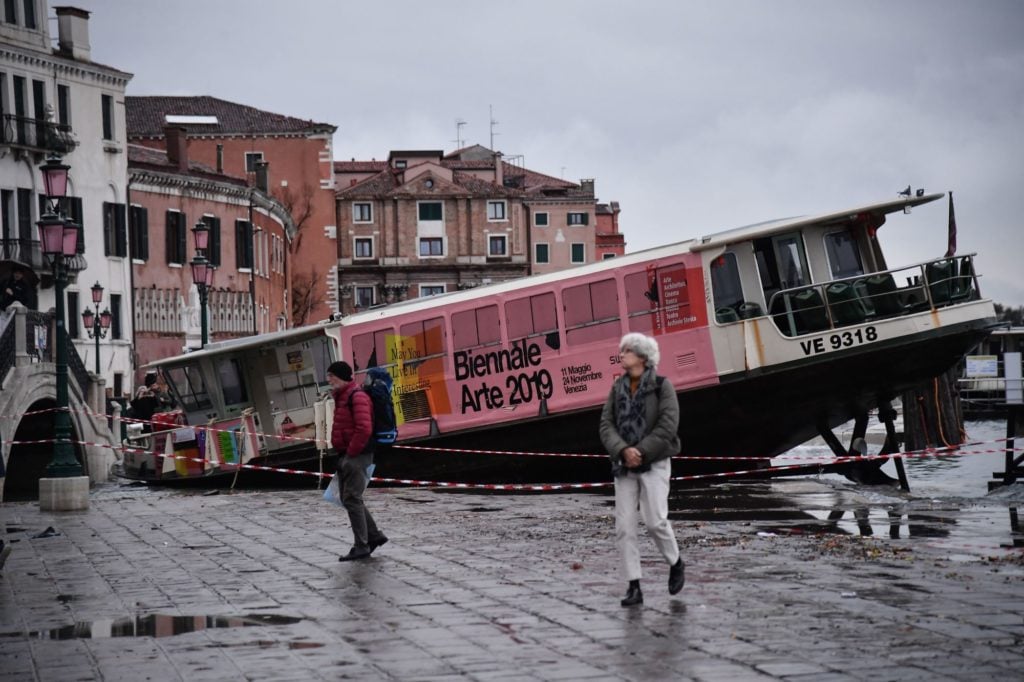
A stranded waterbus after being washed
away by an exceptionally high tide, November 13, 2019 in Venice.
Photo by Marco Bertorello AFP via Getty Images.
We Need to Talk About Venice
One of the defining images of last month’s flood was a stranded
water bus displaying advertising for the biennial. The exhibition
and its popularity seemed implicated in the city’s plight.
“The situation is clearly catastrophic,” says Markus Reymann,
the director of TBA21–Academy. Earlier this year, the foundation,
which has an ongoing mission to address sea advocacy through art,
launched Ocean Space in the Church of San Lorenzo in
Venice with a topical, ocean-themed show by Joan Jonas.
Reymann says the imagery of the art world and other tourists
splashing around in acqua
alta is not entirely bad in the sense that it has a catalyzing
effect: “[They] have the potential to become iconic of the arrival
of climate change to Europe. For a long time, we have all been very
comfortable with the idea of climate change happening elsewhere
despite our warm and cold weather extremes in Europe.”
In late November, Ocean Space narrowly escaped flood damage,
unlike St Mark’s basilica, among other historic monuments, given
that San Lorenzo’s front door is nearly eight feet above sea level.
But the flood water reached its very last step, Reymann tells
Artnet News. So, when the tide finally flows through its tall front
door, it means Venice is in the deepest of troubles.
“As a group of cultural producers, we need to rethink our
practice of production, presentation,” Reymann says, though he
stresses that we still need exhibitions about the impact of the
climate emergency. “What does a rising temperature of 1.5 degrees
really mean? What does it mean that 500 million people will have to
migrate? Art and artists have a unique capacity to condense these
topics in an appealing or disturbing way that lets us build a
relationship to that data.”
And in the lead up to the next Biennale, Reymann wonders if
everyone (who’s anyone) really needs go. “I
think we should think about new formats. Does everybody need to be
in be represented there? Does everyone in the international art
world really need to come?”
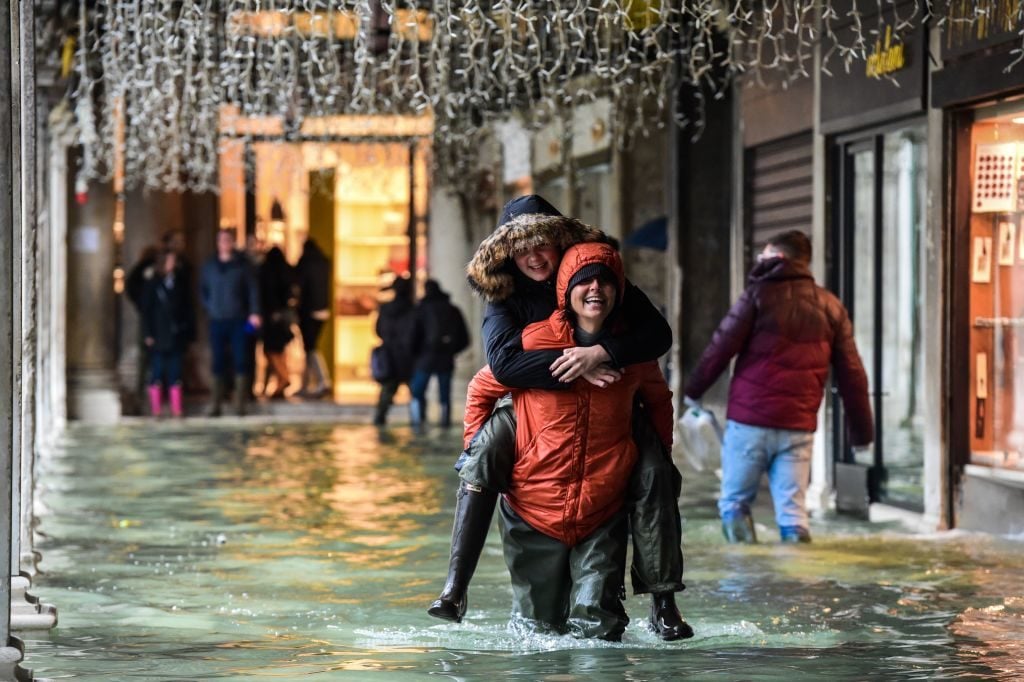
Fun in a flooded Venetian arcade on
November 24, 2019. (Photo by Miguel MEDINA / AFP) (Photo by MIGUEL
MEDINA/AFP via Getty Images)
These Are Crisis Times
Short-term thinking in general seems to plague the endless
circuit of arts and cultural events that take place in Venice. The
film festival rolled out the red carpet this fall overlapping with
the close of “May You Live In Interesting Times.” Next year the
architecture Biennale returns. The Biennale di Venezia, the
official body that oversees the city’s exhibitions and festival,
did not respond to requests for comment on how it would consider
sustainability in future editions.
“It’s difficult to make big infrastructural changes quickly, so
I think the question is where to start, as well as what to aim for
in the mid-to-long term.” says Lucia Pietroiusti, who curated
the award-winning Lithuanian Pavilion that eloquently spoke to the
climate emergency. The Serpentine curator says that sharing
resources, materials, and knowledge will be essential going
forward. That means greater co-operation “between pavilions, as
well as with partners and organizations that already work in the
territory.”
In the last Biennale’s main exhibition organized by Ralph
Rugoff, the Berlin-based artist Tomás Saraceno created a
prophetic installation in the Arsenale. Aero(s)cene: when
breath becomes air, when atmospheres become the movement for a post
fossil fuel era against carbon-capitalist clouds (2019)
created a soundscape that related to changing tides and sea levels.
Works like this will continue to be important, but the Biennale may
also need to rethink its very structure and scale.
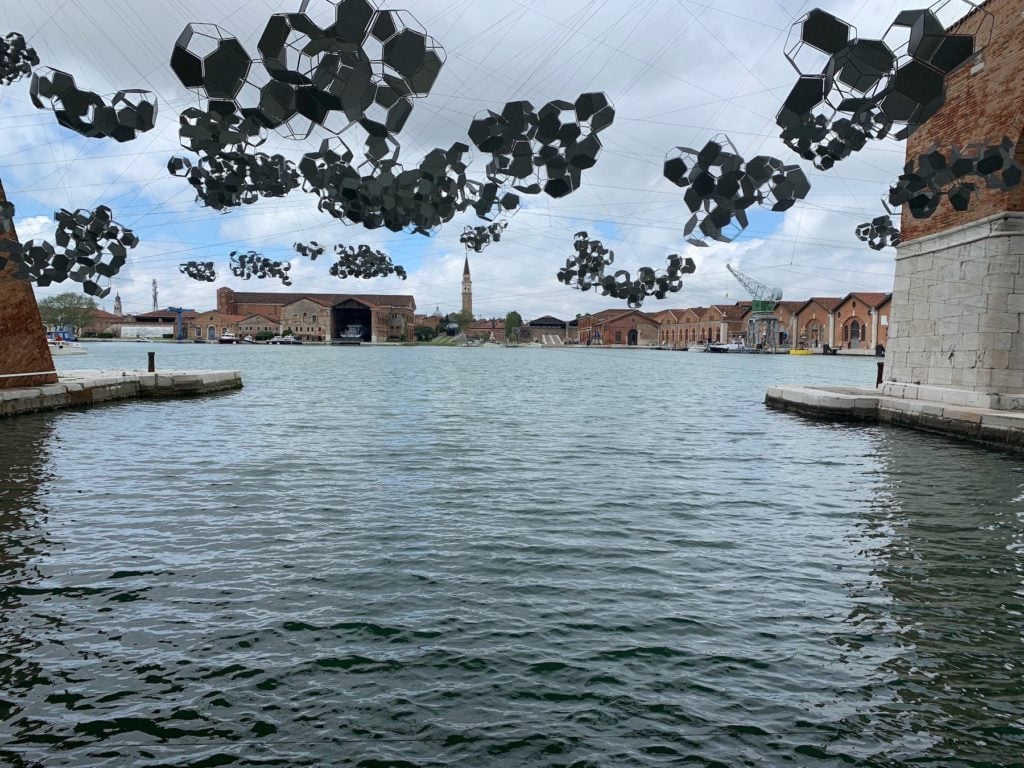
Tomás Saraceno, Aero(s)scene: When
breath becomes air, when atmospheres become the movement for a post
fossil fuel era against carbon-capitalist clouds (2019). Image
courtesy Julia Halperin.
But consciousness raising, however poignant, can co-opt the
narrative and distract from the bigger issues that need to be
urgently addressed in Vence itself. “Obviously there are no quick
fixes or one-size-fits-all solutions to problems or questions
regarding the climate emergency,” local ecological activist group
We Are Venice tells Artnet News. “It would be nice to see an
organization as large as the Biennale using its position to
determine more stringent life cycle analysis criteria to the use of
materials, let alone transportation of art and installations, and
installation techniques.”
Pietroiusti and the Lithuanian Pavilion’s assistant curator,
Caterina Avataneo, are working on a project for the next Biennale.
Pietroiusti describes it as “an independent communications platform
where national pavilions can share materials as well as learnings.”
Pietroiusti says: “It will be simple, but hopefully
useful.”
The Long View
Ocean Space will keep the reality of the aqua alta at the front
of its program. Next year, it will host a large research
project by Territorial Agency, an architectural collective that
will create a major installation beginning in March 2020. The
three-year project will consider Venice’s position as a frontline
for the European climate crisis and look at how humans are
transforming the oceans.
Artists in the next Biennale will surely continue to tackle this
issue with incisiveness as they did in Rugoff’s edition. But less
poetic statements, like what to do about resource distribution,
carbon-offsetting travel, and waste minimization should be
forefront issues for whoever takes the seat.
“[The flooding] is an immense reality check, but also a huge
opportunity to rethink what Venice could and should be: maybe not a
museum of the past but a laboratory for the future,” says Markus
Reymann, the director of TBA21–Academy. “Venice can be a productive
place where we can think through how to live with catastrophe, and
how to deal with the climate in these frontline locations. How do
we live with this emergency? How do we live through it?”
Recently, Bloomberg outlined simple methods to
provide aid to the city, proposing a sort of climate-cultural
patronage that might appeal to some elite arts supporters. Funding
a conservator, for example, costs around $500 a day, while improved
flood barriers for buildings cost around $2,200 a piece. The
desalination of flooded historic buildings like the Ca’ d’Oro
mansion, which would be nursed it back to reasonable health, takes
around $69,000. Visitors to the 2021 Biennale could consider
off-setting their carbon footprints, as could pavilions, artists,
and galleries. Perhaps this is what new arts patronage should look
like: a total overhaul of what is valued.
But will any of that get you a seat at the Venice’s art party
dinner tables come 2021? Probably not, but a lot can change in a
few years. The party in Venice needs to be scaled back, because
this could be the last song.
The post In the Wake of Devastating Floods, It’s High Time
the Art World Rethinks Its Relationship to Venice appeared
first on artnet News.
Read more https://news.artnet.com/market/acqua-alta-venice-biennale-2021-1728891
Further reading


Leave a comment