
Instagram Launched an Algorithm to Fight Fake News. But Is It Censoring Digital Artists?
Could artists who use Photoshop be targeted by Instagram’s new
fake news screeners? The social-media platform rolled out an
algorithm to detect fake news last May, but it appears to be
getting triggered by digitally manipulated artworks as well.
The alarm was sounded earlier this month by photographer
Toby Harriman, who was scrolling
through his Instagram feed when he spotted a warning. “False
Information,” it read. “Reviewed by independent fact-checkers.”
He clicked on the message and the
offending post was revealed: an image by digital artist Ramzy Masri of a man standing atop a hill,
Photoshopped with rainbow colors.
Masri first shared the image—part of
his #SpectrumEdit series
transforming the work of other photographers into otherworldly
rainbow-scapes—in February 2017. The original photo, by Christopher Hainey, was taken in
California’s Death Valley National Park.
The warning didn’t appear on Masri’s account, but when it was
shared by a third-party account that aggregates images. That
account did not identify the photo as a work of fantasy, and thus
could have confused potential visitors to the park, leading them in
a fruitless search for the perfect multi-colored photo op for their
own social media.
The warning isn’t aimed at targeting
Photoshopped images in particular, but is meant to keep people from
mistaking digital fakery from reality, especially when it’s being
shared with the intent to deceive. Posts that have been tagged with
the label will not surface on hashtag searches or appear on
Instagram’s explore page, and the same warning will be applied
whenever it is shared by another user.
“As much as I do love it to help better associate real vs
Photoshop,” wrote Harriman, “I also have a huge respect for digital
art and don’t want to have to click through barriers to see
it.”
"https://www.facebook.com/tobyharriman/posts/10216834489837724" class="fb-xfbml-parse-ignore">Interesting seeing this pop up for the first time when scrolling
the main Instagram feed. Looks like Instagram x…Posted by Toby
Harriman on Friday, January 10, 2020
The National Coalition Against Censorship also
sees cause for concern. “While the goals of this policy may be
valuable, it is absolutely likely to do harm to artists,” wrote
Nora Pelizzari, the organization’s director of communications, in
an email to Artnet News. “Artists manipulate images almost 100
percent of the time, in some way or another—It’s core to what they
do. This should not prevent them from posting freely and
distributing their work as widely as possible.”
"background:#FFF; border:0; border-radius:3px; box-shadow:0 0 1px 0 rgba(0,0,0,0.5),0 1px 10px 0 rgba(0,0,0,0.15); margin: 1px; max-width:500px; min-width:326px; padding:0; width:99.375%; width:-webkit-calc(100% - 2px); width:calc(100% - 2px);">
View this post on Instagram


“We don’t hide content because it’s photoshopped, we apply a
label when a fact-checker has rated it,” a Facebook representative
told Artnet News. “Upon review from the fact checker, they changed
the rating, so it is no longer being labelled as false on Instagram
and Facebook.”
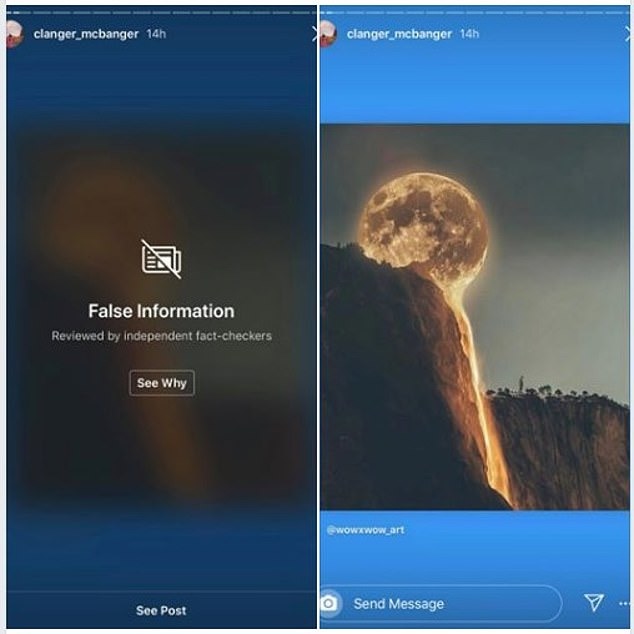
Instagram hit this digitally manipulated
image by Risvan with a fake news label when it was reshared by
another user.
It is unclear how many artworks have triggered the “False
Information” label, but Harriman also found a second example, by
digital artist Risvan—a composite of a NASA photograph of the moon
and a shot of Horsetail Waterfalls in California’s Yosemite
National Park by Instagram user @Markian.b.
“This rating was applied in error and the label has been
removed,” said a Facebook representative.
The fact-checking website Snopes has existing pages
explaining that both images are digitally
manipulated—part of an entire section dedicated to debunking
possible “fauxtography.” But the
boundaries of such a category are hard to define.
“Unfortunately, motivation for altering an image can be
hard to objectively determine (say, by algorithm)—is the image
altered for artistic reasons or to ‘mislead’ seems both a crucial
question and an extremely difficult one to objectively answer,”
Pelizzari added.
And even if artists aren’t being directly targeted, this policy
could still prevent their work from being shared by accounts with
larger audiences, warned Pelizzari. “It would be concerning that
the positive publicity and larger audience dissemination achieved
by having art press share an artists’ work would be minimized by it
coming with a warning label,” she said. The fact remains that
artists don’t have control over how their work is disseminated if
it goes viral.
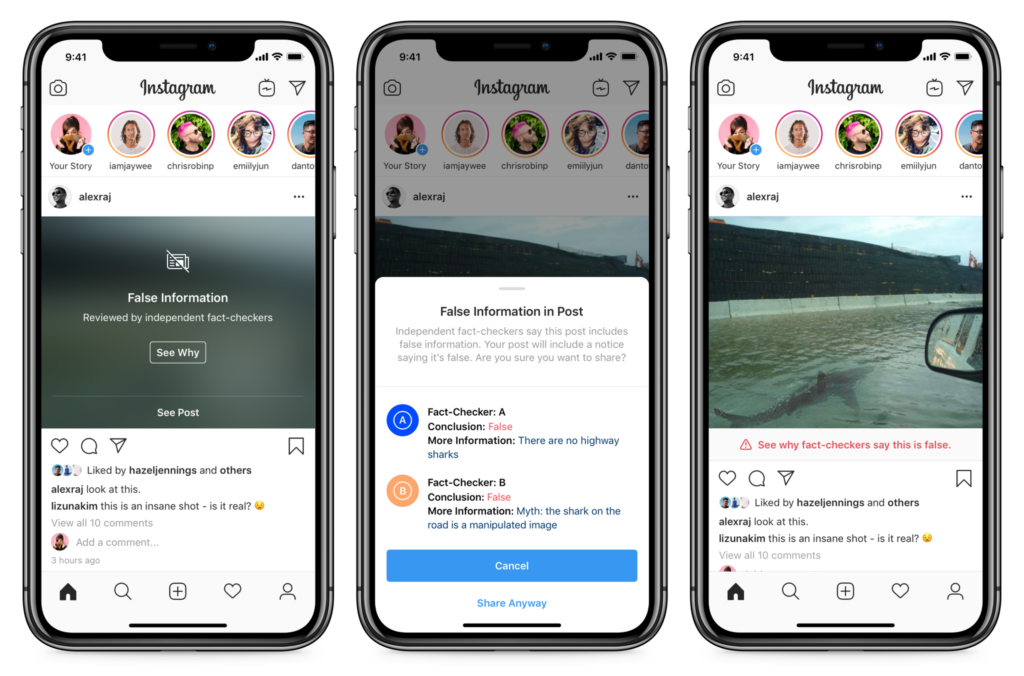
Instagram gave the example of a widely
disseminated Photoshopped image of a shark on a highway as an
example when it announced plans to introduce fact checkers to
combat the spread of fake news. Image courtesy of Instagram.
But given the ease with which misinformation is spread online,
one could argue that the benefits outweigh the downsides.
“Yes, these new policies could potentially infringe on artistic
liberties, but comparing the tiny impact of the art world against
the massive influence of social media in shaping real world
politics, this seems like a worthwhile sacrifice,” said digital
artist Joshua Citarella. On the other hand, he warned, “this
filtration is good optics for Instagram to look like they are
‘fighting fake news’ but leaves other more dangerous propaganda
like [influencers paid to post
about a music festival in Saudi Arabia] up to an activist user
base.”
And, if artists have concerns that digitally manipulated images
might be mistaken for fake news, there are steps they can take to
avoid inadvertently triggering the algorithms.
“We would encourage them to add context to their images in the
descriptions that clearly states this is an artistic work, not a
journalistic one,” said Pelizzari. “Artists who feel they’ve been
wrongly targeted should first initiate Instagram’s reporting
and appeals process.” They can also report the incident to the
National Coalition Against Censorship with its online report
form.
The post Instagram Launched an Algorithm to Fight Fake News.
But Is It Censoring Digital Artists? appeared first on artnet
News.
Read more https://news.artnet.com/art-world/instagram-fake-news-filter-1761660
Further reading


Leave a comment