
Jeffrey Epstein Accuser Maria Farmer Says the New York Academy of Art Helped Enable the Disgraced Financier
As the lurid details about Jeffrey
Epstein’s decades of crimes against women and girls continue to
trickle out, one recurring point of interest in the saga is the New
York Academy of Art, a private graduate school known for its
emphasis on preserving the tradition of figurative art. Now, in
response to mounting questions about Epstein’s relationship with
the school, the academy has promised to issue new guidelines to
govern the relationships between students and collectors.
Epstein was a board member at the
academy from 1987 to 1994 and a regular fixture there at the time,
according to one former student, Maria Farmer, who has gone on to accuse the
disgraced financier of assault, as has her younger sister, Annie
Farmer. “Sometimes he would just come to the school and walk around
and watch the artists. He was at every single event,” Farmer told
artnet News. He was “often lurking around, looking at the students’
studios.”
Farmer says she first met Epstein and his associate Ghislaine
Maxwell at her thesis show in 1995 when the school’s then-dean of
students, Eileen Guggenheim, urged her to sell them one of her
paintings. (Guggenheim is now chair of the academy’s board.)
The work depicted a man standing in a doorway observing a nude
woman on a sofa, which was an allusion, Farmer recently told the
New York
Times, to Edgar
Degas’s Interior (1868-69), also widely known
as The Rape.

Edgar Degas, Interior (1868–69).
Courtesy of the Philadelphia Museum of Art.
Farmer said she was reluctant to agree because she’d already
sold the painting, to a German buyer for $12,000. But Guggenheim
allegedly told her: “‘You will be selling to them,’” Farmer
recalled. “‘They are great benefactors of the academy and you are
going to make them happy. Do you understand?’” (Guggenheim
told artnet News through a spokeswoman that she does not remember
this exchange.)
Epstein also allegedly told Farmer that “if I sold him one of my
paintings for half price he would help me with my career,” she
wrote in a court statement.
Farmer ultimately relented. “I was a trusting student,” she told
artnet News. “Who doesn’t look up to the dean of their graduate
program?” She agreed to the reduced fee of $6,000 and
“embarrassingly” informed the German collector that she was
mistaken and the painting had already sold.
A Visit to the Ranch
Shortly after her graduation, in 1995, Farmer said that
Guggenheim brought her on a visit to Epstein’s ranch in New Mexico.
Farmer was in town to attend a post-graduate workshop at the Santa
Fe Art Institute with the painter Eric Fischl; Guggenheim was there
to attend the Site Santa Fe biennial. Prior to the visit with
Epstein, Farmer recalled Guggenheim instructing her to “act
grateful and tell him how wonderful he is,” insinuating that he was
important to the academy. (Guggenheim said she does not recall
this visit.)
“He was seated in this chair and he’s all flirty with me,”
Farmer said, “but I thought he was married to Ghislaine,” a
formidable woman who made her feel comfortable. “While we were
there she literally rode up on a white horse,” Farmer added.
Once Farmer returned to New
York, Epstein allegedly hired her as an art consultant.
“Epstein had bad taste,” Farmer said, a fact that has
been established in reports about
the aggressively unsettling
décor of Epstein’s homes, which included displays of prosthetic
eyeballs, a female mannequin hanging from a chandelier, a chess set
featuring the likenesses of his staff clad only in underwear, and
a painting of
Bill Clinton in a blue dress by another New York Academy of Art
student, Petrina Ryan-Kleid. “He liked art that made people
react,” Farmer added.
During her employment, she says she did manage to convince him
to buy work by some artists she respected, including Chuck
Bowdish and Damian Loeb. She remembers that Epstein bought Loeb’s
painting of a child swimsuit pageant, Little Miss Pink
Tomato (1995).
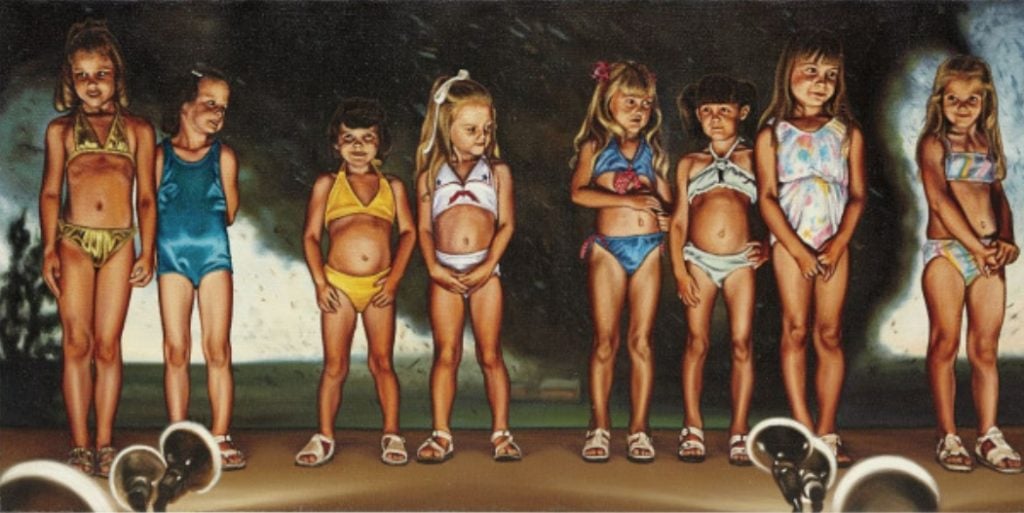
Maria Farmer says Epstein purchased this
painting by Damian Loeb, Little Miss Pink Tomato
(1995), at her suggestion. Courtesy of artnet.
At one point, Epstein offered to
provide Farmer studio space to work on a series of paintings she’d
been commissioned to produce for the set of the film As Good As
It Gets. He arranged for her to travel to the Ohio mansion of
his friend, clothing magnate and art collector Leslie Wexner and
his wife Abigail. While there, Farmer claims that Epstein and
Maxwell sexually assaulted her.
The next morning, she says she called Eileen Guggenheim and told
her what happened. “I was sobbing and said Epstein and Maxwell
are sick people and I think I could have been raped,” Farmer said.
In response, Guggenheim allegedly “blamed me and mocked me.”
Guggenheim said she does not recall this incident.
In a statement, the New York Academy of Art said the school is
taking steps to reconsider the way art collectors interact with its
students. “The New York Academy of Art is deeply shocked and
saddened by what one of our graduates, Maria Farmer, went through
at the hands of Jeffrey Epstein, and we are truly sorry for what
happened to Maria,” a representative said in a statement. “The
office of the president is establishing a committee to formalize a
protocol for how art collectors can and should interact with the
Academy’s student artists.”
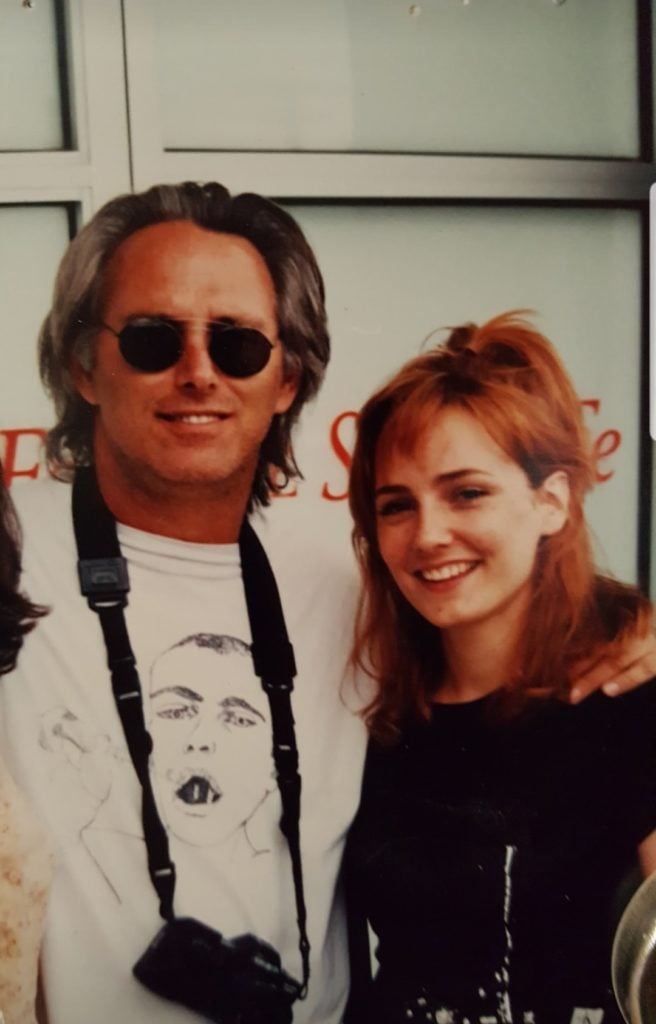
Eric Fischl and Maria Farmer in Santa
Fe. Courtesy of Maria Farmer.
Mixed Messages
Epstein’s ties to the academy have been murky. In 2012, the
Jeffery Epstein VI Foundation announced in a press release that it had
given “crucial funding” to the academy, lauding it as “one of the
few graduate art schools in the United States that focus on a
purely classical approach to the visual arts.” (The previous year,
his status as a “high risk” sex offender, active since 2010, had
been upheld by a New York judge, meaning he was supposed to check
in every 90 days with the New York Police Department.)
“Rigorous training in technique
liberates the artist when approaching contemporary art,” Epstein
was quoted as saying in the press release accompanying the
donation. “It gives him the tools to express himself precisely. The
same can be said for the scientist when approaching science.”
A representative for the school denied
that this happened. “Epstein’s foundation issued a press release
without our knowledge or approval in 2012. We believe that this
‘funding’ referred to the purchase of tickets at the 2012 Tribeca
Ball and his foundation then issued a press release claiming he was
a donor to us because he bought tickets at a fundraiser. We have no
record of any other donation.”
The school also initially denied to Business Insider that
Epstein had ever been a trustee, before correcting itself more than
a month later.
Wexner, Epstein, and Maxwell all
figure in another case that links the academy and the convicted sex
criminal. In 2003, portrait painter Nelson Shanks sued all three
individuals for nonpayment over a $339,900 portrait of Leslie’s
wife, Abigail Wexner, and her four children. Shanks alleged that
Epstein had commissioned the painting as a gift, using Maxwell as
an agent, and that he had gone to the Wexner home to take photos as
source material. Both Epstein and the Wexners found the final
painting unflattering, and refused to pay.
Court papers filed in 2003 depict
Epstein as having a longstanding relationship with the art
academy:
Defendants also state that Mr. Epstein first met Mr. Shanks
several years ago at the New York Academy of Art, where Mr. Shanks
was teaching, when Mr. Epstein served as a trustee for that
institution. During Mr. Epstein’s affiliation with this
institution, Mr. Epstein had occasion to purchase portraits from
students enrolled at this institution. On each such occasion, Mr.
Epstein was given the opportunity to review the finished work,
request revisions to the finished work and, only when Mr. Epstein
was satisfied with the finished work, did Mr. Epstein pay for the
portrait. In addition, Mr. Epstein previously purchased from Mr.
Shanks a portrait of a nude, which Mr. Epstein paid for only after
reviewing and being satisfied with the finished portrait.
Asked about the extent of Epstein’s contact with students, a
spokesperson for the academy said: “It is possible that he or
someone in his employ purchased art or made arrangements for a
commissioned work by a New York Academy of Art artist, but if there
was a commissioned piece, that commission was handled directly
between the artist and Epstein.”
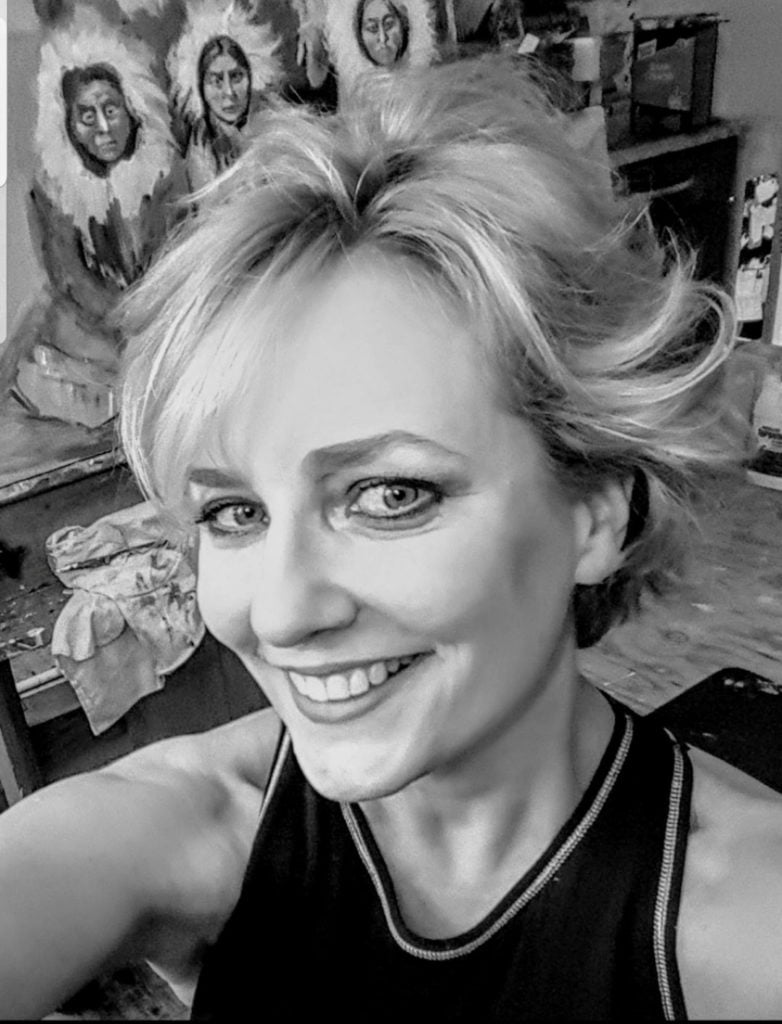
Artist Maria Farmer in her studio in
2019. Courtesy of Maria Farmer.
Life After Epstein
After their encounter in Ohio,
Farmer says that Epstein and Maxwell threatened to burn her art and
destroy her career. As a result, she said she left New York and
largely gave up painting. “I was vulnerable because my career was
used against me,” she said.
She has also since been diagnosed with a brain tumor and,
although it has slowed her down, has vowed to return to
work. Today, she’s working on a new series of portraits of
Epstein’s victims. She’s planning to meet with the women for
sittings and will also create a series of female figures in the
form of paper dolls, representing “all the ones we don’t know
about.”
Farmer said that although Epstein derailed her career, she’s
resolved to have her story told. “I need it said, I want
people to know about the people who really abuse artists.”
The post Jeffrey Epstein Accuser Maria Farmer Says the New
York Academy of Art Helped Enable the Disgraced Financier
appeared first on artnet News.
Read more https://news.artnet.com/art-world/maria-farmer-new-york-art-academy-1610506
Further reading


Leave a comment