
John Baldessari, the Wry Teacher Who Became a Path-Breaking Pioneer of Conceptual Art, Has Died at 88
Pioneering Conceptual artist
John Baldessari, whose droll,
witty work helped expand the definition of art and shaped a
generation of artists who came after him, has died. He was 88. His
gallery, Marian Goodman, confirmed his passing, though a cause of
death was not immediately available.
The subject of over 200 solo exhibition worldwide, Baldessari
was a towering figure in contemporary art both literally (he was
six feet, seven inches tall) and figuratively (he won numerous
honors over the course of his career, including the Golden Lion for
Lifetime Achievement at the Venice Biennale in 2009 and the
National Medal of Arts).
The artist’s international fame also transcended the art world,
earning him a cameo on The Simpsons in
2018—Baldessari did his own voice acting work, appearing at a
gallery opening that is disrupted when a baby Bart Simpson destroys
a sculpture.
Born in National City, California, in 1931, Baldessari was drawn
to art from an early age, earning an MFA in 1957 at the current-day
San Diego State University. He was a dedicated educator who started
out teaching high school and eventually went on to hold prestigious
posts at CalArts, UCLA and UC San Diego, instructing students
including Mike Kelley, David Salle, Barbara Bloom, and Matt
Mullican.
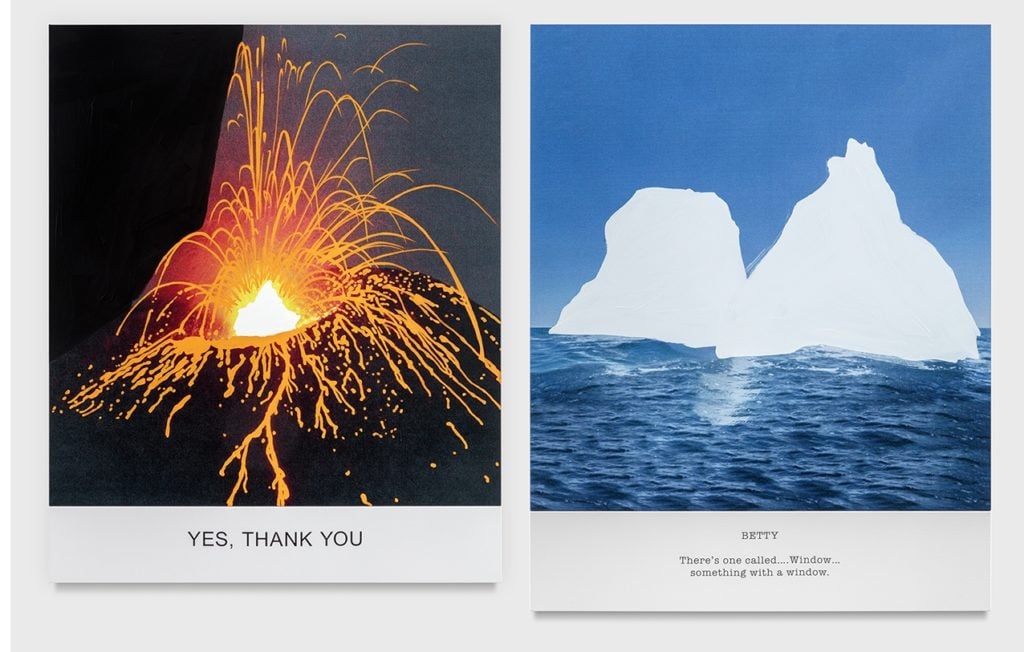
John Baldessari, Hot and Cold.
Courtesy of the artist and Marian Goodman Gallery.
As a teacher, he did much to shape a now-mature generation of
artists coming out of Los Angeles, who learned from his
anything-goes attitude and accessible packaging of high-minded
concepts. In a 2003 interview, he said of his teaching philosophy:
“I set out to right all the things wrong with my own art education.
But I found that you can’t really teach art, you can just sort of
set the stage for it.”
Baldessari—who remained mild-mannered and good humored even as
his star rose—found success as a teacher before he gained acclaim
as an artist. His first major work, in 1970, involved destroying
everything that had come before in a dramatic piece of performance
art titled The Cremation Project. Baldessari burned
every painting he had made between 1953 and 1966 and baked the
ashes into cookies.
It was a rejection of what he had been taught, that “painting
and sculpture were the only acceptable forms of art,” Baldessari
told the Wall Street
Journal. Though he counts Giotto, Goya, and Henri
Matisse among his favorite artists, he felt called to push the
bounds of art. In doing so, he helped give birth to the Conceptual
art movement. Years later, the Los Angeles
Times art critic Christopher Knight would describe him as
“arguably America’s most influential Conceptual artist.”
![John Baldessari, Frames and Ribbon [detail] (1988). © John Baldessari.](https://news.artnet.com/app/news-upload/2019/04/top-half-john.jpg)
John Baldessari, Frames and
Ribbon [detail] (1988). © John Baldessari.
career that would be defined by restless and relentless
experimentation. “I figured nobody was looking, nobody was
caring, and I would try to figure out what art was for
me,” Baldessari recalled during a talk at the Venice Biennale the year he
was honored.
From that point on, the California artist was driven by the
desire to find his own answer to the age-old question of what is—or
is not—art. On that quest, Baldessari delved into mass media
culture, hired commercial sign painters to execute his works,
created influential paintings that paired text with images, and
appropriated everything from Old Masters to film stills to emojis. (A common motif
in his work was obscuring people’s likenesses in found photographs
with colored circles—he once lamented that he’d be remembered as
the “guy who put dots over people’s faces.”)
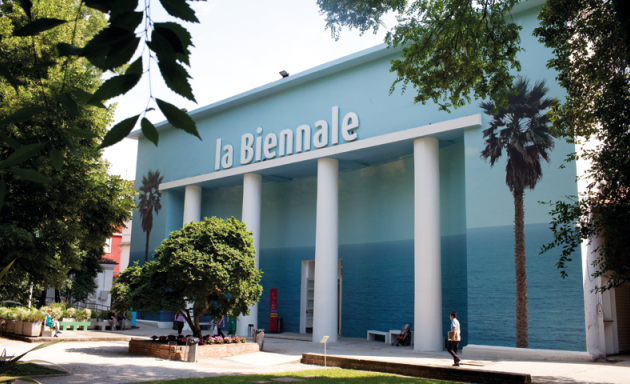
John Baldessari, Ocean and Sky (with
Two Palm Trees), 2009. The artist covered the facade of the
Palazzo delle Esposizioni with laminated wallpaper on the occasion
of being honored with the Venice Biennale’s Golden Lion for
Lifetime Achievement. Photo courtesy of the Venice Biennale.
“I get bored easily,” Baldessari admitted during that
Venice talk. “I like to do things that I’ve never tried before.” He
was talking specifically about the sky blue makeover he’d given the
biennale’s main exhibition hall—leaving the columned structure
looking, as he put it, like a Roman villa by way of Malibu
Beach—but it is a statement that has applied across the board
throughout his multi-decade career.
A master of collage and printmaking, he has repeatedly revisited
painting and sculpture, as well as exploring photography, books,
architecture, exhibition design—even app-making—with just one rule: “No More
Boring Art,” a signature phrase of the artist since 1971, as
immortalized in a piece in the collection of New
York’s Museum of Modern Art.
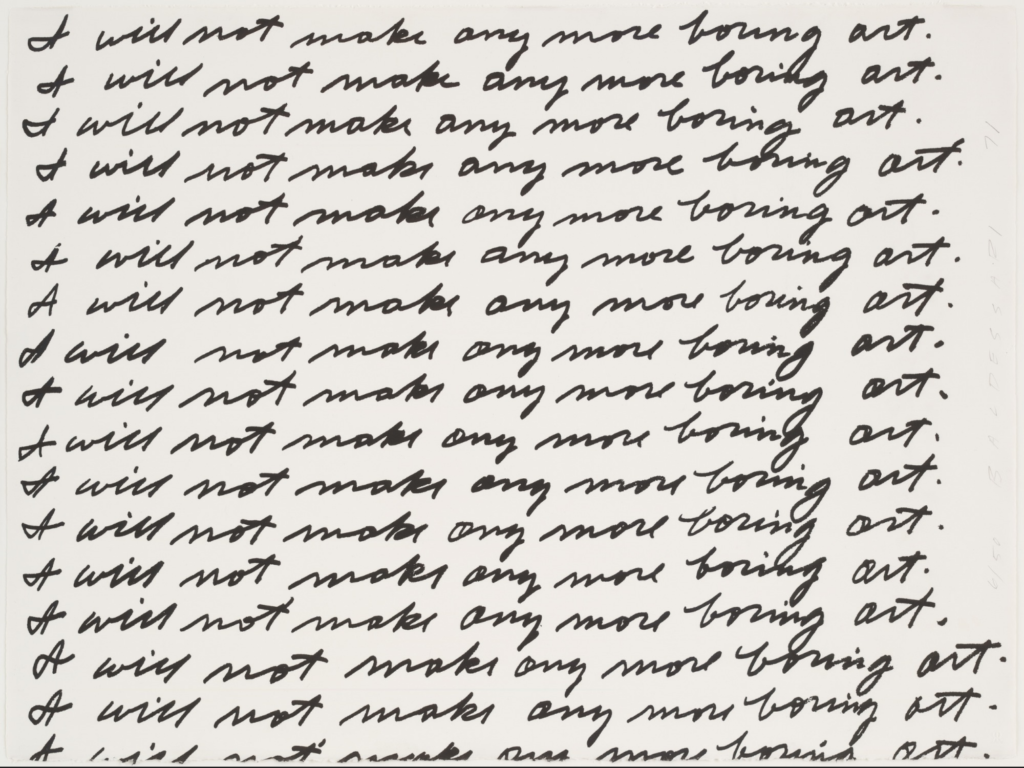
John Baldessari, I Will Not Make Any
More Boring Art (1971). Photo courtesy of the Museum of Modern
Art, New York.
Baldessari’s work is held by such major institutions as the
Hirshhorn, the Los Angeles County Museum of Art, the Broad in Los
Angeles, and and the Solomon R. Guggenheim Museum in New York. He’s
been featured in such prestigious exhibitions as the Carnegie
International in Pittsburgh, the Whitney Biennial in New York, and
documenta in Kassel, Germany.
A 1990–92 traveling retrospective appeared at MOCA, Los Angeles;
the San Francisco Museum of Modern Art; the Hirshhorn Museum and
Sculpture Garden, in Washington, DC, New York’s Whitney Museum
of American Art; and the Musée d’Art Contemporain, Montreal.
Another major retrospective, “Pure Beauty,” debuted London’s Tate
Modern in 2009, making stops at MACBA in Barcelona, LACMA, and New
York’s Metropolitan Museum of Art over the next two years.
As Peter Schjeldahl wrote of the artist in the Village
Voice: “Baldessari is a poet of the wrongness that
esthetic devotion visits upon flawed, shaggy, mere individuality.
He repeatedly evokes the experience, which I believe is quite
common, of feeling devalued by what one loves: just not good
enough, unworthy, even fraudulent. This is an embittering
experience for many. Baldessari absorbs it with consummate humor.”
He continued: “Paying attention to his work won’t make you better
or happier, but it will remind you what truth tastes like.”
The post John Baldessari, the Wry Teacher Who Became a
Path-Breaking Pioneer of Conceptual Art, Has Died at 88
appeared first on artnet News.
Read more https://news.artnet.com/art-world/john-baldessari-obituary-1745781
Further reading


Leave a comment