
Painter Gladys Nilsson Got Her Start as a Member of Chicago’s Hairy Who. Now, at 79, She’s Ready to Shine on Her Own
Gladys Nilsson was beaming. On a recent afternoon the artist—a
member of the Chicago group the Hairy Who, a once-fringe
movement that’s increasingly beloved—was strolling through the
galleries at Matthew Marks and Garth Greenan, admiring the precise
curatorial choices in a much-anticipated fifty-year survey of
her work.
“It’s kind of thrilling really, to see them all in the same
place” she told Artnet News, strolling through the dual exhibition,
which also includes lesser-known aspects of her practice, like
collages and early watercolors. Nilsson herself hasn’t seen many of
the works in years, since they’ve been sold off to collectors or,
in some cases, been languishing in storage.
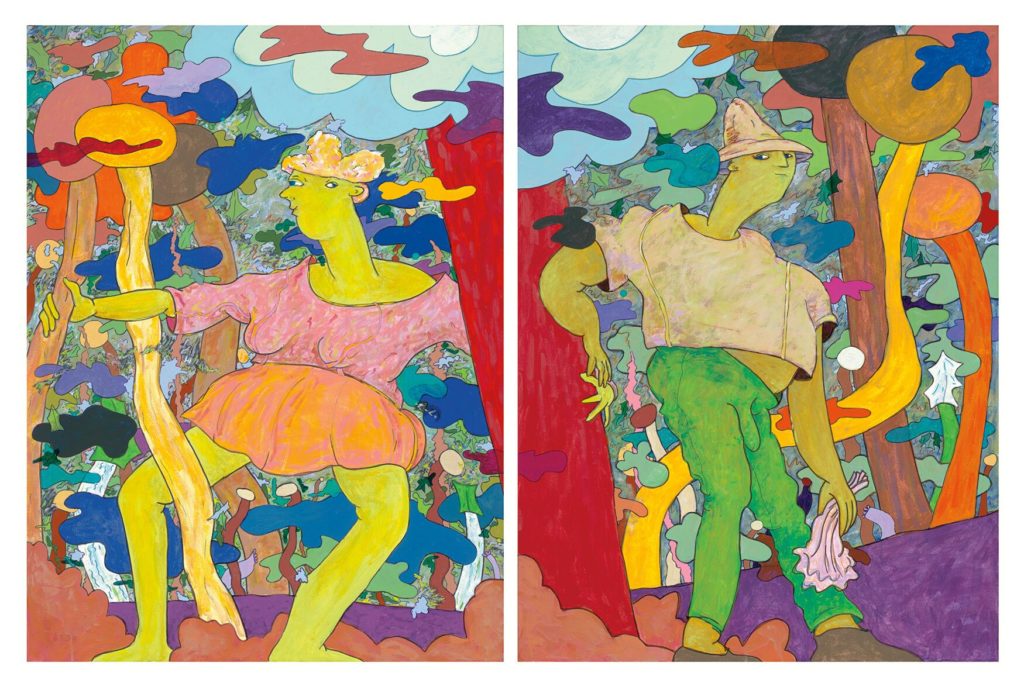
Gladys Nilsson, A Red Tree
(2018). Courtesy of the artist, Garth Greenan Gallery, and Matthew
Marks Gallery.
The Hairy Who collective formed after its members graduated from
the Art Institute of Chicago—where Nilsson is now a professor—and
included Jim Nutt (Nilsson’s husband), Jim Falconer, Art Green,
Suellen Rocca, and Karl Wirsum. It formed out of necessity, when
the artists realized there were few places to show their raucous
work. With the help of Don Baum, the exhibitions director at the
Hyde Park Art Center, the six recent graduates mounted just a
handful of shows over a period of four years, but their success was
immediate and has proven lasting.
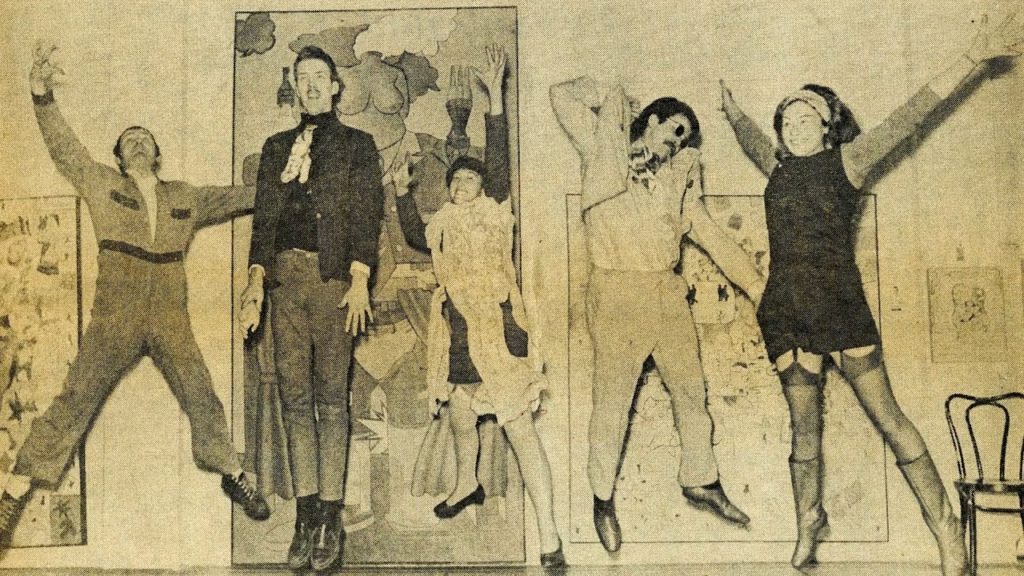
The Hairy Who in Hyde Park, Chicago.
Still from YouTube, courtesy of the Art Institute of Chicago.
What distinguished the Hairy Who was their non-conformist,
non-hierarchical approach to art making, which Nilsson credits to
the tutelage of Whitney Halstead, an art historian who encouraged
his students to look beyond so-called fine art—trawling corner
shops, newspapers and magazines, music, film, and comics for
offbeat inspiration.
The similarities in approach did not yield a cohesive visual
language though. “The only way our work looks related,” Jim Nutt
told Jonathan Griffin in 2018, “is if you
compare it to the standard of an all-black painting by Ad
Reinhardt.”
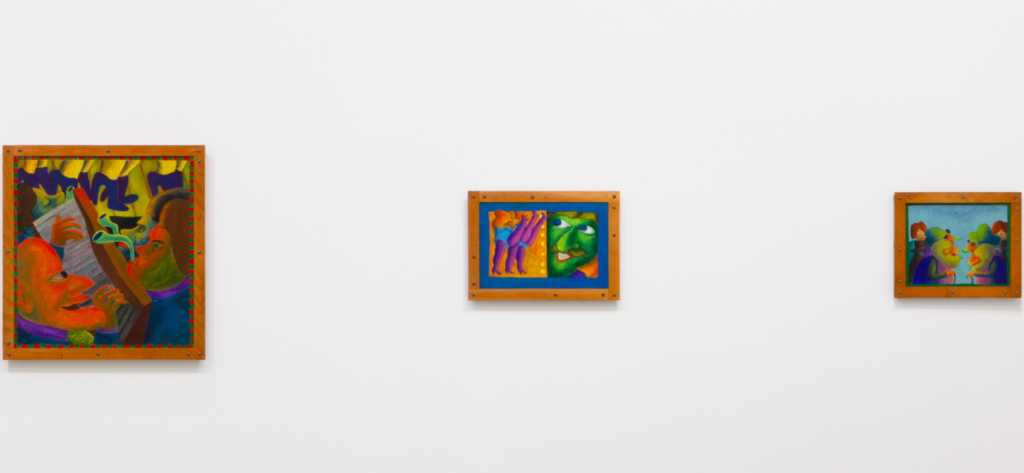
Installation view of “Gladys Nilsson:
Honk! Fifty Years of Painting” at Matthew Marks Gallery.
The joint exhibition, titled “Gladys Nilsson: Honk! Fifty Years
of Painting,” is organized chronologically: at Matthew Marks, more
than 40 works created between 1963 and 1980 are on display, while
down the street at Garth Greenan the paintings are the artist’s
most recent, dated between 2017 and 2019.
In the first room at Matthew Marks, super colorful, smaller
scale works from 1964–1966 invite closer viewing. Nilsson described
herself as being in a “holding pattern” during the early years
after graduation, but it’s clear that once she found her stride
there was no turning back.
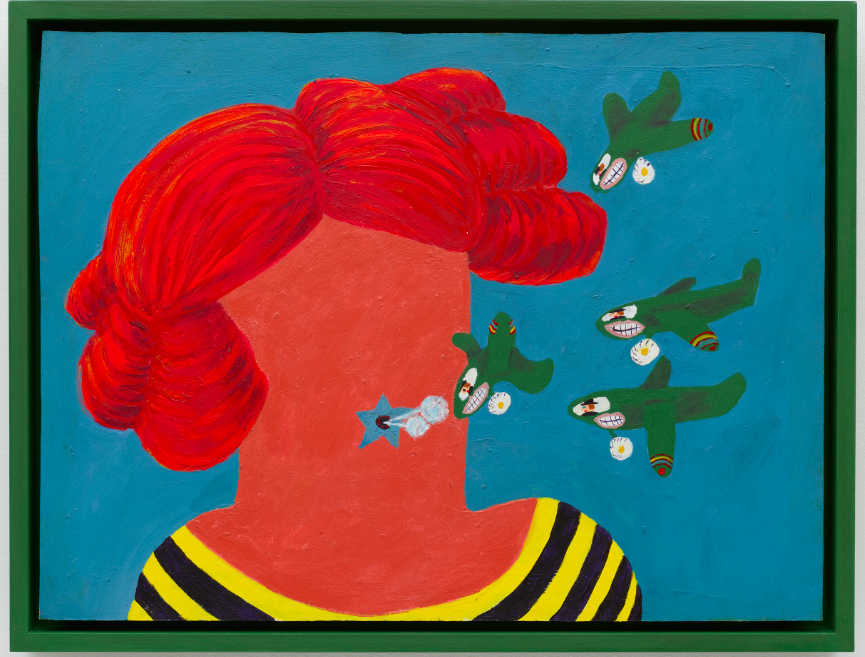
Gladys Nilsson, Gigantica und der
Messerschmitts (1965). Courtesy of Matthew Marks Gallery and
Garth Greenan Gallery.
“I’m always fond of having other people think about what they’d
like to read into it,” she says of her paintings. “I’ve always felt
the viewer has to work for it, too.” In the work Gigantica und der
Messerschmitts (1965) a giant, faceless figure with a
swathe of fire-engine red hair is assaulted by tiny green planes; a
star-shaped puncture where her mouth should be sends out two whiffs
of air, like a balloon deflating.
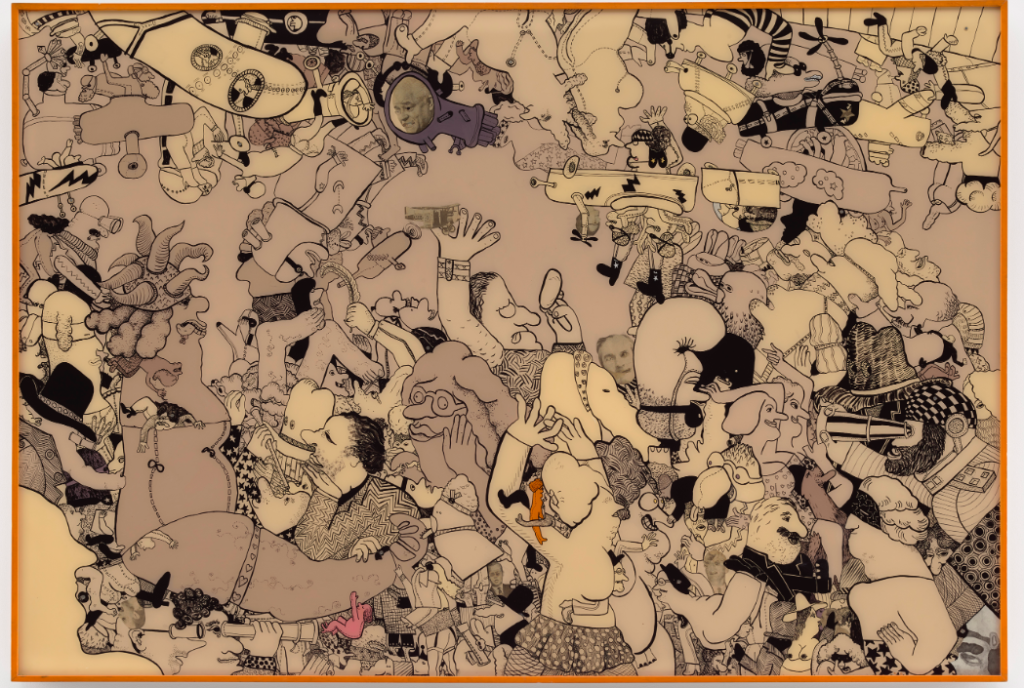
Gladys Nilsson, Very Worldly
(1967). Courtesy of the artist, Matthew Marks Gallery and Garth
Greenan Gallery.
While at school, she and Jim Nutt developed a fondness for
German Expressionist films, which Nilsson said probably planted the
idea of the German aircrafts in her mind. Similar planes resurface
in later works, including her forays into paint on Plexiglas, a
medium she adopted after watching Nutt play around with it.
Nilsson was drawn to the experimental nature of the process,
which involves painting on a reverse film, and only seeing the
final composition at the very end. “Building up [the illustrations]
you just kind of keep going, adding more” she said, “and then when
it’s finished you turn it around and: surprise!”
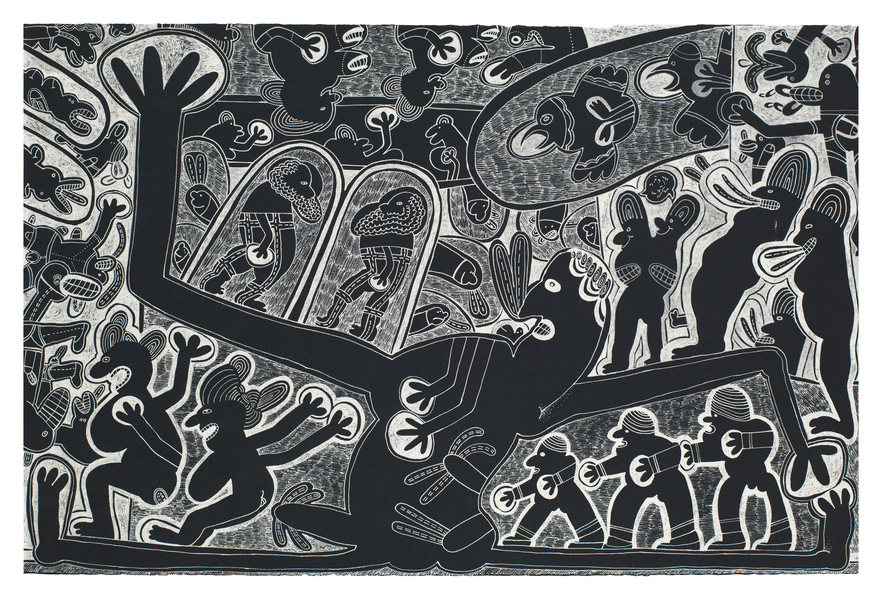
Gladys Nilsson, Untitled (Reach)
(1969). Courtesy of the artist, Matthew Marks Gallery, and Garth
Greenan Gallery.
In some of her Plexiglas works and in earlier watercolors,
Nilsson began incorporating cut-outs from magazines, posters, and
even art history books, in a nod to Halstead’s mandate to pay
attention to both high and low-brow visual culture. At one point
the artist began working on round canvases encased in needlepoint
hoops, which appealed to her because “the boundaries are already
set for you.”
A series of works from the late sixties and early seventies
reveal Nilsson’s deep appreciation for Aboriginal art, borrowing
that form’s constellations of tiny dots and silhouetted animals
organized in frieze-like procession.
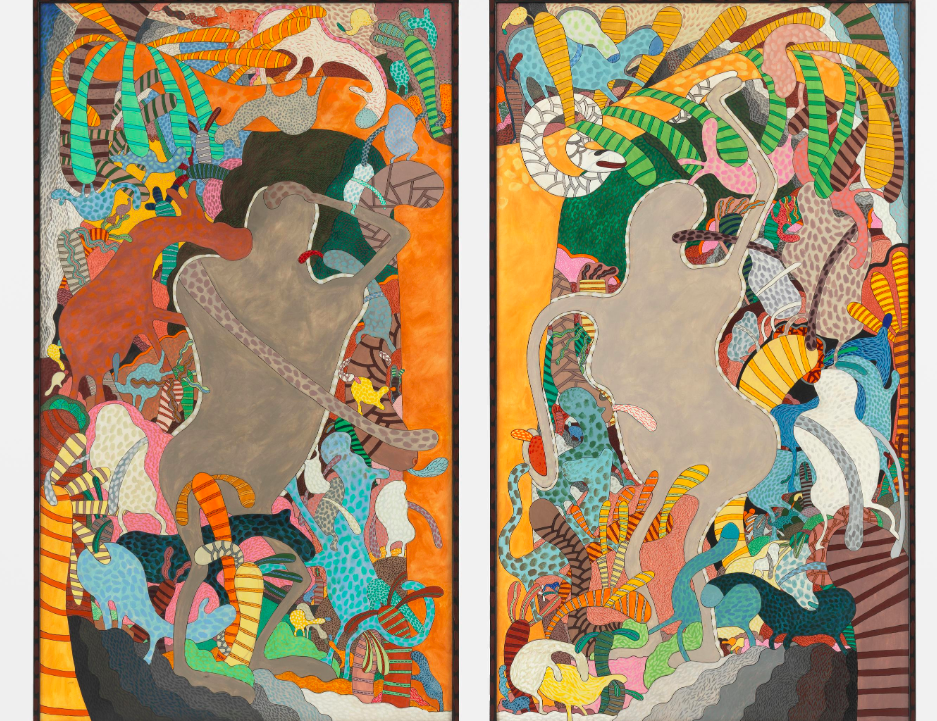
Gladys Nilsson, Dipped Dick: Adam and
Eve After Cranach (1971). Courtesy of the artist, Matthew Marks
Gallery, and Garth Greenan Gallery.
One of the highlights of the show is Dipped Dick: Adam
and Eve After Cranach, in which she recasts the classic
16th-century painting of original sin with Gumby-like figures, set
against a rollicking landscape of color and pattern. (A wily,
green-striped serpent tangled over a branch extending between the
diptych’s two panels.) The painting’s title is a testament to
Nilsson’s affection for word play and the occasional dirty
joke.
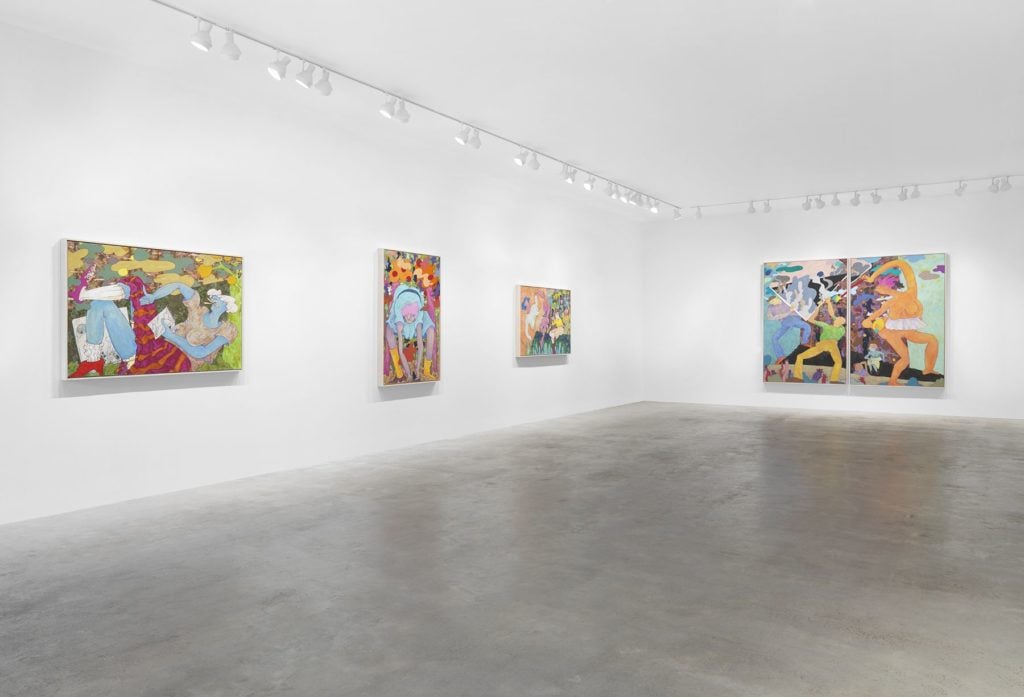
Installation view of “Gladys Nilsson:
Honk! Fifty Years of Painting” at Garth Greenan Gallery.
The large figures in Dipped Dick set the tone for
the most recent works, on view at Garth Greenan. The biggest
painting, finished by Nilsson just months ago, measures about seven
by nine feet—that’s the maximum size canvas that the artist could
fit up the stairs and into her second-floor studio in Wilmette,
outside of Chicago. “It’s hard, it’s very physical,” the artist
confirms. To reach the top of that canvas, she had to paint from a
ladder. She breezily mentioned that she had quite a scare, nearly
falling off recently. It’s all in a day’s work; even at the age of
79, she remains unfazed.
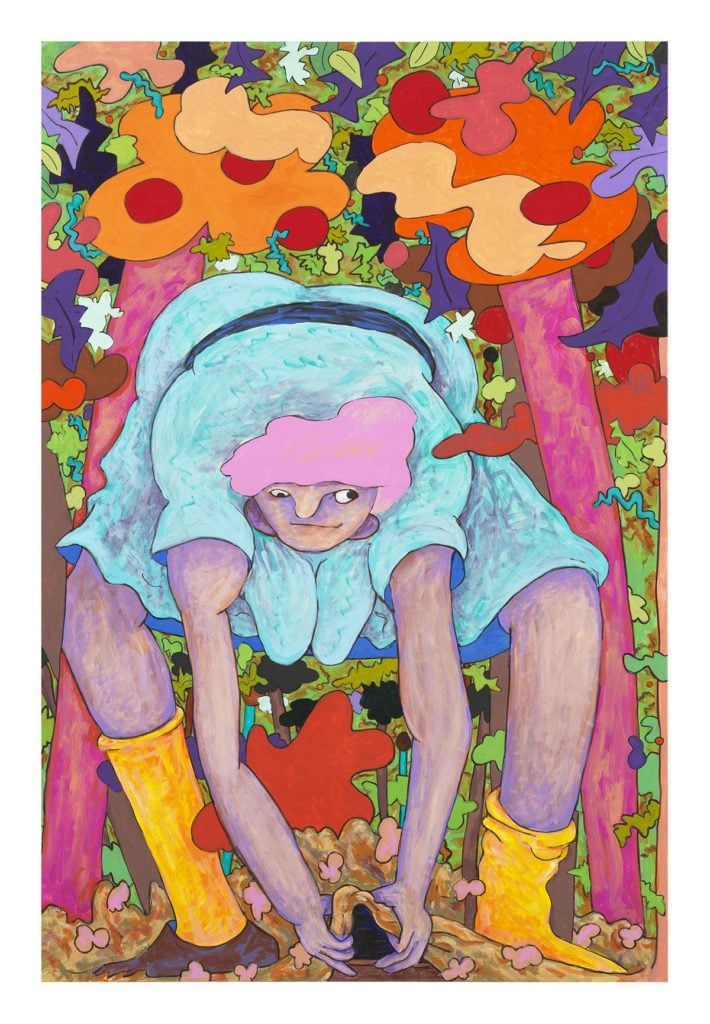
Gladys Nilsson, Tidy Up (2018).
Courtesy of the artist, Garth Greenan Gallery, and Matthew Marks
Gallery.
The figures who populate Nilsson’s paintings from the last two
years are almost indistinguishable at times: large-nosed,
thick-trunked, with long, lumpy limbs. The women tend to have
bosoms that bounce and flop. Their physical bodies are squeezed and
pinched to fit inside the compositions, and every inch of the
surface is filled with lively color. It’s not an overstatement to
say that these impressive, outsized personalities match the
artist’s own spirit. “If you stretched her out,” Nilsson told me,
describing one of her blue-skinned giantesses, “she’d be too big
for the frame.”
“Gladys Nilsson: Honk! Fifty Years of Painting” is on view
at Matthew Marks Gallery, 523 W 24 Street, through April 18,
2020; and at Garth Greenan Gallery, 545 West 20th Street,
through March 14, 2020.
The post Painter Gladys Nilsson Got Her Start as a Member of
Chicago’s Hairy Who. Now, at 79, She’s Ready to Shine on Her
Own appeared first on artnet News.
Read more https://news.artnet.com/exhibitions/gladys-nilsson-honk-1773375
Further reading


Leave a comment