
Puerto Rico’s MECA Art Fair Boosts an Art Scene Valiantly Struggling Amid Hurricane Damage, Debt, and Upheaval
Balmy temperatures, low costs, and an underdog vibe brought
dealers from as far afield as Tokyo to San Juan, Puerto Rico, for
the third edition of the MECA art fair last week. The event comes
as the island continues to struggle to recover from the deadly
assault of the Category Five Hurricane Maria in 2017, which killed
at least as many as three thousand and drove many others away. When
it hit, Puerto Rico, a US Territory, was already in a deep
financial crisis. Since then came further political upheaval when
governor Ricardo Roselló was ousted amid massive protests after his
cruel, sexist, and homophobic text exchanges came to light.
Things looked brighter at MECA (named for an abbreviation of
Mercado Caribeño, Spanish for Caribbean market), held in a handsome
Spanish Colonial-era armory in touristy Old San Juan. With just
twenty-five galleries in the main section, the fair was pretty easy
to take in, even if you added the excellent “Mecanismos”
special section, organized by curators Lizania Cruz, of New York,
and Luis Graham Castillo, from the Dominican Republic. MECA draws
top galleries, like 47 Canal and Bridget Donahue from New York;
Misako & Rosen, of Tokyo; and local greats such as Embajada. It’s
also easy on the wallet, with some works in “Mecanismos” going for
prices in the low three digits. Since space is limited and the
local collecting culture still in development, the founders, Daniel
Báez and Tony Rodríguez, suggested that dealers cut on shipping
costs by simply bringing works in their luggage, and capping prices
at twenty thousand dollars.
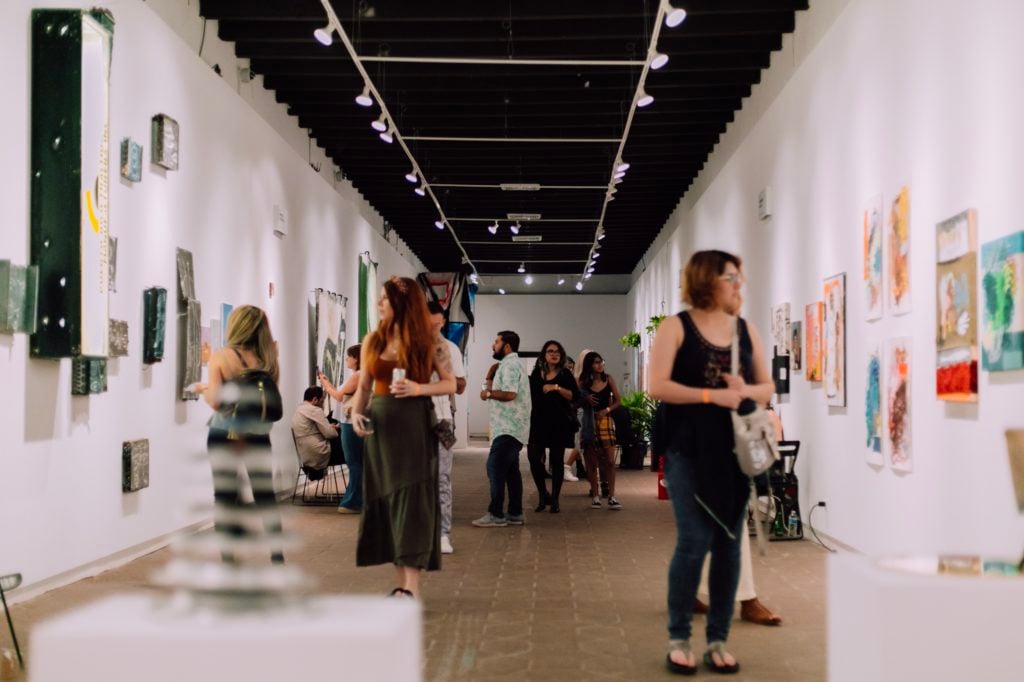
Visitors to the MECA art fair in San
Juan. Photo courtesy Discover Puerto Rico.
The fair is meant to fly the flag for the island’s culture
overall. “Despite all the craziness we’re going through,” said
Báez, who cut his teeth organizing Gavin Brown’s participation in
fairs throughout the Spanish-speaking world, where he also
recruited dealers (including Brown, naturally) to come to San Juan.
“It’s important that people from outside Puerto Rico understand
that cultural institutions are still open for business.”
After repairing their own hurricane damage San Juan’s museums,
including the Museum of Contemporary Art, pitched in to offer space
for artists and local cultural organizations. They relied on
support from private foundations and donors, including local hero
Lin-Manuel Miranda, who recently announced an initiative with
Google to publicize high-resolution photos of the collections of
four local museums. While locals gripe that the institutions have
been a bit short on support for local practitioners, a couple of
San Juan’s art professionals were encouraged by MCA’s new hire of
Marina Reyes Franco, whom they characterize as highly plugged
in.
“There’s still an economic crisis,” said artist-dealer John
Riepenhoff, of Milwaukee’s Green Gallery, “but there’s a cultural
surplus.” Riepenhoff feels a kinship with San Juan, coming from a
city with its own lively cultural scene far from the major art
capitals. Green Gallery brought (in a suitcase) paintings by Tyson
Reeder, selling for around five thousand dollars.
Dealers declined to offer specifics on commercial success, which
suggests that sales were slow, but they offered the customary
optimism, talking about “lots of interest” and “great
conversations” with visitors. But with the participation fee at
just $3,500, the stakes are relatively low.
So, in the face of modest sales, what brings dealers? Ask the
New Yorkers, especially, and they’ll typically say, “We love
Danny!”, suggesting that Báez is on a year-round charm offensive in
New York. (“Galleries do get tired of me inviting them,” he
joked.)
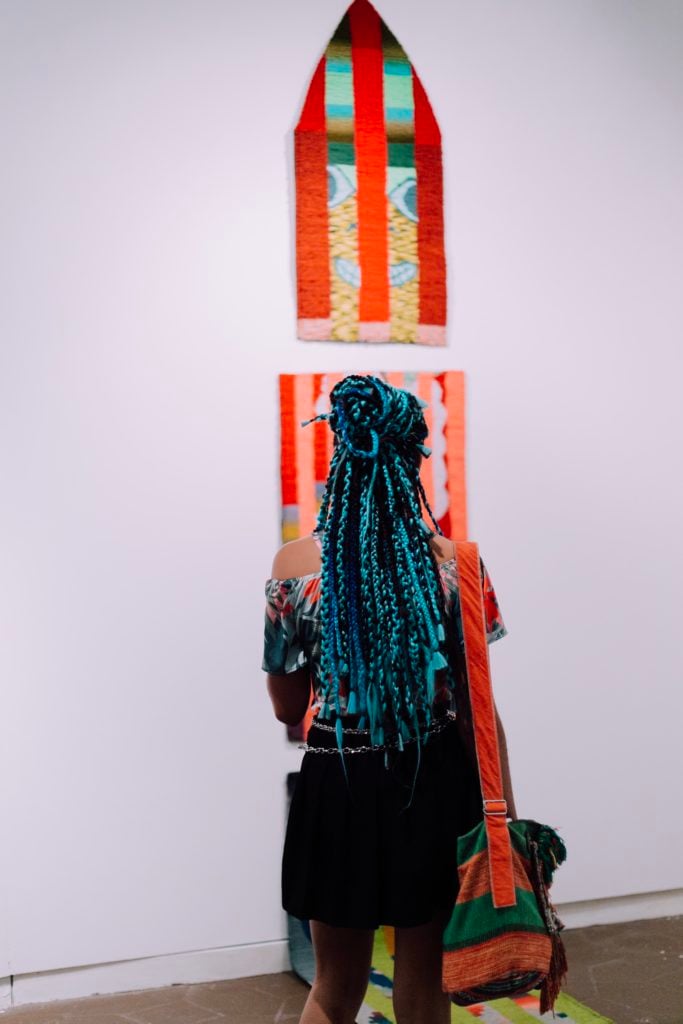
A visitor to Deli Gallery’s booth at the
MECA art fair in San Juan. Photo courtesy Discover Puerto Rico.
But those dealers are also in pursuit of the fifteen or so
serious Puerto Rican art buyers who support local artists while
building international collections. Among them are psychiatrist
Cesar Reyes and his wife Mima Benitez, who collect artists such as
Laura Owens and Elizabeth Peyton. (Visitors to their hilltop home
in the small town of Naguabo were able to spy numerous windmills
whose fan blades had been sheared off by Maria’s winds, which
climbed to 175 miles per hour.) There’s Diana and Moisés
Berezdivin, former clothing retailers whose Espacio 1414, in a
former tire warehouse, displays holdings ranging from a 1973 Sam
Gilliam shaped canvas to recent works by artists like Kathy
Bradford and Mary Weatherford. “It’s a lively scene here,” said
Diana Berezdivin, “and we’re trying to help it grow.” Ignacio J.
López and Laura M. Guerra are also sought-after local collectors
who hosted artists and dealers at a dinner party last weekend.
At the fair, Chicago’s Marianne Ibrahim Gallery brought works by
artists Clotilde Jiménez and Florine Démosthène. Both regularly
sell out, said gallery partner Pierre Lenhardt, but in order to
best support the fair, the gallery would sell only to Puerto Rican
collectors or to buyers who came to the fair personally, he said.
One collector was at the gallery’s stand one minute into the VIP
preview, he said, checkbook in hand.
San Juan wasn’t such a tough sell for North Little Rock’s Good
Weather Gallery, which brought gorgeous works by Ezra Tessler,
either. Founder and artist Haynes Riley successfully recruited some
of his collectors to come from Colorado and have a little vacation
on the island.
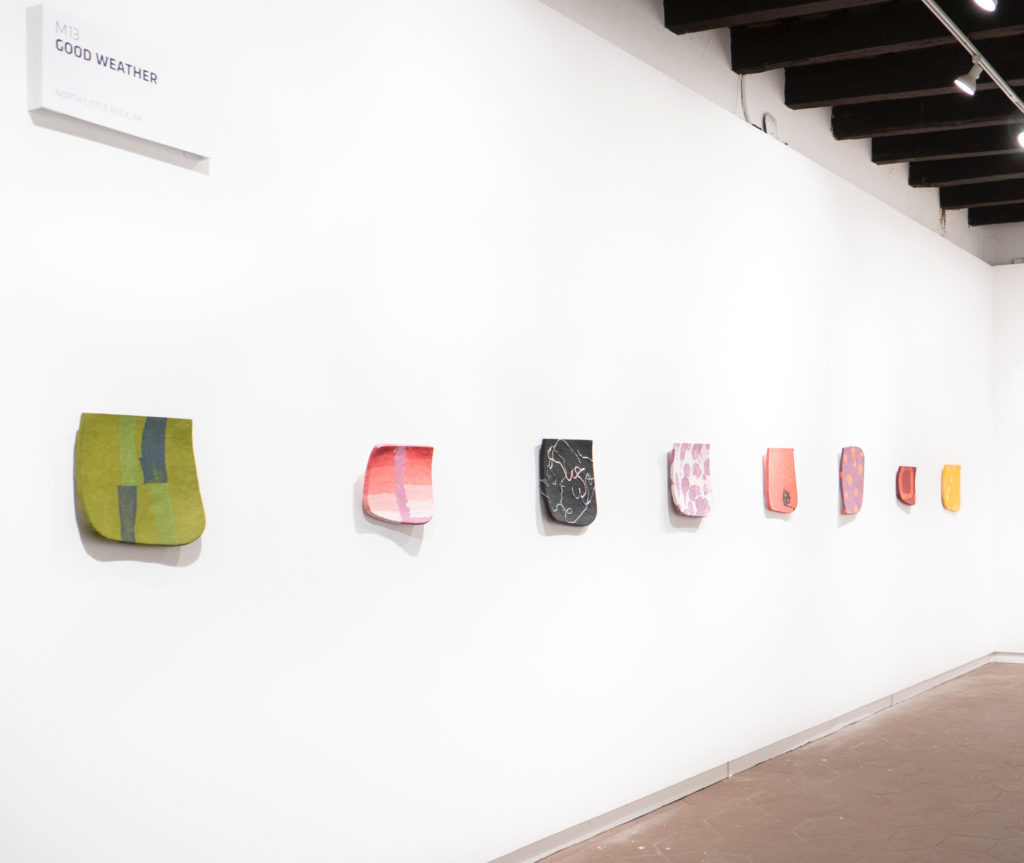
Works by Ezra Tessler, on view at MECA
courtesy of Good Weather, North Little Rock, Arkansas.
Indeed, San Juan’s November weather, with temperatures in the
eighties, and booming gastronomic scene, along with picturesque
beaches and proximity to hikable rainforest, make it an alluring
destination. With several museums there to complement the sandy
beaches, the fair is a kind of low-key Caribbean warm-up for
galleries headed to Art Basel Miami Beach (and its satellite fairs)
two weeks later.
Even the visiting dealers apparently found Puerto Rico’s other
attractions appealing. MECA is the most relaxed fair they’ve ever
done, said some; in fact, one New York dealer reported that her
next-door neighbor had been absent much of the first public day.
The fair even offered hired hands to cover for dealers who needed a
long lunch break, and the armory’s marble floors and timber roofs
gave the fair the opposite of the convention center vibe that
plagues so many such events. “It’s the Architectural Digest
art fair,” joked one dealer’s assistant.
But the political crisis and the storm’s long-lasting aftermath
remain ever-present. Puerto Ricans divide time between before
Maria, and after. “I’m getting goose bumps just talking about it,”
said Tony Rodríguez while showing me around an off-site exhibition
of Puerto Rican graphic artists and designers.
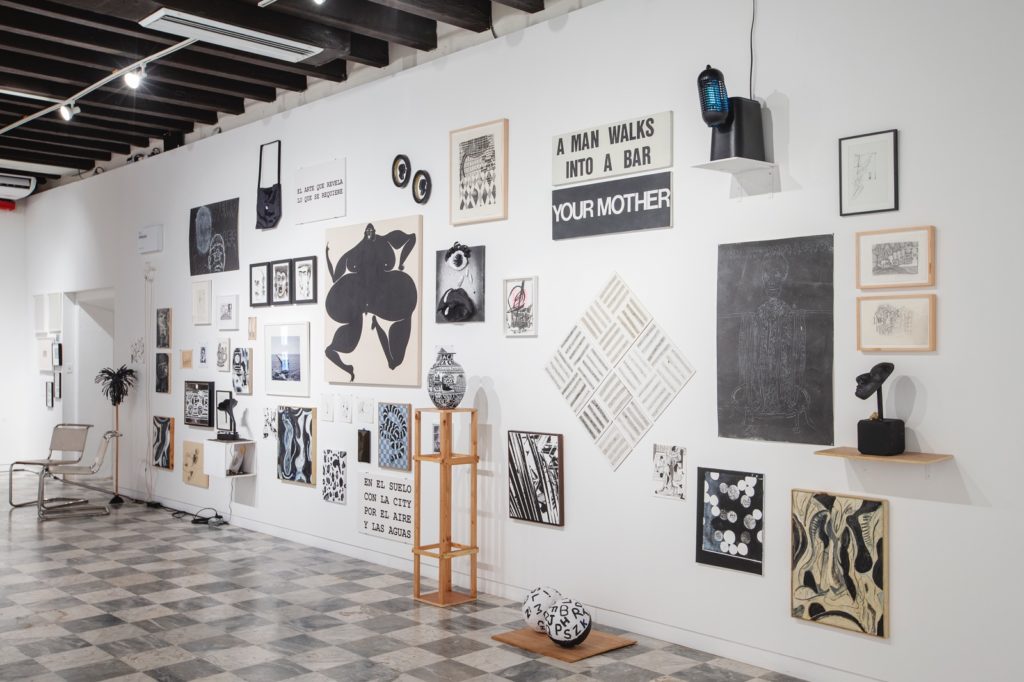
San Juan’s Embajada presents “Blanco y
Negro,” at MECA. Photo: Raquel Pérez-Puig.
Federal help is notoriously absent, with FEMA checks coming
slowly if at all. Two years on, some areas of the island don’t have
power. Anger at the government and over imposed austerity measures
runs high; when José B. Carrión III, chairman of the Financial
Oversight & Management Board for Puerto Rico, showed up at the
fair, he was chased out by protesters, one of whom left the shared
booth of two independent spaces, El Lobi and Taller Malaquita, to
drive the point home. Almost all of Puerto Rico has been designated
as an “opportunity zone,” inviting real estate investors and
offering massive tax breaks, which can easily be exploited by the rich at
the cost of the poor and middle class.
All the same, the people push on. There’s joy along with the
pain. Saturday night saw a MECA-organized concert on the grounds of
the armory, with an all-female lineup, headlined by iLe, 2016 Latin
Grammy winner (and 2019 nominee), who rocked the crowd of hundreds.
One protest-oriented song, she said, was driven by “the hatred in
my heart.” Between tunes, she called on the audience to get out and
vote and protest and organize. One wonders if Carrión, wherever he
was, was able to hear her.
The post Puerto Rico’s MECA Art Fair Boosts an Art Scene Valiantly
Struggling Amid Hurricane Damage, Debt, and Upheaval appeared
first on artnet News.
Further reading


Leave a comment