
Scientists Have Turned a Pigment Invented by the Ancient Egyptians into a Vital New Tool for Biomedical Researchers
A team of scientists in Germany
has found a new, biomedical, use for a pigment invented by the
Ancient Egyptians by turning it into nano-sized
particles.
Egyptian Blue is one of the
oldest manmade pigments. More than 4,000 years ago the Ancient
Egyptians used it on tombs and on statues, including the crown of
the famous limestone bust of Nefertiti, which is today in Berlin’s
Neues Museum.
A researcher at the University
of Göttingen, Sebastian Kruss, has used the pigment, which is also
known as calcium copper silicate, to produce a new nanomaterial
that improves infrared spectroscopic and microscopic
imaging.
It turns out that the pigment is
a good “fluorophore,” a light-emitting material that is used to
stain tiny samples so that they can be seen at clearer resolution
using modern microscopes. The imaging is a vital tool in biomedical
research.
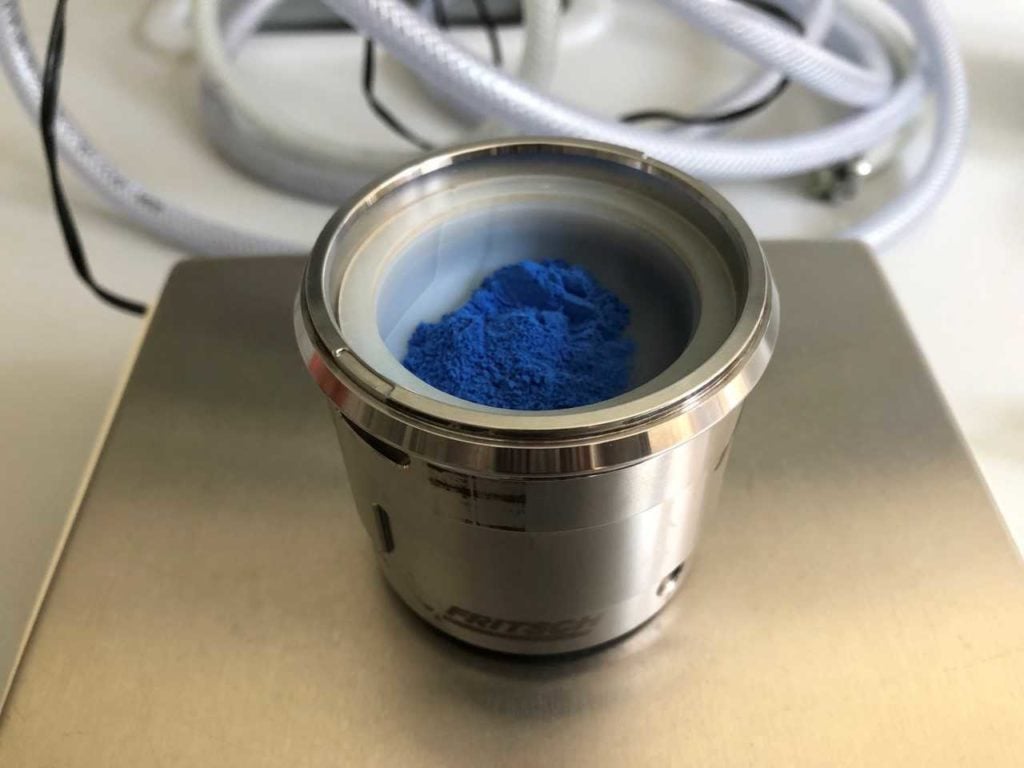
Egyptian blue: the researchers obtained
the nanosheets from this powder. Photo: University of
Göttingen.
Speaking to Artnet News, Kruss
explains that he got the idea after a student labeled a sample with
a pen, and the ink containing the pigment showed up on a
specialized microscope. Kruss says it was “surprising” because very
few materials show fluorescence at the near-infrared level, which
is a light that humans cannot see. “We then started to make [the Egyptian Blue]
pigment smaller and smaller to get tiny sheets that are useful for
biomedical imaging.”
Kruss and his team were able to
strip back the pigment to reduce its size by a factor of up to one million, and
found that even then it works as a good fluorophore, remaining
“extremely bright” and not bleaching as many standard dyes do at
that level. These nanosheets are 100,000 times thinner than a human
hair. “These tiny [Egyptian
Blue] particles are then very useful glowing labels in biomedical
research.”
Kruss suggests that this new
“very powerful fluorophore” could be used “to understand how
an embryo develops or cells divide,” in “image guided surgery, or
labelling of cancer tissue.”
“I am sure it will be of growing
interest for material scientists as well as biomedical research,”
Kruss says.
The post Scientists Have Turned a Pigment Invented by the
Ancient Egyptians into a Vital New Tool for Biomedical
Researchers appeared first on artnet News.
Read more https://news.artnet.com/art-world/egyptian-blue-science-1819458
Further reading


Leave a comment