
Sharing the Wealth? A New Art Fair Plans to Split Profits With Dealers When It Launches in New York Next Year
For many galleries, art fairs
present a “damned if you do, damned if you don’t” proposal. The
cost to participate has grown increasingly steep, with many
charging tens of thousands for a booth, plus expenses for shipping,
travel, and insurance. Do more than one fair a year—let alone five
or six—and that number balloons quickly. On the other hand, not
participating can amount to a significant lost business
opportunity.
Future
Fair, a new New York
startup launched by fair veteran Rachel Mijares Fick and art
adviser Rebeca Laliberte, poses an answer to this problem: it will
cut a share of its profits with all participating
galleries.
“We have so many types of
galleries in our marketplace and yet the fair landscape offers one
cookie-cutter model for them all,” Mijares Fick tells artnet News.
For her, the idea of Future Fair started percolating around 2015 or
2016; it gained steam last summer when she partnered with
Laliberte.
“I realized that we need
optionality to better serve all the kinds of galleries we have,”
Mijares Fick says. “I’ve seen fairs significantly help the careers
of artists and gallerists, I’ve also seen great galleries have to
close their doors because of the pressures fairs present. Why can’t
we have one and not the other?”
For the first four editions of
Future Fair, all 36 participating galleries will split 35 percent
of the profit. That might be nothing the first time around, Mijares
Fick admits, explaining that, as is often the case with new
businesses, the first year’s goal is just to break even. After
that, she and Laliberte expect galleries to get a return of “three
to four figures.”
When this time comes, galleries
will have a choice to accept the money in the form of a cash
payout, use it as a credit for the following year’s fair, or put it
towards what organizers call the “Pay It Forward” fund, which will
be put toward sponsoring up-and-coming galleries in future
editions.
“It’s a way of holding us
accountable and allowing the galleries that join in the first year
to grow with us, share in our success, and be able to invest it
back into their business or others,” says Laliberte.
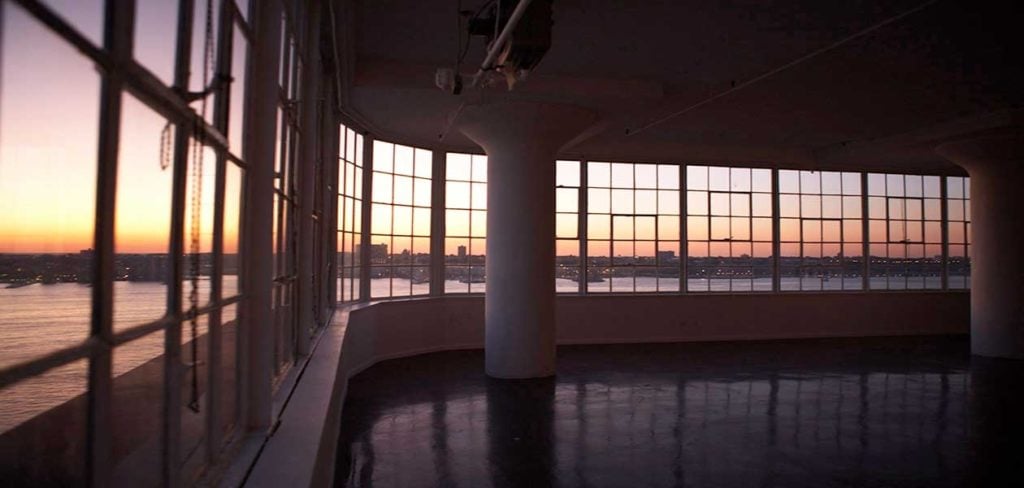
Canoe Studios, where the first edition
of Future Fair will be held. Courtesy of Canoe Studios.
Future Fair joins a relatively
crowded field of startup enterprises trying to upend the
traditional art fair model. Object &
Thing, a booth-less
Brooklyn-based expo where dealers were kept away from the items
they were selling, launched its inaugural version earlier this
year. Other fairs like SPRING/BREAK Art Show, Felix LA, and
Superfine have all introduced their own alternative models in
recent years.
Rather than the cubicle-style
booths that populate most fair floors, Future will dedicate
salon-style rooms to its exhibitors. Galleries will be put two to a
room, where they’ll co-curate exhibitions. (Spaces will cost
between $6,500 for a 300-square-foot room and $10,900 for 700
square feet.)
“The idea is to slow down the
process of going through an art fair,” says Laliberte. “We want it
to feel less like a trade show and more like you’re walking through
a parlor or a series of exhibition rooms like a museum.”
The first edition of the Future
Fair is set to take place May 7- 9 2020, during Frieze New
York.
The post Sharing the Wealth? A New Art Fair Plans to Split
Profits With Dealers When It Launches in New York Next Year
appeared first on artnet News.
Read more https://news.artnet.com/market/new-art-fair-profit-share-model-1635199
Further reading


Leave a comment