
‘She Did the Paintings for Herself’: Curator Barbara Haskell on How Artist Agnes Pelton Learned to Break New Ground in Isolation
As most of the world shuts down and many millions of people find
themselves isolated at home, perhaps it’s fitting that a new
(though now closed) exhibition at New York’s Whitney Museum of
American Art delves into the work of a woman who lived very much
off the grid, and according to her own psychic rules.
“Agnes Pelton: Desert Transcendentalist” is a sprawling
look at the paintings to which Pelton dedicated her life—they were
based largely on themes of mysticism and theosophy and informed by
her own visions. In the few days before it closed as a result of
the health crisis, the Pelton show—which was originally organized
by the Phoenix Art Museum’s Gilbert Vicario—was already
earning accolades. And
it is part of a wider trend of historians reappraising female
artists inspired by the occult (Hilma af Klimt, anyone?).
Whitney Museum curator Barbara Haskell, who worked on the New
York presentation of the show, recently spoke with Andrew Goldstein
to discuss the artist’s stranger-than-fiction life story and why
her work is hitting a nerve right now.
How did you first come to learn of Agnes Pelton and her
work?
In the late 1990s, I was introduced to it by a dealer in Los
Angeles and I fell in love with the work. The trajectory of how the
Whitney ended up getting its first Agnes Pelton painting in
1995—it’s interesting, because she was totally unknown. So I
presented her work to the acquisition committee and they turned it
down.
But I thought that this was something worth pursuing. And I came
back to them a second year and they also turned it down. I came
back to a third year, and finally, Leonard Lauder, who was at that
point chairing the committee, said, “You know, Barbara believes in
this work. I do not want her to come back a third year. Let’s buy.”
So two [Pelton] works have been in the museum’s collection for over
20 years, and they have been on almost continuous view in the new
buildings since we opened in 2015.
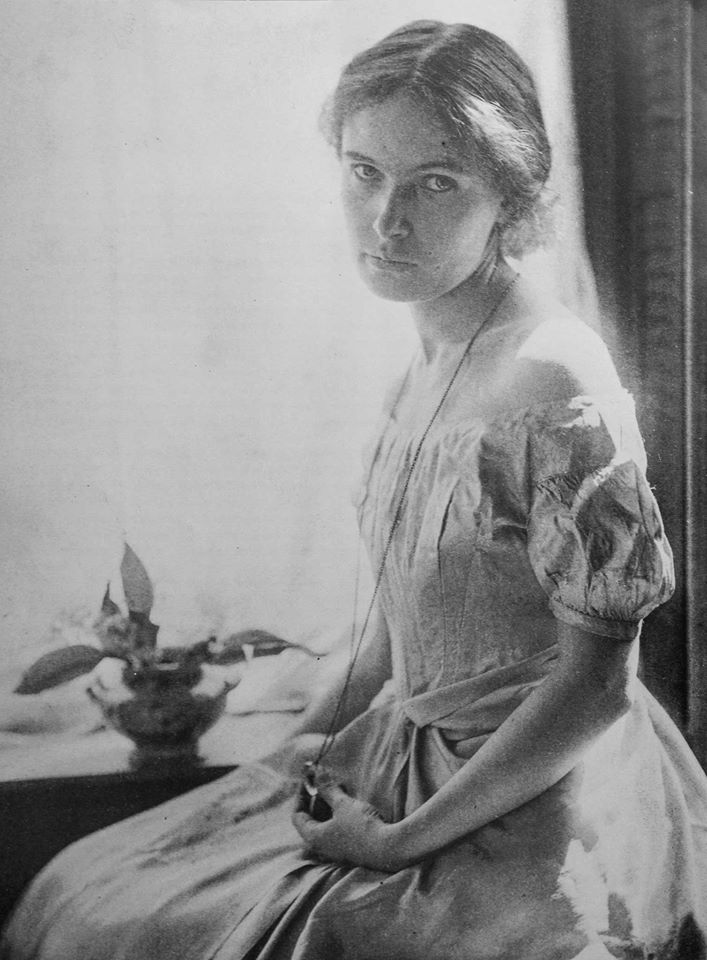
A portrait of Agnes Pelton. Photo: Alice
Boughton.
It’s often helpful to know about an artist’s life when
looking at their work, and for Pelton, this may be especially
critical as she had a particularly dramatic upbringing, like
something out of Dickens.
As she said herself, it was a scandal that cramped both her
mother’s life and her own life, and it does figure very importantly
in her decision to seek a different meaning in life, away from the
physical and into something more spiritual.
So it happened to her maternal grandparents; Theodore and
Elizabeth Tilton. Theodore was an important newspaper editor who
was the protégé of the very well-known abolitionist and pastor
Henry Ward Beecher. At one point, Elizabeth began an affair with
Ward Beecher, who of course in his sermons was preaching celibacy
and morality, and when the affair was made public, Theodore sued
Ward Beecher for alienation of affection. Elizabeth refused to
testify against Ward Beecher, who was still her pastor, and the
trial ended in a hung jury with Theodore completely humiliated.
The Tiltons sent their daughter, Florence, to Europe, and
Theodore himself went to Paris and died impoverished; meanwhile,
Florence met a wealthy expatriate from Louisiana who was something
of a ne’er-do-well, and they had Agnes Pelton in Stuttgart. They
moved back to Brooklyn, but Florence’s husband was unhappy and
Agnes rarely saw her father—he died when she was 10 from a morphine
overdose. The mother became a recluse, still very spiritually
inclined, but excommunicated from the church, and it really set the
stage for Agnes to turn inward, which she did.
And how did Agnes become interested in art?
She attended the Pratt Institute, studying under Arthur Wesley
Dow, the famous art educator who went on to teach Georgia O’Keeffe
and many other abstractionists. Dow was one of the people who
thought that art should be more an expression of the artist’s
experience—it shouldn’t be illustrative.
From there, Pelton studied in Rome for a year, came back, and
was part of a group of artists that tended to paint kind of
mystical landscapes and figures, the most famous of which is Arthur
B. Davies. Pelton’s early works were in that same mode of what was
called introspectives, where there were figures communing with the
landscape, very dreamy and symbolist.
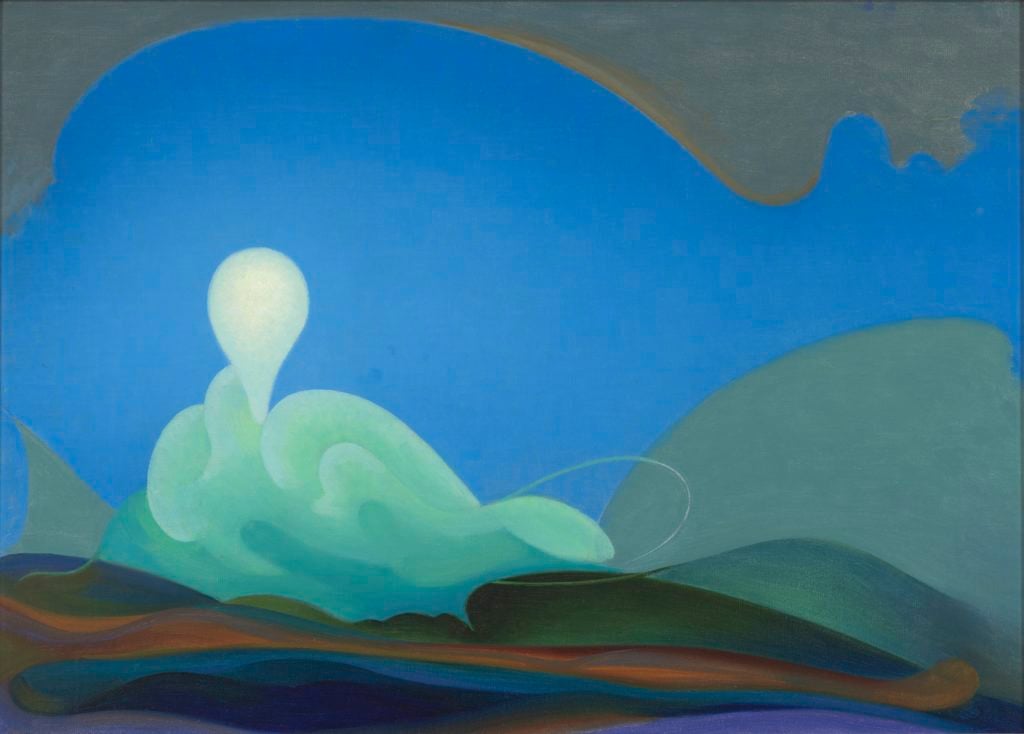
Agnes Pelton, Sea Change (1931).
Courtesy of the Whitney Museum of American Art.
Can we talk a little about her psychology? How did this
very unusual upbringing and traumatic family history shape the way
she was looking at the world and the way that she was presenting
herself?
My supposition is that it encouraged her to turn inward. She
came from a very spiritual family, so the idea of finding meaning
and some sort of spiritual experience was part of her upbringing,
but she had to turn to nontraditional ways to find it. For example,
she dressed in these very ethereal Greek kind of toga costumes, and
began to study occult literature and theosophy.
One thing I’d like to point out is that before she took
this mystical turn, she seemed to have the beginnings of a
successful art career. One of her paintings was included in the
1913 Armory Show, which is famous because it is where
Duchamp’s Nude Descending a Staircase was
debuted.
Absolutely, she was in the Armory Show—she was part of a
Knoedler Gallery show that helped launch a symbolist group. So she
was connected to a group of people who would go on to receive
recognition for their work.
Her move in 1922 to Long Island, when she moved into an
abandoned windmill, was very radical. After her mother died, who
was Pelton’s last connection to the physical world, she wasn’t
fully a recluse, but really was isolated there and cut off
relations to the art world outside.
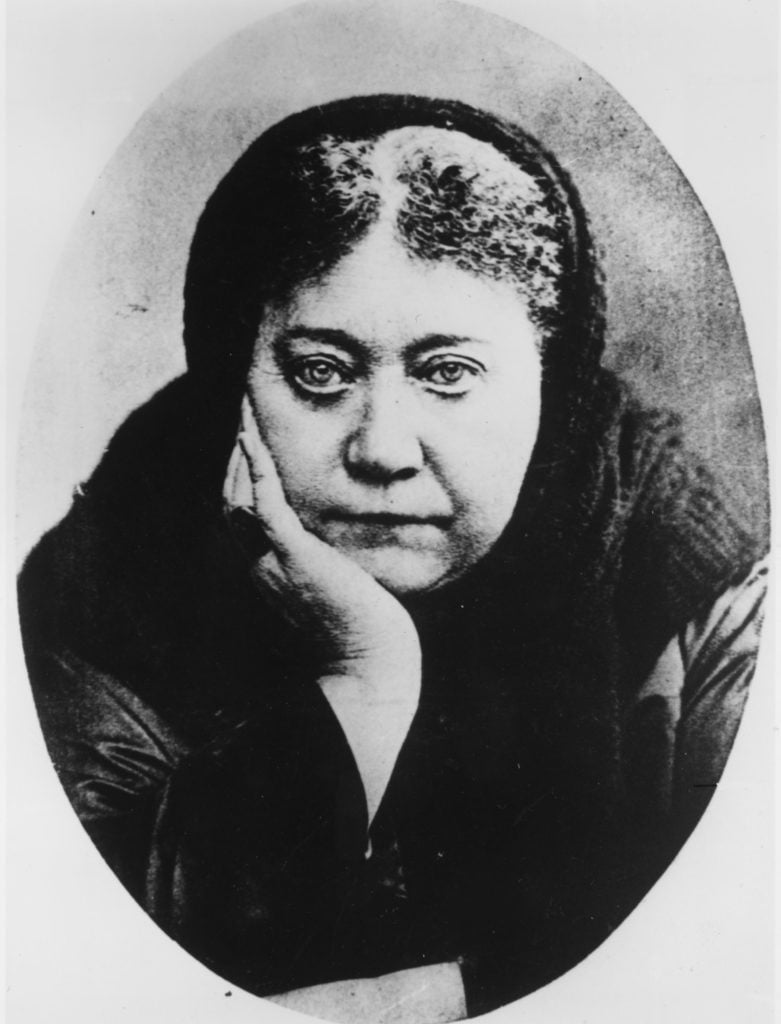
Ukrainian theosophist Madame Helena
Petrovna Blavatsky. (Photo by Henry Guttmann Collection/Hulton
Archive/Getty Images)
You mentioned how she fell under the spell, so to speak,
of Madame Blavatsky, who was this doyenne of theosophy and a sort
of den mother of the occult scene in America. Who else was Pelton
interested in?
After Blavatsky’s death, theosophy sort of splintered into
several groups, and one of them was a philosophy called Agni Yoga
(Agni meaning fire). It was founded by Nicholas
Roerich and his wife Helena and was based on the idea of fire
being a symbol of life force, something very powerful and deep and
a symbol of the spiritual journey to this other harmonious
divinity.
I think many people will be familiar with Blavatsky’s
worldview, which was really a combination of the world’s religions
into one overstory, of a kind of divine path that is followed
through many different tellings. But Nicholas Roerich is a much
more niche spiritualist, and I understand he had an
apocalyptic bent about him. Can you talk about that?
He was kind of a conglomeration of various philosophies and
religions and wisdoms, especially Buddhism and Christianity. But he
was a very messianic figure. He was a painter himself, he was an
explorer, he had a wide range of careers before he created Agni
Yoga with his wife, who transcribed the voices she heard, which
formed the basis of the practice. He was a very charismatic figure,
and one of the paintings Pelton did sort of resembles Nicholas
Roerich.
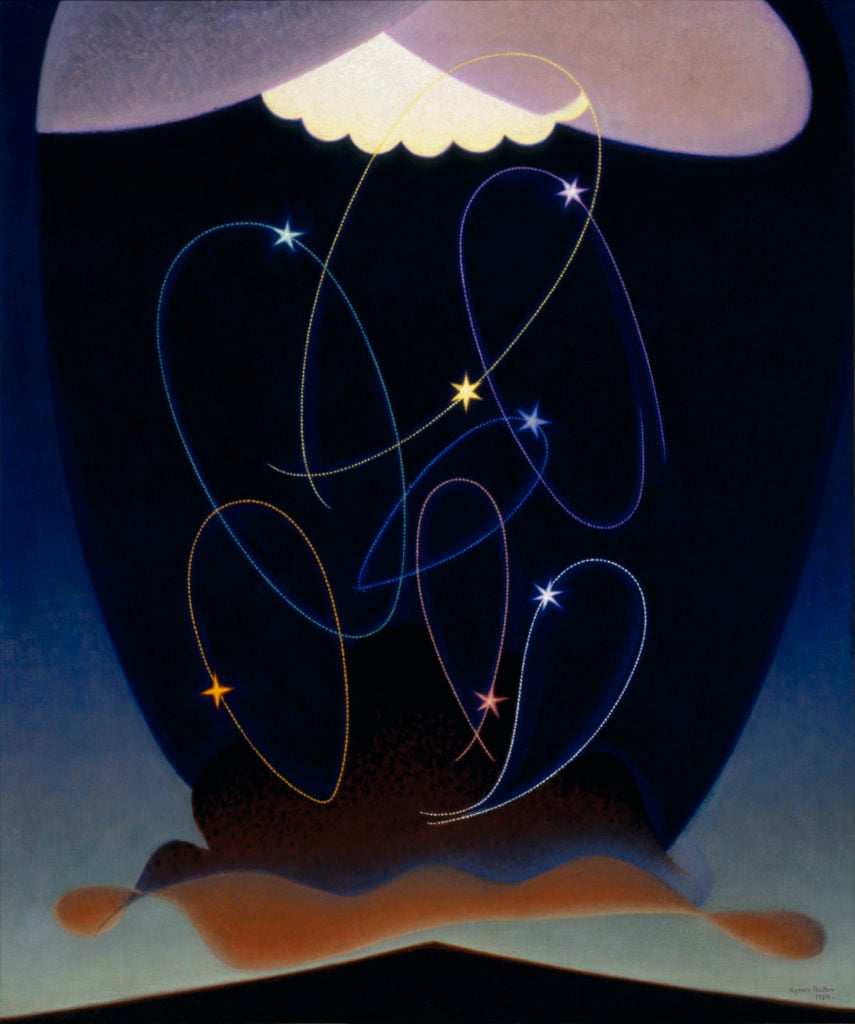
Agnes Pelton, Orbits (1934).
Courtesy of the Oakland Museum of California, gift of Concours
d’Antiques, the Art Guild of the Oakland Museum of California.
So what impact did all of these different kinds of
teachers and mystics have on her art?
Well, it happened in two ways. One, I think it confirmed to her
that there was a world that existed beyond the physical, and that
the goal of life was to connect with that world.
She also began to incorporate symbols into her work that were
part of this whole mystical literature. So stars, for example, were
were the symbol of of Venus, the attainment of enlightenment. She
would use mountains, which she identified as mountains of
aspiration. The work is this very unusual combination of abstract
forms and yet recognizable symbols.
She seems to have drawn a little bit from a fellow
Blavatsky protégé, Wassily Kandinsky.
She was very influenced by Kandinsky. She read his book
concerning the spiritual and art and really adhered to the idea
that it is the necessity of artists to present the spiritual, and
through form and color, artists can evoke impressions and feelings
in viewers.
People often think of Kandinsky as the first abstract
painter, but nowadays we know that there is actually an artist who
has a better claim to that title, and that’s Hilma af Klint, the
mystical Swedish artist who has been very much in the news since
she was the subject of a
blockbuster show at the Guggenheim.
These two women were virtually unknown in their lifetimes and
emerged at the same moment in New York. It’s a wonderful
coincidence.
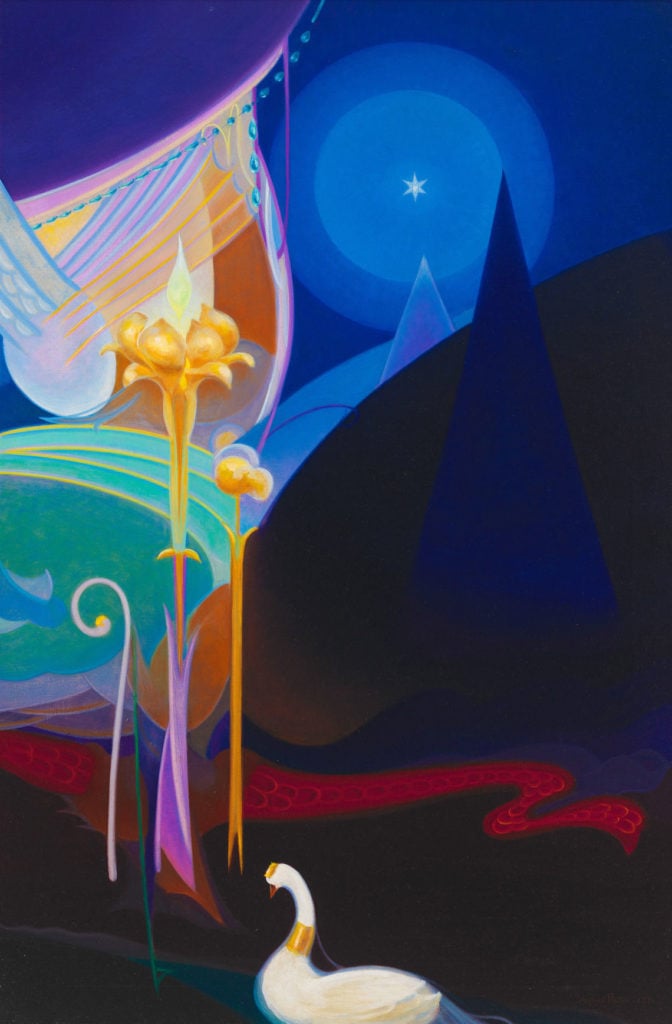
Agnes Pelton, Untitled (1931).
Courtesy of the Whitney Museum of American Art.
Did she know Hilma af Klint?
No, she didn’t. I think they both have a similar drive to
express a spiritual reality. They both read theosophy and a lot of
occult literature. The difference, I think, is that Pelton called
her work abstract and it presents itself as abstract, but it does
include recognizable images.
So there are images of mountains, many stars. There’s that kind
of accessibility that her work has. It engages people with a sense
that there’s a meaning that then they want to decipher.
Simultaneous to this mystical content, there’s almost a
kind of a Disney-esque friendliness to the
composition.
Absolutely. These images of stars and mountains and swans and
various recognizable elements create a sense of a magic fantasy. It
has a kind of dizzy, light quality that beckons people in.
In 1932, at the age of 50, Pelton moved to a tiny desert
town outside of Los Angeles with the incredibly freighted name of
Cathedral City. What drew her to that town?
She was first attracted to Southern California because of the
spiritual colonies that were there. She’d gone to
visit Pasadena in 1928, where there was a group of similarly
minded spiritualists. The desert itself was something—I think the
emptiness, the sense of expansion, the quality of infinity, the
light in the desert. Those are all things that attracted her and
became elements in the paintings. The paintings have a kind of soft
glow that almost reminds you of what the desert feels like in late
evening or early morning.
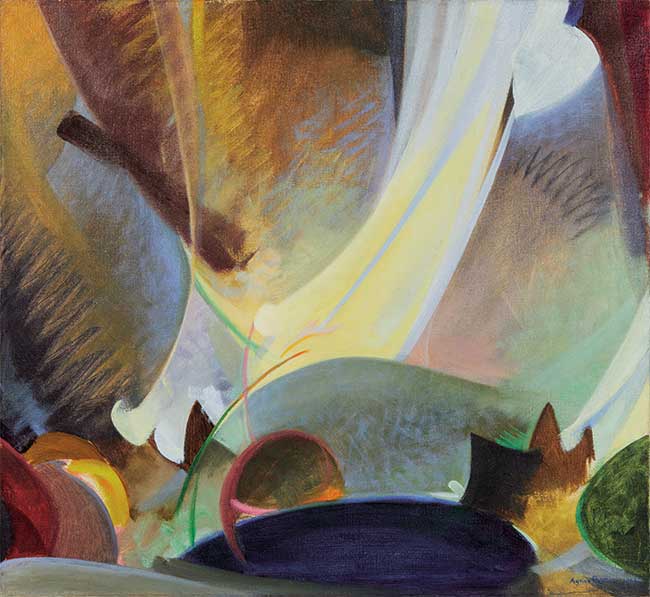
Agnes Pelton, Ray Serene
(1925). Photo by Jairo Ramirez, courtesy of the collection of Lynda
and Stewart Resnick.
Can you describe the kind of paintings that she
made?
Once she establishes her vocabulary in 1925, she does not stray
from it. She didn’t paint for other people. She didn’t paint for
the marketplace. In fact, to make money, she painted realistic
portraits and desert paintings that she sold to tourists.
The abstract work was the real work, and it was difficult for
her to do. She would sometimes only be able to paint one day a
week. It wasn’t as if she would go into her studio and think, okay,
today I’m going to have an inspiration. She had to wait for those
inspirations to come.
Did she ever sell her abstractions?
She sold a few of them, but for the most part, people didn’t
understand them. For example, she sold a couple of paintings to a
collector who lived near Santa Barbara. The collector gave the
paintings to a museum that didn’t want them, so they put them in a
garage sale with a price tag of $40. During the course of the day,
the price kept going lower and lower. Finally, the paintings were
sold for $5.
Wow. Was she able to make ends meet?
She lived very frugally, and then through the sale of these
tourist paintings, she was able to make a living. She wasn’t really
concerned with fame and fortune in the normal way that artists
think of it today—she really did the paintings for herself, to
clarify her sense of how to achieve this level of spiritual
enlightenment.
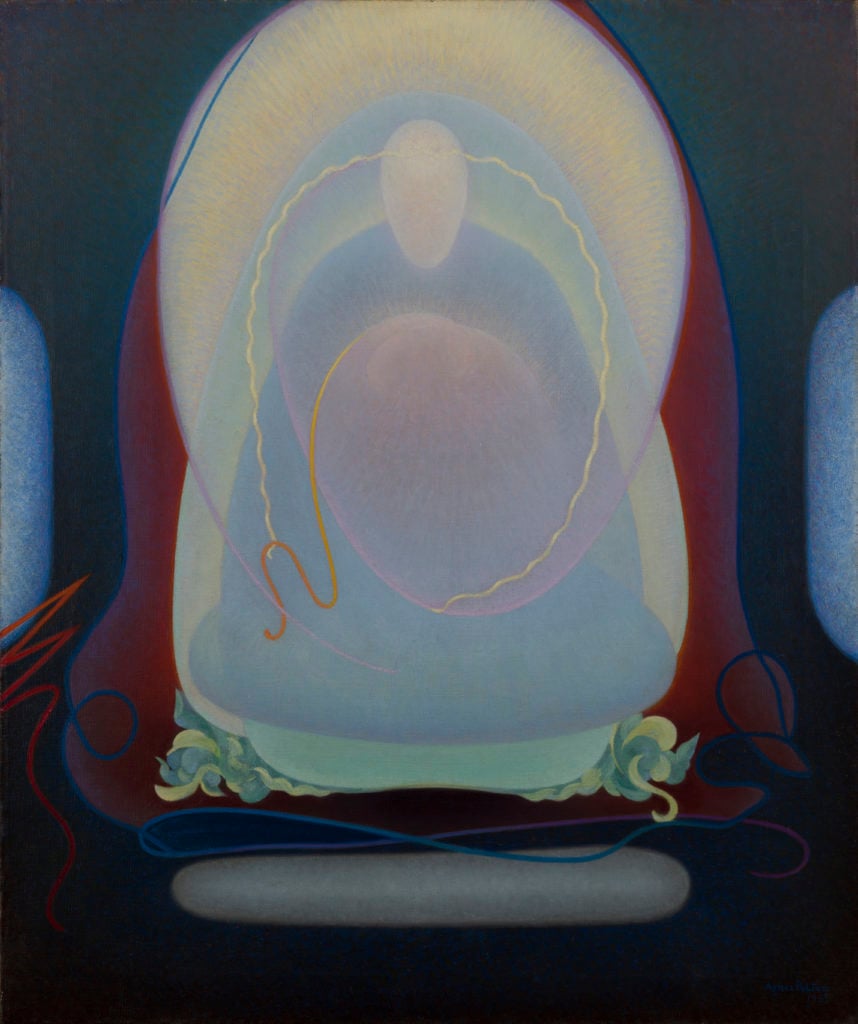
Agnes Pelton, Mother of Silence
(1933). Courtesy of a private collection.
One symbol of how personal was to her was that she had
one canvas that she called Mother of Silence,
which is a Buddha-like figure enrobed in auratic colors, and she
considered this to actually be a form of her mother that she could
talk to, and turn to for advice in times of distress.
It was either her mother or the sense of the female spirit—she
was most attracted to occult literature written by
women. Pelton felt that the painting itself had a living
presence and she would turn to it and ask its advice about what she
should do with her art and with her life. She really felt it was a
living icon for her.
Did she ever have any kind of curatorial interest? Was
there ever a Barbara Haskell who came along during her lifetime and
gave her a spotlight?
No, and that’s why, when she died, the work really went into
oblivion. She didn’t have an advocate. It wasn’t until the late
1980s, early 1990s that people began to look at it again.
And that was when her work was included in some
important shows?
Yes. There was the landmark show in 1986 at the Los Angeles
County Museum of Art, “The Spiritual in
Art: Abstract Painting 1890–1985,” and then, in 1995,
there was a one-person show organized by the Palm Springs Museum,
sort of in her neighborhood near Cathedral City.
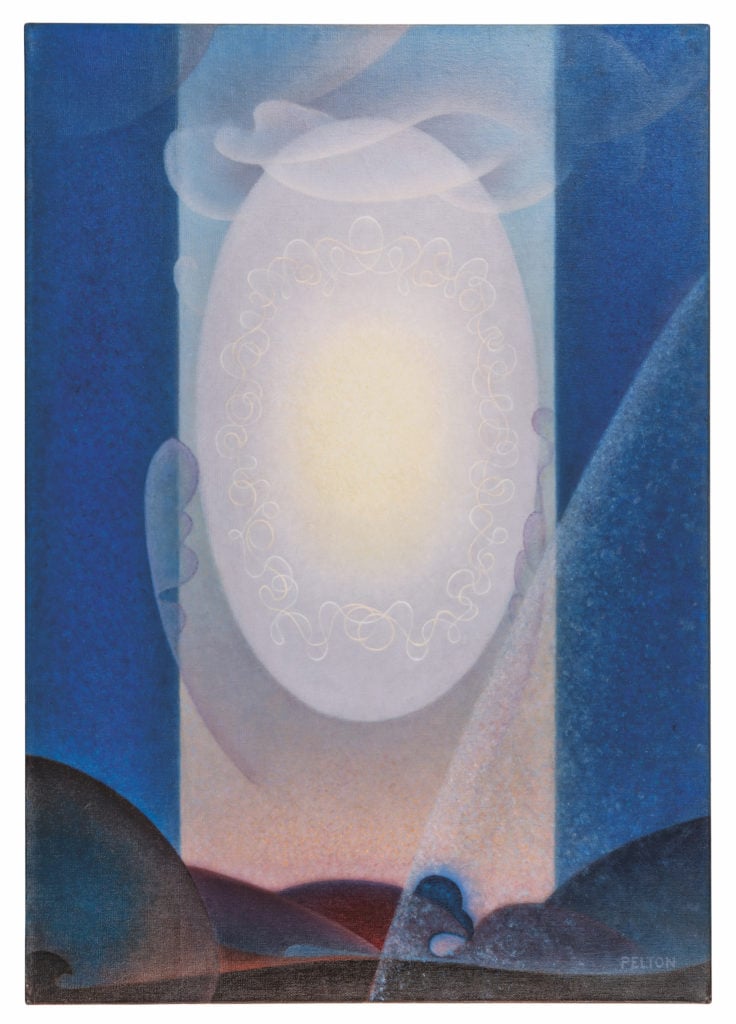
Agnes Pelton, Light Center
(1947–48). Photo by Jairo Ramirez, courtesy of the collection of
Lynda and Stewart Resnick.
Throughout her career, Pelton would invent new shapes,
new compositions, new ways of making her paintings and never
repeated herself, with one exception in 1961, the year she died,
when she recreated a very specific abstraction she had made over a
decade earlier. The painting has sort of a glowing egg shape form
suspended in a column of light.
That’s exactly right. Most of her paintings are very different,
she never worked in series. Because she brought them out of her own
visions, each time it was a different experience with a different
set of problems. But it makes sense that she circled back to
Light Center, with a glowing orb of light
and the circle being a symbol for of infinity, at the end of her
life.
So when she died, was she alone?
She never had any heirs or a long-term relationship, but she did
have a funeral, and a number of people from the community
came. They put one painting up at the funeral, a work called The
Blest that her nieces and nephews felt symbolized her entering
another level of existence.
Historically, it seems that she may have been a little
bit hampered by the fact that she was always compared to Georgia
O’Keeffe, who lived in the same remote kind of geography and seems
to be tackling similar esoteric, so-called feminine topics. Why do
you think that she was the one who really captured the zeitgeist
and Pelton lapsed into obscurity?
Georgia O’Keeffe had the great advantage of having an advocate,
a very powerful advocate, in [her husband, photographer] Alfred
Stieglitz. The other thing about O’Keefe is that the work became
realistic at the time she moved out to the desert. She was able to
combine realistic, sensuous forms like flowers and mountains with a
hard-edge painting technique. The combination of the appealing
subject matter and the strong advocate was what made O’Keeffe so
popular during her lifetime. Pelton had neither.
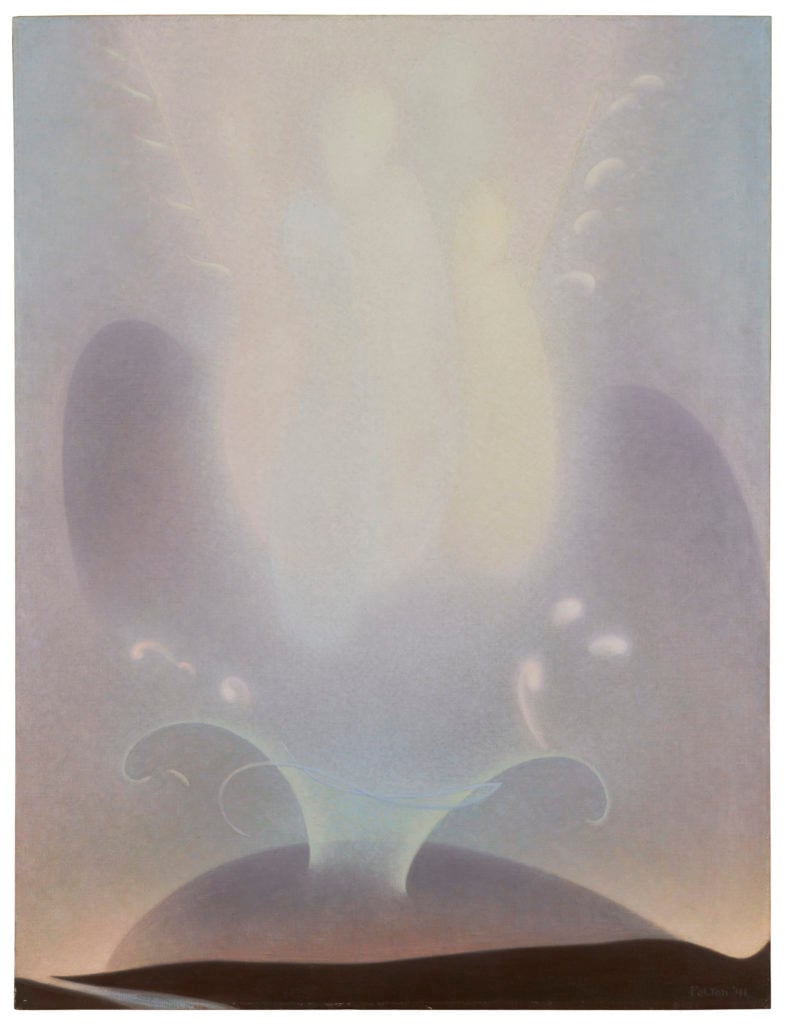
Agnes Pelton, The Blest (1941).
Photo by Martin Seck, courtesy of the collection of Georgia and
Michael de Havenon.
It seems that there is a resurgence of interest in art
that tackles subjects that are slightly beyond the rational, and in
this time where pretty much every certainty has fallen into
question and everything is breaking down, people can’t actually go
see your show at the Whitney right now. But is there any lesson
that can be found in the story of Agnes Pelton and her
art?
In a way, we’re entering a surreal world that none of us has
ever experienced. People are more uncertain and more frightened
than they’ve ever been before, and, paradoxically, Pelton’s work
speaks to us more powerfully now than maybe it did even two weeks
ago.
In the late 19th, early 20th century, there was a lot of
relocation, urbanization, and industrialization that was changing
the way people lived, and there was a lot of uncertainty about what
the future would bring. We’re now in a time when that’s even
perhaps more true than it was a hundred years ago. But the desire
for meaning remains as intense as ever before.
The post ‘She Did the Paintings for Herself’: Curator
Barbara Haskell on How Artist Agnes Pelton Learned to Break New
Ground in Isolation appeared first on artnet News.
Read more https://news.artnet.com/the-big-interview/agnes-pelton-haskell-interview-1822842
Further reading


Leave a comment