
‘She Was Brave, Like Me’: Deborah Kass and Patricia Cronin on How Politics Sparked Their Romance, and the Art They Crave to See
New York artists Deborah Kass
and Patricia Cronin are easily one of the city’s most politically
engaged art-world power couples—and their mutual love of politics
is, in fact, how their romance began.
Both artists have long been
passionate about advocating for the rights and representation of
women in creative circles and beyond, exploring feminist themes in
their respective work, from public sculptures like Cronin’s
Memorial to a
Marriage—a bronze
mortuary sculpture conceived before gay marriage was made legal in
the United States—to Kass’s subversive Pop paintings, like her
famous self-portrait in the manner of
Warhol’s Liz.
In their adjoining studios in Gowanus, Brooklyn, the couple sat
down with Artnet News to discuss how they met, why they continued
to inspire one another, and how they’d like to see the art world
change in the years to come.
How did you first become acquainted?
Deborah Kass: Go ahead,
Patti.
Patricia Cronin: We met when I
was co-curating an exhibition called “Coming to Power: 25 Years of Sexually X-plicit
Art by Women” with the
artist Ellen Canter in 1993. This was before the internet—if you
were trying to organize a group show, you found out which artists’
studios you should go visit through word of mouth and from other
artists. I had known Deb’s work from when she was showing on 57th
Street with Baskerville + Watson gallery, and also knew about the
work she did with José Freire at Fiction/Nonfiction. So, I went to
her studio, and that’s how we met.
What were your initial impressions of each other?
Kass: Well, I didn’t think I was
right for the show. So I told Patti and Ellen that.
Cronin: She did tell us—and she
was probably right—but while we were there, she also told us about
this political-action group that she was co-founding with Mary
Dorman and Annie Philbin, who’s the longtime director of the Hammer
Museum. The three of them cofounded WAC, the Women’s Action
Coalition. And she said, “You should really start coming to these
meetings. They just started, they’re really exciting.” So we
started meeting at the meetings. I’d show up and she’d be
leading the meetings. It was great—we discussed and
organized different political actions all over the
city.
So, then did you go on a date?
Kass: No, I was with someone
else. I didn’t pay much attention. Patti, we should probably talk
about the interview.
Cronin: Oh, right. I had started
visiting New York in 1981, and then I moved to the city in ‘86—and
when you first move to New York from out of town, you go to see all
the shows. Mira Schor and Susan Bee were just starting this journal
called Meaning
with artists’ writings, so I
proposed that I interview Deb for that. We did what I felt was a
really great interview in 1993, and we talked about lots of issues
around sexuality, gender, and representation. It was really
fun.
Kass: And then I broke up with
my other girlfriend and the rest is history.
Wow. What’s something you liked about each other right
away?
Kass: Well, I’ll tell you what I
told my first love about Patti. I called him to tell him I was
breaking up with my then-12-year relationship. He said, “Well,
what’s she like?” And I said, “She’s really young.” And he goes,
“Like you were,” when I was with him. Then I said, “And she’s
really brave.” And he said, “Like you were.” I just thought that
was really sweet. I was crying telling him. She was brave, like
me.
So I really admired that Patti
was really out there, in every way. She was so invested in
everything I was. She was reading the same books and we were
talking about the same issues and our politics were completely
connected. We both had Scorpio rising signs.
Cronin: I think watching her
speak truth to power in those WAC meetings was really special. It
boils down to the same thing, I guess: her having the courage to do
that, and the commitment to do that. It’s related to bravery, as
she said.
We’re both currently following
this impeachment hearing minute-by-minute. I mean, our values are
so intertwined. Having shared values, I think, is one of the key
things. It’s not about liking the same style of art, but having a
shared opinion about the purpose of art. We feel art should be
content-nutritious. Both of us are really passionate about
that.
You were engaging with one another’s artwork from the very
start. What does it feel like to be in a couple with another artist
who regards art—and, specifically, the purpose of art—in the same
way you do?
Cronin: I think it’s great to be
in an artist couple because you can speak in shorthand and be very
clear, and it’s great to have a brilliant set of eyeballs that you
can consult, and someone you can bounce crazy ideas off of. You can
say, “Look at what I’m trying to do. Is this crazy idea really
insane, or is this possibly as good as I think it is?” So that part
is really magic, honestly.
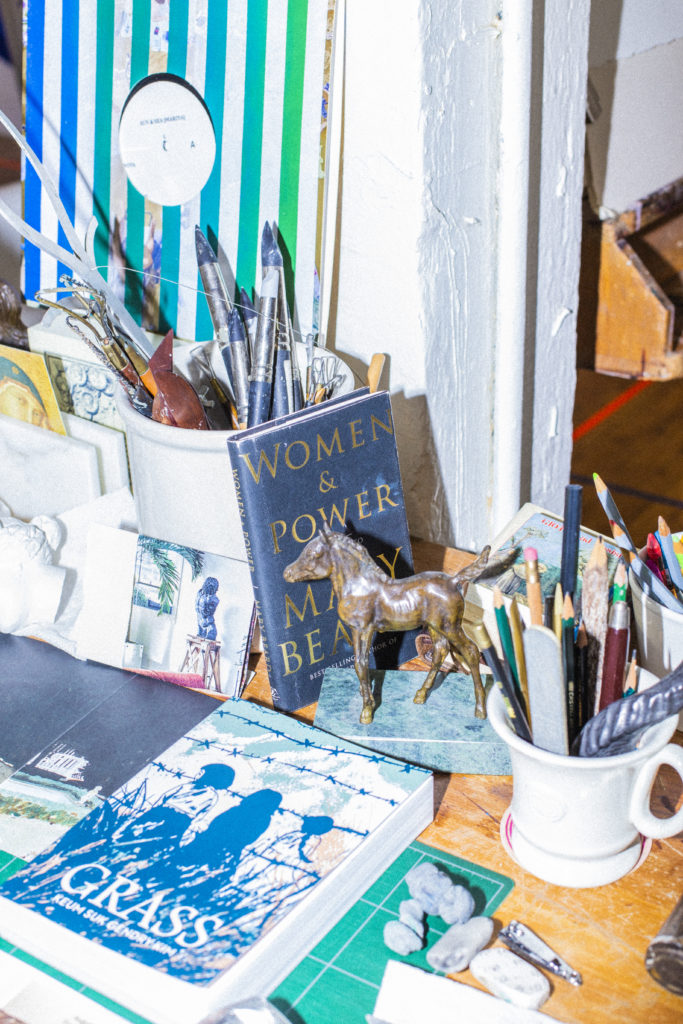
A detail from Cronin’s workspace. Photo
courtesy Nicolas Bloise.
What art-related activities do you like to do
together?
Kass: We’re very big on doing
museums together, regardless of where we are in the world. And, on
birthdays, that’s what we do.
Cronin: My birthday, for sure.
For your birthday, we’re usually somewhere else. Out of town or out
of the country. One of the things we love to do is travel to go
look at art, whether it’s London or Paris or Rome or Venice. It
just goes on and on. We make a real day of it when we do
it.
How do you do it? Do you have viewing rituals?
Kass: We have lunch, we drink
wine, we go back into the galleries. We go in and out. We’re really
committed, and it’s really fun. But it’s very slow, exacting
viewing. And then some wine.
What are some shows you’ve seen this year that you’ve found
particularly interesting?
Kass: The impeachment has been
particularly interesting.
Ah, yes, the longest-running show of the year. It’s felt like
that, anyway.
Kass: And it’s the one that has
interested me most by far. It’s insane. But really, I’ve been very
lean this year, art-wise. I haven’t seen much. For three years,
I’ve been watching political shows. But we might go to Paris,
right, Patti? We want to see Leonardo [da Vinci] at the
Louvre.
Cronin: I’m dying to
go.
Kass: We saw the Titian show in
Rome, at the Scuderie del Quirinale. We go to Rome a lot because
Patti is a fellow at the American Academy and does research there.
We spend a lot of time in Italy.
Cronin: But I think the Lithuanian Pavilion at
the Venice Biennale was one of the best things I’ve seen in a
very long time. There was also a Joseph Cornell show at the Prada
Foundation that was really moving.
As two artists who live and work in the same space, what do
you argue about?
Kass: We like different kinds of
art for sure. A lot of times, it’s like, “Oh, right,
of course
you’d like that.” And it’s not
quite my cup of tea. I like funnier art. And cartoonier art. So
sometimes we argue about that.
Cronin: I like late Medieval and
early Renaissance art. Which I still think is kind of funny,
actually.
What art do you live with at home?
Kass: We have good art at
home!
Cronin: Philip Guston, Elizabeth
Murray, Adrian Piper, Rosa Bonheur, Harriet Hosmer, Karen Heagle,
Catherine Opie, Timothy Greenfield Sanders, Keltie
Ferris.
Kass: Cindy Sherman, Laurie
Simmons. It goes on and on. Aline Kominsky-Crumb. Charles
Schulz.
Cronin, Kass: Sister Corita!
[both laugh]
And what does your home look like?
Kass: We have an 1850s townhouse
in Boerum Hill. The living room has a lot of art in it, as does the
dining room.
Cronin: Oh, and I forgot—Andy
Warhol! That’s very important. We have a Warhol drawing of two boys
kissing from 1952. It hangs over our bed.
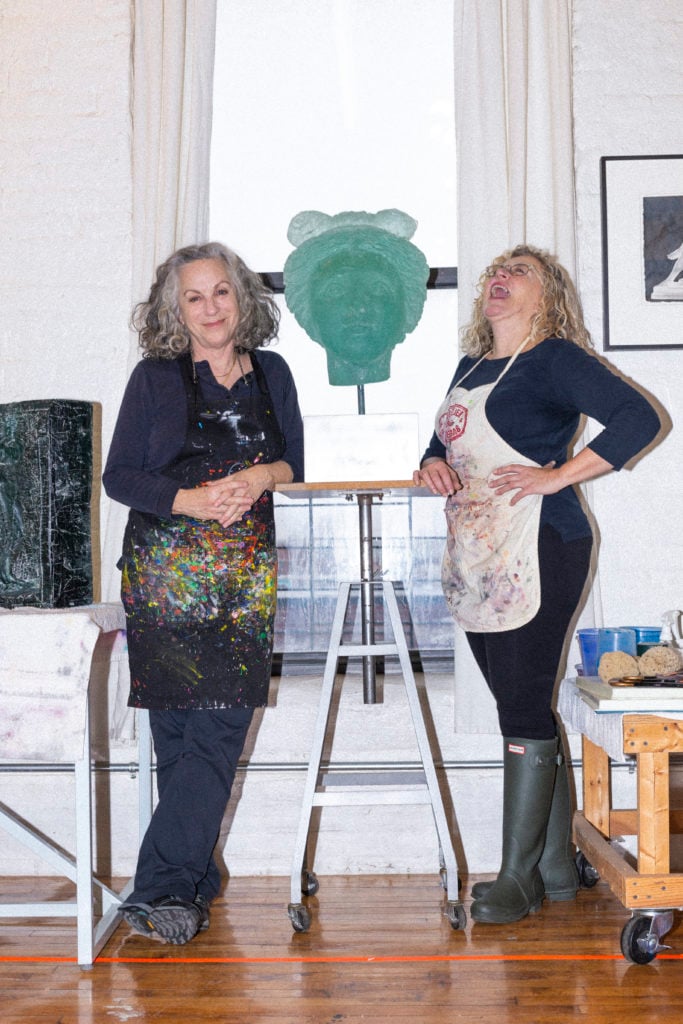
Cronin and Kass before Cronin’s glass
sculpture of an Aphrodite head. Photo courtesy Nicolas Bloise.
That’s great. What, in your view, were the most important
happenings in the art world this year?
Cronin: I think the Wangechi
Mutu sculptures in the little niches of the Met façade and Simone
Leigh’s Brick
House installation
on the High Line were both really important.
I think the national conversation about public
monuments is really one of the most important things to have
happened in the last 12 months. Women have been virtually absent in
public for so long, and everyone’s trying to change
that quickly now, to make up for all those centuries of not
having them there. And they’re tripping over themselves a little
bit, but the idea is right. The motivation is right, and the
intention is right.
Kass: And the anxiety is
right.
Cronin: That’s the burden of
representation!
Kass: I was just going
to say that. Those were my next words. But to be honest, Patti was
dealing with this in 2001 with her public
sculpture Memorial
to a Marriage. Whenever
she spoke about it, she’d say, “There are no real monuments of real
women in New York City.”
Cronin: There were only five.
There was a bust of [former Israeli prime minister] Golda Meir in
Midtown; Eleanor Roosevelt in Riverside Park, though she only got
installed in 1996; Joan of Arc by Anna Hyatt Huntington, also in
Riverside Park; and then Alice In Wonderland and Mother Goose, both
in Central Park. I’m also not talking about allegorical women like
Lady Liberty and all that, I’m talking about sculptures of real
women—and two of them are children’s storybook characters! So
everyone is anxious because they’re trying to get it right now.
That anxiety is great. At the same time, no one sculpture is going
to be the answer for hundreds of years of omission. It’s going to
take a lot more.
But you’re happy with how the conversation progressed this
year.
Cronin: Yes! Because back in
2001, when I made Memorial to a Marriage and commented on the paucity of women being
represented in public, I bought our burial plot in Woodlawn
Cemetery. When I give my lectures, I always tell my female-artist
friends, “If you want to make permanent public art, you’ve got to
buy the land.” And that’s not how it should be.
Kass: Except now I have a
permanent piece of public art in front of the Brooklyn
Museum.
Cronin: It’s
incredible.
Kass: It’s a riot, really. I
can’t believe the museum stepped up in such a great way. It’s
amazing, in fact.
What do you make of the reconfigured
MoMA?
Kass: We haven’t been there
yet.
Any thoughts without having gone?
Kass: My thought is this: I grew
up in that museum, and I was upset with the first renovation.
They’re now on the third. I never got over that Cézanne’s The Bather was moved in the first place, but I’ll adjust.
I haven’t seen it, though.
Patti, you’re a professor of art at Brooklyn College. What is
it like to be a professor at this critical moment in cultural and
political history?
Cronin: Teaching at a public
university in New York City, after teaching everywhere else, is
great. I walk onto that campus and it still feels like New York
City, which is really important.
Kass: And it’s filled with
people who aren’t dying under the burden of loans.
Cronin: Most of our
undergraduates are immigrants or first-generation Americans, or
first-generation college students. They’re adorable, they’re from
all over the world. They speak 180 languages. They’re incredible. I
teach everything from Drawing 1 to graduate seminars. It just feels
like the future is possible there, whereas at a lot of other places
it doesn’t. I can’t imagine being a young student at an art school
and leaving with $100,000 of student-loan debt. It’s criminal. So
that’s why the City Universities of New York are quite
special.
Looking ahead to the new year, what are you both working on?
And what are you hoping will happen or change in 2020?
Cronin: I can’t tell you where
it is, but I’m working on a major museum commission. And as soon as
I can say anything, I will. That’s my main event, but I’m working
on other projects as well.
Kass: The Tampa Museum of Art is
working on fundraising for your piece.
Cronin: Yeah. They commissioned
a monumental outdoor sculpture of Aphrodite. So they’re acquiring
that, which is incredible. I’m the inaugural artist in a new series
they’re doing called “Conversations with the Collection.” They have
a contemporary art collection and an ancient Greek and Roman
collection, and nothing really in between. So they’re asking
contemporary artists to respond to their antiquities collection to
bridge the gap.
Kass: I’m going to be having a
show with Kavi Gupta Gallery in 2020. That’s cool. I’m having a
show with Gavlak gallery in February. And I’m awaiting the end of
fundraising for OY/YO at the Brooklyn Museum, which will
be done soon. I’m awaiting a woman president. I’m waiting for
Hillary—Clinton-Harris. That’s my ticket. But it’s not going to
happen.

A close-up shot of Cronin’s reference
materials. Photo courtesy Nicolas Bloise.
Were you upset when Harris dropped out?
Cronin: Yes. I was really
surprised. Plus, I’d just given her money. [laughs]
Kass: I’d just bought something
from her store. She was having a sale. I should have
known.
Anyway, I hope, for the art
world, that women begin to make as much money as men. And I hope
that women artists have more prominent visibility.
Right. In Artnet’s Intelligence
report this year, we found that, despite all the recent hype
around major galleries and institutions promoting the work of women
artists, they only represent 2 percent of
the market. What do you think about that?
Kass: Oh yeah. I saved that
article as a PDF. We know that.
Cronin: When Tom Finkelpearl was
the commissioner of the New York City Department of Cultural
Affairs, he had all the institutions do
a study of how many people of color worked at the museums, and
at what level—you know, upper leadership or security guard? It was
a fantastic idea. When you do the same kind of study and ask, “How
many works by women do you own, and how many works by men do you
own?” it’s telling. If you have a $10 million Richard Serra, and
you have a photograph by Carolee Schneemann that she was forced to
donate to you, that is not an equal investment. So the women end up
in the works-on-paper and peripheral ephemera categories, and the
men end up with the monumental paintings and
sculptures.
Kass: And I don’t want to hear
about the three exceptions.
Cronin: There’s two ways to
solve it, I guess. Women have to make more money and want to see
their income-earning reflection in the culture, not just their
trophy-wife reflection in the culture. And the men need to be
retrained, or young men need to be educated better. I think if it
was equal financially, collections in museums would look really
different across all races, genders, and
everything.
I know what they should do! A
New York City museum should switch their acquisitions funding
around just for one year. They should switch the little fund for
the women’s committee with whatever they raise for the men’s
collections and then see what happens.
What made you both want to be an artist in the first place?
Are there any early artworks you can recall that informed your
passion?
Cronin: I won first prize at my
local library for an art contest for kids. I got to pick out a
hardcover book from the library—any one I wanted. You might as well
have told me I’d won a million dollars, you know? I grew up around
Boston, so the Museum of Fine Arts was my hometown art go-to and it
was really a privilege to be able to walk through an encyclopedic
museum at such a young age. All that art history just got imprinted
on me. I had such love for it, such awe. Like,
what are all these things? Who made them?
Kass: My best friend’s mother
was an art teacher at school, and she always says, “I take credit
for you.” I learned to draw from MAD magazine.
But Peanuts
was my first experience of great
art. Schulz was my first great visual artist. I wrote to him a lot.
I sent him drawings.
Did he write you back?
Kass: Oh, yes. I got six letters
from him.
Cronin: And one of them says,
“Thank you for the drawings. It’s so good that your teacher puts
them up! Keep it up, you never know where it might
lead.”
Kass: That particular letter is
in my Rizzoli book. It’s the sweetest thing. He kept all my
drawings, and he never sent them back. It was really special
because I was a very voracious culture vulture as a kid, with
really no support from my parents. I was completely on my
own.
Cronin: You used your
babysitting money to see art!
Kass: I did! And the good thing
is, my parents didn’t care that I got on a train and came to the
city.
Do you remember the first museum show that you saw?
Kass: My father would take us to
the Met when I was really little, and if you’re from the suburbs, I
think one of your first class trips is to the Egyptian art rooms.
So I was at the Met often. But I have a very distinct memory of
seeing Picasso’s Portrait
of Gertrude Stein—I was
a little kid—and being completely struck by this image of this
person and how different she looked from every other woman in the
whole collection. She looked like people I knew. It was really
important. It’s the first piece of art, outside of
Peanuts, that I identified with. [laughs] She was a
real person—not a lady, you know, with grapes.
Cronin: Right. I want to
identify with works like that again! I want to see more politically
risky art. I’m less interested in shiny, sparkly objects or, you
know…
Cronin: Exactly. And obvious
market darlings or people who are just printing money. That’s too
emblematic of what’s going on. I got really excited when that new
wave of freshmen senators got voted in during the midterm
elections, and the art world seems to not have been able to catch
up to that yet. At the same time, while people are saying, “Why
aren’t the artists doing more work?” the artists actually are. You
just have to look for the venues that present it to the public.
It’s really their responsibility to show new and different work.
And if they’d rather do shiny, sparkly objects it just holds up a
mirror to a whole bunch of values that I’m frankly not interested
in.

A detail from Cronin and Kass’s studio.
Photo courtesy Nicola Bloise.
What’s the purpose of art today?
Kass: I have nothing to say on
this.
Cronin: I think it’s the
artist’s job to look out, see the world—keenly, hopefully—and
reflect and respond. It’s the artist’s job to tell us what it’s
like to be you, now. But I want to see courageous work. I want to
be moved and provoked to think interesting things. I don’t want
wallpaper. If I want wallpaper, I’ll go to a wallpaper
store.
Kass: Ooh!
Do you think you’ll see that kind of work in the near
future?
Cronin: Oh, I’m not a cultural
curator. That’s on the venues. My job is to make the best, smartest
work I can.
Finally, what’s the most important thing you’ve learned from
each other?
Cronin: Don’t give up. March to
your own drummer.
Kass: Don’t be a [jerk]. That’s
one of my favorites.
Cronin: Yeah, but you didn’t
learn that from me.
Kass: No, I didn’t. I learned
that from life. I learned that from [jerks].
Cronin: But really, I think the
main thing I’ve learned from her is to stay close to that inner
core of steel within you. I try not to be distracted by the market
or auction houses or things like that, and just try to aim really
high and remain focused. What about you, Deb? What’s something
you’ve learned from me?
Kass: How to follow a
recipe?
Cronin: Actually, you haven’t
learned that yet.
Kass: I’m
trying.
The post ‘She Was Brave, Like Me’: Deborah Kass and Patricia
Cronin on How Politics Sparked Their Romance, and the Art They
Crave to See appeared first on artnet News.
Read more https://news.artnet.com/art-world/kass-cronin-art-and-modern-love-1732572
Further reading


Leave a comment