
Thanks to an Old Photograph, an Explorer Believes He Can Solve the Mystery of Amelia Earhart’s Disappearance Once and for All
The fate of Amelia Earhart is one of history’s great
mysteries—but it might be solved soon.
Explorer Robert Ballard, who found the wreck of
the Titanic and the Nazi battleship
the Bismark, believes he can crack the case thanks to
a photograph that provides a tantalizing clue as to what may have
become of the great aviatrix.
“It’s not the Lock Ness Monster; it’s not Big Foot,” Ballard,
77, who is co-leading an underwater expedition with fellow explorer
Allison Fundis, told National
Geographic. “That plane exists, which means I’m gonna find
it.”
Earhart disappeared in July 1937, while attempting to become the
first woman pilot to circumnavigate the globe. The prevailing
theory—and the one put forth by the US Navy—is that Earhart and her
navigator, Fred Noonan, crashed into the Pacific Ocean en route
to Howland Island during the third-to-last leg of their
planned 29,000-mile flight.
But in 2012, Ballard was shown a photo taken by Eric Bevington,
a British officer, in October 1937, three months after
Earhart’s disappearance. It pictures Nikumaroro Island, one of
the Pacific’s mostly uninhabited Phoenix Islands, part of the
Micronesian nation of Kiribati. A tiny speck poking out of the
water on the edge of the photo, known as “The Bevington Object,”
is believed by some to be the landing gear of Earhart’s plane, a
Lockheed model 10-E Electra.
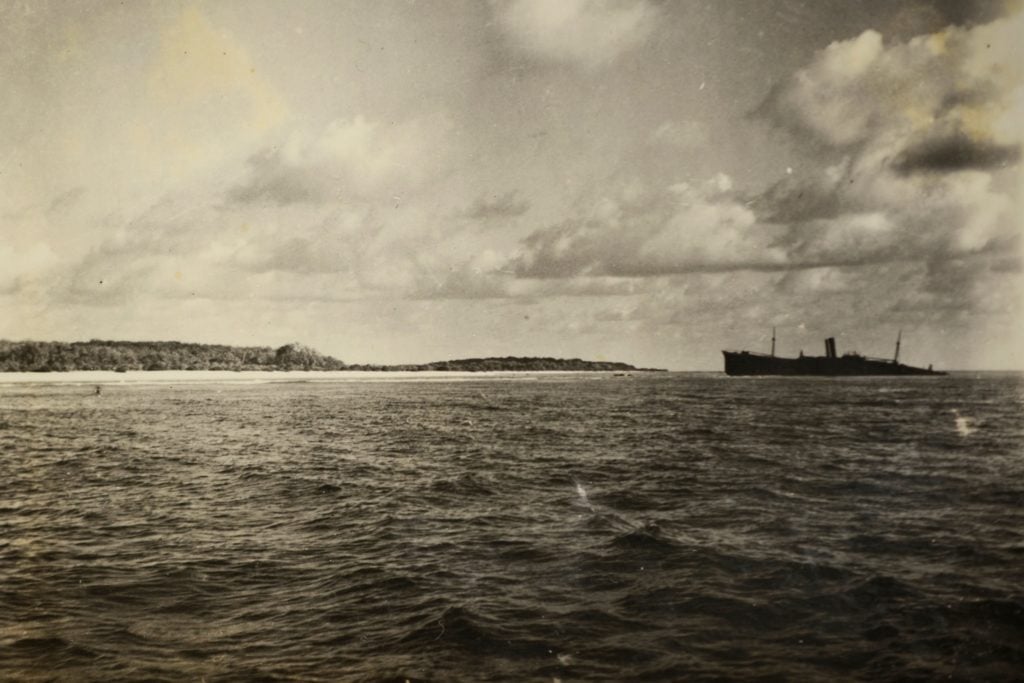
Eric Bevington took this photo of
Nikumaroro Island in October 1937. “The Bevington Object”
poking out from beneath the waves at the edge of the photo may be
the landing gear of Earhart’s plane, a Lockheed model 10-E Electra.
Photo courtesy of TIGHAR/Jeff Glickman.
The photo was first dug up by the International Group for
Historic Aircraft Recovery, or TIGHAR, in 2010, as part of
their Earhart
Project research. In order to enhance the blurry speck on
the old photograph, TIGHAR’s Jeff Glickman, a forensic imaging
expert, reached out to the government for help. The image ended up
at the National Geospatial-Intelligence Agency, which employed
classified technology to better see what Bevington had captured
with his lens. An independent review by intelligence analysts at
the Pentagon agreed with TIGHAR’s conclusion that the indistinct
object looked like the plane’s landing gear.
Based on the location of Earhart’s last confirmed transmission,
it’s possible that she missed Howland Island and continued some 350
miles to the southeast to Nikumaroro, which would have been on her
stated navigational line. It would have been an especially low tide
that day, allowing her to land on a strip of sandy beach on the
atoll, which measures just 4.5 miles long and one mile wide. Over
the next few days, 37 radio transmissions that could have been from
Earhart were received.
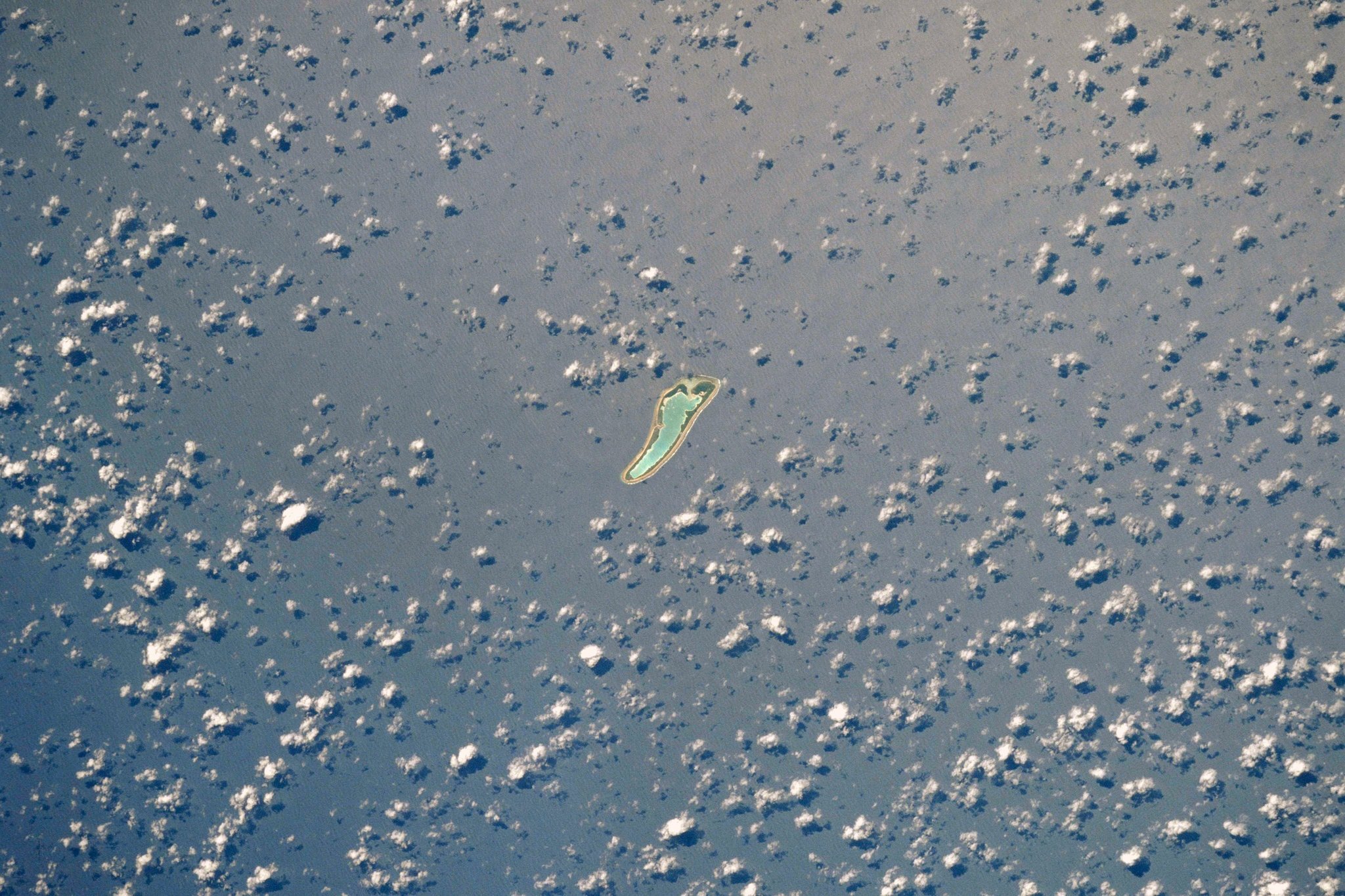
Nikumaroro Island, where Amelia Earhart
may have landed her plane during her ill-fated circumnavigation of
the globe. Photo courtesy of NASA.
By the time Bevington, the photographer, arrived three months
later, the rising waters could have submerged the plane. Nikumaroro
sits atop a 10,000-foot-tall underwater mountain, and the Electra
may have gradually slid all the way down the slope. During the
Navy’s search of the Phoenix Islands later that year, a pilot noted
signs of recent habitation on Nikumaroro Island, but no one
followed up, not realizing no one had lived there in 40 years.
A skeleton was found in Nikumaroro in 1940, but experts believed
it belonged to a man due to the long length of the arms. In 2016,
TIGHAR presented forensic
analysis of photographs of Earhart showing that her arms
were longer than average for a woman. The organization
believes that the skeleton, found alongside a woman’s mirror,
buttons from a flight jacket, and a jar of Earhart’s favorite
anti-freckle cream, is evidence that she died as a castaway on
the remote island.
There are many other theories as to what fate befell Earhart. In
2017, the History Channel documentary Amelia Earhart: The
Lost Evidence offered up a photo that appears to show
two Caucasians, one male, one female, in the Marshall Islands. The
documentary claimed that the image, found in the National Archives,
suggests that Earhart was taken captive
by the Japanese government, and died a prisoner—and that the US
government covered it up.
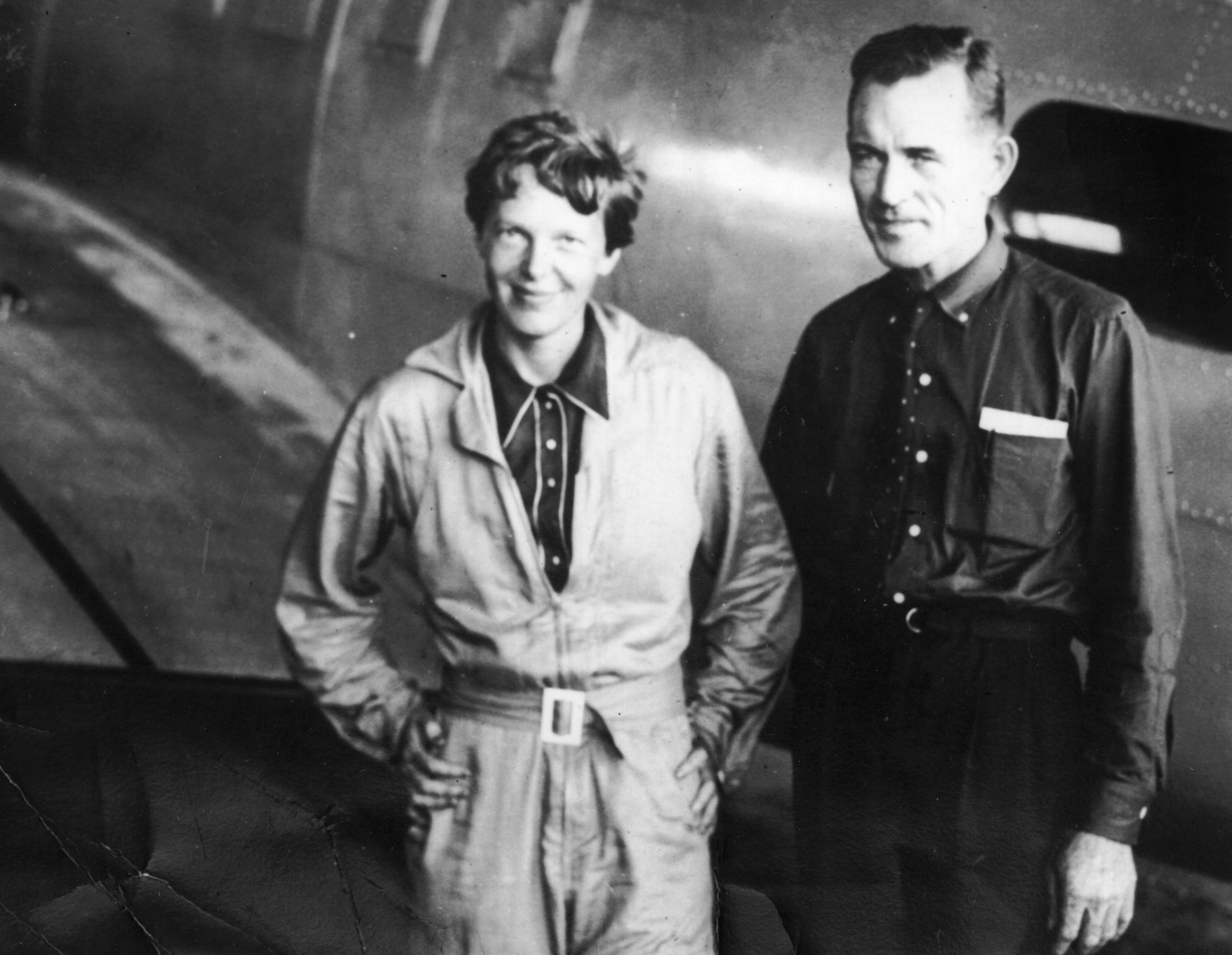
American aviatrix Amelia Earhart with
her navigator, Fred Noonan, in the hangar at Parnamerim airfield,
Natal, Brazil, June 11, 1937, shortly before their disappearance
during their attempted circumnavigation of the globe. Courtesy of
Topical Press Agency/Getty Images.
In support of its Nikumaroro theory, TIGHAR has led 13
expeditions to the island, including underwater dives. But the
group has never had access to the kind of technology Ballard and
his funders at the National Geographic Society have at their
disposal.
Equipped with a state-of-the-art ship outfitted with
drones, a multi-bear sonar, an autonomous surface vehicle (a kind
of robotic boat), and two remotely operated underwater vehicles
with high-def cameras that can dive nearly 20,000 feet under the
surface, the E/V Nautilus is poised to finally
recover the wreckage of Earhart’s plane.
The results of their findings will be broadcast in a documentary
set to air on National Geographic on October 20.
The post Thanks to an Old Photograph, an Explorer Believes
He Can Solve the Mystery of Amelia Earhart’s Disappearance Once and
for All appeared first on artnet News.
Read more https://news.artnet.com/art-world/amelia-earhart-disappearance-may-finally-solved-1623889
Further reading


Leave a comment