
The 1918 Spanish Flu Wreaked Havoc on Nearly Every Country on Earth. So Why Didn’t More Artists Respond to It in Their Work?
More than a century after it
killed upwards of 17 million people around the world, the 1918 flu
pandemic, also known as the Spanish flu, has come charging back
into the public consciousness. The disease—the most devastating of its kind in
modern history—bears some eerie similarities to COVID-19,
especially in its person-to-person transmission and global
impact.
Yet in the annals of cultural
history, the flu of 1918 is little more than a historical
footnote. There are few
obvious depictions of the disease in canonized art and literature,
and the images it recalls are not as vivid as those that followed,
say, the AIDS crisis.
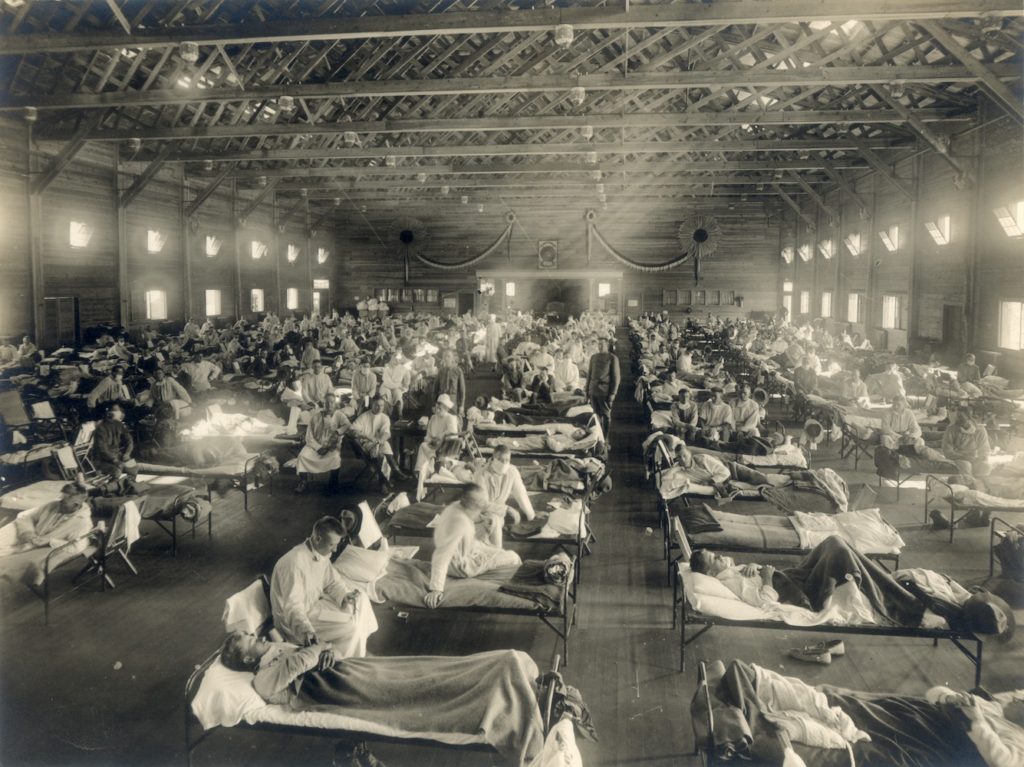
Emergency hospital during influenza
epidemic, Camp Funston, Kansas,” probably early 1918. New
Contributed Photographs Collection, Otis Historical Archives,
National Museum of Health and Medicine.
“If you close your eyes, the
iconography doesn’t immediately flood over you in the way that it
does with war or other historical events,” says curator Trevor
Smith, a curator at the Peabody Essex Museum and the co-curator of
an exhibition on the Spanish Flu held last year at the Mütter
Museum in Philadelphia.
“Millions of people lost their
lives around the world, and it’s hard to even wrap your head around
that,” he says. “There haven’t been many monuments or memorials to
the people who died in that pandemic.”
Though it was conceived as
something of a specialized exhibition at a niche medical history
museum, his show, “Spit Spreads
Death,” has gained
newfound resonance as people look to draw lessons from the Spanish
flu.
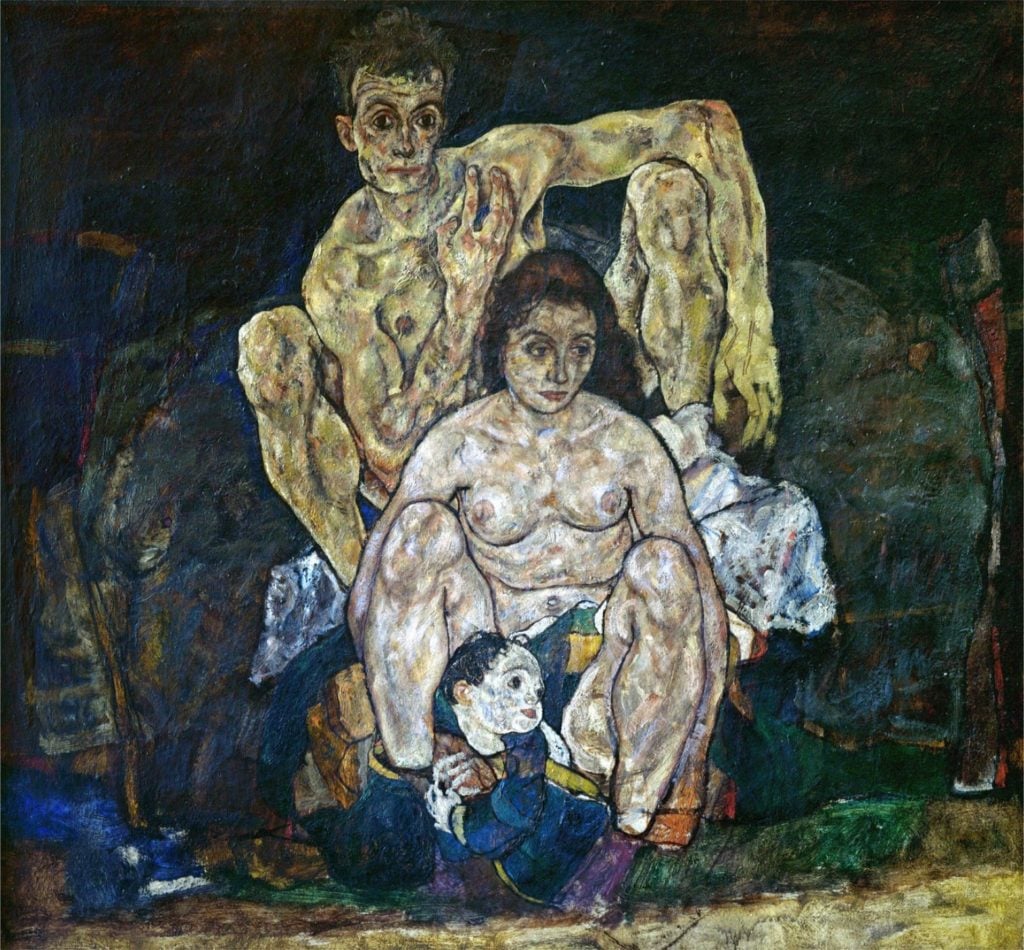
Egon Schiele, The Family
(1918).
The Spanish Flu’s Meager Cultural Legacy
So why was the Spanish flu so long forgotten?
The most commonly cited reason
is World War I. The flu took hold in January of 1918, about 10
months before the war ended. And though the highest estimates for the number of
dead from the disease (around 50 million) outnumber the high
estimates for how many were killed in the war (around 40
million), the
far-reaching political and social implications of the global
conflict have taken precedence in the macro-history of the 20th
century.
Artists, too, were more drawn to
depictions of the war. Marsden Hartley’s Portrait of a
German Officer (1914); John Singer Sargent’s Gassed
(1918–19); and portfolios by Otto Dix (The War,
from 1924) and Kathe Kollwitz (Krieg,
from 1921–22) speak to an almost universal fascination with
the cataclysmic impact of the war.
But when it comes to the Spanish
flu, there are only a few notable artworks recording its
existence. Edvard Munch, one
of the most recognizable names to have been infected, was
fascinated by the disease because it drew out
his long-term
fascination with terminal illnes. He made two noteworthy depictions
of the flu’s effects: the disquieting Self-Portrait
With the Spanish Flu (1919) and the more macabre Self-Portrait
After the Spanish Flu (1919–20).
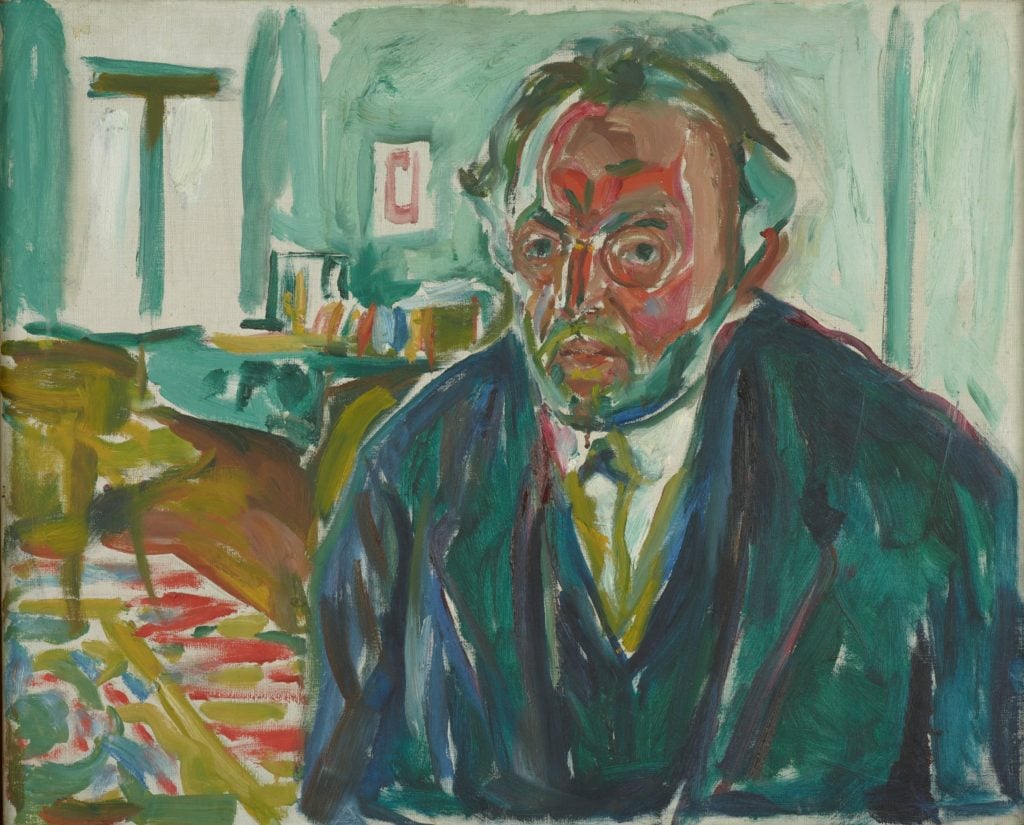
Edvard Munch, Self-Portrait After the
Spanish Flu (1919).
Then there’s Egon Schiele’s 1918 painting, The Family,
which depicts the artist, his wife, and a baby. It was never
finished: Schiele and his spouse died from the flu before he could
complete the work.
“Schiele was at the peak of his career in 1918,” says
Jane Kallir, director of
the Galerie St.
Etienne and the author
of Schiele’s catalogue
raisonné. “He had his
first really successful exhibition in March of that year, his wife
was pregnant with their first child, and he had rented a big studio
in the summer. He was doing well. Then he was just
gone.” (Indeed, the disease often killed patients very
quickly, sometimes just three days after they began exhibiting
symptoms.)
So while the list of canonized
artworks is small, so too is the list of notable
deaths. Besides
Schiele, one of the only other notable artists to die in the
pandemic was the American Precisionist Morton
Schamberg. Guillaume
Apollinaire, the French poet, art critic, and champion of Cubism
also died from the disease, and Gustav Klimt was another possible
victim: he suffered a stroke and contracted pneumonia prior to
the full onset of the flu, and died in February 1918.
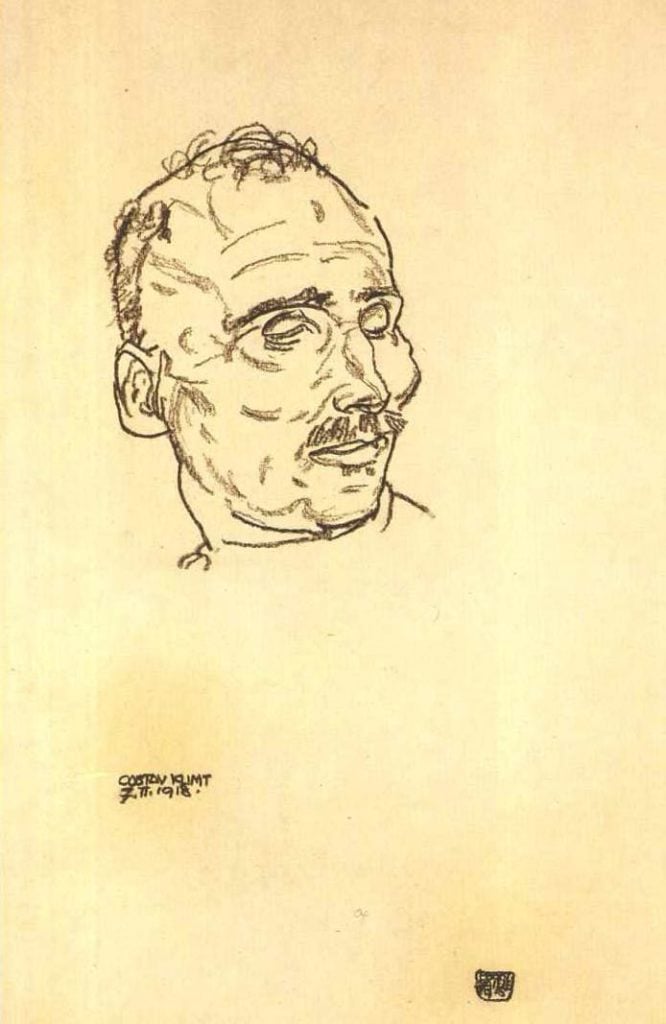
Egon Schiele, Gustav Klimt on his
death bed (1918).
“He was 56, his habit was to
have a bowl of whipped cream for breakfast every day, and he was
seriously overweight,” Kallir says wryly of Klimt.
“So there were underlying
conditions there.”
There’s a reason the Spanish flu
did not kill many prominent artists, and it has to do with one of
the key distinctions between it and COVID-19.
“The 1918 pandemic, as opposed
to the coronavirus today, was that it was a disease of youth,”
Kallir says, noting that people between their late teens and
mid-30s were those most susceptible. “A lot of people who were lost
to that disease died before they ever had a chance to achieve
anything.”
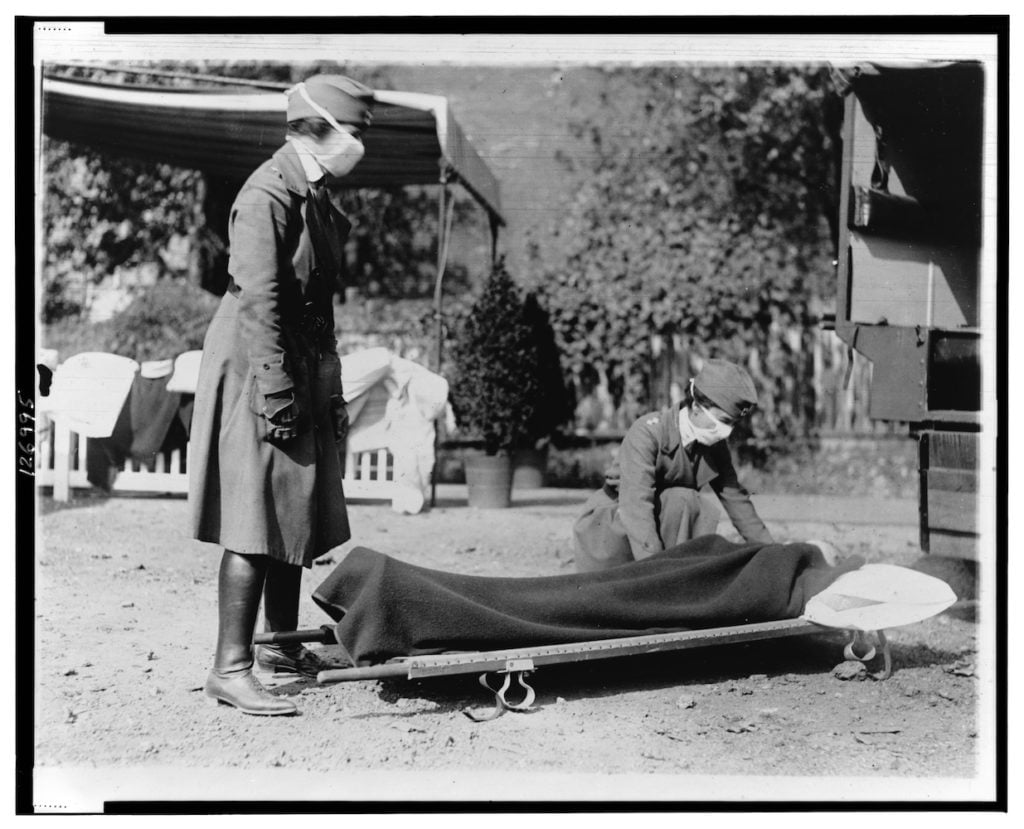
A demonstration at the Red Cross
Emergency Ambulance Station in Washington, D.C., during the
influenza pandemic of 1918. Courtesy of the National Photo Company
Collection, Library of Congress Prints and Photographs
Division.
The Connection to Today
For “Spit Spreads Death,” Smith
and his team commissioned a collective called Blast Theory to
conceive of a new work to commemorate the Spanish flu.
Their solution was to organize a
500-person parade, which took place on Broad Street in Philadelphia last September.
Marchers held up signs with the names of victims and healthcare
workers who died during the pandemic in reference to a parade of
200,000 people that took place in the city in 1918, which
greatly exacerbated the
number of cases in the city and led to an untold number of
deaths.
When the performance took place,
Smith says he reflected on “just how lucky we were to not be facing
that crisis.” Now the situation is quite different.
But Smith—who happened to travel to Wuhan last December (though
he did not contract the coronavirus)—says he is unsure how new art
will reflect the current pandemic.
“Every period has produced works
of art that have moved us in different ways, and I have no reason
to think that this period will be any different,” he says. “I just
think it’s too early to zero in on them.”
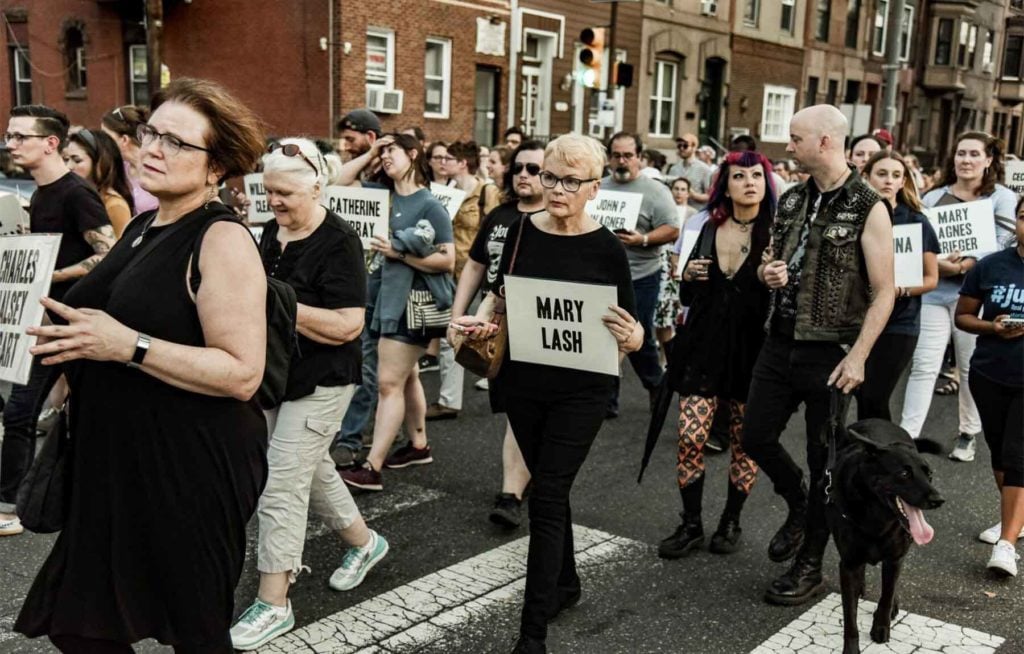
A parade honoring the victims of the
Spanish Flu in Philadelphia, September 2019. © Blast Theory. Photo:
Tivern Turnbull.
Kallir says much the same,
noting that there are far more questions than answers right
now.
She does, however, offer one
bold perspective.
“I am not sure this is going to
accelerate the dominance of the mega-galleries and the mega-artists
and the mega-wealthy,” she says. “Are we going to have an appetite
for a big silver Jeff Koons bunny after this?”
The post The 1918 Spanish Flu Wreaked Havoc on Nearly Every Country
on Earth. So Why Didn’t More Artists Respond to It in Their
Work? appeared first on artnet News.
Read more https://news.artnet.com/art-world/spanish-flu-art-1836843
Further reading


Leave a comment