
The Art World Has Agonized Over Its Reliance on Airplanes. But That’s the Wrong Way to Think About Reducing Carbon Emissions
I recently attended a session on climate change during a London
“unconference”—a meeting that’s led by its participants—on the
theme of the “Future of the Art Market” in the UK.
One provocation gained traction early: that the art market has a
responsibility to minimize its carbon emissions by reducing airline
freight miles traveled as a result of hosting and attending
exhibitions.
Someone floated the proposition that we replace the shipping of
physical works of art with virtual exhibitions. Using augmented
reality to broaden the accessibility of artworks is a wonderful
idea, and already one gaining traction among a number of early
adopters. Virtual shows offer not only high-quality replications,
but also entirely new immersive experiences. Plus, content can be
delivered to smaller cities and museums that may not be able to
financially support larger exhibitions.
But the group was more excited by the notion that replacing
physical art shipments with virtualized experiences could reduce
carbon emissions, rather than creating new and more accessible
experiences. Given the climate emergency, their view was to pursue
any and all discretionary savings of carbon possible.
Superficially, that may appear to be a successful thought
exercise. But I disagree. The percentage of carbon emissions caused
by art-industry air travel is infinitesimally small—and our
activist efforts would be far better spent elsewhere.
To successfully change industries, we must first understand the
costs to all participants in a market or ecosystem. Global
populations moving from traditional cars to electric cars, for
example, may cost Germany $20 billion a year and impact 1 percent
of the country’s labor force. While it’s easy to reduce one’s
personal emissions by buying an electric car, millions of people
buying electric cars change employment markets. And these
disruptions echo into entire societies.
In a well-intentioned quest to reduce carbon emissions, the
unconference group not only incorrectly estimated the carbon
savings from reducing art miles, but also failed entirely to
account for any greater implications. They shifted responsibility
for managing carbon emissions from governments and consumers, into
the art market value chain itself. They would increase burdens on
artists, galleries, and other players in the value chain to the
point of potentially removing those players altogether. And the
result of reducing physical art shipments around the world is
unlikely to cause a significant decrease in emissions.
The True Carbon Cost of Shipping Art
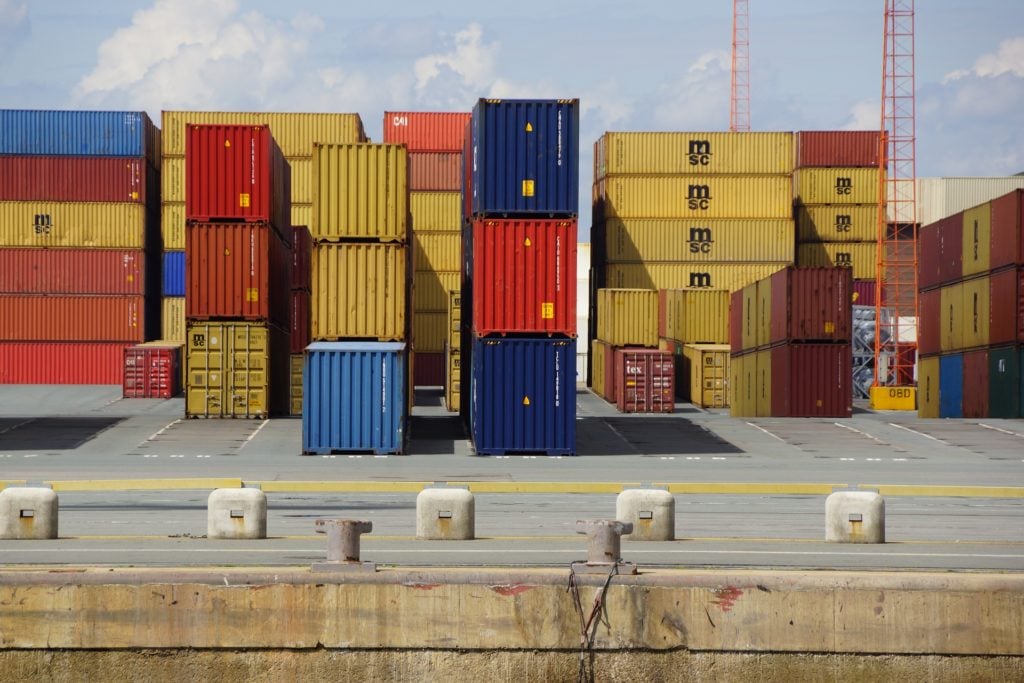
How much does air freight shipping
contribute to climate change? Photo: Creative Commons.
When I asked the group what percent of overall emissions the
aviation sector as a whole represents, the general response was 20
percent, which is fairly typical. Then when asked what share of
that was air freight, the response was about half. Meaning, air
freight generates 10 percent of total global carbon emissions in a
given year. The actual numbers on air traffic contributions to
annual carbon emissions is an order of magnitude less than those
assumptions.
Airline traffic as a whole generates 2 percent of global carbon
emissions. The reason people tend to assume air travel contributes
greater emissions has to do with the visibility of airplanes in our
lives (what’s known in psychology as availability bias). Consumers,
it seems, are much more aware of aircraft—a minor contributor—than
of the much greater impacts of energy and heat produced for cities,
buildings, and ground transport, which are the greatest
contributors.
Air freight accounts for between 7 to 10 percent of total air
traffic. Therefore, air freight may produce a total of about .2
percent of global carbon emissions—50 times less than the heuristic
estimate.
The International Air Transport Association estimates that it
ships five to six million tons of air freight. If all 40 million
pieces of art sold a year were 13.3-inch-square canvases and
packaging weighing an average of 26 pounds were shipped via air
freight, that would be 520 tons, or .9 percent of total air
freight. Air freight is 10 percent of total air traffic and air
traffic is 2 percent of global emissions. Therefore, one could
estimate moving the entire annual art market by air freight would
create .00184 percent of total global carbon emissions. And, given
that only a subset of global transactions will actually ship by
air, the total actual annual carbon contribution from shipping art
continues to collapse to an infinitesimal number.
So why do so many art professionals amplify carbon contributed
by art air freight from an infinitesimal amount into one of the
preeminent issues facing the global art market?
The Proof Is in the Pasta

The pasta eater, by unknown artist, 19th
century. Museo Nazionale delle Paste Alimentari, Rome Italy. Photo
by Leemage/UIG via Getty Images.
We need to look instead at what is known in sustainability as
“lifecycle costing,” which accounts for all the carbon created in
the production, distribution, and consumption of a product. In
2010, a UK grocery store attempted to reduce the total carbon
emissions of a major staple product line—dry pasta. The company
assessed emissions at different stages of the product’s life,
including production, distribution, and consumption. Distribution
produced a minor fraction of the total carbon footprint. The
majority of carbon was produced growing wheat, and at the moment of
consumption: boiling water to cook the pasta.
The impact of carbon generated by dry pasta has been reconfirmed
over the last decade, most recently in a 2019 study in Italy.
Distribution of locally produced pasta generated less than a half
pound of CO2—7 percent of the product’s total carbon
emissions. Distribution of globally-produced pasta generated .67
pounds of CO2—10 percent of the product’s total carbon
emissions. And distributing pasta from global markets generated 40
percent more carbon than local markets on an absolute basis.
However, locally produced created 6.5 pounds of carbon total,
whereas pasta from global markets created 6.3 pounds of carbon—2
percent less carbon.
While pasta from global markets generated 34 percent more carbon
in the distribution phase on its life, in the process overall,
pasta from foreign markets generated less carbon. Even though they
traveled further, those products were more efficient in other
lifecycle stages. Finally, regardless of sourcing locally or
globally, production and consumption together represented over 80
percent of total carbon generated. In terms of carbon, distribution
costs—or savings—were comparatively irrelevant.
Why had both consumers and the grocery store singled out
distribution as the obvious point of carbon savings, when it turned
out to be one of the most minor contributors? The same reason that,
a decade later, a group of art professionals in London arrived at
the same answer for the art market: Both groups amplified the
negative contribution of the lifecycle costs they valued least—and
reduced the contributions from the costs they valued
most. With art, as with pasta, the greatest carbon emissions
come from the last stage—consuming it.
Where to Refocus Our Energy
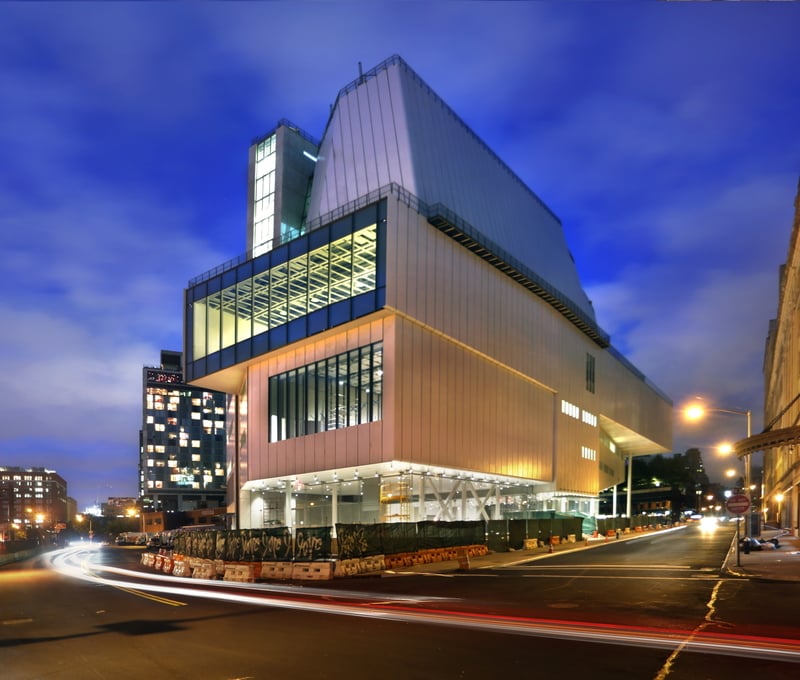
The Whitney Museum of American Art’s new
building became the city’s first LEED-certified art museum. Photo:
Ed Lederman.
When it comes to the art market, the reality is that venues and
audiences produce the vast majority of emissions. Reducing the
total carbon emissions of art consumption requires reducing
emissions of built environments—our buildings, climate control
systems, energy generation sites—and transportation. These are the
domains of consumers and governments.
As beauty is created by the beholder, so, as it turns out, are
the majority of carbon emissions. We must reduce carbon emissions,
but we must not unfairly dismiss our responsibilities as citizens
and consumers, using collective cognitive biases as justifications
to encumber simple activities like the art market’s use of air
freight. Given the intertwinement of fossil fuels in human society,
we cannot simply judge carbon emissions as good or bad. We must
continuously interrogate the benefit of carbon emissions versus
costs, and we must ensure the numbers are right.
As the coronavirus now closes borders to human travel, we must
be aware, in some cases, that pandemic-related border closures may
serve agendas and intentions that were otherwise frustrated.
Borders may not reopen as quickly as they were closed. If we as
individuals are to be increasingly be restricted in our movement,
we must ensure freedom of movement for our ideas, whether as
digital manifestations or as physical objects. This may well mean
shipping more art, not less.
Like pasta, the majority of carbon emissions of art lie beyond
distribution. Unlike pasta, where the majority of environmental
impacts are split between agriculture and cooking, the majority of
environmental impacts from art lie in its consumption, whether
jet-setting to art fairs, or cooling, heating, and lighting
national galleries with fossil-based fuels. Where the art world can
direct its well-intentioned climactic energies does not have to do
with the art itself at all, but rather with designing
buildings.
In 2016, the engineering firm Arup showed that the built
environment generates 40 percent of human carbon emissions. This
includes audiences attending exhibitions and related contributions
from hosting both artworks and audiences in climate-controlled
facilities.
Efficiency is a first totem of sustainability. Consume less
energy. Then shift remaining consumption from fossils to
renewables. We can maintain or even increase art air miles and
reduce lifecycle carbon footprints—meaning we can share and sell
more—if we also reduce the energy footprints of galleries, studios,
warehouses, and the other spaces we use. These building energy
footprints are both much higher impact and also invisible compared
to air traffic. Seeing that clearly, as it turns out, makes all the
difference.
The post The Art World Has Agonized Over Its Reliance on
Airplanes. But That’s the Wrong Way to Think About Reducing Carbon
Emissions appeared first on artnet News.
Read more https://news.artnet.com/opinion/climate-change-op-ed-1833852
Further reading


Leave a comment