
The Gray Market: A Guide to How the $2 Trillion Rescue Bill Can Help America’s Art Sector—and Where It Falls Short (and Other Insights)
Every Monday morning, Artnet
News brings you The Gray Market. The column decodes important stories from the
previous week—and offers unparalleled insight into the inner
workings of the art industry in the process.
This week, using art and
business to check in on national mythology…
BILL ME NOW
On Friday, the United States
passed a $2 trillion emergency spending bill in an effort to
support individual citizens and families, businesses of all types
and sizes, state and local governments, and a healthcare sector all
facing an unprecedented medical and economic crisis. But in the
context of this gargantuan rescue measure, the aid delivered to the
cultural sphere and small businesses alike illuminates a larger,
more uncomfortable reality about the American
Dream.
Known as the CARES Act (you can
guess what the “c” stands for, but the rest is Aid, Relief, and
Economic Security), the legislation represents the most robust
government stimulus in US history, roughly doubling the size of the
economic rescue package ratified in response to the 2008 financial
crisis. If you’re wondering
how much of this cash monsoon specifically irrigated an
art system under
siege, though, you’re
probably going to be disappointed. Even the most generous possible
framing of cultural funding in the CARES Act delivers a sum just
north of $300
million—and that figure
would include a combined $125 million headed to the Corporation for
Public Broadcasting and the Institute of Museum and Library
Services (the latter to beef up free internet
access).
Setting those elements aside,
the core of the arts component is a tepid $150
million to be split
evenly between the National Endowment for the Arts and the National
Endowment for the Humanities. The bill also funnels another $25
million to the Kennedy Center and $7.5 million—cumulatively—to the
19 museums comprising the Smithsonian Institution. For comparison,
these line items together total a few million dollars less than
the £160 million ($190
million) relief plan passed by Arts Council England earlier the same
week. And they are microscopic in comparison to the $4 billion in
assistance for US cultural institutions advocated by the
American Alliance
of Museums, as well as
the Metropolitan Museum of Art’s #CongressSaveCulture initiative.
Yet this was still far too much
dedicated cultural aid for former UN ambassador and South Carolina
governor Nikki Haley, who performatively rage-tweeted that this
money could have gone to “people” instead.
These are the items included in the stimulus
bill:
$75 mill for public television/radio
$25 mil for the Kennedy Center
$75 mil for the Natl Endowment for the Arts
$75 mill for the Natl Endowment for the HumanitiesHow many more people could have been helped with this money?
— Nikki Haley (@NikkiHaley) March 26, 2020
Which begs the question: Does
Nikki Haley think that institutional collections come alive when
the doors are closed and take care of themselves like
Night at the
Museum? Or that
nonprofit staff members and public-broadcasting personalities are
unpaid apparitions? In other words, does she believe art and media
are literally
magic?
The answer, as my
colleague Ben Davis deftly
unpacked, is “of course
not.” He rightly identified Haley’s tweet as the latest example of
a longstanding “Pavlovian reflex for conservatives” that aims “to
distract from giveaways to
corporations and rich people by framing the real problem as lazy cultural
elites living off the fat of government subsidies.”
So it is with great pleasure
that I break down how the CARES Act actually injects billions more
dollars into the cultural sphere than the aforementioned $300
million or so specifically earmarked for nonprofits—but also,
distressingly, why the bill proves just how correct Davis is about
the political head-fake at work.
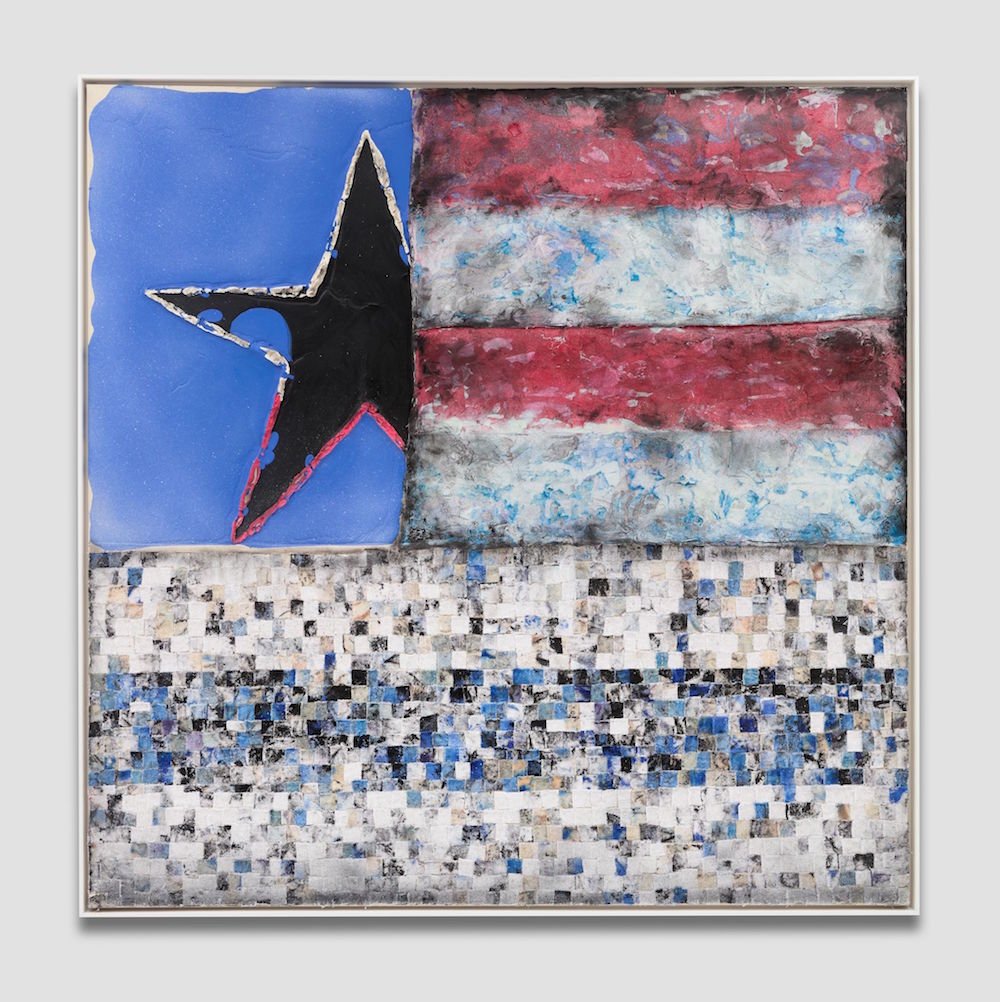
Vaughn Spann, Untitled (Flag)
(2019). Photo by Matt Kroening. Image courtesy of the artist and
Almine Rech, New York.
TO THE RESCUE
Not surprisingly, the CARES Act
is a legislative labyrinth. The full text swells to 880 pages. The
most sober-minded, comprehensive, and readable analysis of it that
I’ve found comes courtesy of Josh Bivens and
Heidi Shierholz at the Economic Policy
Institute, a nonpartisan
think tank that has been advocating for low- and middle-income
workers in the US since 1986. And their summary does contain plenty
of good news for artists, gallery owners, and cultural workers of
all kinds.
I’m going to try to break out
that good news into the simplest, most scannable format I can. I’d
advise everyone who might qualify for any of the below to check the
full details in the final version of the bill, which already
underwent some changes from the draft Biven and Shierholz reviewed.
(I’ve adjusted where possible.)
1. $360 Billion for Small Businesses
How It Works: This bucket
of cash takes the form of low-interest loans, but those loans can
be forgiven if employers keep their staff on payroll, and at the
same pay levels, throughout the downturn.
Who’s Eligible in the US Art World: Every for-profit and nonprofit business with
fewer than 500 employees, theoretically meaning nearly all
galleries, self-employed artists, art-services companies, and
cultural nonprofits.
Caveats: Applicants must
be able to demonstrate they’ve taken a financial loss during the
social-distancing era, which may be difficult given the irregular
nature of sales and payments in the industry. And while
almost all banks
and private lenders can provide the loans, they still involve some processing by the US
Small Business Administration—a hurdle I’ll come back to in a
bit.
2. $300 Billion in Direct Payments to Households
How It Works: The federal
government literally is just sending Americans a onetime check or
direct deposit for up to $1,200 per person and $500 per
child.
Who’s Eligible in the US Art World: Almost everyone!
Caveats: To receive a
payment, you must have filed a federal tax return in either 2018 or
2019. Bivens and Shierholz estimate that 30 million Americans have
not done that, in many cases because their income was so low that
they were not required to. (I suspect more than one artist reading
this can relate.) This creates the somewhat ghoulish prospect that
many people who are already struggling financially will have to do
their taxes in the midst of a historic public-health disaster
before they can get this assistance.
3. $250 Billion in Expanded Unemployment Insurance
How It Works:
Functionally, it’s the same program of joint federal-state payments
made to people who have lost their jobs through no fault of their
own, only augmented in a few refreshing ways. Chief among them:
Instead of covering only about half of lost wages, the payments
will cover nearly 100 percent of the value, and can be received for
as long as the next four months.
Who’s Eligible in the US Art World: Anyone laid off since the start of the crisis
or furloughed by an employer that was forced to temporarily close
(think: galleries, museums, other nonprofits). But for the first
time, freelancers and gig workers can also qualify through a
special emergency provision, opening up the program to a whole host
of ad-hoc art installers, studio assistants, and others.
Additional Details: On
top of the usual unemployment-insurance payments (which they have
been shut off from in the past), freelancers and gig workers are
also eligible for an additional $600 per week. Bivens and Shierholz
assert this tweak replaces “essentially” full wage income for the
bottom half of the American workforce—and, I’m guessing, an outsize proportion of
arts and cultural workers.
Caveats: Not all gig
workers may be eligible, and the determining factors are still
hazy, according to John Cassidy in
the New
Yorker. Americans in
need also still have to apply with their respective state’s
unemployment office (all 50 links accessible
here) and meet the
accompanying requirements for wages and time on the job, which may
not cover everyone.
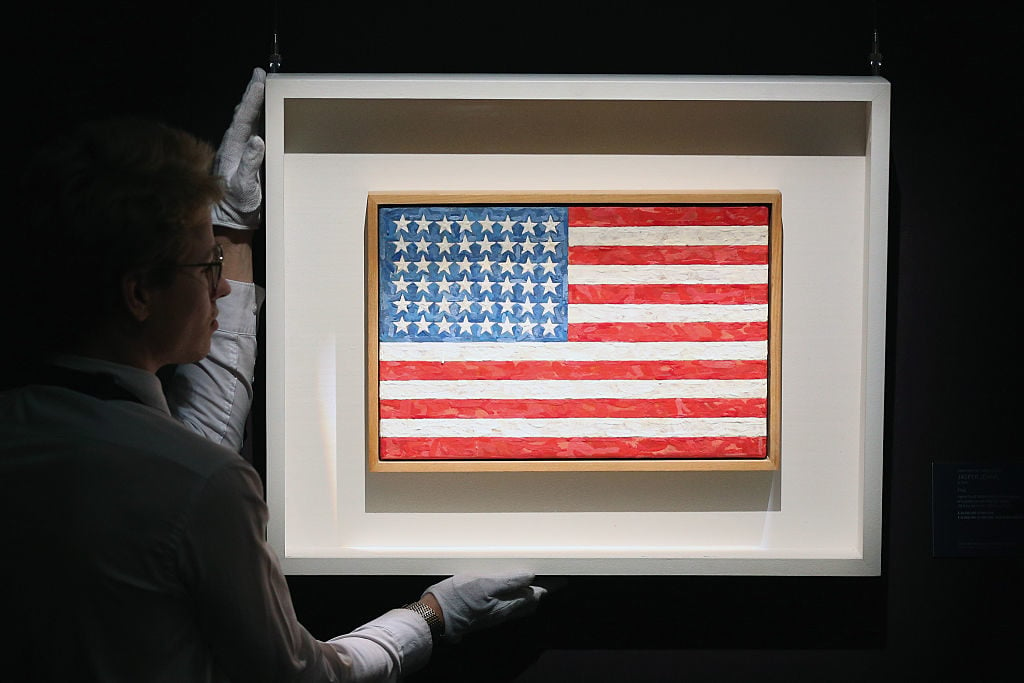
A Sotheby’s employee poses with Jasper
Johns’s Flag. Photo by Carl Court/Getty Images.
Now, of course, millions of
workers in dozens of other industries will also be receiving some
of this money. Still, these three programs give thousands of
artists, art workers, and art-business owners a share of around
$910 billion in aid. Imagine Nikki Haley’s reaction to that
concept, given that the measly $300 million earmarked for arts and
media nonprofits made smoke pour out of her ears like a cartoon
villain.
This last point clarifies a
too-easily-overlooked flaw about the default American attitude
toward the art industry: like many other sectors celebrated by
politicians of all stripes, it is built on small businesses and
entrepreneurship. It’s just that the product—whether it’s an artwork, a museum experience,
or a nonprofit program—is
niche, and the value doesn’t always translate to spreadsheets. (I
will spare you Andy Warhol’s overused mantra conflating good art
and good business, because every time an art writer uses it, a
butterfly gets sucked into an airplane propeller. To my colleagues
in the field: please think of the butterflies.)
But although the CARES Act
verifies that art is a fundamentally entrepreneurial sector of the
economy, it also clarifies that, even in its most hyper-capitalist,
non-art manifestation, the bootstrapping striver is no longer at
the center of the American value system—and has not been for some time.
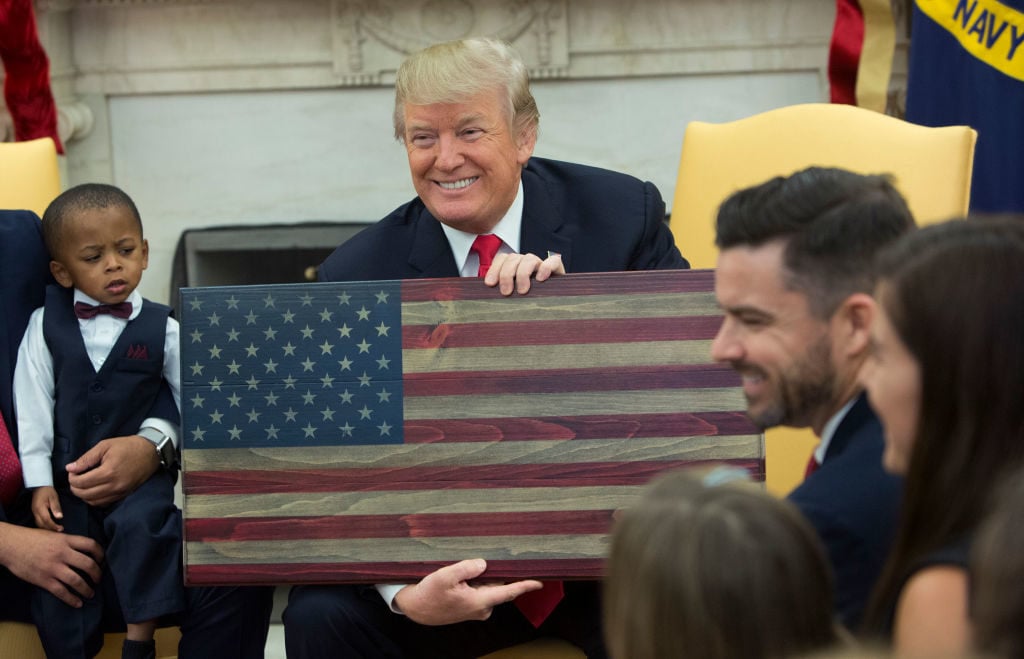
President Donald Trump holds a plaque
made by Brian Steorts, the owner of Flags of Valor, on December 5,
2017 in Washington, DC. Photo by Chris Kleponis/Getty Images.
BIGGER IS BETTER, BIGGEST IS BEST
Let’s return to Bivens and
Shierholz’s deconstruction of the stimulus bill. While the duo
finds minor to modest faults with other bits of the CARES Act, they
direct the majority of their venom toward its largest component:
$500 billion in corporate bailouts.
Now, the devil’s-advocate
argument here is that this discrepancy is only logical. Much bigger
companies need much more money for salvation, and since they employ
more workers, their rescue should do even more good for Americans
than the salvation of small businesses.
While this is true in theory,
execution determines whether it’s also true in practice. Bivens and
Shierholz think the CARES Act fails miserably on this
front:
The single biggest tranche of
money in the package is a large pot… aimed at industry rescues, but
with no guardrails to ensure that public money is directed toward
saving the jobs, wages, and benefits of typical workers rather than
the wealth of shareholders, creditors, and corporate executives.
The bill calls for industry bailouts to preserve jobs “to the
greatest extent practicable,” which is utterly toothless language.
Further, there are no explicit protections for worker safety [in
the context of current threats to public health].
What’s the big problem? The
government regulates the disbursement of the $500 billion in grants
to big business by appointing an inspector general and
congressional oversight committee—a mechanism Bivens and Shierholz
labeled “simply insufficient” even before President Trump suggested that he could
legally gag the
inspector general from
communicating information to Congress at his
discretion.
As evidence, Bivens and
Shierholz mention that the US took this same approach to policing
the now-infamous bank bailouts triggered by the 2008 economic
crisis—bailouts that Americans on the political left and right
generally agreed were massively more favorable to Wall Street than
Main Street.
The potential for corruption
here would be troubling news in any country, but it’s even more
distressing when contextualized alongside the anyone-can-succeed
bedrock of the American Dream. In a study titled “The Missing
Millennial Entrepreneurs,” the US Small Business Administration found
that the rate of self-employment among people aged 34 and younger
“has been gradually declining since 1990.” One think tank used
census data to determine that the proportion of new companies to
established companies plummeted 44
percent between 1978 and
2012, and the Brookings Institution reported that more American
businesses are now being destroyed every year than being
founded.
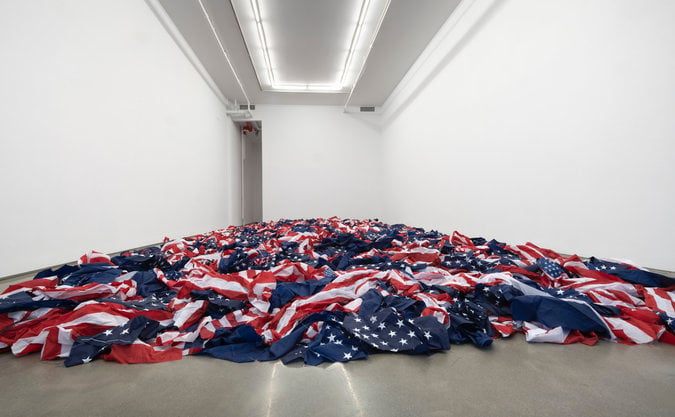
Gardar Eide Einarsson,
Flagwaste. Photo courtesy of Team Gallery.
One of the primary reasons for
this discouraging trend will be familiar to any observer or
participant in an art market dominated by mega-galleries, star
artists, and the Big Three auction houses: the consolidation of
money and power among the few largest, often oldest competitors in
almost any industry. Their still-growing advantages in scale and
capital combine with the globalization of taste to form juggernauts
that make many young would-be entrepreneurs wonder what the point
would be in even trying. And when federal legislators also offer
the apex predators bailout deals lacking even modest mechanisms for
accountability, as the CARES Act does, the savannah of
entrepreneurship becomes even more dangerous for everyone
else.
In fact, whether you’re an
artist or a startup founder, even the most useful aspects of the
CARES Act reveal where the nation’s priorities have shifted. The
Small Business Administration has a staff of fewer than 3,300
people who collectively managed to approve only 58,000 loans in
2019. They will now be responsible for guaranteeing $360
billion in loans to a pool of entrepreneurs that surpasses
30 million, only about half of whom have
enough cash to weather a full month without customers.
Will the SBA be able to get all
that money to so many struggling small businesses before they go
under? I’m concerned—especially since its website does not even
mention that small-business owners can (and I’d say should) apply
for the loans through banks and other private lenders rather than
flooding the tiny agency positioned in the legislation as the focal
point of this massive entrepreneurial rescue mission.
In the end, the CARES Act serves
as a referendum on the American experience in 2020. It once again
shows that, in the US, the arts are seen as a public luxury, not a
public good; that the art industry is a fundamentally
entrepreneurial segment of the economy; and that oligopoly has
become an existential threat not just to the art market, but to all
markets. And while those realizations corrode the favorable aspects
of the bill somewhat, at least we know where we
stand.
That’s all for this week. ‘Til
next time, remember: no one ever said this was going to be
easy.
The post The Gray Market: A Guide to How the $2 Trillion
Rescue Bill Can Help America’s Art Sector—and Where It Falls Short
(and Other Insights) appeared first on artnet News.
Read more https://news.artnet.com/opinion/cares-act-american-dream-1819143
Further reading


Leave a comment