
The Gray Market: Why Galleries and Regional Fairs May Recover Fastest From the Global Shutdown (and Other Insights)
Every Monday morning, Artnet
News brings you The Gray Market. The column decodes important stories from the
previous week—and offers unparalleled insight into the inner
workings of the art industry in the process.
This week, considering the
sequencing of an art-world recovery…
REGIONAL DOUBT
On Thursday, Neil Irwin of
the New York
Times opined that
the lockdown era could accelerate the momentum toward economic
nationalism and regional self-reliance that has been building
around the world since the 2008 financial crisis. And I suspect
that the factors powering the shift away from globalism will
influence how the eventual resurrection of the art industry plays
out, too.
The core of Irwin’s argument
seems borderline-indisputable as the US enters its second month of
stay-at-home life. Disruptions in the international supply chain
for a variety of goods, from medical equipment to toilet paper,
have cast a harsh light on how vulnerable individual countries and
regions have become thanks to the logistics of globalization. After
all, in Irwin’s words, globalization is a system
“in which companies can move
production wherever it’s most efficient, people can hop on a plane
and go nearly anywhere, and money can flow to wherever it will be
put to its highest use.” How
naive does any single one of those expectations sound in the age of
social distancing, let alone all three bear-hugging each other into
an inseparable unit?
Globalization’s newly obvious
pain points don’t necessarily mean that nations will retreat
entirely to their respective corners, though. Some economies are
now so interconnected that total isolationism borders on
impossible. Yet the economics experts Irwin surveyed suggest major
changes could be in store nevertheless. For instance, Susan Lund, a
partner at consulting empire McKinsey, “envisions not so much a full-scale retreat from
global trade as a shift toward regional trade blocs,” as well as a
new commitment on the part of individual businesses to prioritize
long-term resilience over short-term gains.
Similar themes emerged in much
of what I read and heard in the art media this past week. And while
I think geography will be a crucial factor in the art industry’s
post-crisis restructuring, other, finer nuances are likely to play
a role, too.
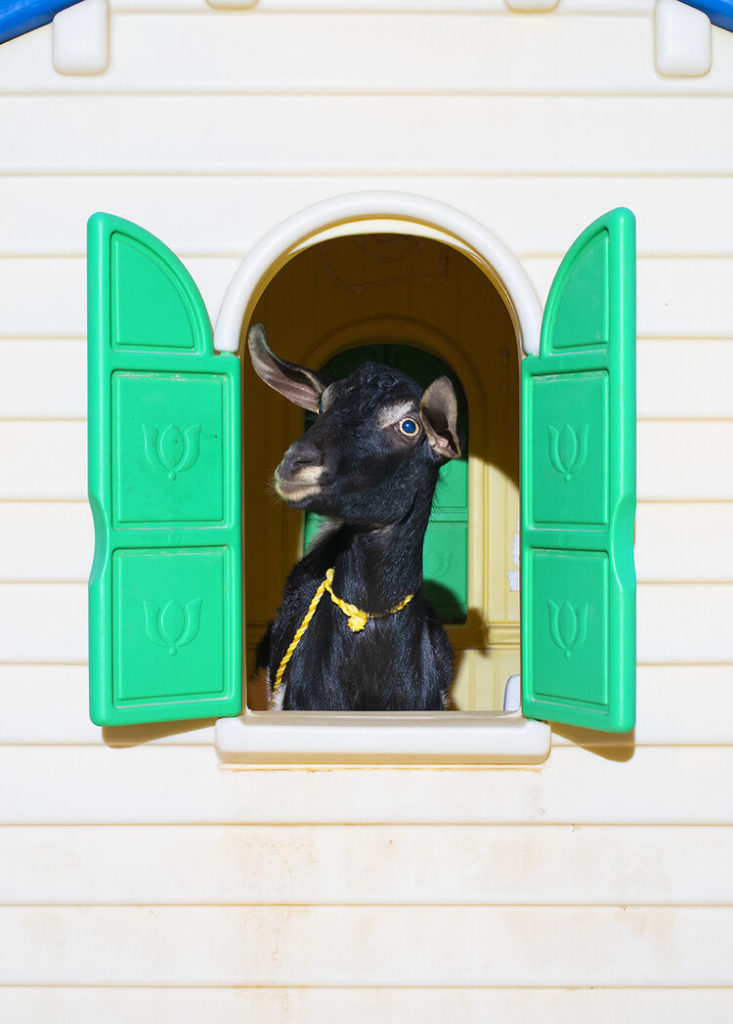
Farah Al Qasimi, Playhouse Goat,
2020. Courtesy of Helena Anrather.
HOME IS WHERE THE ART IS
Since the crisis began, a steady
chorus has been calling out the titanic obstacles now facing the
international art-fair circuit—and for good reason. The entire construct depends on thousands of
art-industry professionals and collectors repeatedly mashing
themselves into large crowds at airports and strapping in among
large crowds on planes to
fly multiple hours through recirculated air to join large crowds
inside convention centers.
For most health-conscious people, this process now sounds about as
reckless as licking the nearest subway handrail like an ice-cream
cone.
The longer the shutdown lasts,
the more nervous people are likely to be about re-entering the
world, too. And despite the art market’s stated intentions to
re-emerge from hibernation in September—a month now crammed so full
of events that the schedule looks like a misprint—I’m increasingly
of the opinion that 2020 as a whole is over for art fairs and other
crowd-dependent art-market events.
As evidence, consider that last
week, the mayors of New York and Los Angeles both said that holding
any mass gathering in their respective cities is “difficult to
imagine” before 2021; a
top-ranking scientist at the National Institute of Health
announced
that the organization’s admirable
progress on a vaccine would still only make it widely available by
spring 2021; and oncologist and bioethicist Zeke
Emanuel projected that,
“realistically, we’re talking fall 2021 at the earliest” for the
return of conferences, concerts, and sporting events—a proclamation
I expect his brother Ari, the CEO of Frieze’s majority owner,
Endeavor, didn’t exactly accept with an attitude of yogic
calm.
Like Susan Lund of McKinsey, I’m
not suggesting that a global trade for art will collapse because of
this fiasco. Elite collectors have been using private planes to
avoid the masses long before there were urgent health reasons to
motivate the choice. The internet will also continue to allow
people to transact across oceans without having to physically leave
their personal protective bubbles.
But while the age of social
distancing has proven that it’s possible to create
community-centric events for art online, I think it’s also proven
that the IRL viewing experience still reigns supreme for most of
us. And this notion returns us to the pivot toward “regional trade
blocs” that Lund mentioned.
An art market justifiably
paranoid about frequent international travel is an art market
incentivized to fracture into regional and local interests. Short
distances won’t just be advantageous on the other side of this mess
because of convenience. They’ll also appeal because of the greater
protection they afford. It’s the same calculus driving distributors
in so many other industries to consider restructuring from largely
global supply chains to ones centered closer to their actual end
consumers.
For collectors, then, the
question should ultimately become: Where can I see and buy art
after the relative safety of a car ride rather than the high
anxiety of a commercial flight?
If the logistical flaws and
psychological after-effects of the social-distancing era undermine
global travel and mass gatherings, sellers will have to adjust in
all kinds of ways. How much international artwork is worth shipping
to, and being exhibited in, new markets to try to convert
regionally focused collectors? Does Art Basel go back to simply
being the biggest fair in Europe instead of the biggest fair in the
world? Does Gagosian really need to maintain a permanent space in
Athens? The list goes on.
Yet geography won’t be the only
factor that matters on the other side of the crisis, either. The
return of the art world will be just as dependent on the setup of
the specific destinations in question.
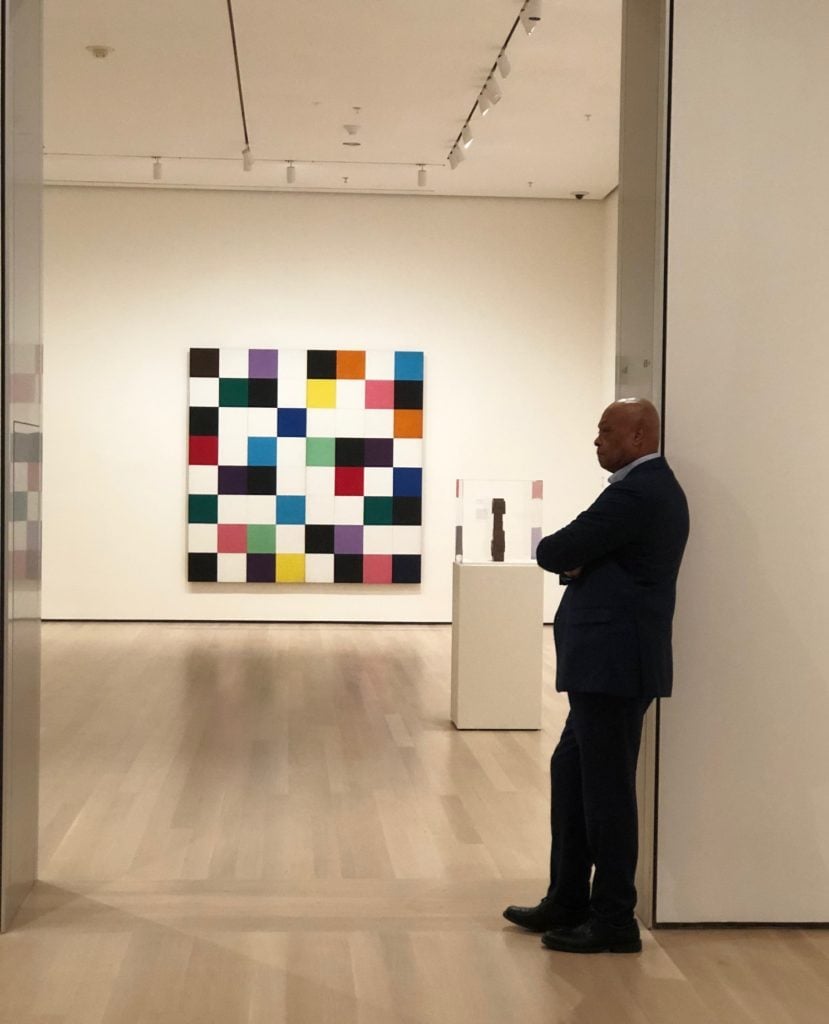
Installation view at the newly MoMA in
October 2019. Photo: Caroline Goldstein.
FUNCTION FOLLOWS FORM
From what I’ve seen and heard,
the anxiety about restarting the art market as we knew it largely
revolves around art fairs, large museums, and gallery openings. The
logic is sound on a macro level: they all hinge on large crowds,
and large crowds are now potential public-health
catastrophes.
However, I think this line of
reasoning overlooks the amount of operational flexibility at these
destinations—and
ignoring that flexibility can trick us into thinking too narrowly
about how and when a recovery could take hold.
Hard numbers help test our
assumptions here. Colleen
Dilenschneider, a
data-centric consultant for cultural institutions, recently
conducted a survey in which roughly 4,300 US adults expressed
whether they were more or less likely to return to various cultural
attractions once lockdown life is a thing of the past. Contrary to
the dominant assumption I’ve heard from art professionals so far,
museums ranked as one of only five options that respondents now
consider even more desirable to visit than before the
shutdown.
Why? The key doesn’t so much
seem to be what’s on view, but rather how visitors view
it.
In a later
post, Dilenschneider
distinguishes between “exhibit-based institutions” and
“performance-based institutions.” The former (think: museums) are
relatively large spaces where visitors can move freely and on their
own schedule, absorbing a variety of different attractions
displayed throughout the venue. Performance-based institutions
(think: concert halls, ballets, movie theaters) tend to be smaller
spaces where visitors settle into fixed positions packed tightly
next to one for extended blocks of viewing time for a program over
which they have no influence.
Broken down this way, it seems
obvious why exhibit-based institutions might be more resilient than
we think—and why
concert halls, performing-arts
centers, and movie theaters became, according to Dilenschneider’s
survey, significantly less attractive destinations in the aftermath of
social distancing.
Another critical factor to
consider: exhibit-based institutions can introduce sensible
operational measures to further limit their potential risks.
Strategic advisor András
Szántó outlined several
possibilities in an op-ed on Artnet
News last Tuesday,
including timed entry, enforcement of the “six feet of personal
space” rule, and a requirement to wear masks. I think it’s also
very likely that museums will rethink their exhibition layouts
post-lockdown, decreasing the number of works on view and spacing
out their placement.
It’s not a coincidence
that many of the same
tactics are now at work
in some galleries in Austria, which reopened to the public last
week, and in Germany, where many others will reopen this Monday.
(Seoul and other Asian art destinations, too, have been progressive
on this front, which I’ll have more to say about later this week.)
And in the final days before a total shutdown became necessary,
some galleries in New York were already transforming their opening
receptions into daylong events to space out foot
traffic.
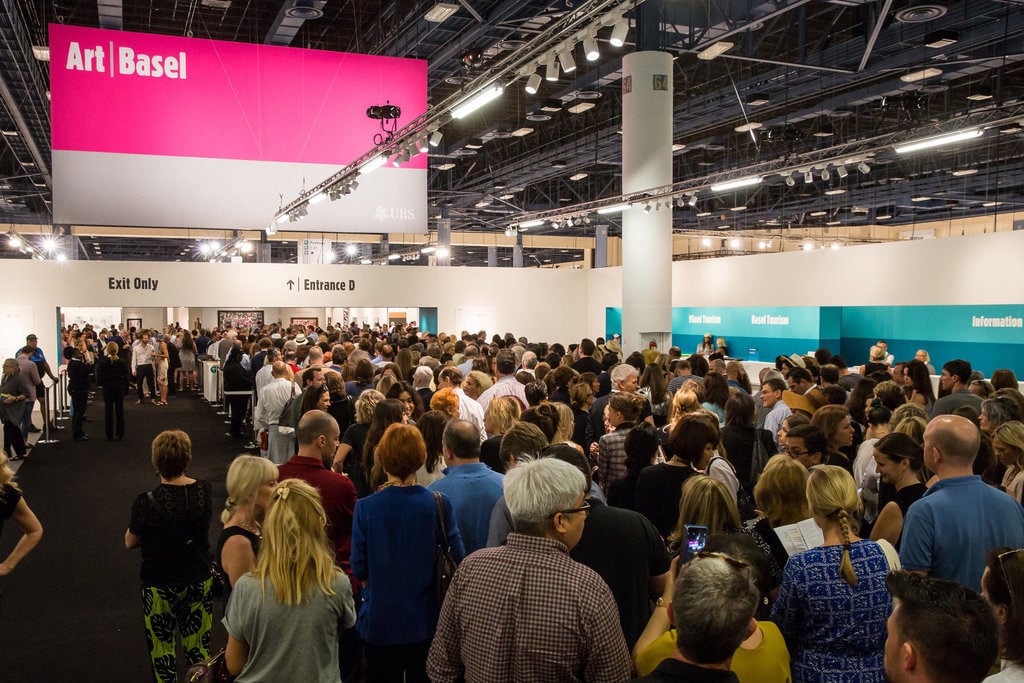
The lines to get into Art Basel in
Miami. How much does this scene make you cringe now? Courtesy
of Art Basel.
It seems somewhat harder, but
not impossible, to implement many of these tweaks at art fairs as
well. Aside from the viability of more heavily local and regional
audiences, the main question might be whether timed entry and
enforced social distancing inside the venue would make the
economics unsustainable for organizers and exhibitors alike. Both
adjustments would reduce the amount of paying visitors and, more
importantly, the sense of frenzied competition and see-and-be-seen
glitz that fueled the sector’s explosive growth this
generation.
Still, the format positions
fairs better than in-person auctions. Like stage plays, auctions require dozens of
people to sit right next to each other in an enclosed space for a
few hours at a time, with no control over the program. True,
auction houses could follow the lead of
pro sports leagues by
putting an auctioneer in an empty room and conducting bidding
remotely. But what would be the point, especially now that so many
huge deals are decided before the public auction via financial
guarantees anyway?
Add all this together, and a
hierarchy starts to emerge. Regional and local destinations for
in-person viewing should be preferable to international ones;
exhibit-based destinations should be preferable to
performance-based ones; and museums and galleries should be
preferable to fairs—which should in turn be preferable to live
auctions.
This new art-world order would
mimic what Irwin and his experts foresee for the world economy at
large, and it might also banish some of the most vilified aspects
of the brand-dominated, travel-burdened, globally indistinguishable
art trade of the early 21st century. Even if plays out this way, I
doubt the situation will last forever. But we won’t know until we
try, and that chance may be on its way.
That’s all for this week. ‘Til
next time, remember: if you want to make the universe laugh, tell
it about your long-term plans.
The post The Gray Market: Why Galleries and Regional Fairs
May Recover Fastest From the Global Shutdown (and Other
Insights) appeared first on artnet News.
Read more https://news.artnet.com/opinion/gray-market-regional-flavor-1838466
Further reading


Leave a comment