
The Gray Market: Why New York’s Museum of Ice Cream Wins at Business by Betraying Its Name (and Other Insights)
Every Monday morning, artnet News brings you The Gray Market. The column decodes
important stories from the previous week—and offers unparalleled
insight into the inner workings of the art industry in the
process.
In this edition, adding toppings
to last week’s “democratization” sundae…
I SCREAM, YOU SCREAM, WE ALL SCREAM… FOREVER
On Wednesday, my
colleague Sarah
Cascone reported that
the Museum of Ice Cream (MOIC), the pop-up Instagram trap that
spawned a thousand would-be
heirs to the selfie
throne, will open a permanent location in New York City this fall.
The announcement has compelled the art-world chorus to once again
decry the MOIC’s bastardization of the term “museum.” And while the
candy-colored cathedral to Likes most certainly is not a museum in
any traditional sense, the most outrageous aspect of its next
chapter is how vividly it clarifies that the MOIC is a superior
business to running an actual art institution.
First, though, let me disgust
you with some relevant details! The MOIC New York will take up
residence in SoHo, in a roughly 25,000-square-foot space recently
vacated by fast-fashion retailer H&M. Along with, in Cascone’s
words, the “largest version of its signature sprinkle pool to
date,” the flagship will offer visitors these brain-liquefying, sweets-themed attractions:
Guests can also look forward
to 13 brand new installations inspired by ice cream and other
desserts, created by MOIC’s architects and designers. Highlights
will include a three-story slide, a floating table of desserts, a
hall of giant scoops, an MTA-inspired “Celestial Subway,” and a
hidden “Queen Bee hive.”
Honestly, I might rather live
under a bridge for the rest of this year than experience what any
of that means in person. Nevertheless, it’s all happening, thanks
largely to the fact that the Museum of Ice Cream has scooped up
more than 1.5 million visitors since opening its first pop-up in
2016.
And it’s still only the
beginning. Manish Vora, one
of the MOIC’s two
cofounders, said in a statement that the forthcoming SoHo space is
only “the first of several
flagship locations that will launch in the US and abroad over the
next 18 months.” And as I mentioned in last week’s Gray
Market on the
always-dubious “democratization” of contemporary art (via
Pace Gallery’s mysterious
PaceX initiative), the
MOIC’s parent company, Figure8, recently landed $40 million in
venture-capital investment that staked the company to a
$200 million
valuation.
So how is this possible, let
alone justified from a business standpoint?
Naturally, a big part of the
answer has to do with the tractor-beam pull of hype and the
depressingly basic taste of the average person. (Remember when “the
wisdom of the crowd” determined that a British polar-research ship
should be christened Boaty
McBoatface, or that
Frito-Lay should debut cappuccino-flavored
potato chips? These are
all outcomes made possible, even likely, by turning aesthetic and
sensory decisions over to the masses.)
But an equally big part of the
MOIC’s success has to do with dollars and cents, especially in
comparison to what it takes to run a real museum.

Wheeeee, guests cash in precious seconds
of youth they can never regain by frolicking in the Museum of Ice
Cream’s Instagram-famous sprinkle pool! Photo by Kelly
Sullivan/Getty Images for Museum of Ice Cream.
(SORT OF) GETTING WHAT YOU PAY FOR
Now, I should point out that the
MOIC’s cofounders recently trademarked the term “experium,” a
mashup of “experience” and “museum,” to describe its branded
locations. One might argue this shows Figure8’s intent to quash any
illusions that it is an actual scholarly institution. At the same,
it is still called the Museum of Ice Cream, and my point
in this column isn’t to accuse them of false advertising, so I
think we can all agree to move past the semantic nuances,
yes?
One crucial variable in the
Museum of Ice Cream’s success is its admission price. Entry to the
New York flagship will cost visitors an ice-cold
$38.
If you think that sounds
extreme, you’re right: Cascone notes in her story that $38 is
“far more than the city’s
premiere cultural destinations like the Metropolitan Museum of Art
and the Museum of Modern Art (both $25) or the nearby New Museum
(just $12).”
But the situation is actually
even starker than that. I ran the numbers, and it turns out that a
ticket to New York’s permanent Museum of Ice Cream will cost more
than a general-admission ticket to any major art museum in
America.
OK, let’s take a breath here.
Yes, I wrote exactly what you thought I wrote:
The new Museum of Ice
Cream will cost more than a general-admission ticket to any
major art museum in America.
Here is a chart to more tightly
focus the nightmare we are now living through.
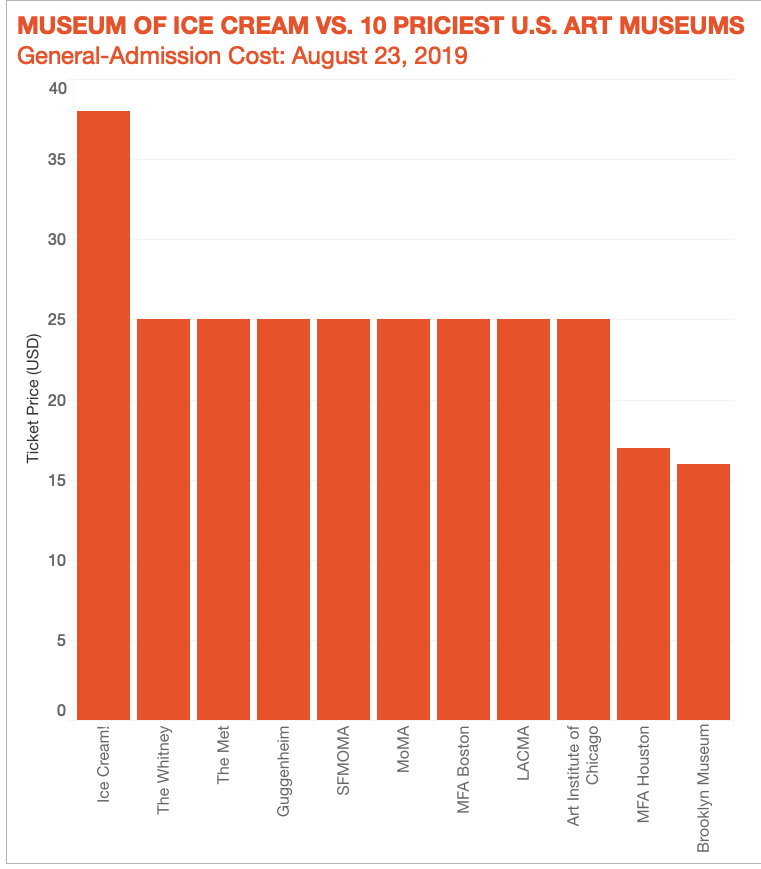
Read ’em and weep: ticket prices for the
Museum of Ice Cream vs the 10 most expensive major US art museums.
© Tim Schneider 2019.
In fairness, the original Museum
of Ice Cream pop-up “only” charged $16, so not every one of the 1.5
million-plus attendees to date has shelled out what the NYC
flagship will ask. Still, $16 is the price of general admission to
the Brooklyn Museum today, and the MOIC has been charging $38 for
access to its permanent outpost in San Francisco since September of
last year, with demand apparently staying healthy enough to warrant
no change in pricing strategy.
Yet the MOIC doesn’t just have
more money coming in per ticket than major art museums. It is also
paying out much, much less to keep operating.
THE COST OF DOING BUSINESS
Museums often get accused of
debasing the high-flown values of art in service of pursuing the
almighty dollar. Shades of that criticism certainly stick in some
cases—remember MoMA’s
Björk retrospective?—but
it’s usually exaggerated rhetoric.
However, we have an answer for
what it would look like if all those accusations were 100 percent
true… and that answer is the Museum of Ice Cream.
Unlike legitimate artwork and
artifacts, the “attractions” inside the MOIC are worthless. On a
surface level, this means you don’t need to pay to insure them
against loss, damage, or destruction, and you certainly don’t need
to maintain a conservation department to care for them. It’s not as
if the MOIC has to pull a Rijksmuseum and invest millions of
dollars in Operation Night
Watch if some kid barfs
in the sprinkle pool. Just replace the sprinkles for a few
bucks!
Similarly, since what’s on view
has no history or aesthetic depth, the MOIC has no reason to pay a
curatorial staff to study and properly contextualize anything for
the public, either. The “hall of giant scoops” is not a hall of
kings whose past deeds will enrich visitors’ appreciation of art
and history. No greater dialogue is going to emerge from explaining
why the table of floating desserts has been juxtaposed with the
“Celestial Subway.” It’s. All. Just. Nonsense. For. The.
‘Gram.
Also unlike legit art
institutions, the Museum of Ice Cream is not at risk of
marginalizing important voices and, therefore, providing a biased
or incomplete history of its field. Which means it has no
continuous responsibility to evolve its collection by buying more
(expensive) objects, let alone to pay the high cost of storing
what’s not currently on view in climate-controlled, archival
conditions.

Museum of Ice Cream cofounders Manish
Vora and Maryellis Bunn are millionaires many times over based on
the MOIC’s runaway success. Let that sink in. Photo courtesy of the
Museum of Ice Cream.
Oh, and is there any incentive
for the MOIC to curate a rotating program of exhibitions? Hell no!
As long as the attractions continue bringing in guests, you just
leave them alone, the same way Cawker City, Kansas never has to
swap out the World’s Largest Ball of Twine for some other
tourist-baiting roadside attraction. As a result, the MOIC saves
tens of thousands of dollars that museums regularly pay for
exhibition design, build-out, art shipping, installation,
de-installation, packing, crating, return shipping, demolition, and
gallery repair. (And forget the cost of studio visits or research
trips, too.)
Finally, while the MOIC is
saturated with merchandising opportunities, the cost of creating
its merch is dramatically lower than for art museums. Why? Because
the MOIC never has to pay artists, estates, or foundations to
license the works being reproduced for its gift shop. And books, a
particularly labor- and cost-intensive part of museums’ retail
playbook, are completely irrelevant, since no one wants either a
scholarly essay on a three-story slide or any images of the MOIC’s
attractions that they
themselves are not in.
Instead, the MOIC gets to focus
on products like its own brand of ice cream (sold at Target and
soon, Albertsons), its own clothing line (also sold at Target),
and, for reasons that may only be decipherable from some vantage
point on the astral plane, its own makeup collection (with
Sephora)… all of which, we can safely assume, its corporate
partners pay the
museum to stock in exchange
for a cut of sales.
Mix it all up, and the MOIC
charges significantly higher ticket prices than real art museums,
with equal or better merchandising options, while having to pay out
significantly lower, and fewer, expenses to keep visitors coming
in.
That, ladies and gentlemen, is a
recipe for good business. But it is also enough reason for anyone
who cares about the public’s exposure to great art, not empty
experiential calories, to stress-eat their way into the nearest
emergency room.
That’s all for this week. ‘Til
next time, remember: value and values are two very different
things.
The post The Gray Market: Why New York’s Museum of Ice Cream
Wins at Business by Betraying Its Name (and Other Insights)
appeared first on artnet News.
Read more https://news.artnet.com/opinion/gray-market-museum-ice-cream-1634467
Further reading


Leave a comment