
The Gray Market: Why Twitter’s Ban of Political Ads Could Have an Important Impact on Instagram’s Censorship of Artwork (and Other Insights)
Every Monday morning, artnet News brings you The Gray Market. The column decodes
important stories from the previous week—and offers unparalleled
insight into the inner workings of the art industry in the
process.
This week, assessing how a Big
Tech standoff radiates back to the art world…
SKIN IN THE GAME
On Wednesday, Twitter CEO Jack
Dorsey announced via tweet
thread that his platform
would no longer allow political advertising. Scheduled to go into
effect on November 22, the new policy puts Dorsey’s platform in
direct opposition to Facebook, which last month eliminated its
requirement for paid ads to avoid making “deceptive, false, or
misleading” statements as long as they originate directly from a
political candidate or political party.
The clash between the two
social-media titans assumes special importance for the art world
based on events from the previous weeks. Only a few days
after Facebook chairman and
CEO Mark Zuckerberg went to Washington, DC, to deliver a lengthy prepared monologue on the supreme
importance of unregulated free speech to Georgetown University
students (as well as to get
dragged in Congress over his in-development cryptocurrency project,
Libra), representatives
from Facebook and Facebook-owned Instagram met with around 20
artists, curators, and members of the National Coalition Against
Censorship in a closed-door session in New York to discuss
Instagram’s much-maligned content-moderation policies and community
guidelines.
According to
Maximilíano Durón of
ARTnews,
participants included artists Marilyn Minter, Micol Hebron, and
Joanne Leah, while painter Betty Tompkins sent a statement to be
read aloud during the proceedings. All attendees were asked to sign
non-disclosure agreements. A company spokesperson clarified that
this measure is standard practice for anyone entering Instagram
headquarters, not an exception applied to veil this specific event.
Press were not invited to attend.
Chief among the issues discussed
during the roundtable was Instagram’s ban on nudity in artworks
other than paintings and sculptures. Even this seemingly
straightforward (if frustrating) policy has several inconsistencies
that have been highlighted in posts made by some of the artists in
attendance. For instance, Instagram
temporarily removed Tompkins’s account after she posted a photo of one of her sexually
explicit “Fuck Paintings” this April.
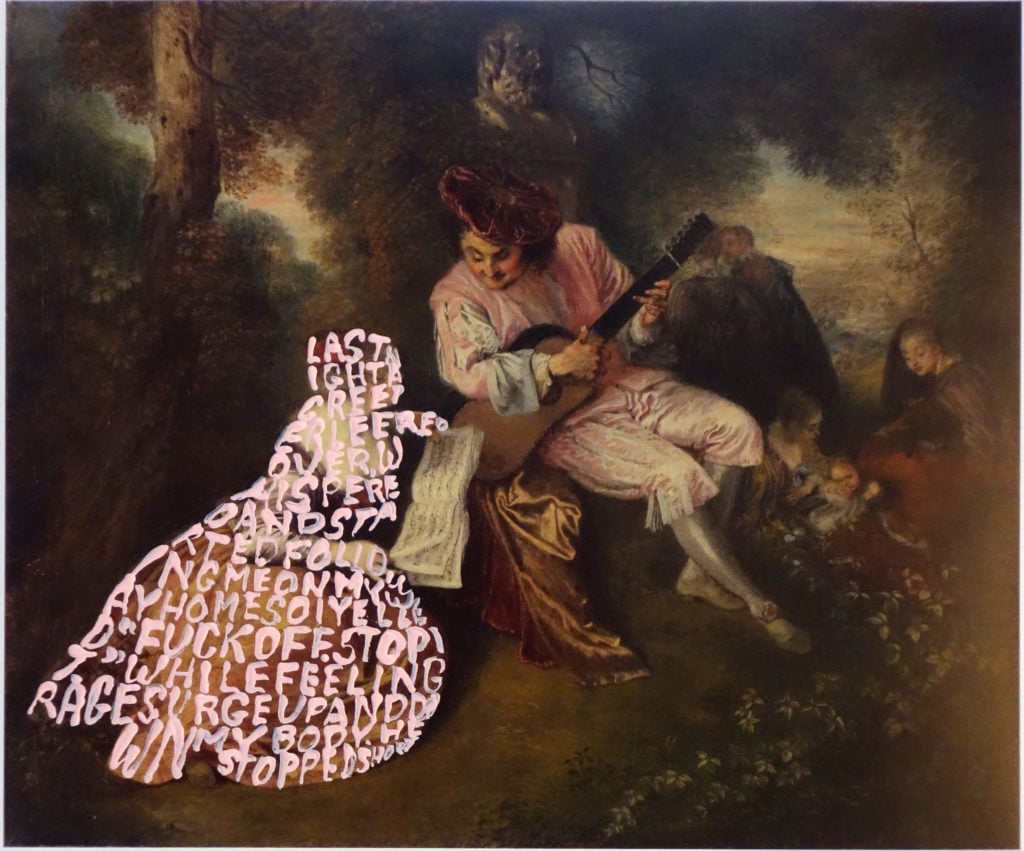
Betty Tompkins, Women Words #1
(Watteau), 2018. Courtesy of the artist and PPOW, New
York.
According to Leah,
who appeared on
Vox’s Reset
podcast last week to discuss the summit, she and Hebron
also called out Instagram’s negative fixation on the “female
nipple.” The simplest expression of the policy is that photos and
videos of topless men are okay, but photos and videos of topless
women are not.
Even setting aside the fact that
a global social-media platform is being governed by this
exceptionally American attitude toward the human body, it still
raises hard, meaningful questions about the rights of transgender
and non-binary folks. For example, during their time on the
podcast, non-binary model Rain Dove mentioned the confusion of
seeing literally the same set of nipples go from “banned” to
“permitted” on Instagram after a friend had top
surgery.
Confusion continues to abound
with Tompkins’s work, too. Ironically, her Instagram
account was suspended again only a few days after the closed-door session
between Facebook, Instagram, and the aforementioned members of the
arts community. She confirmed in an email to me this weekend that
the ban only lasted “2–3 hours,” and that it was triggered because
someone thought one of her paintings was a photo. (“First time I
have been penalized for doing it too well,” she added wryly.)
Still, the experience proves the platform’s leadership will need
time to digest what it heard from the summit’s
participants.
I should note that most, if not
all, of those attendees who have spoken to the press agreed that
they believe Facebook and Instagram are genuinely trying to listen,
learn, and do better. But A National Coalition Against Censorship
rep told my colleague Caroline Goldstein that, after the
meeting, “the only solid
commitment made by Facebook was its intention to issue
clarification around its guidelines that regulate what appears in
searches and hashtags.” Leah echoed this takeaway on
Reset, noting that Facebook and Instagram “did
promise that the [community] guidelines would evolve… but they
didn’t say when and how.”
So how do policies about
artistic nudes on Instagram connect to policies about political
advertising on Facebook and Twitter? More directly than it might
seem at first.
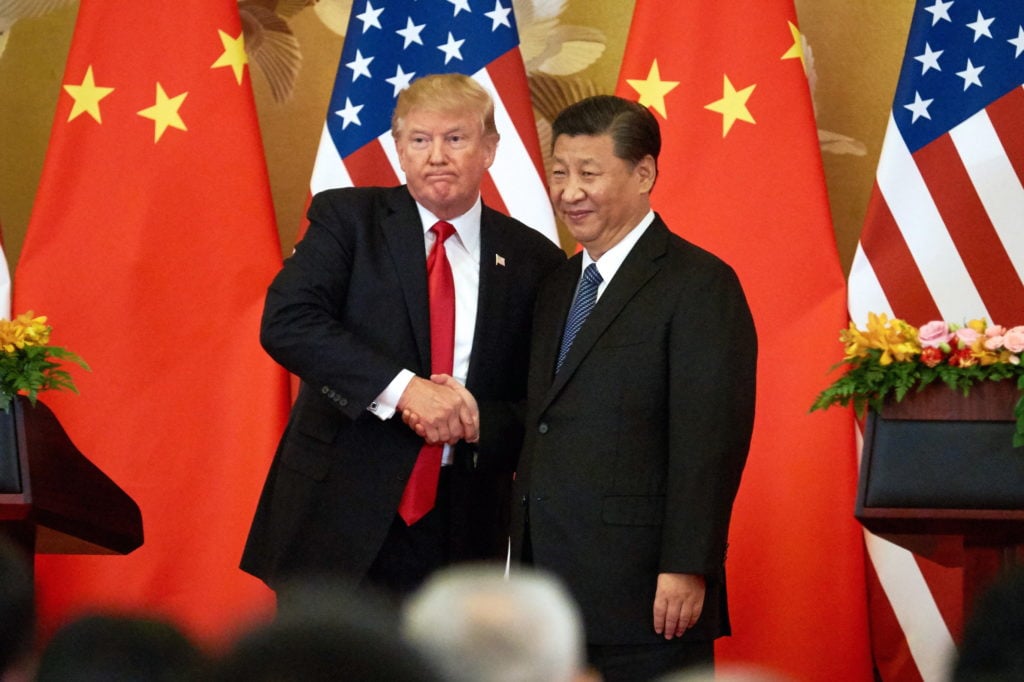
President Donald Trump and China’s
President Xi Jinping. Photo by Artyom IvanovTASS/Getty Images.
FALSE EQUIVALENCE
In Zuckerberg’s
earlier-mentioned Georgetown address, he declared,
“More people being able to share
their experiences and perspectives has always been necessary to
build a more inclusive society.” He also contended he “[doesn’t] think it’s
right” that social-media platforms be tasked with the power and
responsibility of judging what content should be protected by the
right to free speech online.
But both of these statements
referred to Facebook’s decision to allow political candidates and
parties to spew outright lies in ads seen by thousands upon
thousands of people. Apparently, he does not think the same
open-minded standard should apply to Instagram when artists want to
post work that includes the “female nipple” and/or “fully-nude
buttocks,” or when nonbinary users simply want to post the same
kinds of selfies or photos of those close to them as others who
self-identify as one of the traditional genders.
Seems a tad inconsistent, no?
It’s sort of like hearing someone say that they love autumn but
hate the lower temperature and shorter days. After all, what could
more directly satisfy “more people being able to share their
experiences and perspectives” than these types of
posts?
If you think that statement
sounds overly simplistic, it may be. But it’s a valid response in
the extreme terms that Zuckerberg has been using to frame the
debate about freedom of expression on the social-media colossus he
co-founded and chairs. Tech journalist par excellence Kara Swisher argued
in the New York
Times that his
Georgetown monologue boiled free speech down to “an either-or
choice—either we have it, or we’re China.”
In this sense, Facebook’s
decision to continue running misleading or false political ads
gives the lie to its squishy rhetoric about the urgency of
protecting First Amendment rights for the sake of inclusiveness,
unity, and connecting people. (Rani Molla
at The
Verge reported that
Zuckerberg used the word “together” 14 times in his 40-minute
address.) It reminds us again that Facebook is first and foremost a
business. And commerce is the only lens through which we can
reconcile its decision to unleash politicians’ worst impulses for
cash while simultaneously locking down artists and marginalized
groups’ best intentions for the supposed good of “the
community.”
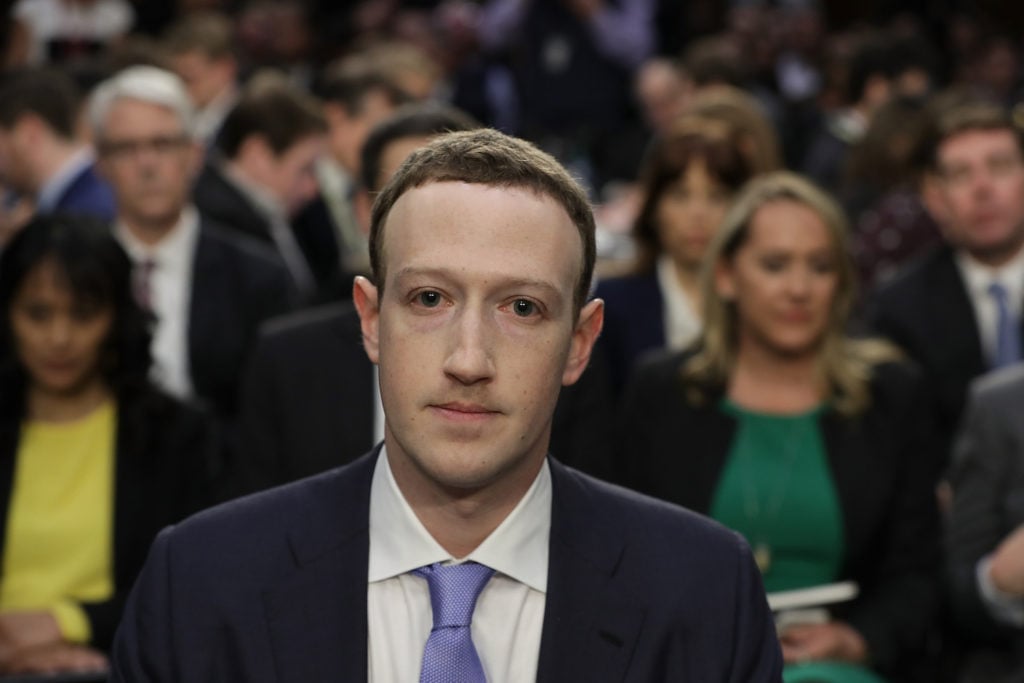
Facebook CEO Mark Zuckerberg arrives to
testify before a combined Senate Judiciary and Commerce committee
hearing in the Hart Senate Office Building on Capitol Hill April
10, 2018 in Washington, DC. Photo by Chip Somodevilla/Getty
Images.
TOO BIG TO BAIL?
At bottom, the difference
between these two situations is scale. On Facebook’s third-quarter
earnings call last Wednesday, Zuckerberg partly used his prepared remarks to
discount the notion that greed was shaping the platform’s hands-off
policy toward campaign ads, saying that “ads from politicians will
be less than 0.5 percent of our revenue next year.” Given how much
blowback it’s received for the policy, he implied, why would the
company compromise itself for so little upside?
But as Josh Constine at
Techcrunch noted,
Facebook’s third-quarter revenue of $66 billion means that the
company might make between $330 million and $400 million from ads
run by candidates alone next year. A Facebook spokesperson also
confirmed after the call that the 0.5 percent number did not count
spending by PACs or political parties on so-called “issue ads,”
i.e. those about specific political issues rather than specific
candidates running for office. Which in turn means Facebook likely
expects to rake in hundreds of millions more from its ad policy in
the aggregate.
(For comparison, Constine
reports that Twitter made only around $3 million, or about 0.1
percent of its annual revenue in 2018, from ads connected to that
year’s midterm elections.)
The point here isn’t to argue
that Facebook’s gain from political ads is bigger than it claims.
Instead, the point is to surface the calculus it uses to make
decisions about what content to allow, and what content to ban. The
simple truth is that Facebook and Instagram’s internal projections
have undoubtedly been a factor in shaping their current policies on
nudity and artwork. If too many people could accuse either platform
of harboring content that could be construed as porn with even a
shred of credibility, it could be a fiasco for the bottom
line.
But defining the line between
artwork and pornography has always been a difficult process, full
of complex questions that deserve serious deliberation. So too is
the task of parsing the intangible costs of amplifying political
speech for a fee. Although Twitter clearly stands to lose much less
money than Facebook by rejecting political ads, it has now joined
LinkedIn, Pinterest, and TikTok in deciding that human interests
and democratic ideals outweigh this particular revenue
stream.
Here’s hoping that Facebook and
Instagram can do some similarly mature thinking while they
re-evaluate their content-moderation policies for art and nudity.
But if they don’t, remember Zuckerberg’s attitude toward political
advertising, as well as what it suggests about cause and effect:
that he and his confidantes would rather have overly conservative
community guidelines than even modestly declining
profits.
That’s all for this week. ‘Til
next time, remember: cash rules everything around us, even when
we’re online.
The post The Gray Market: Why Twitter’s Ban of Political Ads
Could Have an Important Impact on Instagram’s Censorship of Artwork
(and Other Insights) appeared first on artnet News.
Read more https://news.artnet.com/opinion/facebook-instagram-artwork-censorship-1695246
Further reading


Leave a comment