
‘The History of Art Is Not So Clear’: How Contemporary Artists Are Joining Forces With the Frans Hals Museum to Tell a New History of Art
A rare collection of
16th-century damask silks hangs in a gallery of the Frans Hals
Museum in the Dutch city of Haarlem. These cloths, often referred
to as “white gold,” are so delicate and difficult to read that the
museum almost never displays them. They are on view, however,
because British contemporary artist Lubaina Himid wants them to
be.
The display is part of a broader
effort on the part of the historic Netherlands museum to
reinvigorate its Old Masters collection by presenting it through
the eyes of contemporary artists and alongside their
work.
Himid is certainly up to the
task. In her recently opened exhibition “The Grab Test” at the
Frans Hals Museum, the Turner Prize winner’s revisionist oeuvre
attempts to reorganize our understanding of history by inserting
black voices who have historically been left out, conjuring absent
and overlooked views of the past.
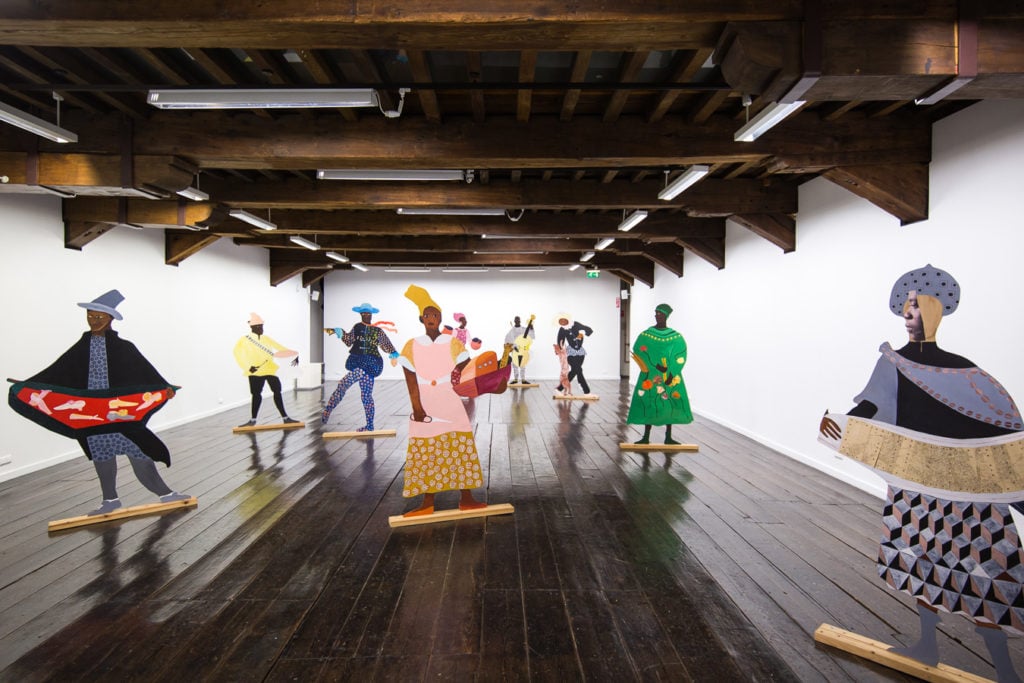
Installation view of “The Grab Test” by
Lubaina Himid at the Frans Hals Museum. Courtesy the Frans Hals
Museum.
The project is exemplary of
director Ann Demeester’s programming reboot since taking the helm
of the institution in 2014. The director says art history is not
linear and that she does not believe in adhering to strict
boundaries between fine art and craft. “The history of art is much
more chaotic and dirty, and it’s not so clear,” she says. “Art is messy.”
In recent years, Demeester has
invited various contemporary artists, including London-based Shezad
Dawood, American artist Nina Katchadourian, and UK multimedia
artist Marianna Simnett, to reflect on its historic collection by
teasing out social and political themes. Last year, the museum also
rehung its collection with a new emphasis on questions of
migration, cultural appropriation, and identity.
“My idea was to show that art is
a continuum, and to acknowledge that there is no such thing as art
only belonging to one period, or existing in splendid isolation,”
Demeester notes. The results have so far been met with approval
from local critics and a increased engagement with the museum on
social media.
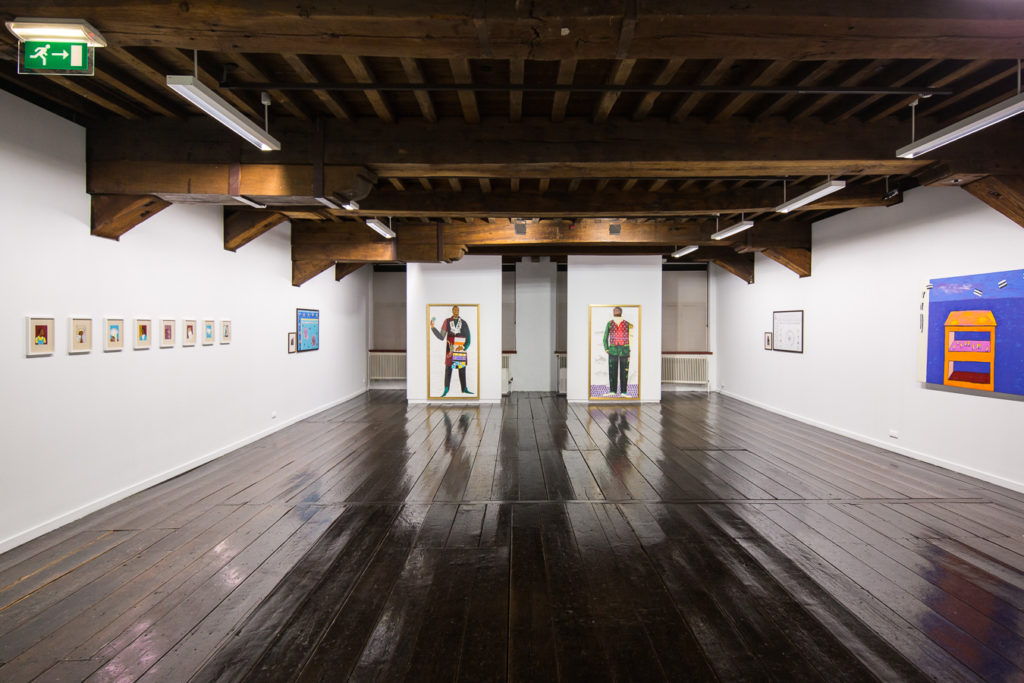
Installation view of “The Grab Test” by
Lubaina Himid at the Frans Hals Museum. Courtesy the Frans Hals
Museum.
History Within the Folds
Despite the exceptional
fragility of the damask silks, the museum adhered to Himid’s desire
to display them. The artist wanted to include them in her show
because she’s interested in the fluid line between visibility and
invisibility, and because the fabrics, a material Himid often works
with, tell a story of migration and labor.
In the case of the silks, it is
one of migrants and refugees: After the Dutch revolt against
Spanish rule of the Low Countries (a region that includes
modern-day Netherlands, Flanders, and Belgium) in the 1580s,
weavers from Antwerp fled the city for Haarlem, bringing their
craftsmanship with them. Damask production was a marriage of these
regional skills and local innovation at the time.
According to Demeester, Himid’s
work similarly reflects this approach, pulling in strands of
history while exploring contemporary themes. The 2017 Turner Prize winner, who was born in
Zanzibar and grew up in the UK, became a central figure in the
British Black Arts Movement of the 1980s. Her work often
incorporates textiles, looking at the stories they tell.
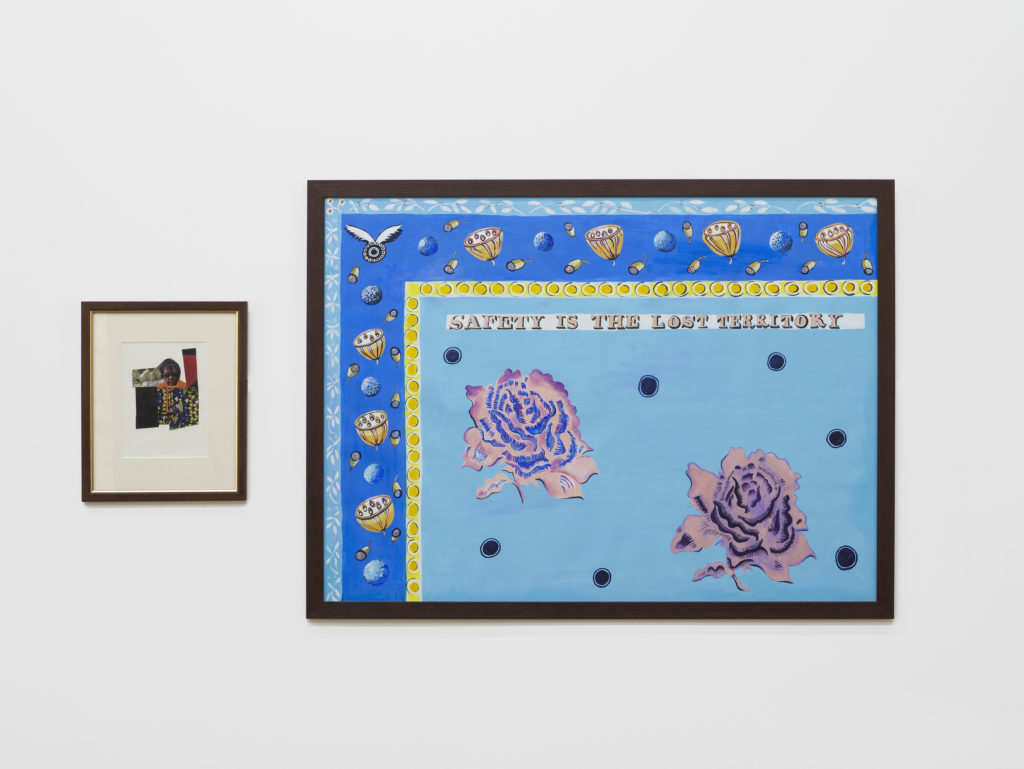
Lubaina Himid’s Safety Is the Lost
Territory (2011). Courtesy the artist and Hollybush
Gardens.
“We want to connect Old Masters
to the present to say that there is no such thing as dead
heritage,” says Demeester. “At the same time, the contemporary art
that many people regard as alienated or alienating is often deeply
connected to the past. We hope that more meanings and more stories
are being generated by those combinations.”
For the central piece of the
exhibition at the Frans Hals, Himid has put another form of cloth
center stage, this time her own: The Grab Test from 2019 is a newly commissioned work after
which the whole exhibition is titled. It features a series of
connected Dutch Wax cloths, a traditional fabric printed with
colorful and elaborate prints, that hang in the middle of a gallery
chamber and wrap around its interior columns. She has painted her
own figures, such as birds, flowers, and hands, in acrylics onto
the piece.
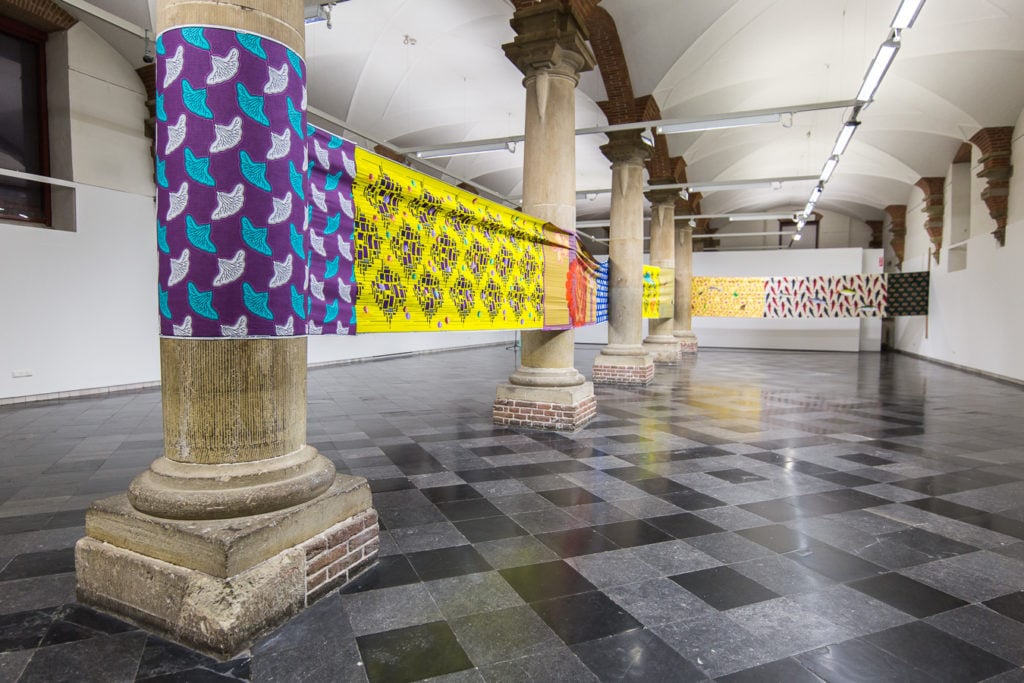
Installation view of “The Grab Test” by
Lubaina Himid at the Frans Hals Museum. Courtesy the Frans Hals
Museum.
Not unlike the damask silks
Himid had pulled out of storage, Dutch wax also has a multi-layered
history: It was created in the Netherlands in the 1800s as a way of
mass-producing Indonesian batiks, during the period of Dutch
colonial rule in what was then known as the Dutch East Indies.
Ghanaian soldiers who served in World War I in the Dutch colonial
army in Indonesia first popularized them in Ghana. Today, they are
so popular in West Africa that many people simply think of them as
a quintessentially African material.
“All these ideas of circulation,
migration, appropriation are integral to the textile itself,” says
Demeester. “It raises questions like, what belongs to a certain
continent and what is brought there? Dutch wax is about shopping
and about identity and the patterns are sometimes symbolic. These
are all subjects that interest Lubaina.”
The exhibition also includes 10
life-size figurines from her monumental multimedia
installation Naming the
Money (2004),
which consists of 100 wooden cut-outs depicting fictional black
historical figures, each inspired by a unique swatch of fabric that
hangs on the back of each cut-out alongside a poem about the
character. Jazz music plays with voice-overs telling the stories of
each one.
“This particular work was
responding to the fact that she looked at 17th- and 18th-century
portraiture and saw that black people were not really there,”
said Melanie Bühler,
curator of the exhibition.
“Or if they were they were there, they were only there to highlight
the status of the white protagonist or in a subservient role. She
invented lives for these de-individualized persons, and gave them
life again, gave them individuality.”
Lubaina Himid’s “The Grab Test” is on view at the Frans Hals
Museum in Haarlem, the Netherlands, until February 23,
2020.
The post ‘The History of Art Is Not So Clear’: How
Contemporary Artists Are Joining Forces With the Frans Hals Museum
to Tell a New History of Art appeared first on artnet
News.
Read more https://news.artnet.com/exhibitions/lubaina-himid-frank-hals-1712310
Further reading


Leave a comment