
The Louvre Is Opening Its Blockbuster Leonardo Anniversary Show This Week. Here’s What to Expect
Leonardo da Vinci lovers hoping that the Louvre’s blockbuster
anniversary exhibition will settle questions concerning the
whereabouts of the missing $450 million painting, Salvator
Mundi, will have to keep holding their
breath. With just three days
to go until the exhibition’s public opening, the question of
whether the prized painting will be present or absent still hangs
in the balance.
The largest-ever exhibition of
Leonardo’s work is set to open at the Louvre this week, on October
24. The show, which has
been 10 years in the making, marks 500 years since the death of the
Renaissance master. Its two curators, Vincent Delieuvin, from
the Louvre’s department of paintings, and Louis Frank, from the
department of prints and drawings, have exhaustively re-examined
the existing bibliography of Leonardo’s life, and have made new
headway into the master’s life and work.
While the Louvre already owns
five paintings and 22 drawings by Leonardo, it will also show
nearly 120 paintings, sculptures, drawings, manuscripts, and objets
d’art on loan from some of the world’s most prestigious art
institutions, including the Vatican Museums and the Metropolitan
Museum of Art. In all, the exhibition features some 160 works,
including at least nine paintings and 80 drawings by Leonardo, as
well as works by his two main disciples, Marco d’Oggiono and
Giovanni Antonio Boltraffio.
The Salvator Mundi
Whether the most expensive
painting in the world, which is believed to be owned by the Saudi
crown prince Mohammad Bin Salman, makes an appearance in the show
will be as much a “surprise” to the curators as it will be to
visitors, Delieuvin says. Salvator Mundi has been
conspicuously absent from public view since it sold at auction at
the end of 2017 for $450 million.
“If the painting is there, it is
because the lender has decided to lend it. If it is not there, it’s
because the lender decided not to,” Delieuvin says. “We still don’t
know if it is coming, the lender hasn’t given the final say
yet.”
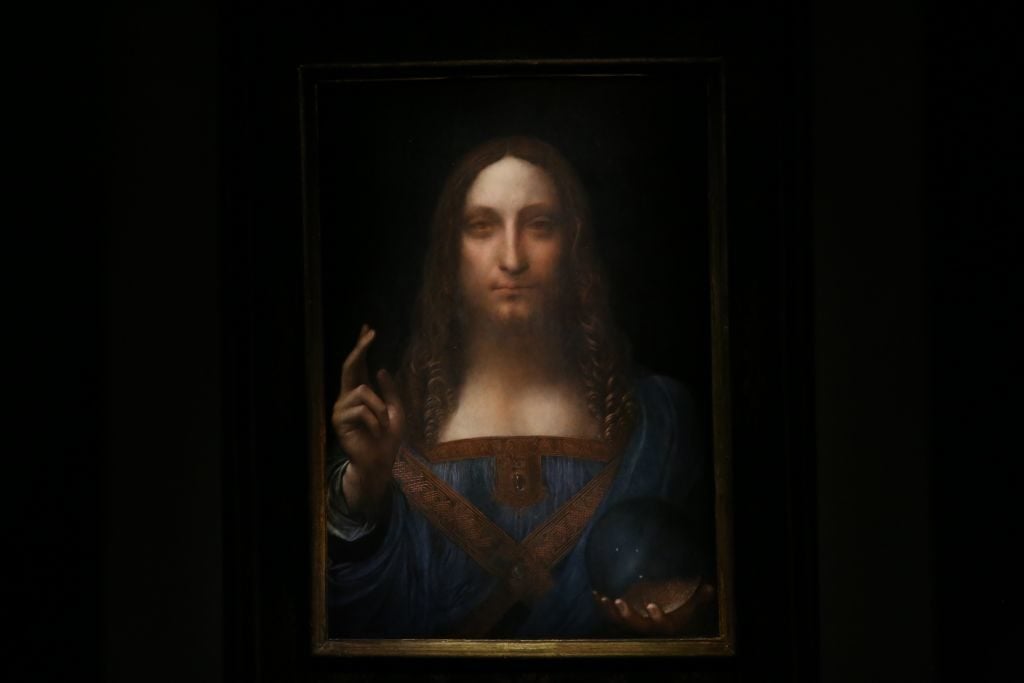
Leonardo da Vinci’s Salvator
Mundi is seen at the Christie’s in New York in 2017.
Photo by Mohammed Elshamy/Anadolu Agency/Getty Images.
The validity of the work’s
attribution to Leonardo has been subject to contention among art
historians, but the French curators cannot weigh in on debates
over privately owned works because they are functionaries for the
state. An attribution from the Louvre will only be given if the
painting is loaned for the exhibition.
The show certainly does not
depend on the inclusion of this particular work,
however. “The way the
exhibition is constructed, it is not conditioned on the presence or
absence of any painting,” Delieuvin says. Because of Leonardo’s
profound interest in science and technology, the curators decided
to include in the show all the infrared reflectograms that show
deeper layers of paint, and sometimes hidden images, on the
artist’s canvases.
These will in some cases be
shown side-by-side with their companion paintings, and in others
will stand in for works that are absent, such as the
Annunciation
from the Uffizi Galleries in
Florence, the National Gallery of Washington’s portrait
Ginevra de’
Benci, the
Madonna of the
Carnation from
Munich’s Alte Pinakothek.
The Lady with an
Ermine will also
not be on loan from the National Museum in Krakow,
Poland.
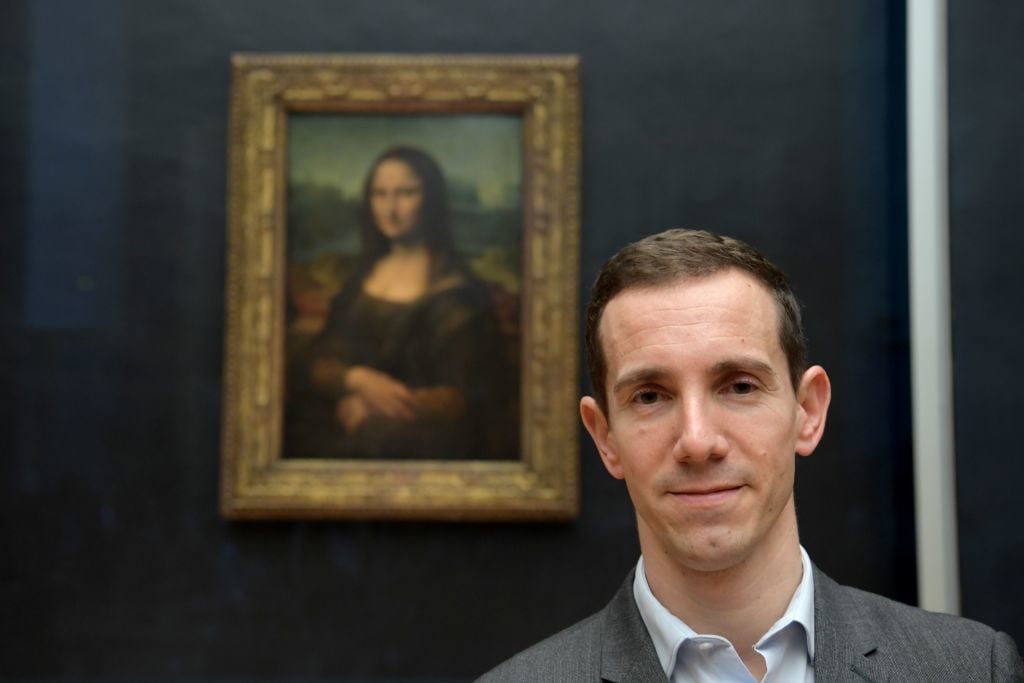
Vincent Delieuvin poses next to
the Mona Lisa at the Louvre Museum. Photo by
Eric Feferberg/AFP via Getty Images.
The Mona Lisa will
remain on view in its permanent hanging space, in the museum’s
grand Salle des États, rather than move to be with the rest of the
show in the Napoleon Hall. Delieuvin explains that this is purely
for practical reasons: The majority of the 30,000 visitors who come
to the Louvre every day want to see Mona Lisa, and the
Napoleon Hall can only accommodate a maximum of 7,000 people. “If
we put the Mona Lisa down there, the exhibition would be
practically unvisitable,” he says.
Leonardo’s most famous painting
will also figure into a new virtual-reality experience at the end
of the exhibition. “This will allow people to rediscover the
Mona Lisa, and I think that it will give people the desire
to go upstairs and see the painting in her room, which has just
been renovated with a new intense and deep dark blue
color,” Delieuvin says.
Political Interference
A bitter political standoff
between officials in France and Italy over international loans
briefly threw a wrench into the exhibition, as Italy’s former
nationalist culture ministry tried to renege on loans
previously promised to France, with one official complaining
that “Leonardo was Italian, he only died in
France.”
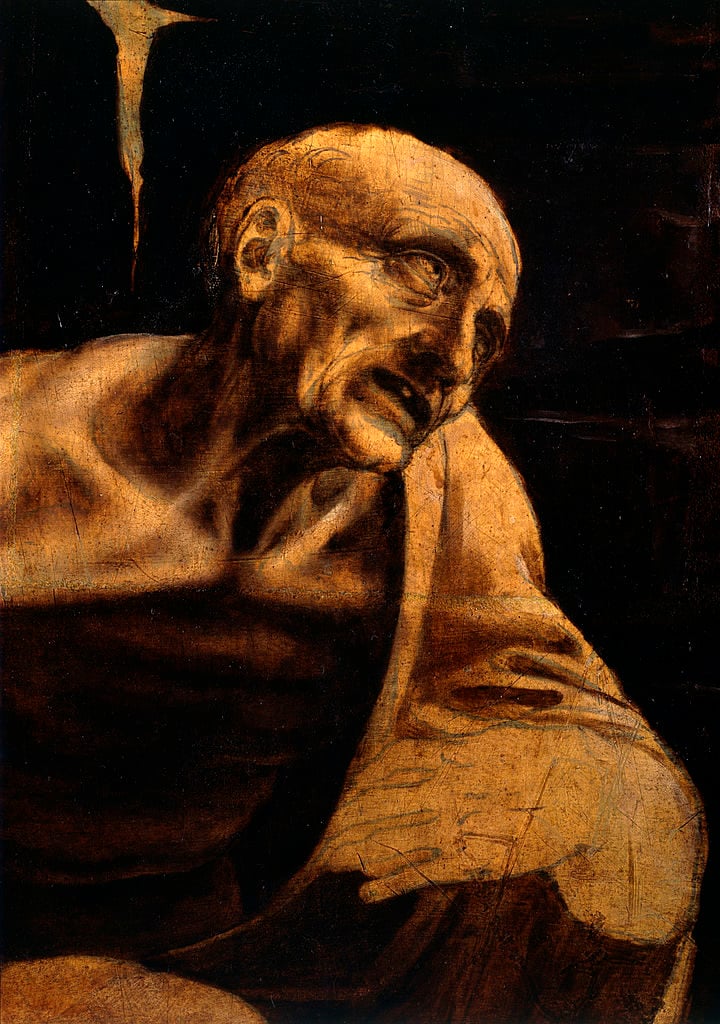
A detail of Saint Jerome in the
Wilderness at the Vatican Museums. Photo by Electa/Mondadori
Portfolio via Getty Images.
However, important loans
were eventually secured,
including Leonardo’s iconic Vitruvian Man, after an eleventh-hour court ruling threw out a case mounted by
an Italian heritage conservation group that tried to block it
from leaving the country. Other “extraordinary works” loaned from Italy
include the Vatican
Museums’s Saint Jerome in
the Wilderness.
But it was not just the
Leonardos in the exhibition that were hard won. The exhibition
begins with a sculpture by Andrea del Verrocchio, under whom
Leonardo apprenticed during his youth in Florence.
Verrocchio’s Christ and
Saint Thomas, owned by
Florence’s Orsanmichele, that was offered in exchange for 16
reciprocal loans, including two Leonardos.
Asked whether national politics
often interferes with curatorial work, curator Louis Frank says
that it comes up primarily when a subject captures public opinion
as much as Leonardo does. “But it is worth noting that, in the
majority of cases where a loan was refused, it was not for
political reasons,” Frank says, adding that most of the loans were
negotiated between museums, not heads of state.
Overall the curators say they
are “very happy” with what they have managed to secure for the
exhibition, and expressed particular thanks to the generosity of
the Queen of England, who has loaned some 24 drawings from the
Royal Collection. Despite the ongoing Brexit discussions, the UK
was the biggest lender of works to the exhibition, sending works
from the British Museum, London’s National Gallery, the Courtauld,
and the National Galleries of Scotland, among others.
New Revelations
The exhibition is the outcome of
10 years of curatorial research. “When we began our work we didn’t
understand anything about Leonardo, because the bibliography is
immense and, above all, it is contradictory,” Frank says. “We had
to start all over again to understand.”
Delieuvin undertook the enormous
task of reading the entire bibliography concerning Leonardo and,
together, the curators re-examined all the available historic
documents and literary sources relating to the artist. They redid
transcriptions and translations, and carried out new laboratory
analyses. The Louvre’s own works have undergone new technical
analyses, and three—Saint Anne, La Belle Ferronière, and
Saint John the Baptist—have had fresh conservation
treatments.
“All this means that we now have
an image that is not totally different, of course, from the
Leonardo we know, but it is now built on foundations that are clean
and solid, and there are many details that we have clarified,”
Frank says.
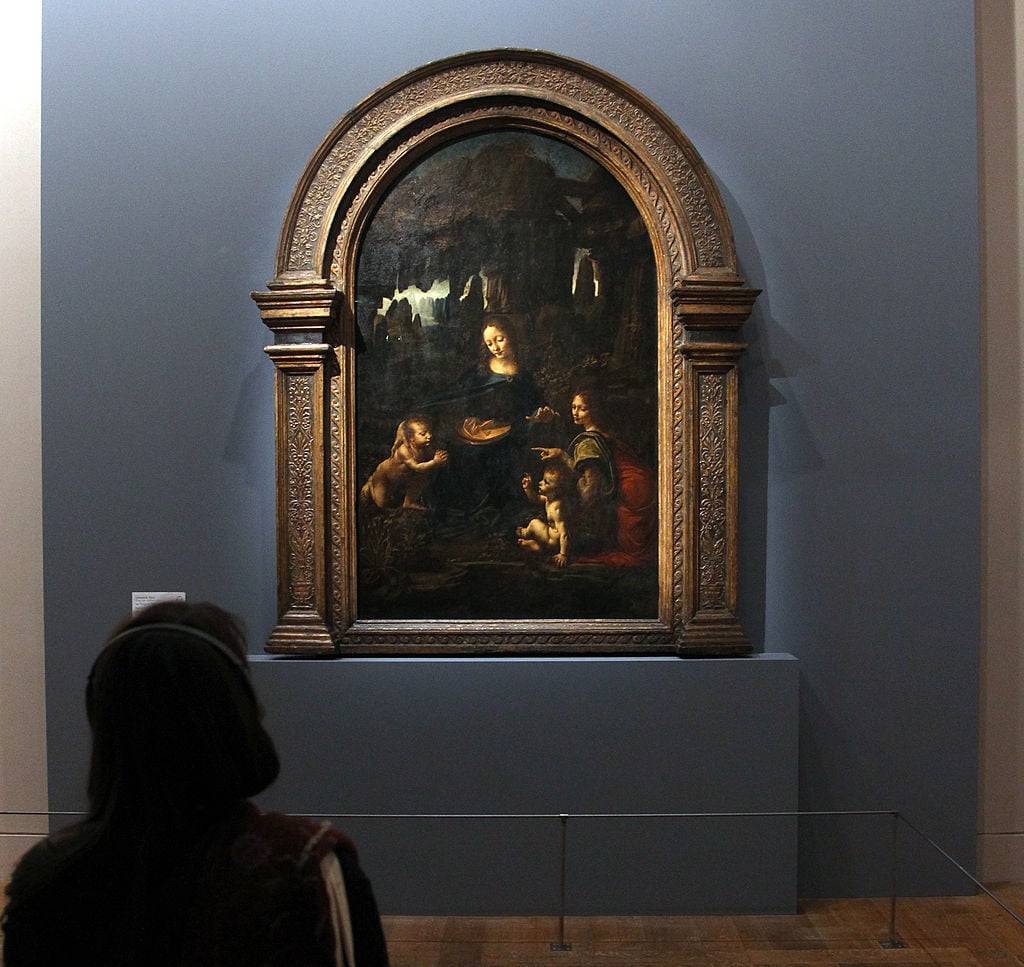
A visitor looks at the painting The
Virgin of the Rocks at the Louvre. Photo by Jacques
Demarthon/AFP/Getty Images.
Their research has, for example,
offered up a better understanding of the history of the two
versions of the Virgin of
the Rocks. Until now it
was believed that there was a years-long conflict over the earlier
painting, which is part of the collection at the Louvre, after it
was rejected by the Brotherhood of the Immaculate Conception for
being heretical because of its depiction of an angel figure. “Today
we understand that this was a false idea, and there are many of
this kind of false ideas in the historiography of Leonardo,” Frank
says.
The case was solved with the use
of infrared reflectography, which shows that the angel figure was
actually a later addition to the first painting, indicating that
the conflict was instead a financial one resulting from the
brotherhood not wanting to pay the supplement that the painters
wanted.

Leonardo da Vinci, The Virgin and
Child with Saint Anne. Photo by Christophel Fine Art/Universal
Images Group via Getty Images.
A further example of the
curators’ break from traditional beliefs about Leonardo’s work
concerns the Mona Lisa and Saint Anne, which were long thought to be late works,
dated at around 1510. A document discovered in 2005, however, which
has been a source of contention among art historians, shows that
both works were actually in advanced stages as early as 1503. The
Louvre curators have accepted this new chronology, which means it
took the artist 15 years to create the Mona Lisa and
Saint Anne.
“For us, one of Leonardo’s
fundamental traits is that he pursued the execution of his works
over a very, very long time, which is to say that, for us, he was
not at all someone disinterested in procedural execution, for whom
painting was something abstract that came after the conceptual
work,” Frank says. “To the contrary, the execution was essential
for him. Once he found an idea, he reworked it infinitely, and that
was really what was at the heart of his life. So we have put the
science of painting, the divine diversion, back at the very heart
of Leonardo’s life.”
“Leonardo da Vinci” is
on view at the Louvre, Rue de Rivoli,
75001 Paris, France, October 24,
2019,–February 4, 2020.
The post The Louvre Is Opening Its Blockbuster Leonardo
Anniversary Show This Week. Here’s What to Expect appeared
first on artnet News.
Read more https://news.artnet.com/exhibitions/leonardo-louvre-preview-1683961
Further reading


Leave a comment