
The Met Bought a Looted $4 Million Egyptian Coffin. New York Authorities Just Sent It Back
Last summer, the Metropolitan Museum of Art opened an exhibition
to showcase one of its splashiest new acquisitions: a golden coffin
from the 1st century BC dedicated to Nedjemankh, a high-ranking
priest of the god Heryshef of Herakleopolis. But the show shuttered
two months early when the museum discovered that the coffin—which
it had purchased for nearly $4 million in 2017—had in fact been
looted from Egypt.
Yesterday, that coffin was formally returned to its country of
origin in a repatriation ceremony in downtown Manhattan. In
the presence of numerous Egyptian officials including Sameh Hassan
Shoukry, the minister of foreign affairs, New York’s district
attorney Cyrus Vance Jr. provided more detail about the object’s
shadowy journey from the Middle East to the United States and
acknowledged an ongoing international investigation into those
responsible and larger problems that persist in the battle against
international trafficking of stolen antiquities.
“Our office has been investigating this
for more than seven years with support from our law enforcement
colleagues in Egypt, Germany, and France,” Vance said. The coffin’s
return is part of a concerted push by the DA to recover stolen
cultural treasures and return them to their countries of origin.
Hundreds of possibly looted objects from around the world are
currently under investigation, according to Vance.
The coffin purchased by the Met was crafted in Egypt sometime
between 150 and 50 BC and remained buried for more than 2,000
years. It was stolen from the Minya region of Egypt at the end of
the revolution in October 2011, smuggled out of Egypt, and
illegally transported to a warehouse in Dubai, according to law
enforcement. It was later shipped to Germany
for restoration and then sent to France, where it was sold to the
Metropolitan Museum of Art for nearly $4 million by an art
dealer.
Some details, including pending criminal
charges for those involved, have not yet been determined or could
not be discussed because of the ongoing investigation, officials
said. The Met previously stated that
it had received a false ownership history and fake documentation
for the coffin, including a forged 1971 Egyptian export license.
The DA’s office seized the object from the museum in
February. Once presented with evidence of the theft, the Met
“fully cooperated,” according to the DA.
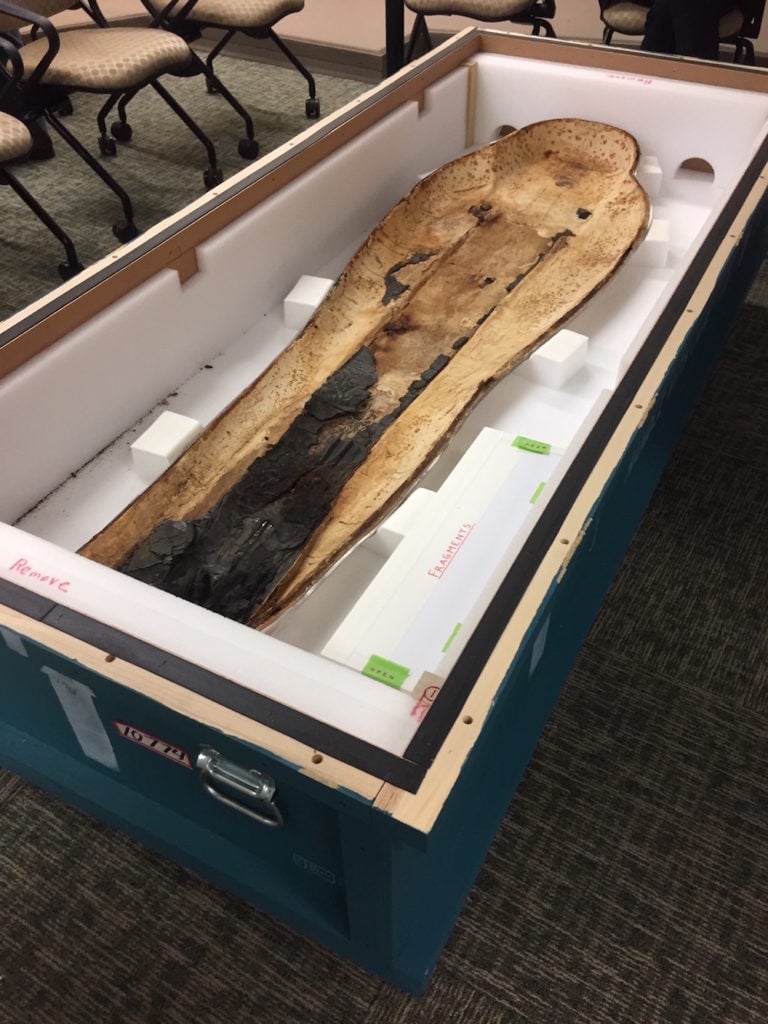
Photo by Eileen Kinsella
At the ceremony, Vance suggested the Met should have known
something was amiss: There were several “red flags,” he said, like
the fact that the six-foot-long, 2,000-year-old artifact had not
been part of a documented portfolio before it arrived in
Paris. “It is the responsibility of a buyer to confirm the
proper provenance of a piece of art or antiquity,” Peter Fitzhugh,
a special agent-in-charge for Homeland Security, said.
Back when the coffin was seized from the Met—the most recent of
several incidents in which the museum
surrendered objects that appeared to have been stolen—the museum
said it planned to review its acquisition procedures. The Met did
not immediately respond to a request for comment on the purchase of
the coffin or the status of that review. But in a podcast interview
with In Other Words
posted today, the Met’s director Max Hollein offered some
additional insight into his perspective on restitution.
Hollein emphasized that the Met wants nothing to do with stolen
objects and is proactively researching objects with questionable
provenance. “It is clear for the Met—especially for the
Met—anything that came to the Met, for whatever reason, in an
unlawful context, that we should restitute that work,” he said.
But he fell short of endorsing the more progressive views put
forth by France and some other European countries. He does not
share the view expressed by the Élysée Palace, which announced
in 2017 that “African heritage can no longer be the prisoner of
European museums.”
“I see the conversation currently, in some areas, going into a
direction that basically almost makes the argument that an object
or any artwork ideally should be returned to its original… place of
origin,” Hollein said. “[T]o argue that works can really only
fulfill their destiny by returning them to the place where they
originated, I think that goes completely against the whole idea,
of… well, for sure, the encyclopedic museum, but actually, also the
idea of art having, that has been traveled, has been traveling
around the world, and influences, and is in dialogue with so many
different people.”
The post The Met Bought a Looted $4 Million Egyptian Coffin.
New York Authorities Just Sent It Back appeared first on
artnet News.
Read more https://news.artnet.com/art-world/new-york-returns-ancient-4m-mummy-1661824
Further reading


Leave a comment