
‘The Planet We Think We’re Living on No Longer Exists’: 3 Profound Ways the Art World Can Address the Climate Crisis
While the art world’s habit of
jetting from one art fair or biennial to the next becomes
increasingly untenable as the climate crisis looms, a group of art
industry leaders headed to the Swiss mountaintops last weekend to
discuss how the field can reduce its complicity in environmental
collapse.
The irony of traveling to a
remote alpine village to discuss the climate at the fourth annual
Verbier Art Summit was not lost on some of its speakers. Across two
days of programming, “Resource Hungry: Our Cultured Landscape”
showcased presentations by artists including Joan Jonas as well as
organizations like Julie’s Bicycle, but it was finally on the last
afternoon that Stefan Kaeg of art group Rimini Protokoll voiced
what everyone had been thinking the whole time: Could the knowledge
shared in Verbier have happened in a different form, without any of
us being there? However
noble the cause, one wonders if luxurious symposia like Verbier are
even close to sustainable.
While the art world drags its
heels on structural overhauls, this year’s
organizer Jessica Morgan, director of Dia Art Foundation nevertheless
pulled together a fascinating crop of creatives to tackle
formidable questions around the industry’s ecological
impact.
Here are three of the weekend’s
biggest takeaways.
1. Form Can No Longer Follow Function
Artist Andrea Bowers said it
plainly on Saturday afternoon: “The earth is not ‘out there,’ we
are part of it.”
Indeed, as we sat glassed-in on
the third floor of the resplendent W Hotel, with the occasional
paraglider-on-skis floating by, this could be easy to forget. Many
speakers referenced the need to break down the divide between the
museums, galleries, art fair halls, and the real, exterior world.
Offering a Global Warming 101 reminder, French architect Philippe
Rahm, who works in the fields of physiology and meteorology,
stressed that 42 percent of CO2 emitted today is from the cooling,
heating, and general operation of buildings.
So, how can a climate-controlled
storage space, gallery, or museum reduce its energy consumption, or
is that besides the point? Rahm said we need to look beyond updates
to wall insulation and instead completely redesign space in line
with what he calls “climactic architecture”—a method that utilizes
a building’s own convection, radiation, and conduction capabilities
to optimize renewable resources. Architecture, said Rahm, “is no
longer [based on the idea of] form following function or function
following form. It’s function for the form that follows
climate.”
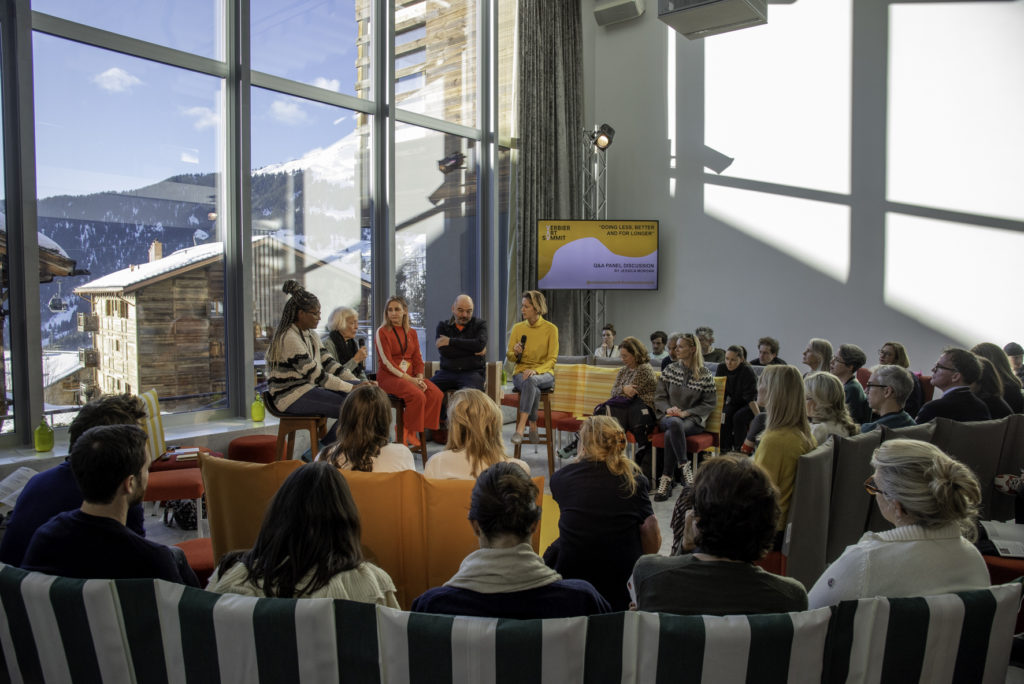
Djamila Ribeiro, Joan Jonas, El Ultimo
Grito, and Jessica Morgan at Verbier Art Summer. ©Alpimages
Renowned professors of design
practice Rosario Hurtado and Roberto Feo—collectively known as El
Último Grito—took the question raised by Rahm to a more speculative
level: What would it mean if museums were free from fixed spaces
altogether? While humans continuously create permanent structures,
many of these places deteriorate or get demolished relatively soon
after. Meanwhile, structures initially built with ephemeral
intentions (take the Eiffel Tower, for example, which was supposed
to be a temporary installation for the World’s Fair) survive for
centuries.
With this, Hurtado and Feo’s
question seemed to push back against the status quo of the art
world’s usual haunts, underscoring that the museums and galleries
that we have become so familiar with need to be fundamentally
reconsidered. While spacious, pristinely white, and
climate-controlled venues may feel like they’re here to stay, art
historian Dorothea von Hantelmann pointed to exhibition spaces of
the 18th-century which were extremely crowded, with walls crammed
with art from the floor to the ceiling. “We need to strive against
the white cube,” said von Hantelmann. “We need to bring things that
we’ve been separating back together.”
2. Older Doesn’t Always Mean Wiser
One of the most significant
changes professors Hurtado and Feo said they witnessed in their
students over the past decade was the shift away from
individualistic thinking towards collaboration. It’s a shift seen
beyond the confines of art and architecture schools, of course, as
today’s youth bring forth new ideas and fight collectively for
their future, most notably through the Fridays for Future
movement.
Artists Joan Jonas and Andrea
Bowers echoed this hope in young activists. Jonas explained that
children have become subjects in her work about the future and the
environment (“they’re the ones who are going to inherit it,” she
added, simply). With similar motivations, Bowers’s new video My
Name Means Future, which is currently on view at New York’s
Andrew Kreps Gallery, spotlights Tokata Iron Eyes, a 16-year-old
member of the Standing Rock Sioux tribe, and her involvement with
the movement to stop the Dakota Access Pipeline. But what was
missing in both presentations was a consideration of the changing
role youth plays in viewership; both artists were mute on whether
they even considered the importance of young people seeing their
work.
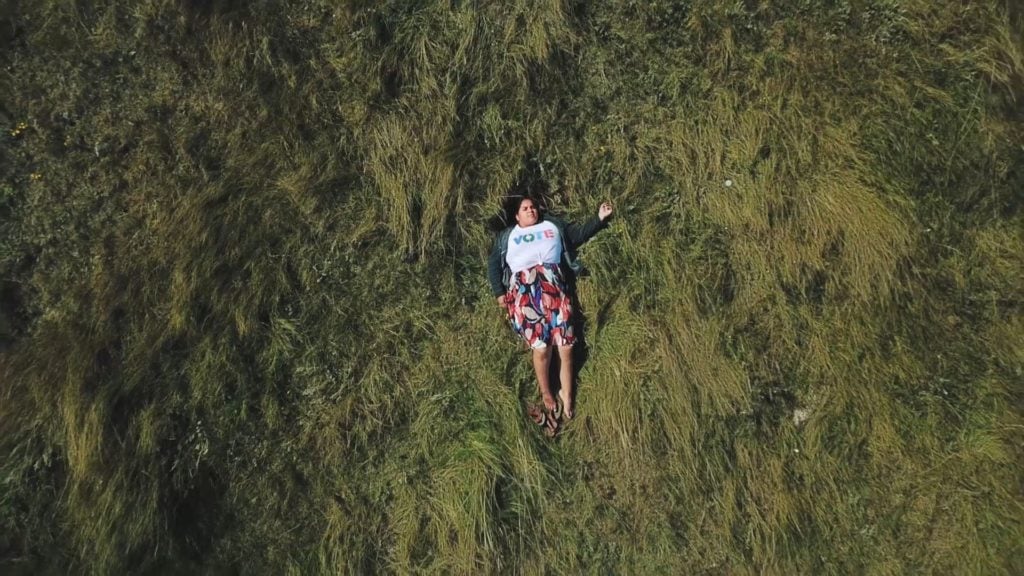
Andrea Bowers, My Name Means
Future (2020). Image courtesy of the Artist and Andrew Kreps
Gallery, New York.
To place the crisis of climate
change on the shoulders of one generation and await a solution is
clearly not the answer; Catherine Bottrill from Julie’s Bicycle, a
London-based charity that supports creative industries’
transformations towards sustainability, stressed the need to
“support young people who are going to bring about solutions,”
while operating at all ages and levels laterally, collaborating
across organizational boundaries and typical
hierarchies.
3. Decolonizing Narratives Are Ecological
Narratives
The calls to decolonize the art
world might not immediately conjure a connection to climate change.
However, Brazilian philosopher Djamila Ribeiro emphasized that,
more than listening to the voices of indigenous cultures, we need
to begin to act upon their novel ways of thinking and apply them to
the ways we treat the natural world. In order to hear those voices
that are so often drowned out, current power structures need to be
dismantled, he argued. Other speakers, including Bottrill of Julie’s
Bicycle, concurred: Hierarchies have to be disrupted. This was a
major talking point, as architect and urban designer Adrian Lahoud
pushed for a similar upheaval, adding that “the planet we think
we’re living on no longer exists.”
"background:#FFF; border:0; border-radius:3px; box-shadow:0 0 1px 0 rgba(0,0,0,0.5),0 1px 10px 0 rgba(0,0,0,0.15); margin: 1px; max-width:500px; min-width:326px; padding:0; width:99.375%; width:-webkit-calc(100% - 2px); width:calc(100% - 2px);">
View this post on Instagram
One of the most effective ways
to fight climate change will be to redefine our values. Lahoud
shared a moving story behind a
painting on view in
the current edition of the Sharjah Architecture Triennial, which he
curated. A group of 40 Aboriginal artists painted an 8-by-10-meter
canvas, collectively depicting the story of their cultural history;
they then submitted the piece to the Australian government as
“proof” of their rights over nearly 30,000 square miles of land.
Amazingly, the Australian government accepted this painting as
evidence of ownership and, in 2007, granted them the rights over
the disputed territory.
Alternative modes of existence
“embody different ways of being in the world, outside of the
xenophobic, extractive, capitalist modes of relating that currently
dominate the world, that lead us to exhaustion, and soon to
extinction,” according to Lahoud. And, at least in some cases, art
can be a welcome bridge to these new ways of thinking.
The post ‘The Planet We Think We’re Living on No Longer
Exists’: 3 Profound Ways the Art World Can Address the Climate
Crisis appeared first on artnet News.
Read more https://news.artnet.com/art-world/verbier-art-summit-2020-1769085
Further reading


Leave a comment