
The Private Museum Boom Takes a Dark Turn With the Opening of Musja in Rome, a Cavernous Showcase Themed to ‘Fear’
The
irresistible rise of the private museum has arrived in Rome in a
dramatic way. The Italian collector and real-estate mogul
Ovidio Jacorossi has opened a new museum called Musja in a
cavernous space filled with sinister works.
Like
many of Rome’s museums, Musja is built on top of ancient ruins. It
aims to challenge the idea that locals and visitors to Rome are
more interested in historic art than the art of today. Judging by
its strong opening show, Musja could succeed in what is always
going to be a tough task.
The
Italian capital might be home to a number of contemporary art
galleries, including outposts of international powerhouses like
Gagosian, or the superbly cool Gavin Brown’s Enterprise, but the
city is not known for its contemporary art scene. Its Modern and
contemporary art institutions, such as the MAXXI and Macro museums,
must vie for visitors with the Vatican Museums, art-filled historic
churches, and world-class archaeological museums. The Villa
Borghese might have stepped up its contemporary art program, but it
remains better known for its ancient treasures and Renaissance
masterworks.
Jacorossi’s new museum, which opened to the
public on October 8, aims to fill a gap in the city’s contemporary
offerings. The venue has evolved out of a commercial gallery, and
is now a state-recognized, nonprofit institution.
“It is an innovative cultural
space,” Jacorossi said in a statement, describing the museum as a
“donation to the community, [and] the expression of an accessible,
democratic, and shared idea of culture.”
A
collector since the late 1960s, Jacorossi started out buying
Italian Modern art. His 3,000-strong collection now boasts
contemporary pieces by leading international artists. Several are
included in the museum’s inaugural show, including a drawing of a
burning cross by Robert Longo, and Monica Bonvicini’s sculptures
made of black fetish belts. The German artist Gregor Schneider has
“sacrificed” pieces from the founding collection to make a
site-specific, installation with the apocalyptic title End of
the Museum (2019).
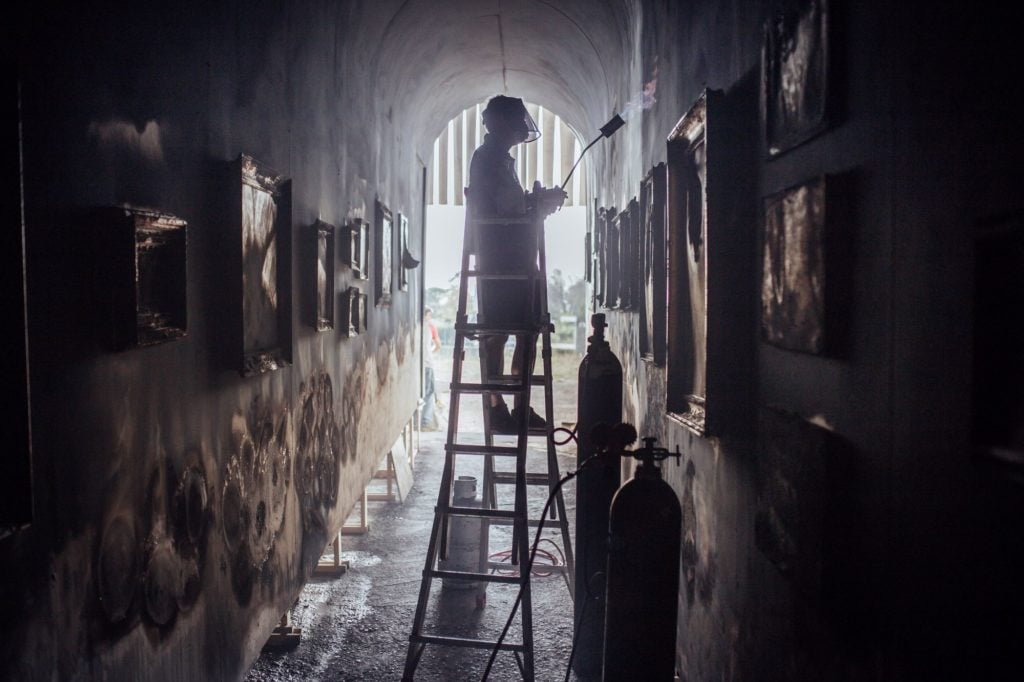
Gregor Schneider, End of the
Museum (2019).
Courtesy the artist.
The
inaugural show, “Who Is Afraid of the Dark?”, is the first in a
trilogy on the theme of fear. “With this exhibition, we tried to
give an idea of the collection, and to move from a private
collection to a museum,” says the veteran curator Danilo Eccher. He
is curating the next
chapters, which will explore fear of time, and fear of loneliness.
A curator and art critic, Eccher has served as director of a number
of Modern and contemporary art museums across
Italy.
Eccher invited Schneider to
create a site-specific work for a tunnel-like space in the museum.
It is a clever choice, as Schneider’s work is centered on
explorations of emotional states of distress, often installed in
claustrophobia-inducing spaces. Schneider’s new
work consists of dozens
of charred paintings hung on the corridor’s burnt walls. “When I
told [Schneider] I wanted him to create a work for a new museum he
said: ‘OK, then we destroy the old one,’” Eccher explains. The
canvases all came from Jacorossi’s collection, which Schneider
arranged on the wall and then took a torch to. “We chose not the
most interesting ones,” Eccher says.
The
museum’s complex, cavernous spaces lends itself to such moody
ruminations. It is built—like much of the neighborhood it is
located in—on the ruins of the ancient Theater of Pompey. Some
walls in the museum’s lowest level are part of the ancient Roman
ruin. “This is the area where Julius Caesar was assassinated,” says
Eccher. “Caravaggio killed a man not far from here, too. I thought
it would be good to link the emotional aspect of this space [to the
exhibition], and chose one aspect of humanity’s dark
side.”
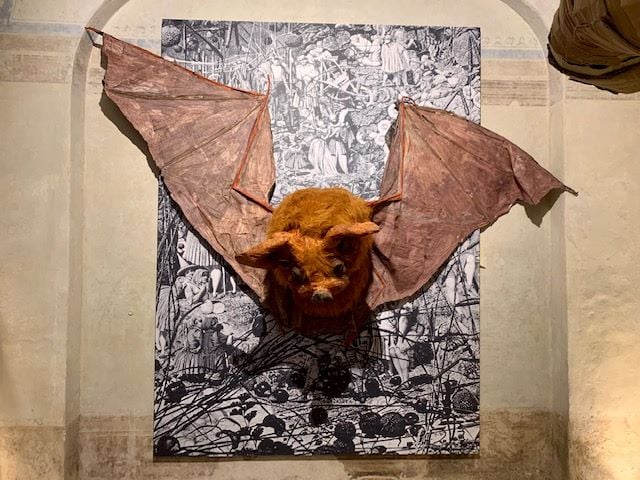
Monster Chetwynd Bat (2018).
Courtesy Fondazione
Sandretto Re Rebaudengo.
Three
large-scale, mixed-media pieces by the British artist Monster
Chetwynd dominate a small antechamber. They include a wide-open
dragon mouth Red and
Black Head (2018), and
the artist’s Hell
Mouth 1 (2005). The
latter playfully evokes Rome’s famous Mouth of Truth,
an ancient marble mask, which is a stone’s throw away at the
site of the Forum Boarium. Other highlights in the small yet
beguiling show include new pieces by US artist Tony Oursler, a
meandering site-specific woven piece by the Indian artist Sheela
Gowda, and two beds entangled by the Japanese artist Chiharu
Shiota’s signature yarn webs. On opening night, two performers
crawled into the beds and rested.
For
now, a private museum is a rarity in Rome. Contemporary art is not
in high demand here, and most tourists are unlikely to add Musja to
their Rome bucket list. (Full admission price is €13, or $14).
According to Eccher, the audience he had in mind is locals as well
as Italian tourists who are interested in the international
contemporary art scene.
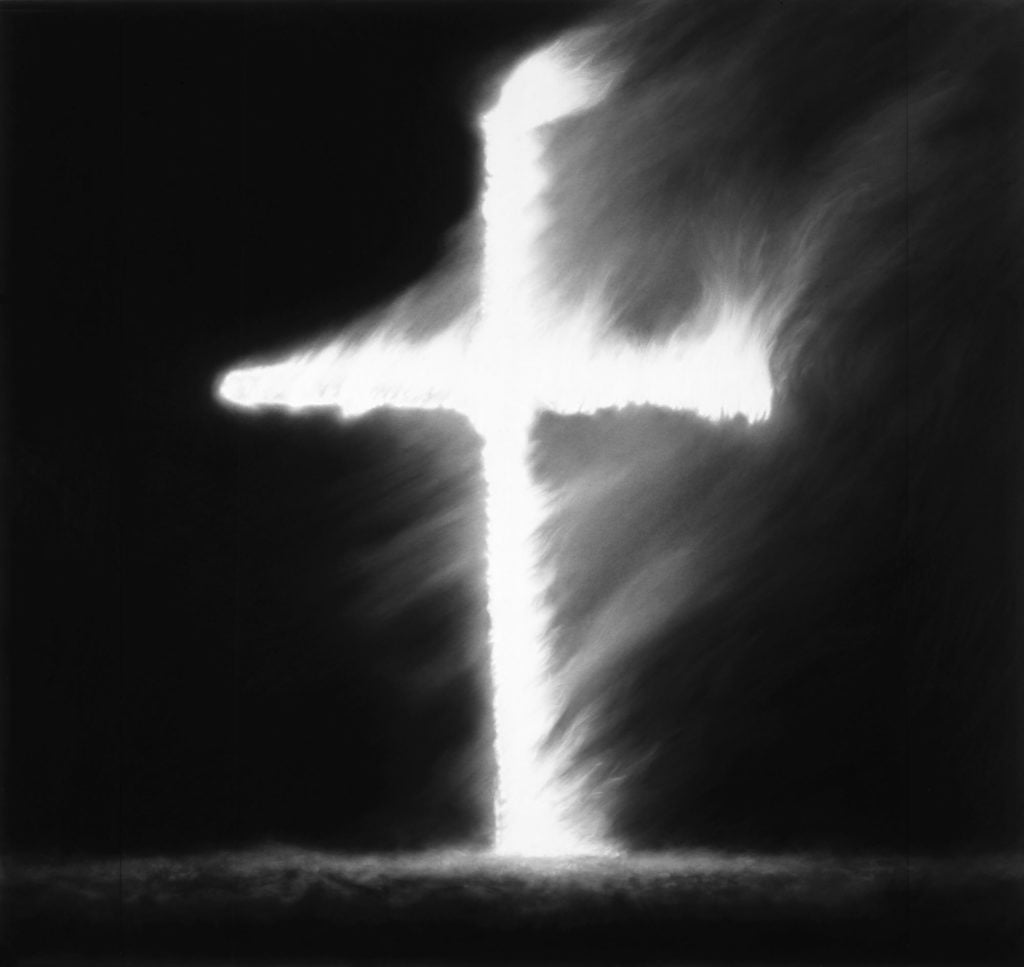
Robert Longo Untitled (Burning Cross
– From the
American Stories Cycle) (2017). Courtesy the artist & Galleria
Emilio Mazzoli, Modena.
Venice
has its biennales. Milan and Turin host Italy’s leading art fairs,
and all three Northern Italian cities are home of major corporate
collections and private museums, including the Pinault Collection,
Prada Foundation, Pirelli Hangar Bicocca, and the Fondazione
Sandretto Re Rebaudengo. While Rome has its share of contemporary
art collectors, they prefer to remain private, and have not so far
embraced the global trend to open their own museums and spaces.
“[Musja] could be an example,” Eccher says. “Maybe not necessarily
for opening more private museums, but to make Rome’s private
contemporary art collections accessible.”
The post The Private Museum Boom Takes a Dark Turn With the
Opening of Musja in Rome, a Cavernous Showcase Themed to ‘Fear’
appeared first on artnet News.
Read more https://news.artnet.com/exhibitions/new-private-museum-rome-1678864
Further reading


Leave a comment