
To Portray America’s Diversity in the Age of Polarization, Shirin Neshat Went to New Mexico to Photograph One of Its Poorest States
I recognized Shirin Neshat by her black kohl eyeliner, which
frames her kind eyes like war paint.
We met at Goodman Gallery in London, where the veteran artist is
presenting a new body of work in her first solo exhibition in the city in two
decades. The two films and the series of photographic portraits on
view in “Land of Dreams” convey a shift in focus for Neshat, who has
often used her work to look back at her native Iran.
Now, her steely gaze is fixed
firmly on her adoptive home, the US.
Neshat told me this new chapter
is somewhat “activist” in tenor. “The rise of white supremacy and
fanaticism in the US is very real,” she said. “We—and I say we
because I think I am American as well—are at risk of a major
transformation.”
Installation view, “Shirin Neshat: Land
of Dreams” courtesy Goodman Gallery.
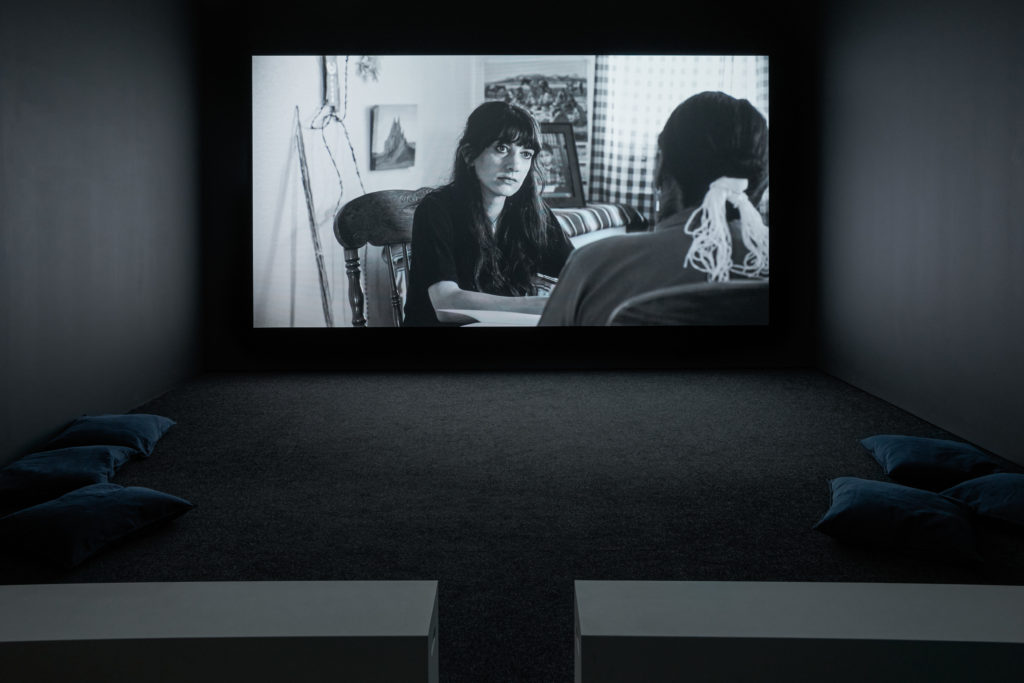
The artist’s highly stylized
black-and-white films follow a young Iranian art student, Simin, as
she travels across the US taking portraits and asking her subjects
about their dreams. Along her journey, Simin has doors slammed in
her face, but she’s also welcomed, which Neshat said echoes her own experience of
America.
“I feel that all the time that
I’ve been in this country, I’ve been mostly treated really well,”
she said. “But I have also felt racism, and that’s one of the
reasons I think I wanted to make the film, because the United
States of America is changing.”
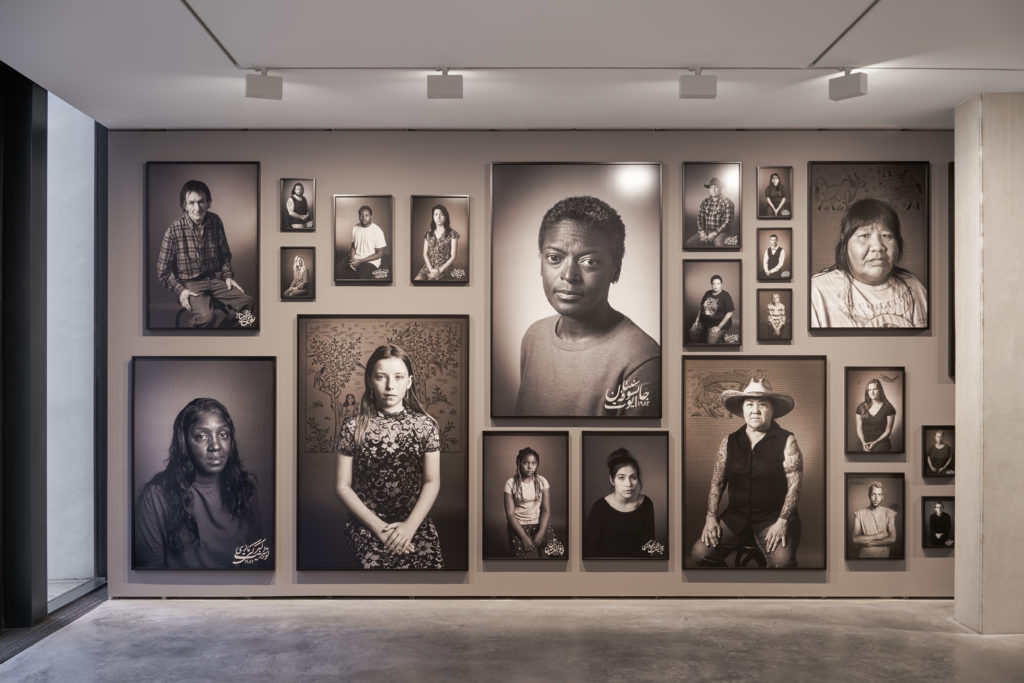
More than 60 portrait
photographs are also on view, which Neshat captured as she traveled
across New Mexico going door-to-door offering people $20 to
photograph them. She chose New Mexico because of its diverse
population, which comprises white Americans as well as a large
Hispanic immigrant contingent, African American communities, and
Native American reservations. It is also one of the poorest US
states.
“It’s a kind of a portrait of
America, a portrait of immigrants,” Neshat said. “What you see 20
years from now may be very different. There is an idea of
‘purifying’ the white race, and of building walls, which is a
phenomenon that is fundamentally anti-American.”
Installation view, “Shirin Neshat: Land
of Dreams” courtesy Goodman Gallery.
Land of Dreams
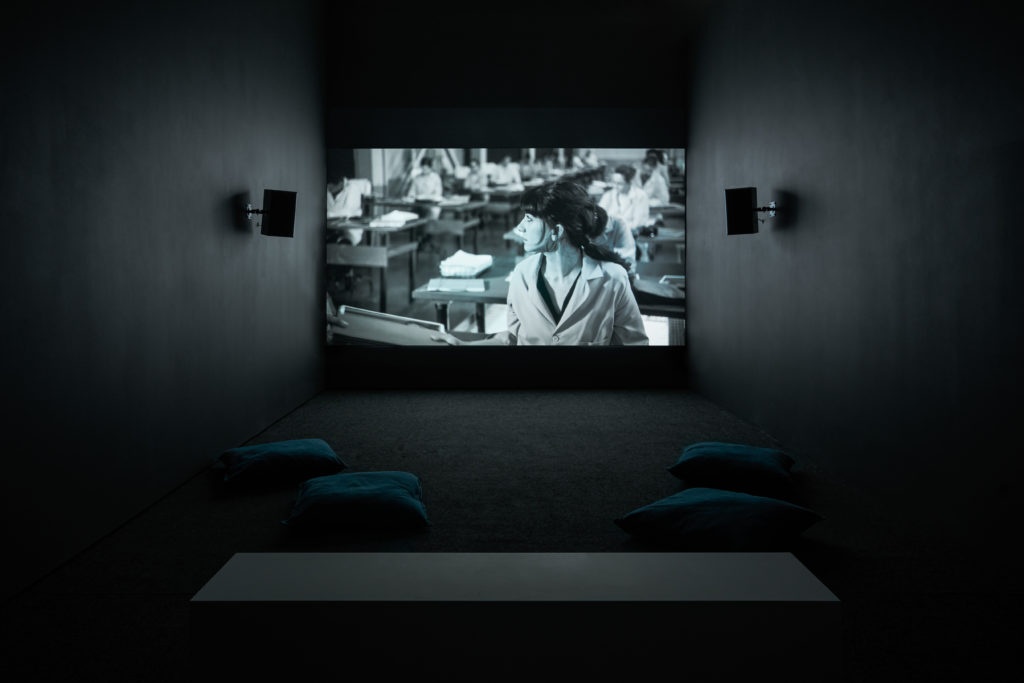
The second film in the
exhibition, The Colony, involves an absurd twist, revealing
Simin as an Iranian spy who reports American dreams back to a
dystopian Iranian colony in the mountains. As the film progresses, Simin begins to
emotionally identify with her American subjects’ dreams.
“Dreams are very similar
regardless of where you come from,” Neshat says. “Our nightmares
and anxieties are similar. They are fears about aging, about death,
war, and displacement.”
Growing up in Iran, Neshat
experienced the rise of radical Islam in the years leading up to
the Iranian Revolution in 1979. Since she emigrated to the US in
the 1990s, her work has often raised questions about how her
country was ideologically transformed in such a brief
period.
“I always thought of Iran as
having had absolutely the most backward and unbelievable
transformation, a resurrection of something that in this time and
age seemed impossible,” she said. “But it happened, and now they
have been in power for 40 fucking years, and people are
brainwashed.”
Similarly, she is alarmed by the
dominance of Fox News in the US, and says “there is a risk of
fascism in America.” She also sees “frightening similarities” between the rise of
white supremacy in the US, the UK, and parts of
Europe.
But the art market, she said, can blind artists to their social
responsibilities.
“They are more concerned with
making commodities, and the whole art world is so dominated by the
market that artists are often very ambivalent,” she
said. “I sometimes feel
bad saying this, because to be honest, I’m a blue-chip artist
showing in a commercial gallery. But we don’t need to exist only to
serve the museums and galleries and collectors.”
Installation view, “Shirin Neshat: Land
of Dreams” courtesy Goodman Gallery.
The Colony
Late last month, Trump introduced even tighter restrictions on
foreign travel to the US. And even though she is an American
citizen, Neshat expressed a growing concern that she may not
be permitted to return to the States because her place of
birth is marked on her passport.
In the early ’90s, Neshat had a harrowing experience that still
haunts her. After attempting to leave Iran, she was detained by
officials for hours before being permitted to travel abroad.
“I was just devastated,” she
recalled. “I knew I would never go back. As I entered the US on the
other side, there was an African American immigration officer. And
the first thing he said after he gave me back my passport was
‘welcome home,’ and I just started crying.”
“To me, that was the definition
of America,” she added. “And that is changing.”
Over the next two years, Neshat plans to return to New Mexico
to film a feature-length version of
the films in the exhibition. She and her team have been working on
the script for the past three years, and they are now in
fundraising stages and plan to start shooting in May.
“I want to explore a greater
balance in terms of the representation of the communities in
America. I don’t want it to be like poverty porn,”
she said.
Neshat said she has considered
leaving the US if Trump gets re-elected. But the artist is trying to stay
optimistic.
“I think the issues are so
immense and overwhelming that you could just lose yourself in
despair. But I have an individual responsibility, and I see that as
an artist, I have a minor, minuscule role as a communicator. And I
will play that role.”
“Shirin Neshat: Land of Dreams” runs through March 28
at Goodman Gallery, London.
The post To Portray America’s Diversity in the Age of
Polarization, Shirin Neshat Went to New Mexico to Photograph One of
Its Poorest States appeared first on artnet News.
Read more https://news.artnet.com/exhibitions/shirin-neshat-land-of-dreams-interview-1785786
Further reading


Leave a comment