
Vija Celmins’s Art Will Make You See the World in a Whole New Way. Here’s How It Works
It’s the most basic function a picture can serve: Just pointing
to things in the world, to say “Look at that.” That simple, primary
duty of “ostension,” as a philosopher might put it, outweighs all
the later decisions an artist makes about how an image should look.
Over tens of thousands of years, pictures, in any number of styles,
have done the job of pointing to prehistoric bison, medieval
saints, Japanese courtesans, and even cans of Campbell’s soup. So
what are the chances that someone could come up with a new set of
pictures—highly realistic pictures, at that—that manage to bypass
or even undo art’s vital finger-pointing?
That, amazingly, is what Vija Celmins has achieved, again and
again, over her 50-year career in Los Angeles and then New York. In
the Celmins retrospective now
at the Met Breuer in Manhattan, that achievement gives her art
a philosophical depth, and a profound weirdness, that overcomes a
first impression of straightforward image-making.
Celmins’s early paintings, from the mid-1960s, do in fact offer
a standard, Pop Art-y job of pointing at things in our domestic
world: a heater, a lamp, an electric fan. Those subjects may not be
much to point at, but they’re still caught up in the venerable
artistic task of “looking at the overlooked,” to borrow Norman
Bryson’s famous phrase. By the
middle of the next decade, however, Celmins started messing with
art’s normal ostensive aims.
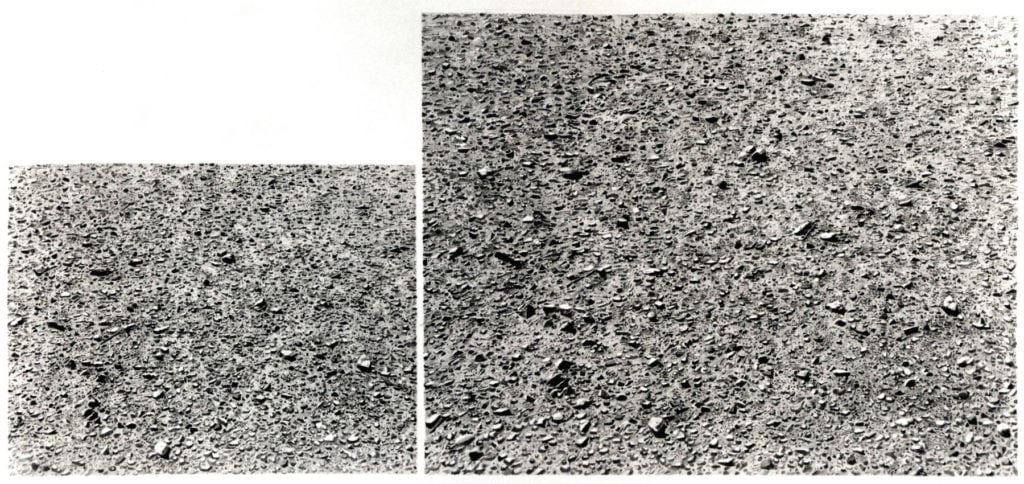
Vija Celmins, Untitled (Double
Desert) (1974). Collection of Harry W. and Mary Margaret
Anderson © Vija Celmins, courtesy the artist and Matthew Marks
Gallery.
In Untitled (Double Desert), from 1974, she provides
two identical images of the same little patch of dry ground, side
by side—meaning that one of them, at least, has nothing left to
point to that hasn’t already been pointed to by the other. And yet
Celmins has spent vast labor achieving that non-pointing, using the
sharpest of pencils to capture just about every grain of sand in
her scene… twice. That labor alone tells us that something
substantial must be at stake—more, certainly, than a doubled
demonstration of traditional realist skill.
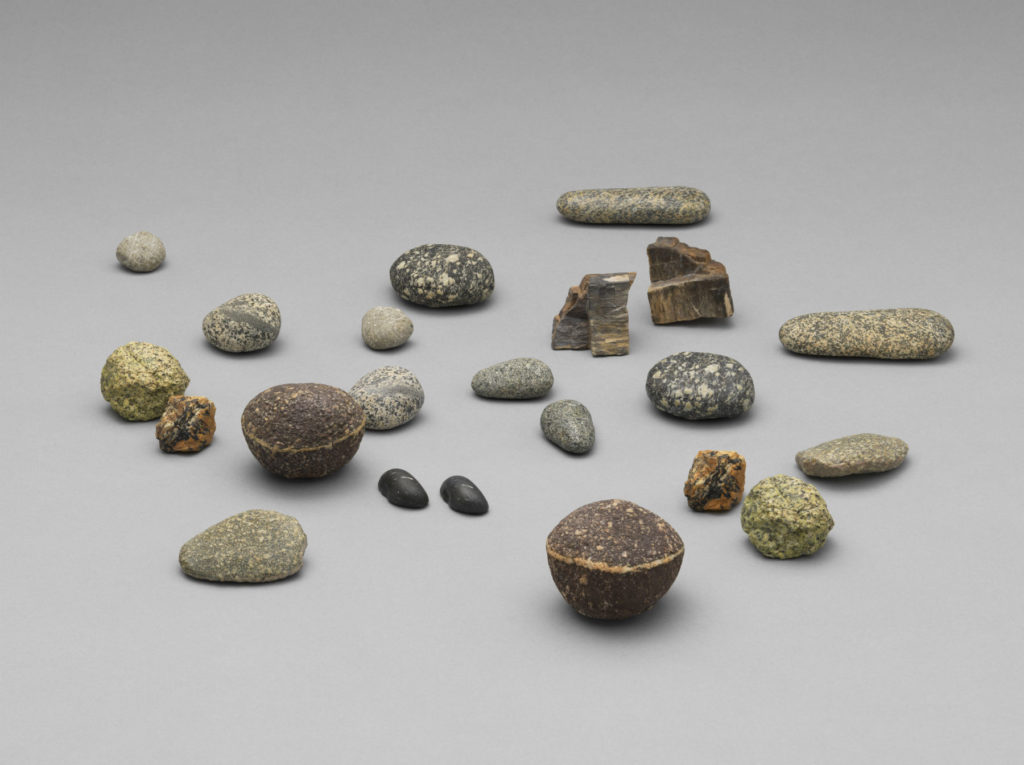
Vija Celmins, To Fix the Image in
Memory I–XI (1977–82). The Museum of Modern Art, New York,
gift of Edward R. Broida in honor of David and Renee McKee © Vija
Celmins, courtesy the artist and Matthew Marks Gallery Image © The
Museum of Modern Art/Licensed by SCALA / Art Resource, NY.
In the Renaissance, when European theorists got busy thinking
about representation, they talked about the way the new realist art
could make “absent things present.” Celmins’s utterly peculiar
update on that notion is to make present things
present, replacing function with hard-won redundancy. Doublings
like the one in her desert diptych happen again and again in her
art, including in the sculptures she has gone on to produce in more
recent decades. She presents real found rocks and pebbles, of no
particular distinction, alongside hand-made sculptures of precisely
the same banal stones, shaped and painted to perfectly reproduce
each and every one of the real ones. Celmins has deployed the
obsessive efforts of trompe l’oeil to fool us into seeing something
that’s already there for us to look at.
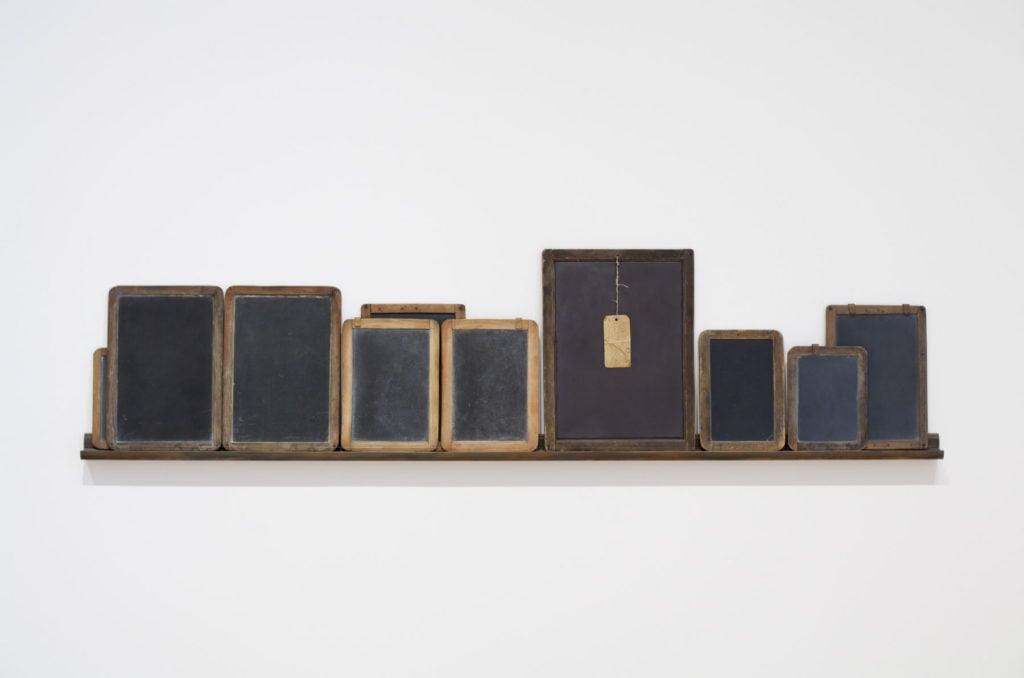
Vija Celmins, Blackboard Tableau
#1 (2007–10). San Francisco Museum of Modern Art, purchase, by
exchange, through the bequest of Elise S. Haas © Vija Celmins,
courtesy the artist and Matthew Marks Gallery.
She plays the same trick with old grade-school blackboards that
she bought here and there and then had fabricated in perfect
facsimile. Erased of all the scribbled content they might once have
carried, her doubled blackboards actually depict the content-less
state of all her duplications.
Even works by Celmins that don’t involve doublings seem to fail
in their pointing function. Drawn or sometimes painted as
black-and-white monochromes, her images almost always make clear
that they are perfect reproductions of photographs that have
preceded them—meaning that any ostension that needed doing was
already done in those photos. Why point again at something that has
already been pointed out?
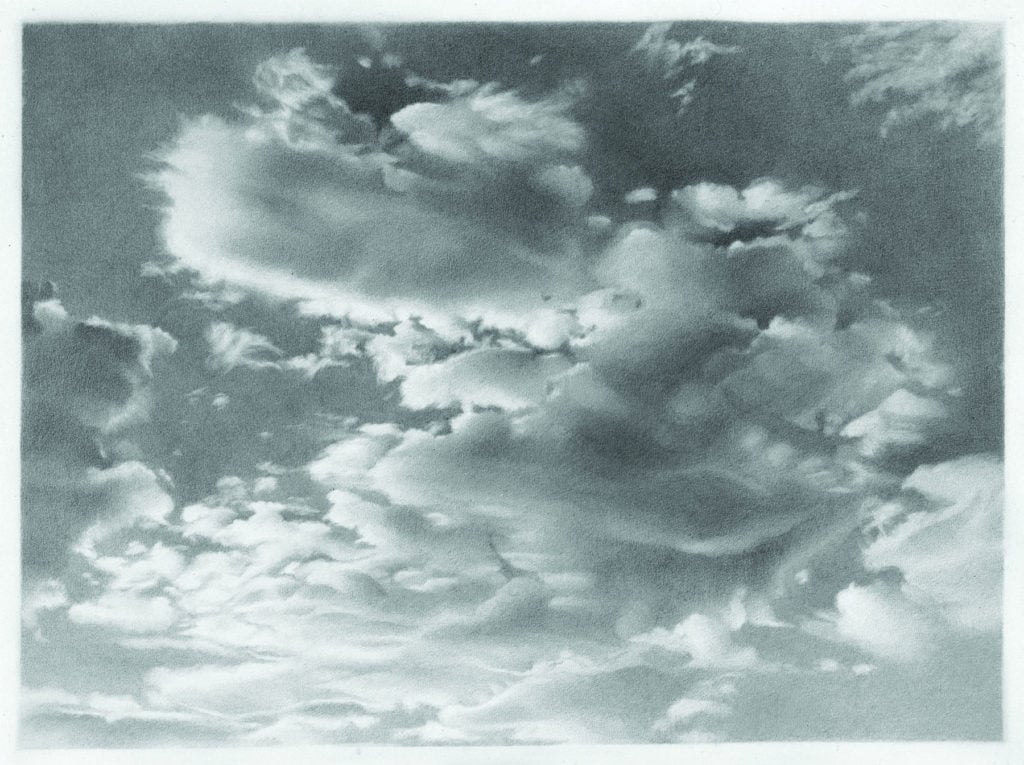
Vija Celmins, Clouds (1968).
Collection of Eba and Jerry Sohn © Vija Celmins, courtesy the
artist and Matthew Marks Gallery.
And even before they got hand-reproduced, many of the source
photos chosen by Celmins didn’t really do anything like a decent
act of picking-out. When she presents us with a half-dozen images
of various choppy waters, or of different patches of the night sky,
or of assorted spiders’ webs, their subjects are so generic that
one of her pictures could stand for the whole series. The tiny
differences between each rectangle of sea or sky or web, however
fanatically recorded by Celmins (or her camera), don’t actually add
up to information we can use. Each picture, and each series, just
confirms the mental image we already have of its banal subject,
thanks to the thousands of photos of it that we’ve come across
before. You could say that Celmins depicts the over-seen.
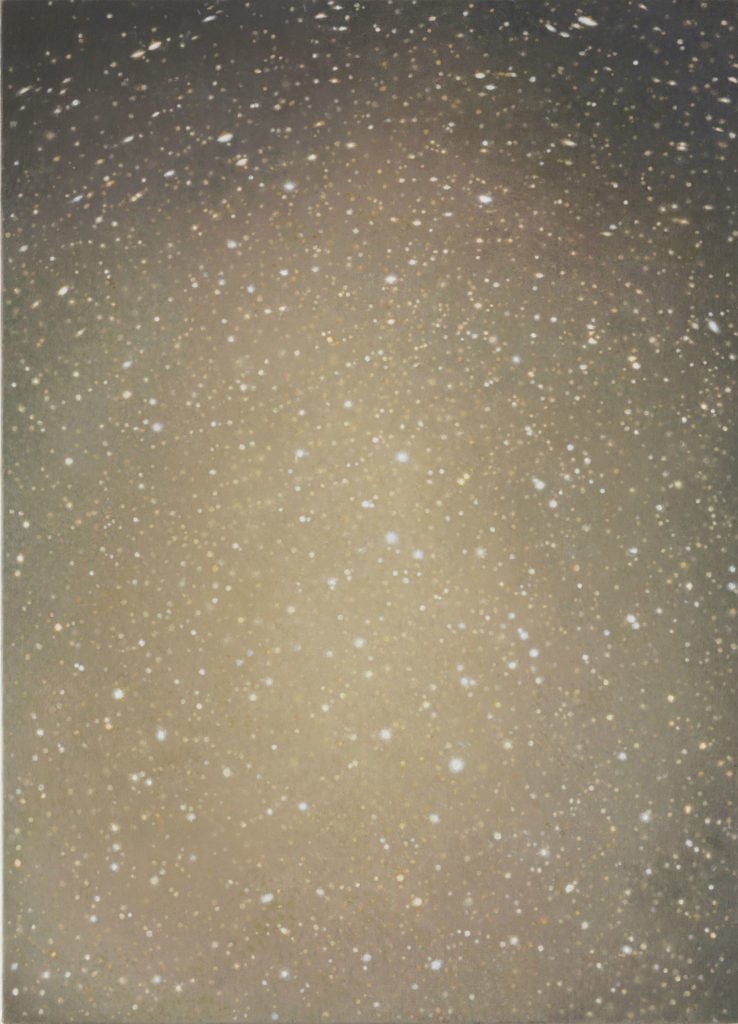
Vija Celmins, Night Sky (Ochre)
(2016). Private collection © Vija Celmins, courtesy the artist and
Matthew Marks Gallery.
Although Celmins’s images look vastly informative, almost
scientific, in their surfeit of detail, there’s rarely any novel,
usable knowledge to be gleaned from them. Even when she blows up a
single one of her starry nights to fill a wall, it carries
precisely the same content—the same number of dots of light, in the
same positions—as if it were presented much smaller. This isn’t
about zooming-in closer on the real world so as to get at more
detail in it; it’s just enlarging an image. The increase in scale
involves more work, maybe, but to no more effect. And that’s
precisely the point.
If futility is at hand in Celmins’s pictures, that’s hardly
surprising. She came of age as an artist at the moment when
painting, along with most hand-made imagery, had been declared
moribund or maybe plain dead, and especially lifeless when it came
to the old task of ostension, which had been usurped by
photography.
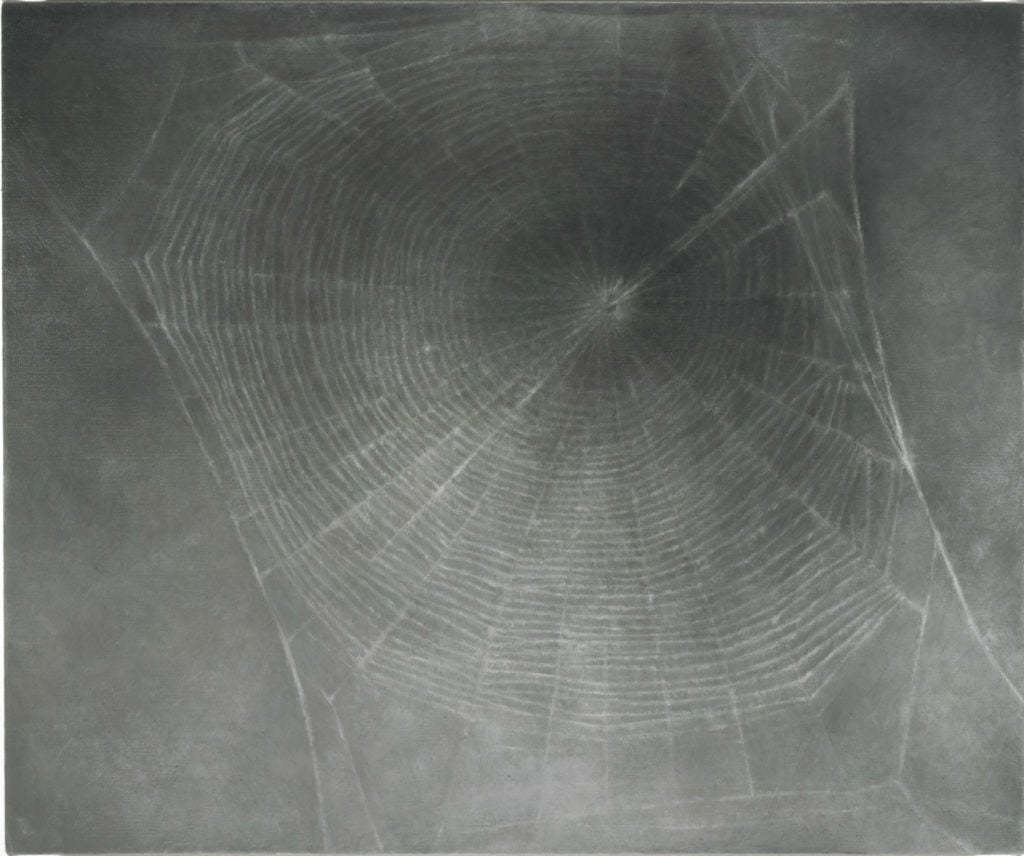
Vija Celmins, Web #3
(2000–2002). The Museum of Modern Art, New York, gift of Edward R.
Broida, 2005 © Vija Celmins, courtesy the artist and Matthew Marks
Gallery.
What Celmins did was to recognize—and depict—what a peculiar and
unlikely state that was. Her work shows how, after all those
millennia of picture-making, the 20th century ushered in a
moment when not pointing at last became an artistic
possibility. Modernism had made that possible the easy way, with
abstraction. The postmodern art of Celmins took the much harder
path of doing it with high realism. It proves that there’s still
life left in depiction, by showing that it—and only it—has the
power to point to its own disempowerment.
Blake Gopnik is the author of Warhol, a comprehensive
biography of the Pop artist forthcoming from Ecco at
HarperCollins.
The post Vija Celmins’s Art Will Make You See the World in a
Whole New Way. Here’s How It Works appeared first on artnet
News.
Read more https://news.artnet.com/exhibitions/vija-celmins-met-breur-1684402
Further reading


Leave a comment