
‘We Evolve Together’: Food Artist Laila Gohar and Graphic Designer Omar Sosa on How Married Life Fuels Their Creativity
What’s it like for two artists
to be in a romantic relationship?
History has provided us with
enough examples to know that partnerships between creatives can be
as mutually beneficial as they can be toxic. In fact, some of the
more famous love stories over the years have been those of artists
whose brightly burning unions emit as much smoke as they do light.
Frieda Kahlo and Diego Rivera, for instance, ultimately couldn’t
live without each other—or, as it turned out, under the same
roof. The artist Françoise Gilot, Pablo Picasso’s longtime
lover, noted in her recent memoir that “a relationship with Picasso
was a catastrophe I didn’t want to avoid.” Lee Krasner and Jackson
Pollock, meanwhile, shaped and influenced each other’s styles
considerably, even though they maintained a strict invitation-only
policy for visiting each other’s studios.
It doesn’t have to be that way, though.
Recently, Artnet News sat down
with food artist Laila Gohar and graphic designer Omar Sosa at
their favorite New York haunt, Cafe Altro Paradiso, to learn about
their lives as two married young creatives building a future
together. The Cairo-born Gohar, who designs “eating experiences”
and edible still-life installations, uses food to bring people from
different cultures around the same table, while also drawing
attention to the way technology has disrupted even such simple
human interactions as sharing a meal. Her thoughtful culinary
approach has made her a frequent collaborator of New York’s Chamber
Gallery, Creative Time, and Galerie Perrotin, as well as brands
like Google and Tiffany & Co.
Sosa, her husband, grew up in
Barcelona and runs his own design firm, working with clients like
the Museum of Contemporary Art in Vigo, Spain; the sneaker brand
Camper; and the Spanish fashion house Mango. In 2008, Sosa
co-founded the cult-favorite magazine Apartamento with a mission to showcase the charm of
unstaged, real-life interior design. (Its tagline reads “a tidy
house only exists in your mother’s imagination.”)
Below, Noor Brara spoke to Gohar
and Sosa about how they met and fell in love, what it’s like to be
wedded to another creative person, which artist’s work they hope to
acquire (someday), and the pains of
self-promotion.
How did you meet?
Laila Gohar: We have different
versions of this story, but I’ll let Omar tell it. My version is
much less romantic.
Omar Sosa: I’ll tell the short
version. I used to come to New York often when I lived in
Barcelona, where I grew up. One day we were introduced by mutual
friends. After that, we saw each other at a few dinners. I don’t
remember how we ended up going to Coney Island alone—it was
supposed to be a big group of people, and for whatever reason no
one else showed up—but we had a great day together. I thought it
was romantic, and she thought it was whatever. Despite that,
though, she started texting me nonstop. After a few years of
texting and more visits to New York, the relationship slowly began
to evolve. It’s going to take me so long to tell this
story.
Gohar: Do you see how he’s
itching to tell the long version? [laughs] Basically we met, but nothing happened for a
couple of years. I didn’t really like him for a long time. He
wasn’t really living here and I didn’t want to do long-distance. We
would just see each other every once in a while when he would
visit. Eventually, he moved here and then moved in with
me.
How did you know the relationship was something more than a
friendship?
Sosa: She became someone I
always wanted to talk to. When we were apart, we would have dinner
together over FaceTime. So we grew closer. It was half because of
that, and half because she was an obsession of
mine.
Gohar: You were obsessed with
me?!
She was your muse!
Sosa: She was. And then, of
course, moving to New York meant that we could begin to really
envision a life together, but I didn’t want to get too stuck on
that. I didn’t know how serious she was about me. But eventually,
she came to Barcelona to visit me—my policy was, you know, “Come to
me if you think this is serious”— and we spent a couple of weeks
together and then we knew we wanted to be with each other. Then I
moved here. The rest is history. A year and a half later, we were
married.
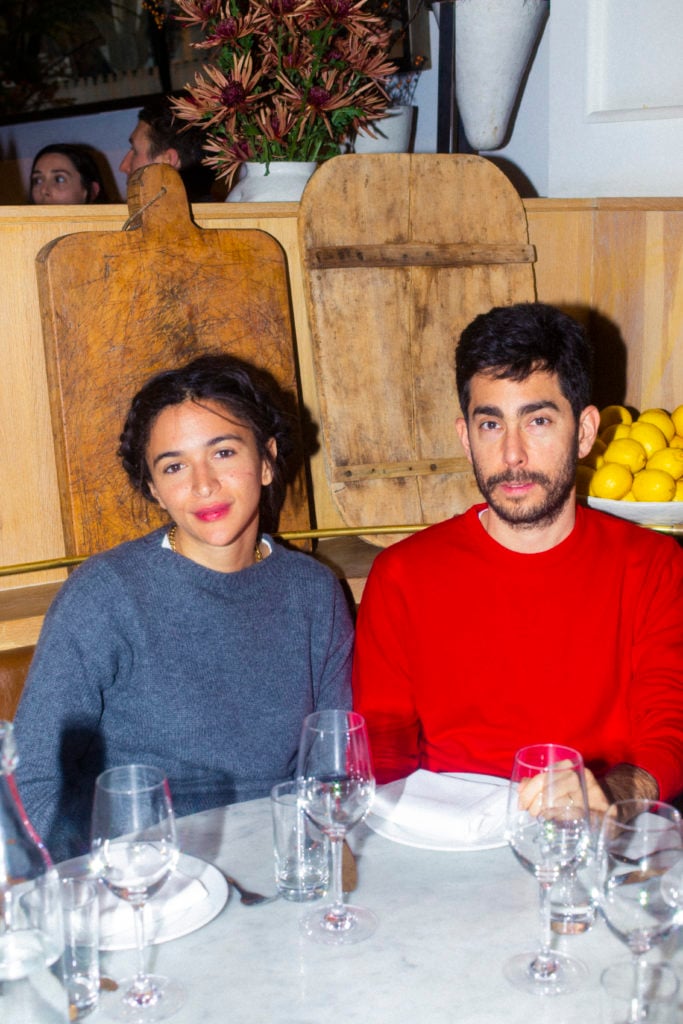
Laila Gohar and Omar Sosa at Cafe Altro
Paradiso. Photo courtesy Nicolas Bloise.
You were married last year at a gorgeous wedding in
Andalucia, to which you both arrived on horseback. What was that
like?
Gohar: Our wedding was really fun. Not to talk myself
up, but if I have one skill it’s that I can throw a really great
party. So it was just that—a really, really fun party. I enjoyed
every minute of it, from the planning to the actual ceremony. It
was very relaxed, but it was also very celebratory and
rowdy.
Sosa: We want to do it again. We
fantasize about that all the time, but it’s too soon to do it now.
We wish it were five or 10 years from now—it would be fantastic.
It’s definitely going to happen again.
As an artist couple, tell me a little about how you engage
with art. What art do you enjoy together or disagree about? What do
you like to live with?
Gohar: I would say that we’re
drawn to similar things. Certainly, there are also some differences
in what we gravitate towards. I think when you live with someone
you get to know what they will be drawn to, to some degree, and I
appreciate that we know what the other likes. I think there’s also
a big difference between what you like and what you like to live
with. I wouldn’t limit the latter to one category, but, for
example, Omar doesn’t like to have figurative works in the bedroom,
which I don’t really mind. He doesn’t like to look at faces in
there, but now, for some reason, we have a lot of that kind of
work. It’s funny how you think you don’t like something, but with
time, you ease into it. I find that our preferences—our
relationships with our things and the things we like—can be really
fluid.
Sosa: I think the thing we have
in common is that neither of us have clear boundaries about what we
do and do not like. Even though we have different tastes, we kind
of evolve together—sometimes in different directions, but I think
that’s what makes life interesting for us. It’s never black or
white. It’s never a static situation.
Gohar: Omar is a graphic
designer and at one point he was drawn to more graphic, repetitive
prints and works. We had a lot of stuff like that in our home, a
lot of patterned things. But he’s moved away from that more
recently.
Laila, why did you decide to become an artist?
Gohar: I never had a set career
path, whereas Omar knew he wanted to be a graphic designer. He went
to school to study the thing he still does today. There’s been some
twists and turns along the way, but his path has always been more
linear in that sense. In my case, it was more of an evolution and a
series of decisions that lead me to where I am now. I didn’t study
anything in relation to what I do. For me, food art is just the way
I know how to express myself. I don’t know if there’s some greater
mission behind it—it’s just more that I know how to communicate
something using food when words fail me. It’s how I know how to
realize my thoughts, and it’s basically as simple and as complex as
that.
You’re also known for your great dinner parties here in New
York. Did you grow up cooking with your family?
Gohar:
I grew up around the kitchen with
my family, yes. My mom is not an especially good cook, but my dad
and other people in my family are. Food lives at the core of my
family’s culture.
Omar, what lead you to become a graphic
designer?
Sosa: It’s pretty typical—I grew
up painting and drawing, like many graphic designers. I wanted to
study something that had to do with the visual arts, but something
that could be done quickly, too. I was very impatient. I thought I
would like industrial design, but ultimately felt it would take too
much time to make something like a chair or a car.
My grandmother always encouraged
me to be an artist, while my dad wanted me to pick something
clearer. He’s a real estate agent. So I ended up picking graphic
design, which sits between tech and art. I liked the freedom of it,
and I liked how quickly I could design things. When I was a kid, I
designed my own money. It was a very natural fit for me. Later I
realized I didn’t want to only be a graphic designer. That’s how
Apartamento
came about, and being a designer
certainly helped in making that magazine.
Apartamento
lead me to do other things as
well—I learned about editing and running a business. I started
making artists’ books. And that opened doors to meeting a lot of
artists. I think the boundaries are sort of blurred today between
all the creative fields. If you’re making a book, you’re a
designer, but you’re also an editor. I love making books because
you get really deep into someone’s work and life, and that’s pretty
special.
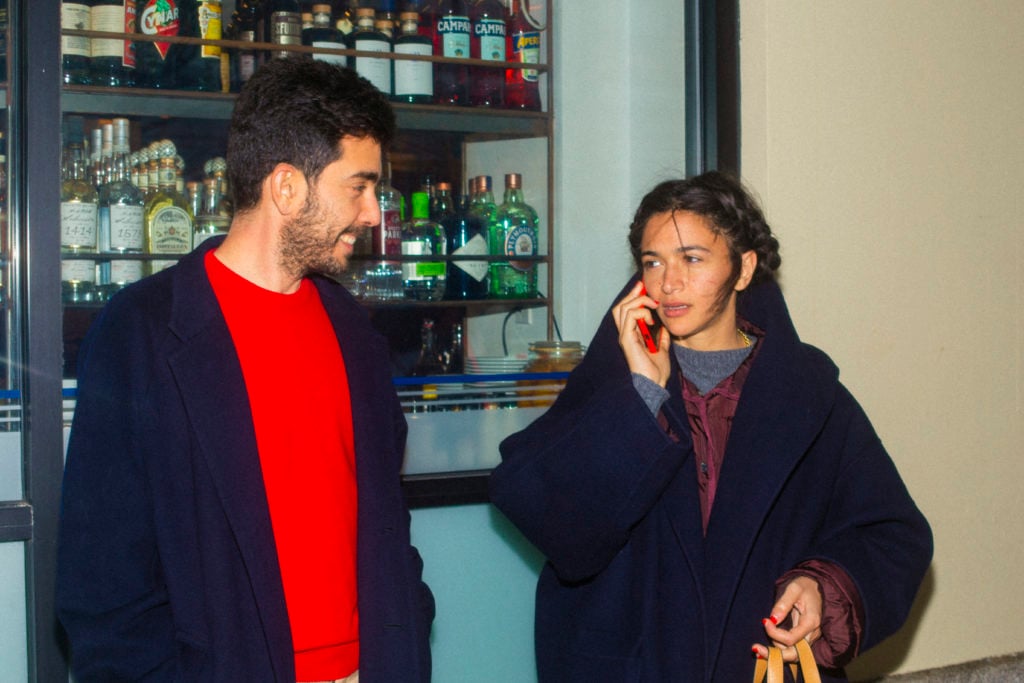
Sosa and Gohar. Photo courtesy Nicolas
Bloise.
What’s an example of an artist book that you produced
recently?
Sosa: I designed a book for the
photographer Peter Berlin, the gay icon from the ‘70s. The
challenge there was to figure out how to show his work—most of
which has never been seen—in a contemporary way, without trying too
hard. For me, that looked like an art book. Peter wasn’t
comfortable with the idea in the beginning, which is what made it
interesting. I think that’s really important—forcing yourself to do
something different. After he saw the results, I think he was happy
with it.
That’s the most recent thing I
did, and of course we’ve done a lot in collaboration with
Apartamento. In the fall, for example, we launched a book
with Michael Anastassiades, an artist and interior designer. The
book accompanied an exhibition of his work that he presented at a
museum in Cyprus. It was also his first monograph. I really enjoy
those moments.
How much do you both weigh in on each other’s work?
Gohar: A little bit. Omar’s
opinion is pretty important to me. I care about what he has to say.
I know he’s going to be honest with me. If something is great,
he’ll say it’s great, or if it needs work, he’ll say so. A lot of
times people are supportive and will always say nice things, so I
think it’s nice to be able to rely a little bit on his criticism,
too.
Sosa: Laila usually brings the
disruptive, critical side. That can be a nice wakeup call from the
pleasantries of most people. Sometimes I’ll take it personally if
she’s very harsh—and she tends to be—but I think overall it’s
healthy and it helps me a lot. The relationship we have with each
other’s work is very casual, but it’s deep at the same time because
obviously we care about what the other is doing. I think we also
inspire each other, and I think what we do together inspires our
work.
What do your day-to-day schedules look like?
Gohar: Generally, we wake up and
we each go to our studios and then we come home for dinner, which
we try to have together. Omar’s schedule is more consistent, while
mine is more project-based. We’ll meet at home around 8 or 9 in the
evening. I travel a lot, too. I opened an installation in Shanghai
last week at the West Bund Art & Design
fair, and before that I was in Tokyo for research. I work a lot
in Paris and London. I move around quite a bit.
What are the most challenging aspects of being in a
relationship with another artist?
Sosa: We’re both opinionated,
which can be difficult sometimes. It’s not like one person decides
something and the other goes with the flow. In regards to what we
eat, we always go with Laila’s opinion. I love food, but that’s her
thing. For everything else, we have strong opinions so, of course,
we fight sometimes. We disagree. But it makes things
interesting.
Gohar: Yeah, disagreements are
fine. I would say it’s frustrating if I want to buy a work and Omar
doesn’t want to, so then I have to buy it by myself [laughs].
That’s annoying. But it doesn’t happen that often.
Can you give me an example of a disagreement you’ve had over
an art- or design-choice?
Sosa: Laila repainted the whole
house while I was away. It was terracotta originally, and she
painted it a light yellow. Then she made me see it alone when I
came home. She wasn’t even there.
Gohar: I was kind of tired of
the color. Omar thinks more long-term—he gets attached to things,
and he likes consistency. We spent an obscene amount of time
picking the terracotta color, and after about a year and a half, I
got sick of it. People tend to get overly attached to the color of
their home I think. Anyway, I went to visit this artist who was
quite old—she’s passed away now—and I really loved the color on her
walls. I asked her grandson if he knew what it was, and he said,
“Oh, it used to be white, but my grandmother smoked for 80 years
and the nicotine stained all the walls.” He moved aside a frame to
show me, and sure enough it was white behind it! I was like, “Wow
what a beautiful color.” So I got this yellowish-white paint that I
really love. Omar wasn’t into the idea, and I kept trying to
convince him for three months. Then he went away—so I painted
it.
Sosa: Welcome to my life. But
now I like it.
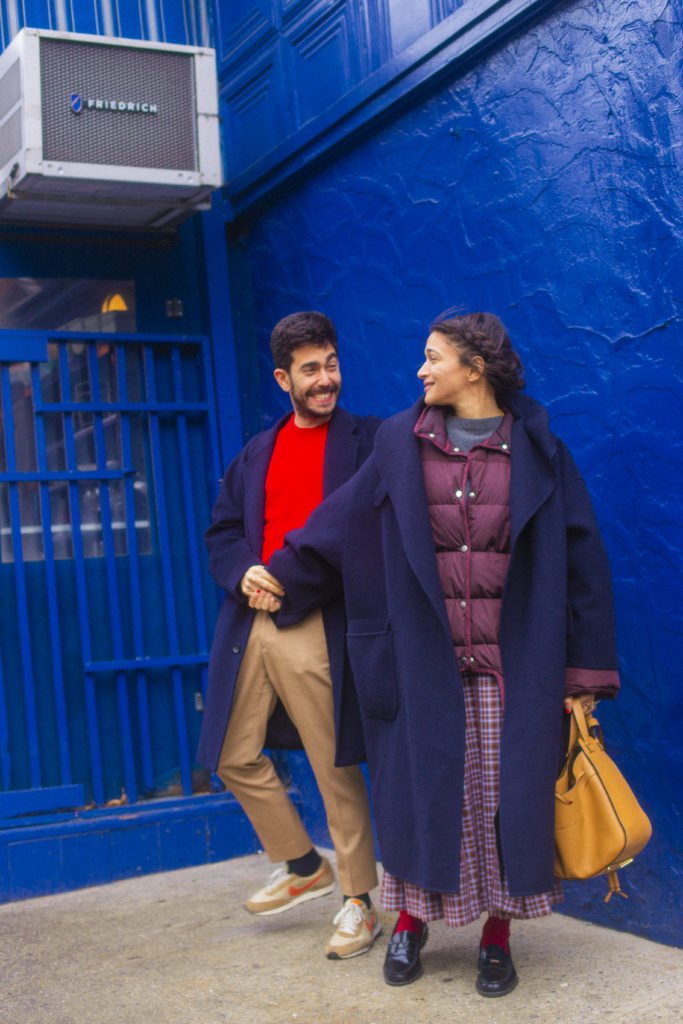
Sosa and Gohar. Photo courtesy Nicolas
Bloise.
How does that difference—your need for constant change and
Omar’s preference for more permanent, fixed ideas and
objects—manifest in your artwork?
Gohar: I’m much more attracted
to ephemeral things. My work is all ephemeral—you know, you throw
food away. I spend months thinking about the work and planning it
and working on it and then it sort of evaporates. I’m fine with
that. Omar makes books, so it’s the opposite—books are objects that
are here to stay. I’ve found that I’m not so concerned with leaving
a mark on this world or a legacy or anything like that. I’m more
concerned with providing an experience in the context of a moment,
which eventually goes away and becomes a memory. The memory is then
the closest thing you get to leaving a mark.
Sosa: We’re very yin/yang in
that sense. Laila thinks about what’s happening two seconds from
now. In a way, her version of long-term is tomorrow. And I’ll think
about two years from now. I prevent her from crashing sometimes,
and she prevents me from staying the same and becoming absolutely
boring.
What do your studios look like? How are they the same or
different?
Gohar: I recently moved studios.
It’s still fairly new and we’re building it out. It’s kind of funny
to have a space that’s just my own—I don’t have to consult with
Omar about any aesthetic decisions. I can just do whatever I want.
I used to share a studio with another artist in Brooklyn. I found
this space one day as I was walking to the bridge to go to
Brooklyn, on the border of Chinatown. It feels great for the kind
of work that I do, and it’s only a five-minute bike ride from my
house. I feel like our studios both reflect our home in many
ways. My space is two floors, and the ground floor is more of an
industrial, raw space for the work, but then I have a little room
upstairs for my office. People joke that it looks like a
bedroom.
Sosa: I’ve always had a studio.
It’s the first thing that I looked for when I moved here. A
couple of years ago, I got a space in Chelsea. I go there every
day. It’s very beautiful. For me, it’s an extension of the house,
too—I have wall-to-wall carpet and a big sofa. It’s cozy. You can
spend a weekend there easily. For me it’s important to structure
your ideas in a space that allows for that because at home you can
get easily distracted.
Is there an artist or work you one day hope to add to your
collection?
Sosa: Yes. And we actually both
agree on who it is.
Gohar: We would really love to
own a painting by [early 20th-century Mexican painter] Dr. Atl.
There’s a really personal story behind that.
Sosa: It’s personal because when
we were living in two different cities and there was this romantic
thing going on between us, we used to send each other letters.
Laila once sent me a photo of this painting of Dr. Atl’s that I
already knew and liked so it was like, “Oh, we like the same
artist.” It wasn’t really about the art, though. It was more about
the meaning behind it. There were two big mountains and an ocean
behind them, and Laila wanted to imagine what living together would
be like. She sort of thought that idea—of living together, of a
life together—stood beyond the mountains, which in a sense
represented our two cities at the time. It made the painting
important for us. We still can’t afford it, though. Laila gave me a
really nice etching of Atl’s, but we’d like to have a
painting.
How do you feel about the year coming to an end and the work
that you’ve done in 2019? Is there anything in
particular that you’re proud of?
Gohar: No. [laughs]
Sosa: I’m a little bit like Laia
in that sense. We’re pretty terrible at promoting our own
work.
Gohar: I think it’s because
we’re both not American. I’ve found that self-promotion is a skill
we really lack. We’ve gotten slightly better at it, but I feel like
people here are taught to speak about their work in a way that’s
really positive and they really know how to present their work. I
recently learned that people can join Speech and Debate clubs at
school. And even when you first meet someone, the way that they
explain what they do or what their ‘thing’ is feels very advanced
to me. I don’t talk about my work like that—I have very clear ideas
about what I’m doing and how—but to be able to verbalize all of it
is a struggle and it’s one of the reasons why I make my
work.
Sosa: It’s a really common thing
with artists. I still like that approach. When you explain things
too much, it complicates them. I don’t like how it sounds. I know
talking about your work is the norm today, but if you look at
artists from the past or artists that you really admire, they don’t
really narrate their work or talk about themselves too much. They
make the work and that’s it.
Of course, some of the work we
do is not purely artistic, so it’s helpful when you can explain the
idea properly to a client—who has to pay for it—because they need
that narration. I feel that that’s very necessary if you’re living
in America. Instead of saying, “I made this for you,” you have to
explain why you made it and why it works. I don’t like that side of
it, though. It’s hard for me.
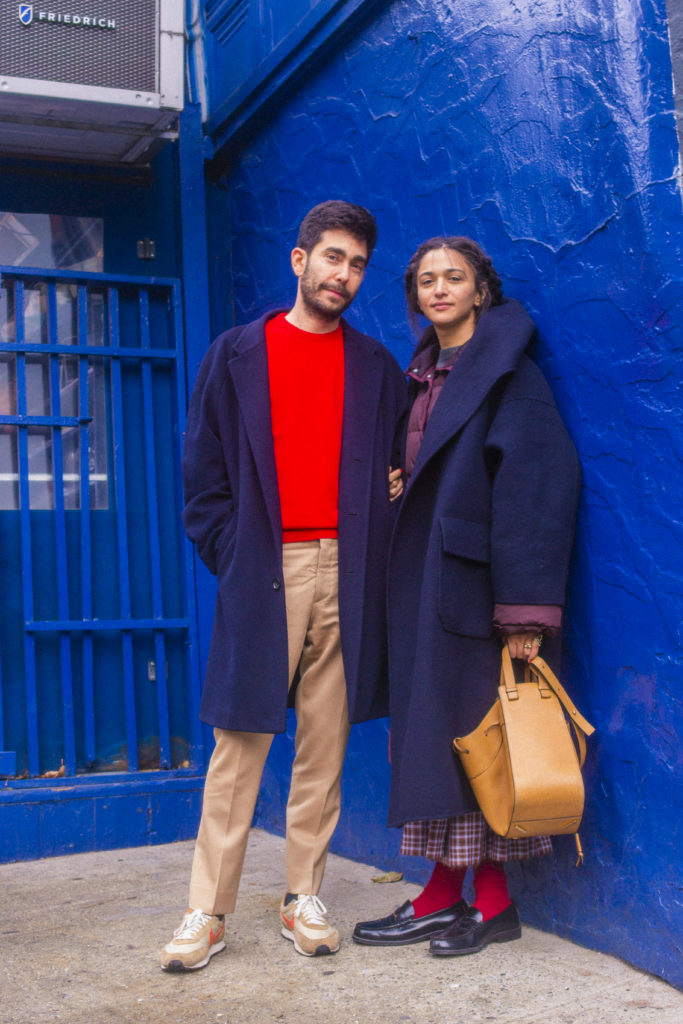
Sosa and Gohar. Photo courtesy Nicolas
Bloise.
It’s interesting that you mention that. We recently did an
interview with Anish Kapoor, who said, very expressly, that
he has nothing to say as an
artist.
Gohar: What’s the point of
making the work if you’re going to spoon-feed it? It doesn’t need
to exist then.
Sosa: It’s worse than spoiling a
movie before you watch it. You’re depriving someone of reaching
their own conclusions, which is the best thing art can do or help
with. I think now especially, with social media, everything is so
explained and labeled. But like Laila, I wish I were a little bit
better at packaging myself, because admittedly everyone around us
is better at it.
Gohar: I really admire when
people are good at their elevator pitch. It’s not like I’m talking
it down. It’s just not something I’ve ever really learned. It makes
me uncomfortable.
Do you ever think about leaving New York?
Gohar: Definitely. I grew up in Cairo. It’s a very different city
than New York. It’s in a developing country, and it’s much more
raw. That sort of chaos is pretty innate to me, and that way of
life feels the most natural. I fantasize about a move like that. I
try to go back once a year. Omar came with me recently for the
first time.
Sosa: We just want to be free.
We feel we can go anywhere and make it work. It’s also nice to have
a place here and there and move between them.
Gohar: I don’t care about any of
that. I’m ready to just pick up and leave. I’ve moved many times in
my life when I was younger, whereas Omar moved to New York in his
twenties. The older you get, the heavier the move I
think.
Sosa: For me, it’s actually the
opposite. I think once you do it, it becomes
easier.
Gohar: Okay, yeah. For me, my
family is scattered all over the world. We all live in different
countries and we’re very mobile. That’s why I’d say the idea of
creating a home in an apartment or a studio is really important to
me because that’s my only real attachment to the notion of a home
or conceptually what it means to be from a place. I was born in
Egypt, but I don’t feel any nationalistic sort of pride or
anything. So that’s why creating a nestlike environment in my
immediate realm is really important. It’s less about being
geographically attached to a country and more about creating a
little ecosystem of my own.
The post ‘We Evolve Together’: Food Artist Laila Gohar and Graphic
Designer Omar Sosa on How Married Life Fuels Their Creativity
appeared first on artnet News.
Read more https://news.artnet.com/art-world/laila-gohar-1715859
Further reading


Leave a comment