
‘We Lived for Seduction’: Yves Saint Laurent’s Muse, Betty Catroux, Recalls Their Wild Adventures Through a Bygone Art World
In 1967, designer Yves Saint
Laurent met his match in Betty Catroux, a young émigré from
Brazil who was then half-heartedly working as a model for Coco
Chanel in Paris.
The two met for the first time
at Chez Régine, a
popular club that played host to everyone from playboys to princes.
A grandfather of sorts to Studio 54, Chez Régine
was the first modern iteration of a discotheque,
and regularly turned
out celebrities and cultural icons like Andy Warhol, Serge
Gainsbourg, Jane Birkin, and Vogue editrix Diana Vreeland.
As the English journalist Robin Leach once said of Paris’s social
scene in the 1960s: “You’d just go to Régine’s
every night and wait for the princesses to file in.”
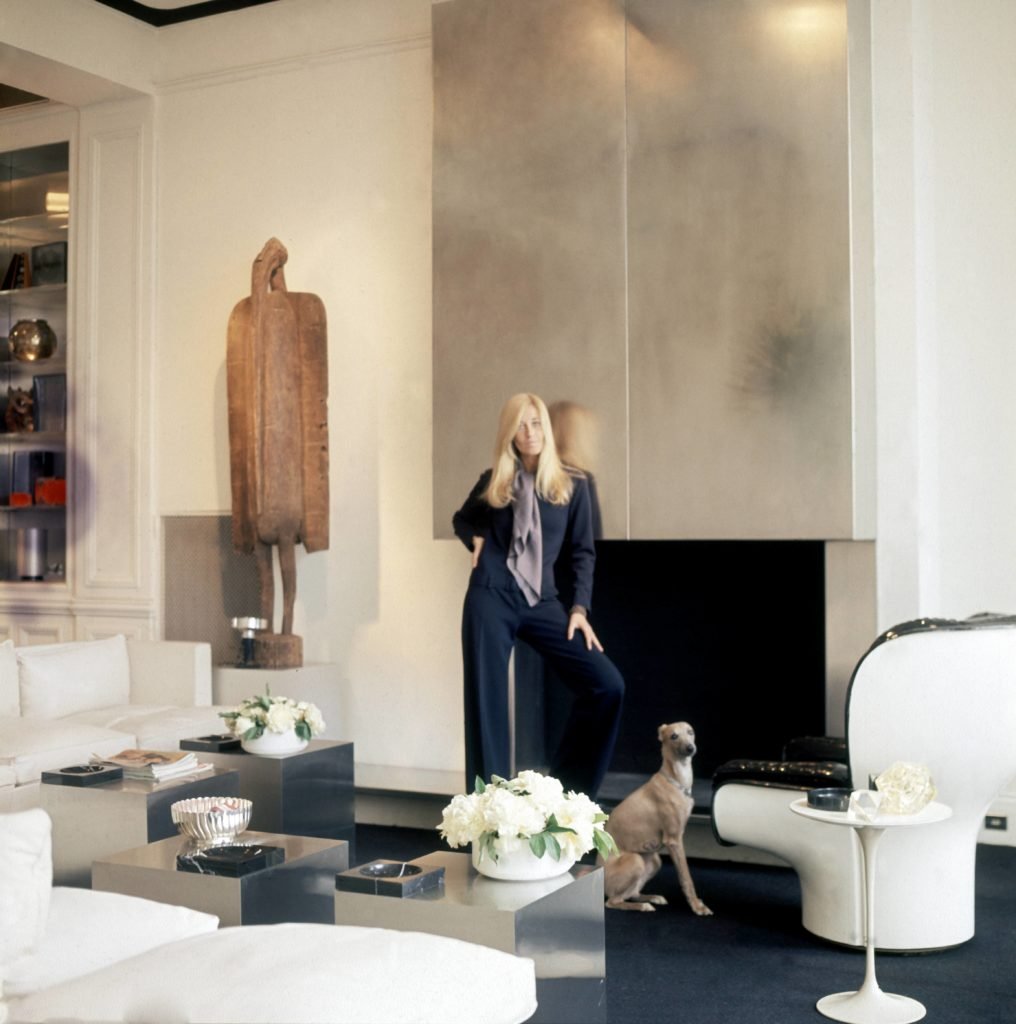
Betty Catroux in her Paris apartment
with her whippet. Photo by Horst P. Horst/Conde Nast via Getty
Images.
Laurent and Catroux drowned
their shared melancholies in nightly revelries and became fast
friends. For Laurent,
who was working to develop a new aesthetic he called the
“masculine/feminine,” their relationship was a professional boon as
well: in mens’ blazers and boyish clothes, Catroux instantly became
what the designer called “the embodiment of the feminine ideal.”
Her style laid the foundation for YSL’s slick, strong designs,
which appealed to women who found themselves “in a seductive
position when dressed in boy’s clothes,” as Catroux put
it.
“She’s perfect in my clothes,”
the designer wrote of the six-foot-tall Catroux. “Long, long,
long.”
A splashy exhibition about the woman behind Saint Laurent’s
pathbreaking work (“Betty Catroux: Feminine Singular”) opened at
the Musee Yves Saint Laurent in Paris in early March. And
though it remains off view to the public at the moment, there is
still plenty to look at
online. (The show is
organized by Anthony Vaccarello, the house’s creative
director.)
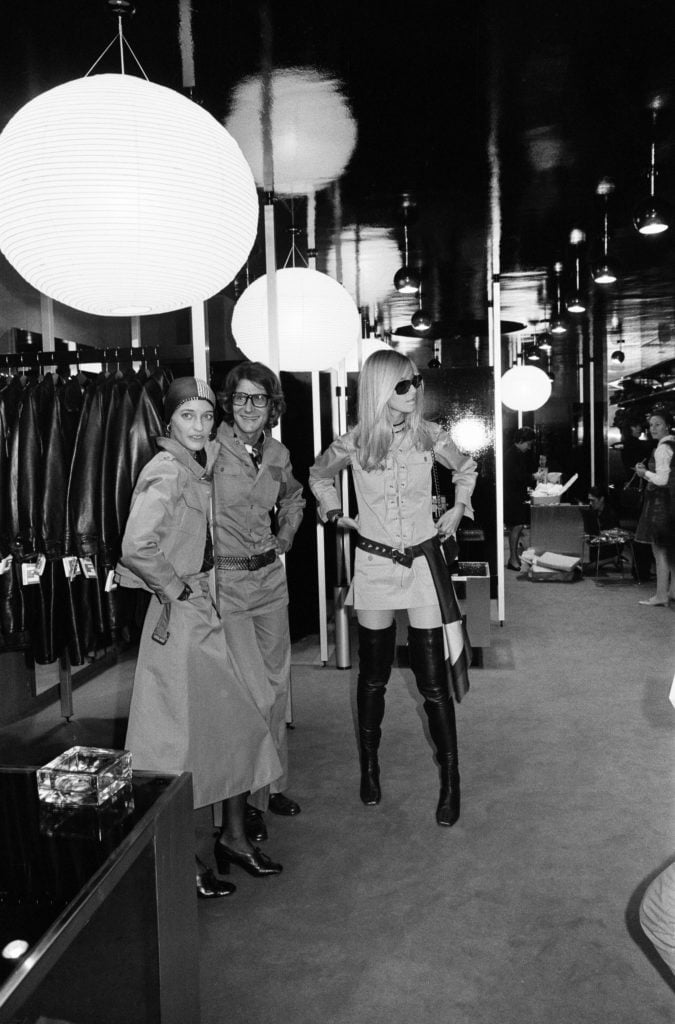
Yves Saint Laurent at his London store
on New Bond Street with Louise de La Falaise (left) and Betty
Catroux (right) in 1969. Photo by Dorean Spooner/Mirrorpix/Getty
Images.
The exhibition illustrates how many of Saint Laurent’s
pieces—from the safari jacket to
the trench coat, to YSL’s iconic women’s tuxedo—were made to
appease Betty, and how she helped the designer crystallize the
mission of his couture house.
Catroux hated fashion. But her
soft spot for her “twin” brother, as she called Saint Laurent,
allowed her to continue to work alongside him for
decades.
“For Yves, it was love at first sight, physically,” she tells
Artnet News of their first meeting. “I was androgynous, asexual. It
definitely affected him, but our resemblance was not only physical.
We were alike morally, mentally. It was something incredible, and
what was amazing about him was that he felt that I could be his
soul mate—a kindred spirit.”
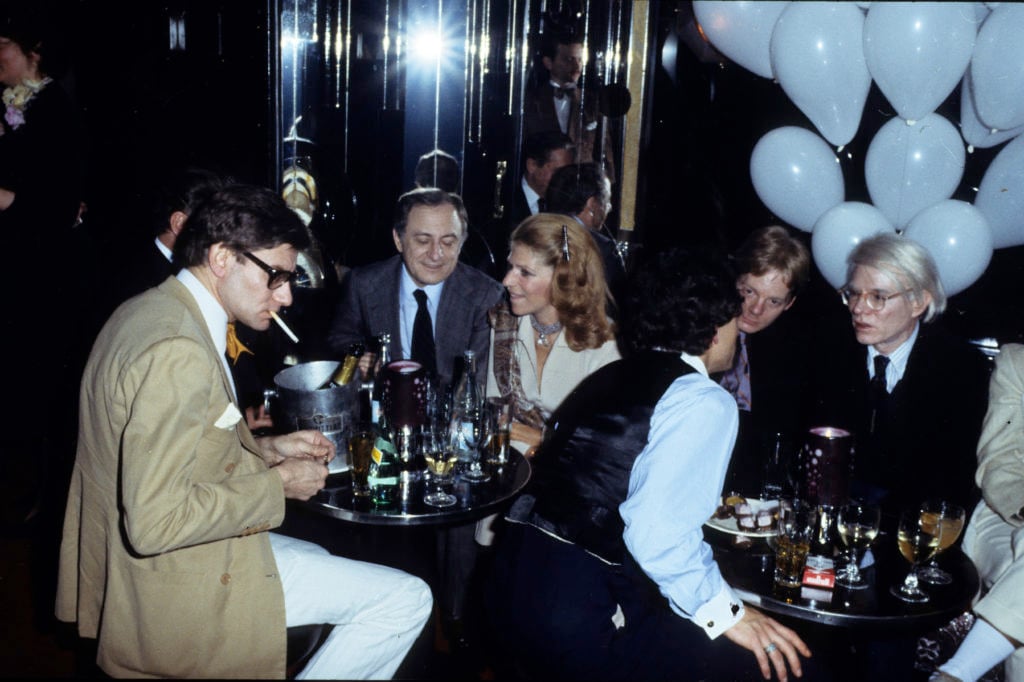
Yves Saint Laurent, Pierre Berger, and
Andy Warhol at a party in 1977 in Paris. Photo by Michel
Dufour/WireImage.
The pair shared an interest in art and artists of their
era. Warhol, for example, who
portrayed the designer in multiple works, became a close friend of theirs, and introduced
them to the other artists he palled around with. Catroux has
especially fond memories of their time at Le Sept
nightclub.
“I met Francis Bacon there, whom
I worshipped—he was lying dead drunk on a table—along with David
Hockney and Robert Mapplethorpe, who was a great friend of [Saint
Laurent muse] Loulou [de la Falaise]. Andy was there, obviously.
When we got bored during a meal, we’d go downstairs to dance,
flirt, and drink. And when we got tired of that, we went back to
the table.”
Although she only met Hockney a
few times, Catroux notes that he’s long been her favorite artist.
“I find him fascinating as a character,” she says. “I have a
passion for his work, which has a sort of childish and spontaneous
side.”
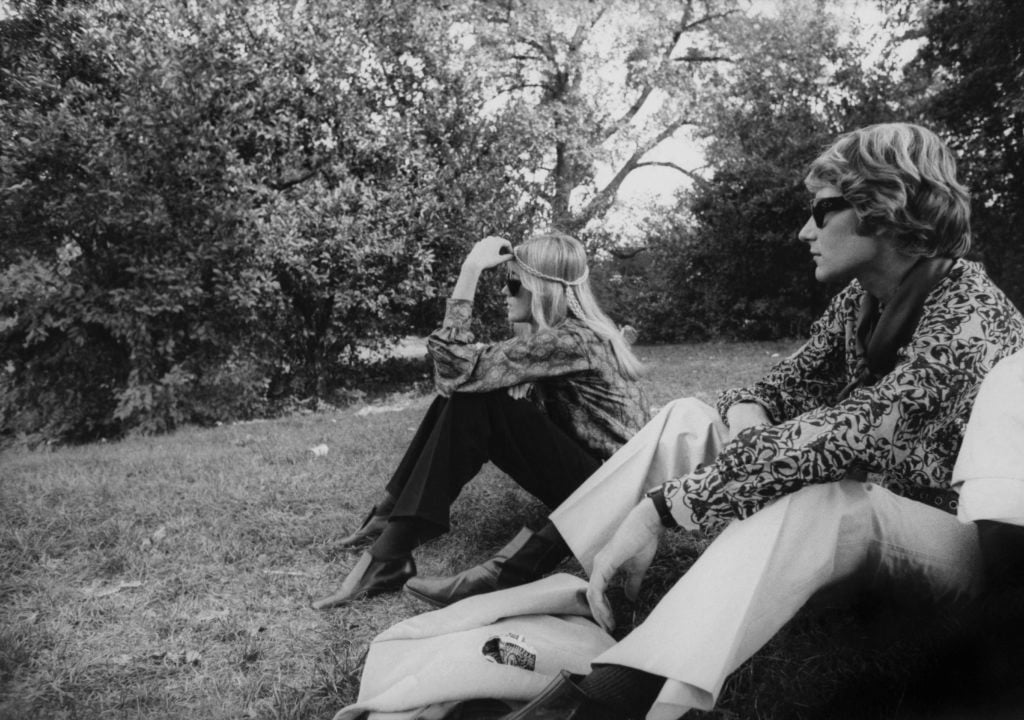
Saint Laurent and Betty Catroux sitting
in Central Park in 1968. Photo courtesy Getty Images.
She recalls mingling with
François-Xavier and Claude Lalanne,
though they weren’t particularly close. Still, she says, it didn’t
matter. Everyone lived for fun and continuously borrowed ideas from
one another, spending days in each other’s ateliers and partying
late into the night thereafter.
Since Saint Laurent’s death in 2008, Catroux has remained loyal
to the brand he founded, showing up to fashion shows and modeling for
the occasional campaign. “She
lives and breathes Saint Laurent,” Vaccarello says.
One story captures that devotion especially well: each
night, Betty Catroux raises a toast to an Yves Saint Laurent
portrait made by Warhol.
“We lived for seduction,”
Catroux says. “Seduction was our goal. To charm, to seduce; it gave
us immense pleasure. As for the rest, it was all about partying,
every night. To only do fun things. Be naughty. Drink. Excess. All
the things that people don’t do anymore.”
The post ‘We Lived for Seduction’: Yves Saint Laurent’s
Muse, Betty Catroux, Recalls Their Wild Adventures Through a Bygone
Art World appeared first on artnet News.
Read more https://news.artnet.com/art-world/saint-laurent-exhibition-betty-catroux-1837224
Further reading


Leave a comment