
What Are Famous Artists Cooking Up Under Lockdown? Urs Fischer, Chloe Wise, and Others Share Their Deliciously Creative Recipes
We’re all cooking a lot more than we used to, and Memorial Day
cookouts give us even more of an excuse to get creative. This year,
in search of a little culinary inspiration, we turned to artists
who have worked with food in their practices, either as a material
or subject matter, to ask them what they’ve been cooking during
these unprecedented times.
Here are the dispatches they sent in from around the world in
late March and early April on their favorite recipes, their
strategies for stocking up, and advice for special diets.
Enjoy—and don’t forget to check out some of our
previous posts on artists’ recipes here and here.
Urs Fischer
Urs Fischer’s food-related art includes a series of
irreverent portraits overlaying ingredients—a banana, a hardboiled
egg—atop his subject’s faces, obscuring their features. He also
created a line of Louis Vuitton bags adorned with dangling
sculptures of strawberries, apples, carrots, mushrooms, and other
food items.
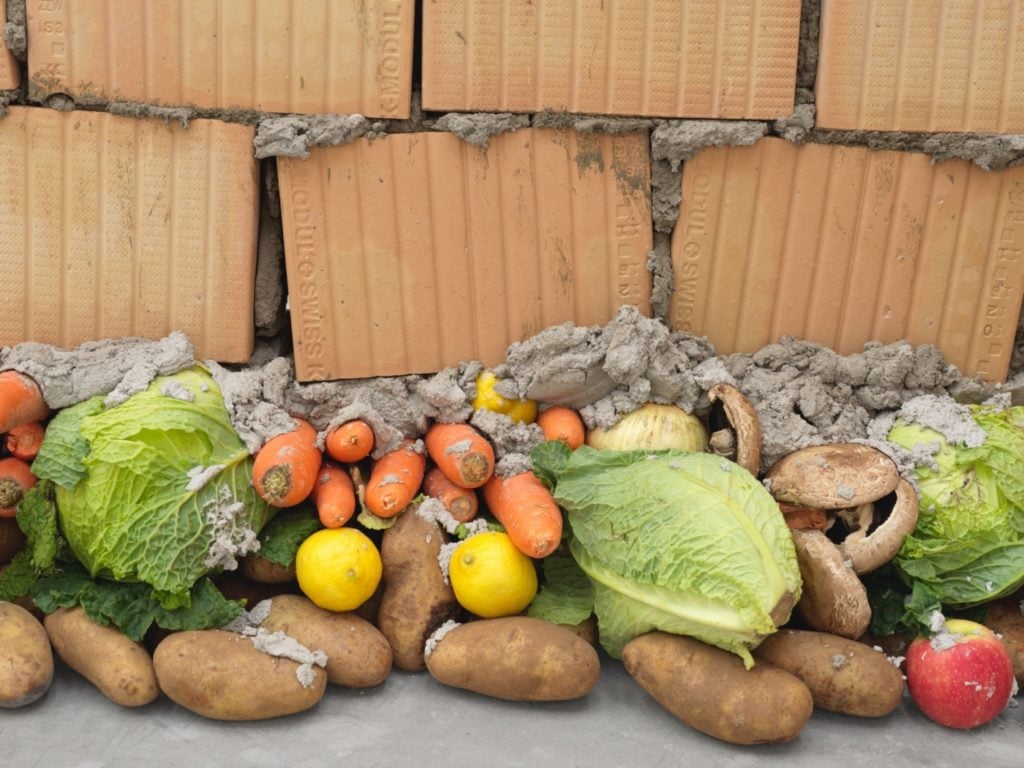
Urs Fischer, Faules Fundament (Rotten
Foundation) (1998). Courtesy of the artist and Karma
Gallery.
This is a recipe to celebrate one of those rare days when we get
home from the supermarket with fresh produce in the bag.
Tofu Cucumber Salad
Ingredients:
½ pack firm tofu
1 cucumber
cilantro
hot pepper
sesame oil
amino acid & soy sauce (I personally like the coconut aminos)
toasted sesame seeds
Instructions:
Slice firm tofu into three or four slabs. To extract the water,
press the slices between two kitchen towels until they feel
dry.
Crumble up dried tofu by hand into a bowl until it looks like a
crumbled feta cheese, and season with amino acids/soy sauce.
Beat the cucumber to make it a little softer. Half lengthwise
and deseed. Cut the cucumber into little cubes. (I do them about
three eighths of an inch.)
Put cucumber in a separate bowl and toss with sesame oil.
Combine seasoned tofu and the cucumber cubes with chopped
cilantro, and, if you like, finely chopped and deseeded hot
peppers.
Sprinkle toasted sesame seeds on top.
Jorge Pardo
Jorge Pardo’s explorations of the intersection between art
and design have resulted in his furniture-based sculptures, which
include a functional dining room
installation for the restaurant in Berlin’s
Paul-Löbe Building, part of the art collection of
the Deutscher Bundestag. During lockdown, he’s been filming a
new series, “Cooking With Jorge Pardo,” for his New York gallery,
Petzel. This summer, Pardo plans to open a bistro-style
Yucatan-influenced restaurant, Hunik, in Merida with his business
partner, chef Roberto Solis.
I’ve always cooked, even when I was a kid. My father used to
cook and I used to cook with him and my mother cooked and I cooked
with her. My mother used to be really good with desserts and I
would always help her with recipes because they’re in English. My
grandmother always cooked. I’ve always been involved in cooking.
But I’ve discovered while I’m here, that I have to cook every
freaking day—I’ve been enjoying it though. I don’t think I’ve
cooked this consistently ever in my life, but I do love it.
About two weeks ago, I figured it might get kind of crazy so I
went and stocked up on chicken, beef, and pork—not really fish, you
have to buy the fish fresh. I bought a lot of pasta and bunch of
things that I need for cooking and I just froze it all. I probably
bought 50 pounds of protein and 20 pounds of pasta, 12 bottles of
tequila and 20 bottles of prosecco and stuff like that. I bought
three pounds of chocolate from my favorite chocolatier here in
Merida, ki’ Xocolatl. And I got three
gallons of aloe vera gel and a couple of gallons of alcohol for a
homemade sanitizer. I am now having masks made by my local tailor
using leftover fabric from the clothes that he makes for me.
Tongue with Polenta and Zucchini Squash
Ingredients:
1 tongue
1 onion
2 tbsp fish sauce
1 can sardines
2 bottles cheap white wine
6 cloves garlic
1 tbsp fermented Korean chili paste
a little bit of chili powder
1 tsp oregano
1 tsp cumin
salt and pepper to taste
Instructions:
Sauté all ingredients except tongue and wine in a pressure
cooker until it smells great. Add tongue and brown.
Add wine to cover tongue by a half inch.
Turn pressure cooker on. Total cooking time is around an hour
and a half, but you should open and check after 45 minutes. Add
more wine if it needs to finish cooking for 30–45 minutes.
Once tongue is cooked, take tongue out, peel creepy skin off,
and cut into desired chunks. It should be very soft and yummy.
Take liquid out of the pressure cooker and strain. Then put
the liquid in a sauce pan and reduce. Add tongue until it starts to
caramelize a bit, and serve over polenta.
Polenta is simple to cook. It should take about a half hour in
total. The ratio is four to five cups of water to one cup of
polenta.
Bring water to a boil in a medium-size heavy sauce pan.
Pour cornmeal slowly into the water, stirring with a wire whisk
or wooden spoon.
Continue stirring until creamy and soft. Add parmesan and butter
to taste.
Elia Alba
For her portrait series “The Supper Club,”
highlighting contemporary artists of color, Elia Alba hosted 25
dinner parties, discussing political issues over a communal meal
and then photographing guests such as Jeffrey Gibson, Hank Willis
Thomas, and LaToya Ruby Frazier.
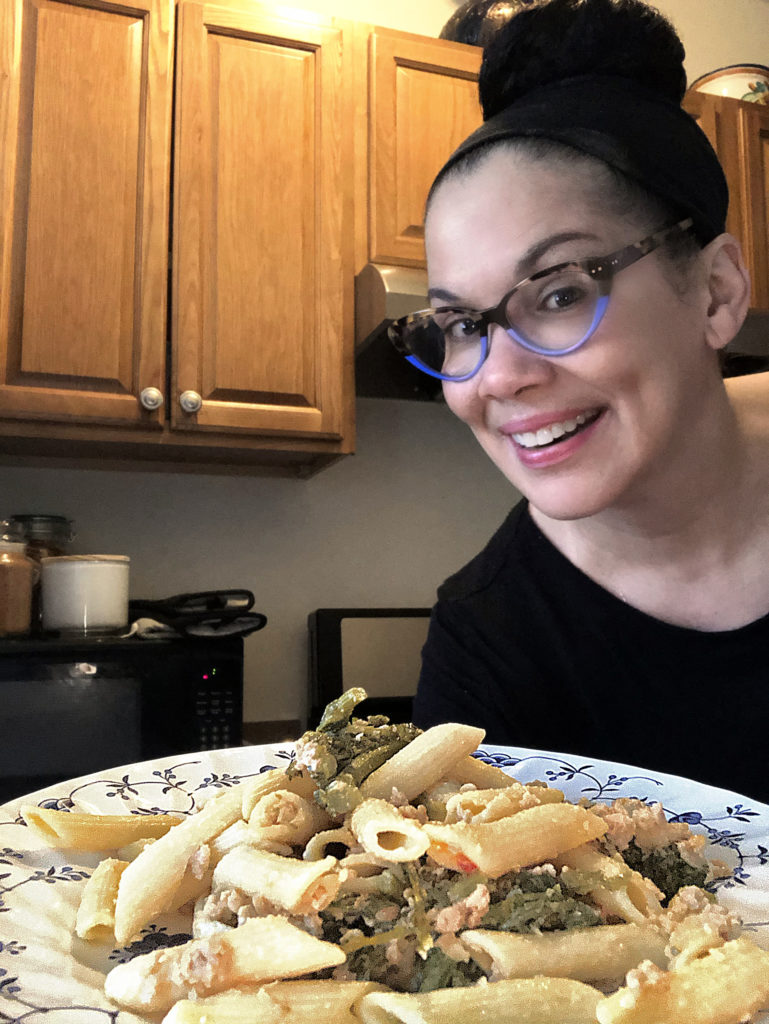
Elia Alba with her pasta with broccoli
rabe and sausage. Photo by Elia Alba.
Cooking was very important to my mother. I think our lives
revolved around food all the time. There were specific meals for
holidays and birthdays, food as gifts and so on. My parents
immigrated from the Dominican Republics in the 1950s. By the time I
was six, we settled in the Bronx. At that time, it was a mixed
neighborhood and our neighbors where predominately Italian,
Jamaican, Germans, and Puerto Ricans.
I think it was at that time that my mother started to introduce
Italian food into her menus. It was through her and our neighbors
that I really learned to love Italian food, and looking back now,
it was through food that two families were able to meet and
commune.
It is no wonder that my recent art project revolved around food
and community; I really learned this from my mother. In this time
of isolation, contemplation, and reflection, I have been thinking
of my childhood and the sense of caring and comfort that came out
of the food our mother made for us.
Pasta with Broccoli Rabe and Sausage
Ingredients:
1 lb orecchiette or penne
1 tbsp olive oil
1 lb hot Italian or turkey sausage, casings removed
4 cloves garlic, finely chopped
2½ cups low-sodium chicken broth (water ok)
⅛ teaspoon crushed red pepper
1 bunch broccoli rabe (rapini)
4 tbsp butter, cut into pieces
1 cup grated Parmesan (4 oz)
¼ tsp kosher salt
¼ tsp black pepper
Instructions:
Cook the pasta according to the package directions. Drain and
return it to the pot.
Heat the oil in a large saucepan over medium heat. Add the
sausage and cook, breaking it up with a spoon, until it’s no longer
pink, five to six minutes.
Stir in the garlic and cook one minute.
Add the broth and red pepper and bring to a boil. Add the
broccoli rabe and simmer, covered, until tender, three to four
minutes.
Stir in the butter and Parmesan and cook, uncovered, until the
sauce thickens slightly, one to two minutes.
Toss the pasta with the sausage mixture and salt and pepper.
Mark Dion
Mark Dion ran his own lemonade stand at the very first
Armory Show, then called the Gramercy International Art Fair,
back in 1994—a project he restaged for the
fair’s 25th anniversary in 2019. Last year,
his Conservatory for Confectionery
Curiosities (2008/2019), a display of colorful desserts
created with wife Dana Sherwood, was part of “Mark Dion: Follies” at
Storm King Art Center in upstate New York.
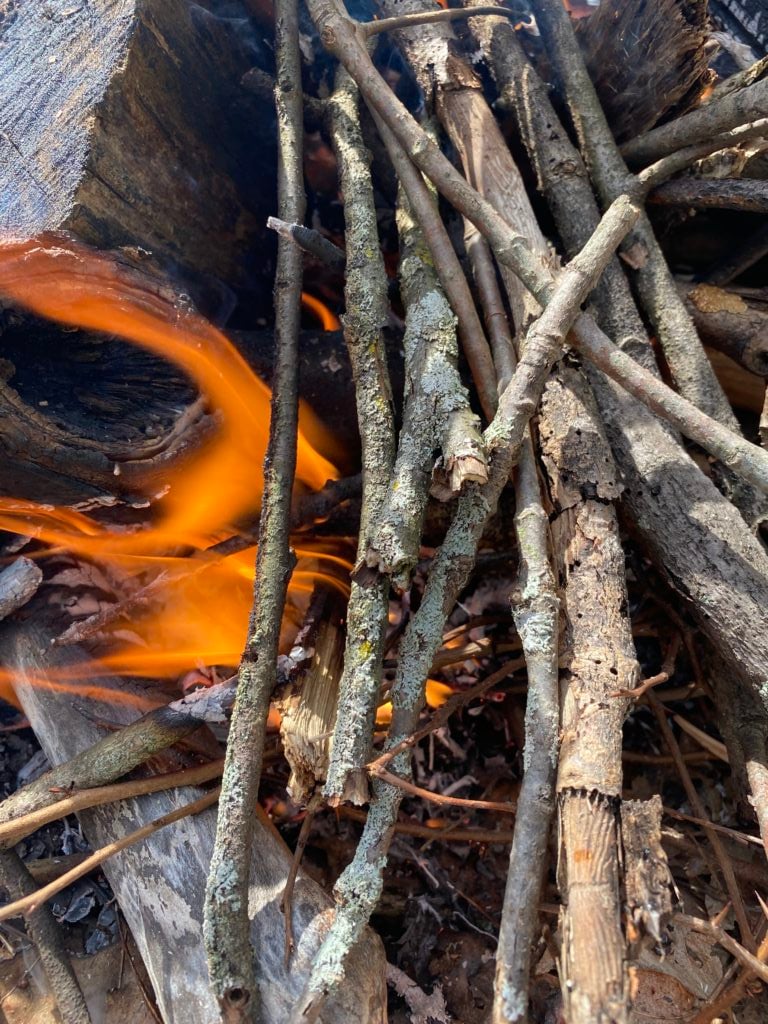
Mark Dion cooks steaks over an open
fire. Photo by Mark Dion.
I grew up in Fairhaven and New Bedford, Massachusetts, the
location of some of the world’s best seafood. The port is sited
close to extraordinarily rich fishing grounds and New Bedford lands
around 123 million pounds of fresh seafood a year. Sea scallops,
scrod, lobsters, quahogs—those are my primary choices when cooking.
However, I now live in rural upstate New York. It’s an area with
many charms, but access to amazing sea food is not one of them.
Last week was my 12th wedding anniversary, and to celebrate with
my wife, the artist Dana Sherwood, I thought I would cook a bone-in
ribeye steak over the coals of a open fire.
I will never be a vegetarian (I did try when I was young),
however I am deeply concerned about the well-being of the planet,
so I am willing to cut down on my meat consumption—way down. A
steak is now something quite special. Where I live, we can buy the
meat directly from the farmer and we know a great deal about where
the beef comes from and how the cattle are treated.
A Serious Steak Cooked on a Bed of Coals
First one must build a fire in a stone-lined fire pit. Cooking
sausage, vegetable, and chicken for many years at the artist’s
think tank and residency program, Mildred’s Lane [in Beach Lake,
Pennsylvania], has given me a good deal of experience in how to
build a bed of coals to cook on.
Copious amounts of dead and seasoned wood are all around my
home. I don’t have to order wood or cut living trees, just do a bit
of scavenging and preparation. This all takes time, but I am not
cooking an everyday piece of meat: This is something ritualistic
and special.
Starting a
Fire:
When building a fire, it is best to start small and the add
larger pieces. I save all the paper, fiber, and egg crates we
generate, and use this to start the fire. It is a super fire
staring material. Place twigs and then larger sticks on top tepee
style, as you may have have learned in Girl Scouts or Cub Scouts.
Keep feeding the fire bigger and bigger pieces of wood.
Never Cook Over Fire:
The goal is produce a bed of even hot coals. Never cook directly
over flame; it will certainly burn the food.
The Bed of
Coals:
In the early stages, you must tend the fire, crafting it to a
good size blaze that then you can step away from and let burn down
over a few hours. It is wise to check in on the fire every 20
minutes or so to make sure it is optimally burning and forming
colas. With a little practice, a bright even bed of coals will form
over time. Be patient and plan that this is going to take time.
The Grill:
There are lots of grills you can buy. If you are a sculptor, you
can easily make one. I like the have the grill 10 to 12 inches off
the coal bed. Just like with a properly seasoned skillet, I don’t
over clean the grill—in fact I never clean it.
The best steak chef I know is my old friend, the artist Jason
Simon. He is a true meat master. I have learned all my fine steak
cookery from Jason and would always defer to his expertise. He
likes a three-quarter-inch thick bone in ribeye (or porterhouse), I
prefer it to be two inches thick. The meat needs a good rub down
with coarse salt some hours before. We put a mild film of olive
oil, pepper, and more salt on it.
Once the fire is ready and grill hot, the steak if first stood
up on its bone edge, standing strait up. Hold it in this strange
position for about seven minutes. I can’t really give you times for
anything else. The heat is too variable and one’s taste is
different. I eat my steaks extremely rare. If you cook like this
over years, one develops a sense for timing. Be sure to remove the
steak before you think you should, since it will still be cooking
as your give it time to rest. I would not cut into it for at least
ten minutes.
This is not something I do often, but as a way of marking
special occasions. Of course, I am also married to cook of
extraordinary talent, so I had better make certain that I am
skilled in the few culinary duties I perform.
Chloe Wise
Chloe Wise first became known for her urethane “Bread Bag” sculptures, which mash up designer purses
with delicious baked goods. Her work also often includes portraits
of women posing with food.
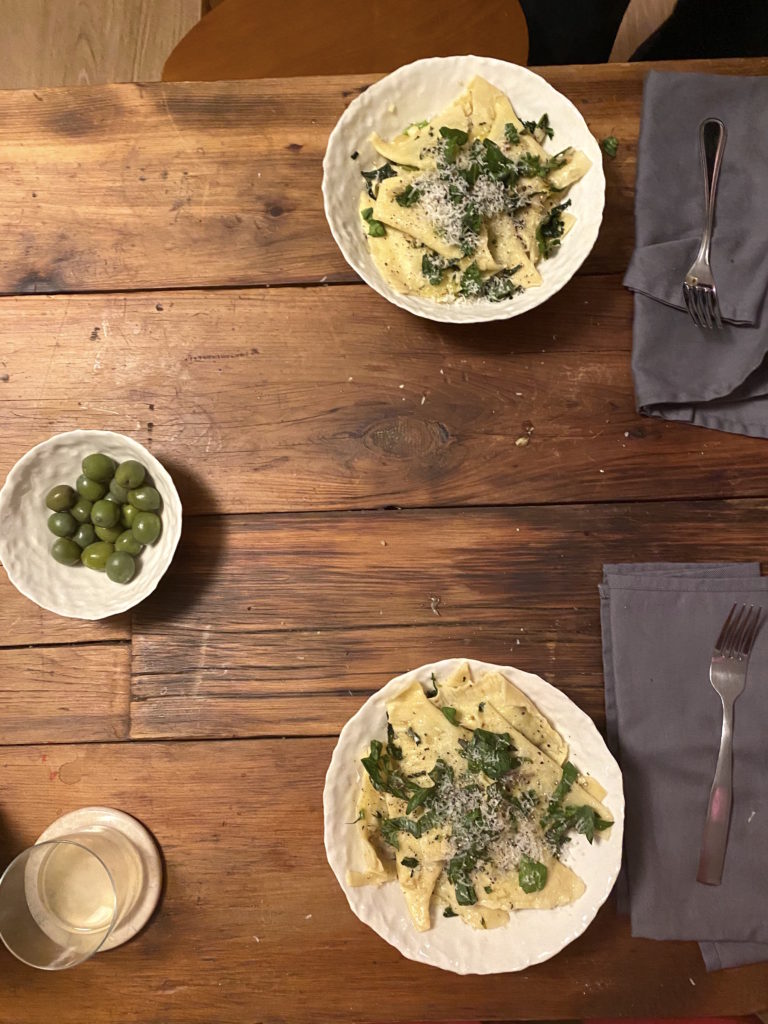
Chloe Wise’s homemade triangoli pasta.
Photo courtesy of the artist.
Triangoli Pasta
Here is a sort of wing-it-triangoli pasta from scratch, with a
lot of guess-work and a lot of texting [Sofia’s chef] Adam Leonti
for pointers. He has cookbooks and a restaurant that is currently
delivering beautiful bread and Italian food!
Start by making the pasta dough. On a clean counter, drop three
eggs into two cups of flour, a teaspoon of salt, and fold and knead
it into a shaggy dough. Let that sit for 30 minutes while making
the filling.
Boil three bunches of spigarello (or any dark leafy green) in
salty water. Drain, let cool, and wring it out, getting rid of most
of the water. Then chop that up.
In a pan on medium, heat olive oil and cook two minced cloves of
garlic. Add spigarello, salt, and pepper. Remove from heat, then
add the spigarello mixture to a bowl with around a cup of ricotta
and an egg, salt, and pepper.
Drink a bunch of natural wine and listen to the entire
discography of the Zombies.
Dust the counter with semolina flour. Divide the pasta dough
into sections and roll it out super thin. We didn’t have a rolling
pin so we used bottles of the aforementioned wine. Text Adam Leonti
and ask if you’re doing it right. Take a really long time to roll
it out to desired pasta thinness, which is hard without a pasta
machine, but is a nice workout, or something.
Once the dough is thin enough to see your lil fingers through
it, cut the dough into squares. Get competitive with your
quarantine partner at this point and see who can make a more
beautiful piece-o-pasta. Add a little filling in the center of the
squares, being careful not to put too much, and fold them over,
closing the corners with your fingers, making handsome little
triangles. You can also use a fork for crimpers edgers.
Cook those triangle guys in salty boiling water for two
minutes.
Toss them in whatever you feel like. We did garlic, shallots,
olive oil, more spigarello, butter, salt, pepper, Parmesan, and
basil. IT WAS SO GOOD.
Robert “Ces“ Provenzano
A New York graffiti artist known for his Wild Style
lettering, Ces also makes drawings of food, like Grill ‘N Chill, his
tribute to the grilled cheese sandwich.
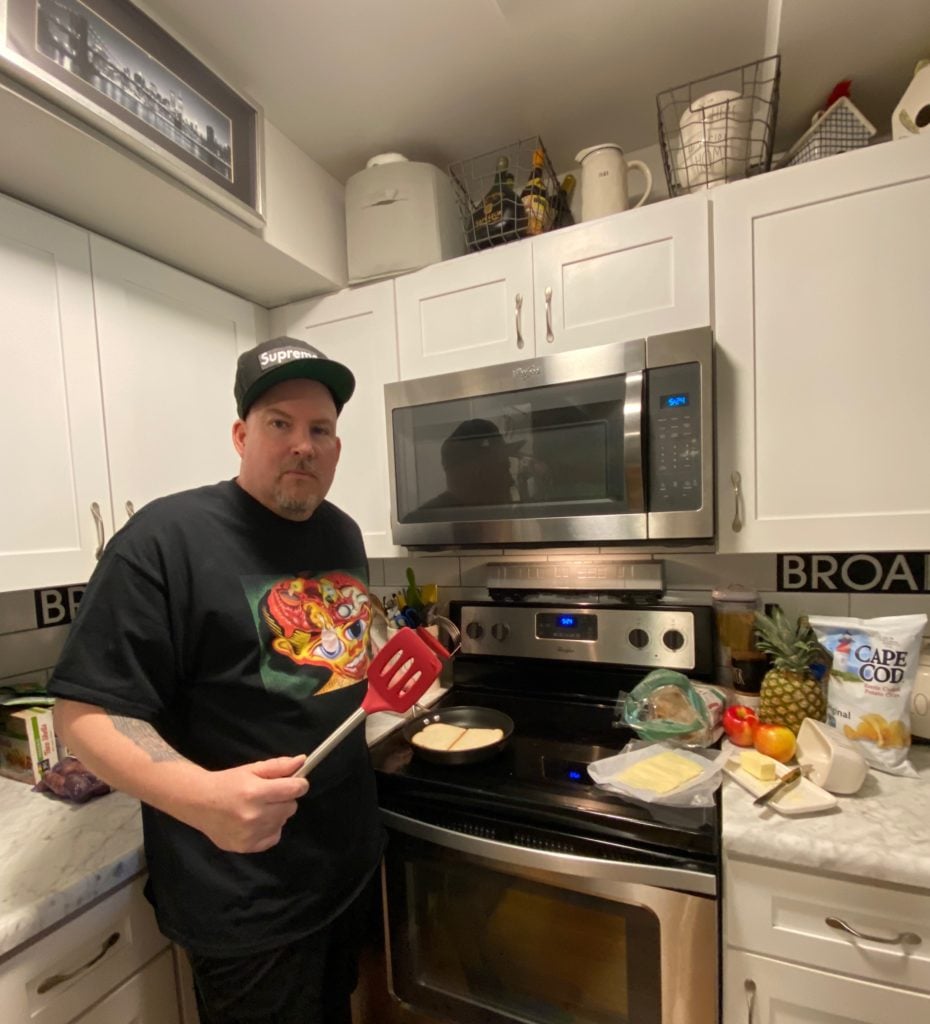
Ces making grilled cheese. Photo
courtesy of Ces.
Ces No-Frills Grilled Cheese Recipe
Ingredients:
6 tbsp Land O’ Lakes Salted Butter
4 slices Pepperidge Farm Farmhouse Hearty White Bread (Levy’s
Seeded Jewish Rye is another go-to!)
An abundance of freshly and thinly sliced Land O’ Lakes Yellow
American Cheese (No fancy smoked Gouda here, although Muenster
would be A-1.)
Instructions:
Heat a nonstick skillet over medium heat with one
tablespoon.
Once butter is melted, spread 1 tablespoon butter on one side of
each slice of bread (don’t be shy) and add both to the skillet,
butter side down.
Add as many slices of yellow American cheese as you’d like to
both sides, and cook until bread is golden and cheese starts to
melt. We like extra toasty grilled cheeses in our house, so if
that’s you, you may want to leave it for a minute or two
longer.
Flip one piece of bread onto the other piece and let cook for 45
more seconds.
Repeat for second sandwich.
Plate and serve with a half sour pickle and some kettle cooked
potato chips for the ultimate shelter in place lunch.
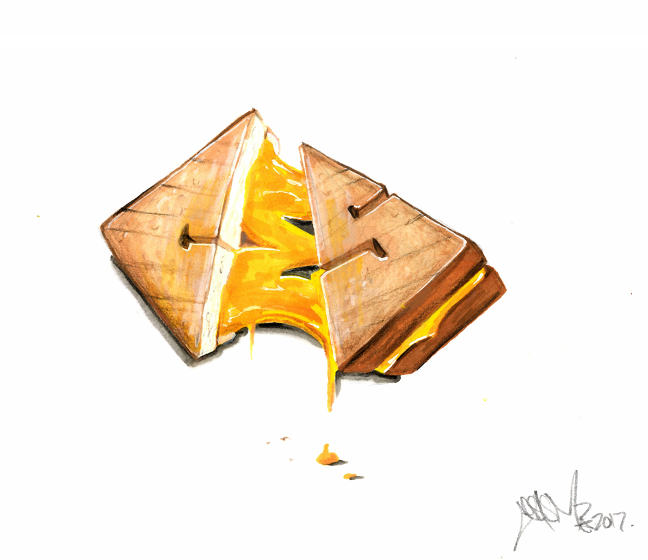
Ces’s drawing of his grilled cheese.
Courtesy of Ces.
Shing Ying
Khor
Shing Ying Khor has been keeping incredible illustrated food
diaries during quarantine and building their
own Animal
Crossing contemporary art
museum.
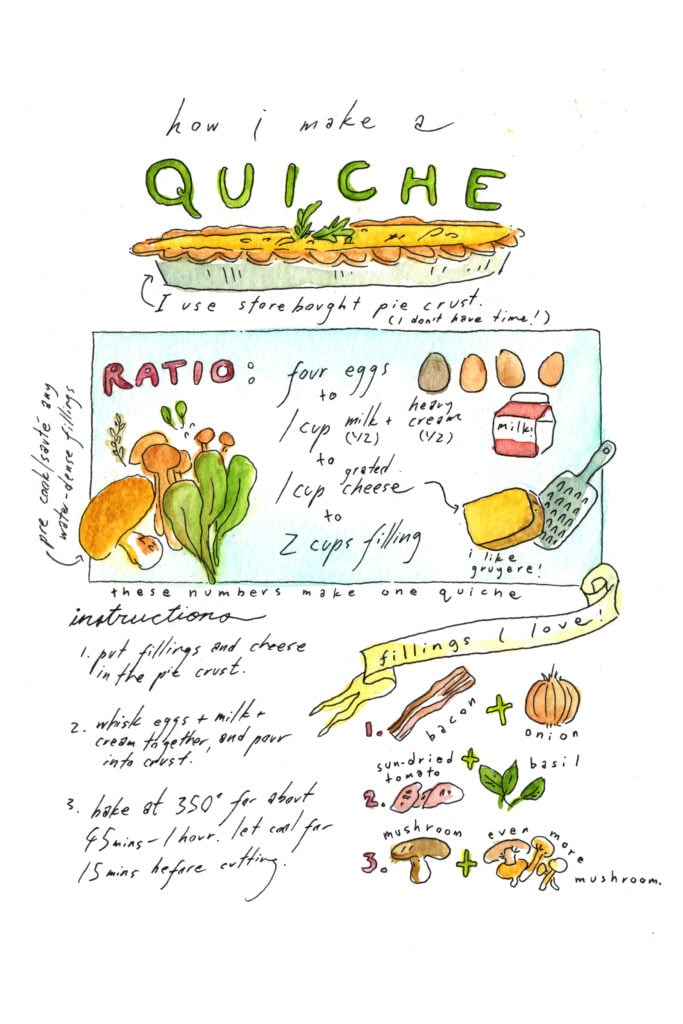
Shing Ying’s recipe for quiche. Courtesy
of the artist.
In isolation, I have developed a resentment of yeast. All my
bread attempts have failed, and I am surrounded by images of
perfect loaves, all of which are mocking my inability to make this
amalgamation of fungi do fungus things. I’ve learned to make
homemade pasta, though, so that is a small joy. I like cooking, but
it has become both a significant mental load and a calming presence
in my life, and I don’t know how to reconcile the two yet.
I work on an annual food-centered endurance art charity project
with my friend and fellow artist Eron Rauch, called Project Pizza,
which raises money for a food non-profit called Food Forward. They
rescue produce from farmers markets and wholesale distributors and
redistributes to food banks and food kitchens. I’m thinking of how
that project might be able to translate to a more online version,
because so much of the joy in it is having a bunch of artist
friends come over and eat homemade pizza and frantically make pizza
art. I don’t even like pizza, but my lack of access to real good
pizza is making me crave it.
My favorite recipes are for congee and quiche, which are less a
matter of recipes than they are basic ratios, which is how I prefer
to cook.
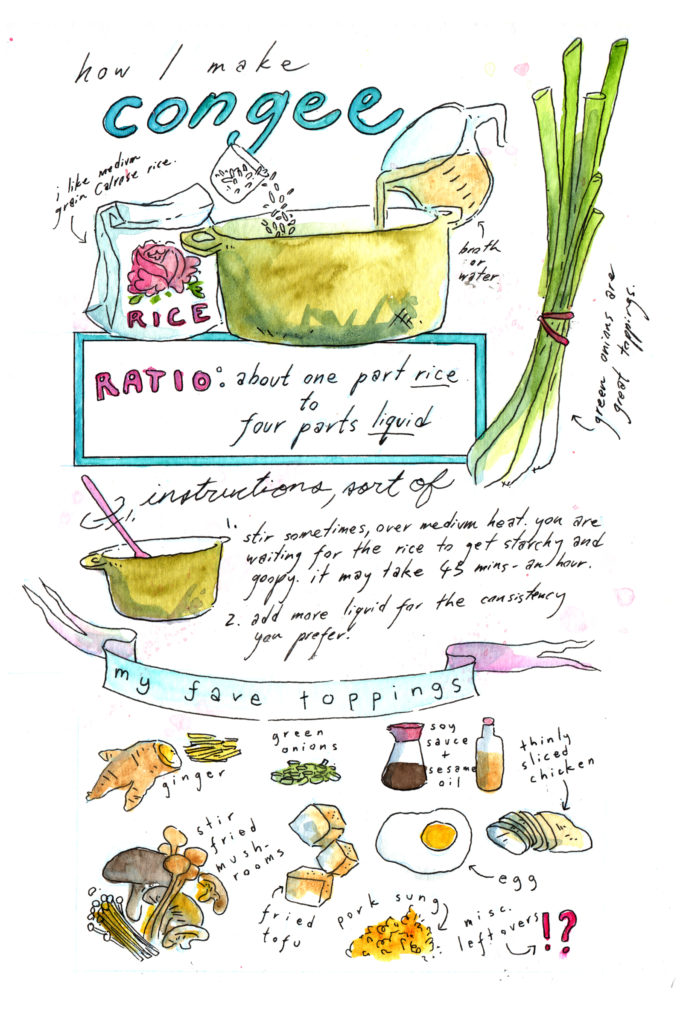
Shing Ying’s recipe for congee. Courtesy
of the artist.
The post What Are Famous Artists Cooking Up Under Lockdown?
Urs Fischer, Chloe Wise, and Others Share Their Deliciously
Creative Recipes appeared first on artnet News.
Read more https://news.artnet.com/art-world/artists-recipes-part-3-1869456
Further reading


Leave a comment