
Why Hauser & Wirth Is Investing Big in a Virtual Reality Tool That Can Plan Shows, Calculate Fair Logistics, and Even Host Residencies
Like the rest of the world, galleries and museums have been
forced to innovate like never before to develop virtual
alternatives to showcasing their wares in real life. Amid the
proliferation of virtual viewing rooms and online curator tours,
the mega-gallery Hauser and Wirth is making an even bigger leap
forward with the announcement of ArtLab, a new technology and
research division.
Its first project will be a virtual reality exhibition model, to
be called HWVR, which will launch later this month and will
literally take place in a “gallery of the future,” Hauser and
Wirth’s in-progress outpost in Menorca, which is being designed by
Luis Laplace and will physically open next year.
Hauser and Wirth first began exploring the initiative in 2019
but then stepped up its efforts again during the recent shutdown,
gallery co-founder Iwan Wirth told Artnet News.
“We accelerated it because of the current situation of being
isolated,” he said, adding, “When? if not now?”
The technology’s applications are perhaps broader than one might
expect. In addition to the virtual exhibition, the technology is
already proving useful with planning shows and projecting art fair
logistics, even down to questions of crating, shipping, and storage
for art fairs and gallery shows. (An early version of the software
helped reduce the gallery’s freight costs by roughly 50 percent
during the 2019 edition of Art Basel Miami Beach.)
ArtLab, which will be based in Los Angeles, will even offer an
artist residency and give the gallery artists opportunities to
experiment with the technology in their own practices. The
residency program will take place on an invitation-only basis for
artists and their teams. “We can introduce them to something that
feeds their natural curiosity,” Wirth says. The duration of
the digital residency will depend on the artist’s needs, a
representative of the gallery said, noting that Hauser and Wirth’s
existing residency program in Somerset, England, ranges from a
couple of weeks to several months.
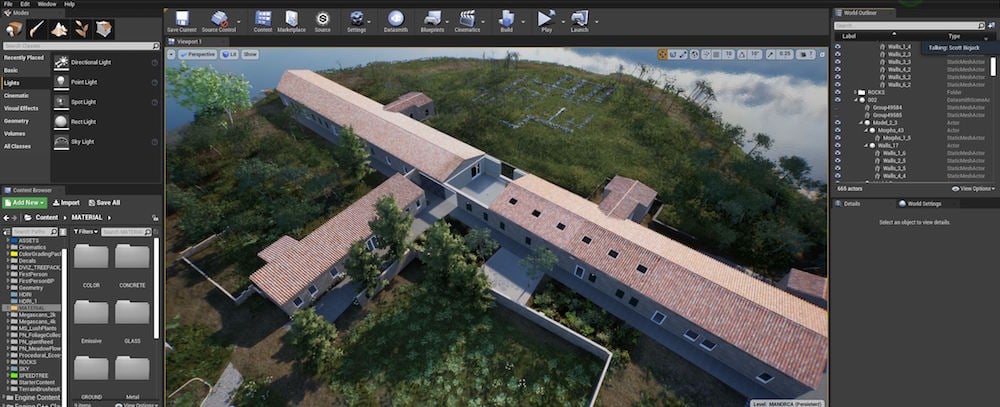
ArtLab, in software. Hauser & Wirth
Menorca exterior view created in HWVR. Courtesy of Hauser &
Wirth.
“Sustainability was the main driver. We felt the way the art
world, including us, was approaching the business model as an
analogue dinosaur,” says Wirth. Part of that is unavoidable with
art, given that you must move works, physically, from place to
place. “But the way we make choices about what to ship, how to
pack, where to ship, is a huge waste of resources,” Wirth says.
“The tools that existed were disappointing.”
Working with a team of both in-house talent and
consultants, “we built this from the ground up combining three
different types of software,” Wirth says. “We’ve taken what existed
from the world of video games, from the world of architecture, and
the world of construction.”
Wirth declined to say how much the project cost. “It’s not
finished yet,” he says. “We see this as an ongoing long-term
project.” However he conceded that it’s “quite a substantial
project that involved significant resources with respect to time
and money.”
Asked whether he thinks the technology could eventually
substitute participating in an art fair, Wirth gave a firm “no,”
saying, “I don’t believe technology and our VR will replace art
fairs. It will redefine them. Has the Internet replaced books? No.
Nothing can replace an experience with a work of
art. But it expands the audience, that is what i love about
it.”
The post Why Hauser & Wirth Is Investing Big in a Virtual
Reality Tool That Can Plan Shows, Calculate Fair Logistics, and
Even Host Residencies appeared first on artnet News.
Read more https://news.artnet.com/art-world/hauser-wirth-launches-virutal-reality-platform-1829160
Further reading


Leave a comment