
Women of the Art World Top the BBC’s List of Greatest Female Filmmakers
Cheers to the power of women
filmmakers! For the 2019 iteration of BBC Culture’s
annual “greatest films” poll, the network focused solely on female
directors. Admitting that “a paucity of female directors has been a
feature in each of our annual surveys” in years past, poll
organizers set out to correct that unfortunate
imbalance.
368 film experts—defined as
critics, journalists, festival programmers, and academics—hailing
from 84 countries voted for 761 different films in
total. Many of the
recognized filmmakers also have an art-world presence.
The late, much-celebrated artist
Agnès Varda, whom Artnet News
described as a “maverick,” emerged as the most popular director overall,
with six of her films making the cut, including
The Beaches of Agnes
(#89), The Gleaners and I (#31), Vagabond (#13), and Cléo from 5 to 7 (#2).
For her work in film, and the
arts in general, film critic Roger Ebert dubbed Varda as “the very
soul” of French New Wave cinema, saying it was not enough to merely
call her the godmother of the movement. But she also never slowed
down later in life. As recently as 2018, Varda received an Oscar
nomination for Faces,
Places, the documentary
she co-directed with street artist JR, and she was the first female
director to be awarded an honorary Academy Award. The indie crowd
loves her, too; a selfie Varda took
with like-minded feminist artist, writer, and filmmaker Miranda
July went viral in
2015.
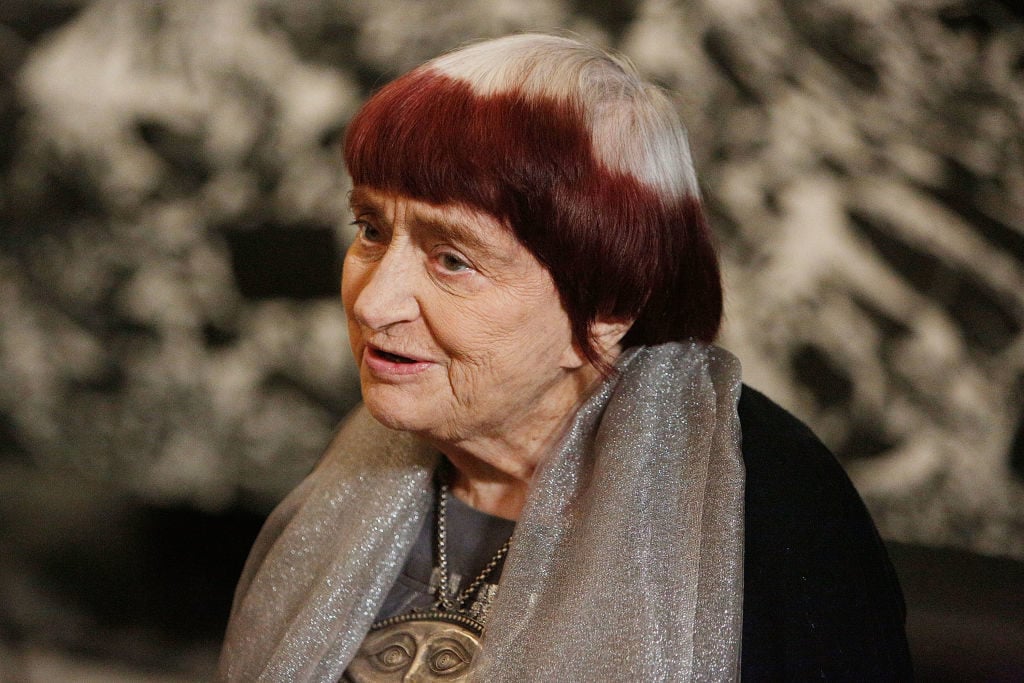
Agnès
Varda in 2019. Photo: Lars Niki/Getty Images for Museum
of Modern Art, Department of Film.
Three films made by artist and
director Chantal Akerman also appeared in the round-up, with
Jeanne Dielman, 23 Quai du
Commerce, 1080 Bruxelles placing third behind Varda’s
Cléo from 5 to 7.
Upon its release in 1975, French film journalist
Louis Marcorelles called Akerman’s art house film about a single mother
and sex worker the “first masterpiece of the feminine in the
history of the cinema.”
Also notable on the list is
American director Ava Duvernay, whose 2016 Netflix
documentary, 13th (which placed 56th), about the United States’
criminal justice system, inspired patron
Agnes Gund to start the Art for Justice Fund, a nonprofit established to address criminal
justice reform. Gund, in fact, used the income made from the sale
of a Roy Lichtenstein painting to launch the
organization.
A more surprising and perhaps
uncomfortable inclusion that ranked #45 on the list is the 1935
German film Triumph of
the Will, which was
directed, produced, edited, and co-written by Leni Riefenstahl, and
commissioned by Hitler himself. The film, which focuses on Nazi
Party aesthetics, is largely recognized as the epitome of
propaganda filmmaking, and remains noteworthy for Riefenstahl’s
original techniques, such as aerial photography, use of long-lenses
to distort perspective, and unique use of music and
cinematography.
Finally, coming in at #1 on the list of 100 is Jane Campion’s
1993 film, The Piano. Though she is regarded
primarily as a film director, Campion originally studied as a
visual artist, enrolling at London’s Chelsea School of Art in 1976
and receiving a Masters from Sydney College of the Arts in
Australia in 1981. Campion cites her art school education as having
shaped her vision, and considers Frida Kahlo and Joseph Beuys to be
major influences on her work.
The post Women of the Art World Top the BBC’s List of Greatest
Female Filmmakers appeared first on artnet News.
Further reading


Leave a comment