
7 Dramatic and Highly Specific Predictions for the Art Industry in 2020
Ah, the early days of the new
year: perhaps the only stretch of the calendar when it feels not
just permissible but obligatory to spend serious time wondering
which events among infinite possibilities might actually take place
in the next 12 months.
It’s no different here in the
art business. And after a 2019 that can be described as anything
but calm, plenty of prospects have a real chance to alter the scene
in ways big and small before 2020 closes. Here are the seven
objectively (dis)provable predictions I’m ready to put my name on.
Let’s dance…
1. Activist investors force at least one organizational
change at the MCH Group that directly impacts Art Basel.
From the exodus of several
important exhibitors from its Baselworld watch fair
and Swiss-Moto motorcycle fair, to
the divestment and/or
cancelation of nearly
all of the regional art fairs the company added to its portfolio in
the preceding two years, to the short-term abortion
of an experimental, $15,000-per-ticket conference in Abu
Dhabi in late November,
a tower of turmoil has been building inside Art Basel’s parent
company, the MCH Group, for much of the past 18 months. The
company’s situation could get worse before it gets better, too,
depending on how the ongoing unrest in Hong Kong affects Art
Basel’s starry fair there in March.
However, I think the most
underrated threat is comes in the form of a shakeup triggered by
the MCH Group’s own investors.
The day after the 2019 edition
of Art Basel Miami Beach closed, my colleague Eileen Kinsella
reported on a trove of internal
documents that appeared
to outline the most pressing strategic dangers to the organization.
Among these was a strong and vocal
dissatisfaction with the company’s direction from Erhard
Lee, whose 10 percent
stake in the MCH Group makes him its largest private shareholder.
Also highlighted was profound unease about the intentions of
Russian investor and art-world instigator Sergey Skaterschikov, who
acquired nearly four percent of the MCH Group in
October, and who is
rumored to be interested in spinning off Art Basel from its parent
company.
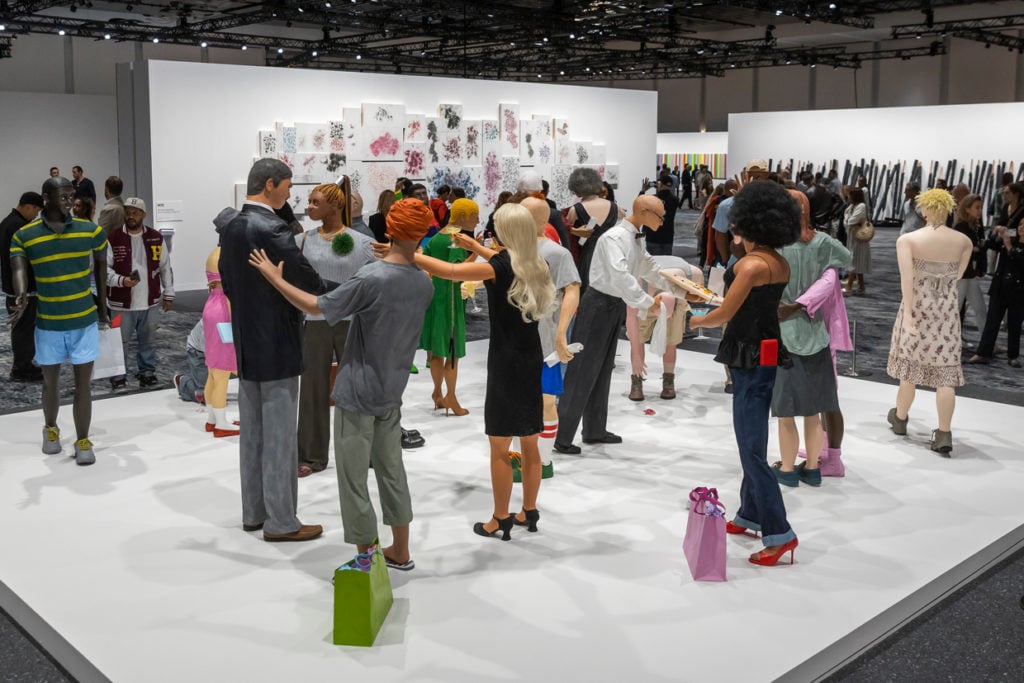
A view of Tom Friedman’s installation in
Art Basel Miami Beach’s Meridians sector, presented by Stephen
Friedman Gallery and Luhring Augustine. Photo: Courtesy of Art
Basel.
Lee and Skaterschikov both
qualify as activist investors: for the uninitiated, outsiders who
buy large equity positions in what they perceive to be
errant-but-undervalued companies, then go to war with the
entrenched corporate leadership in an effort to chart a new, more
profitable strategic direction. Remember when hedge-funder Dan
Loeb leveraged a 9.6 percent stake in Sotheby’s
into the ability to add two
like-minded members to the auction house’s board, which would later go on to replace old-guard CEO
William Ruprecht with new-school
diversification hound Tad Smith? Textbook activist investing.
For now, the MCH Group’s current
power brokers are fortunate that Lee and Skaterschikov seem to want
to drag the company in polar-opposite directions. Lee argued that
the MCH Group should sell off its entire array of trade fairs and
channel its full resources into its live-marketing-solutions
division (effectively, a
consulting business for live events). The company’s leadership announced its
intention to do the opposite last fall, and publicly rejected
Lee’s call for an extraordinary general assembly and related
activist moves in mid-December. With Art Basel now the indisputable queen on
the MCH Group’s shrinking chessboard of assets, I suspect he’d
fight like hell to prevent Skaterschikov from peeling it
off.
That said, the Swiss canton of
Basel-Landschaft rearranged its books last year so it could sell
its 7.85 percent stake in the MCH Group if a buyer emerged. The
Loeb-versus-Sotheby’s clash proves that if Lee, Skaterschikov, or
allies of either one are able to swallow up most or all of those
shares, they could have enough firepower to add or replace at least
one board member. Any number of significant strategic shifts are
possible from there, and Art Basel should be a focus of any of
them. I expect we’ll see either the board shakeup or another
strategic concession to appease the activists before 2020
ends.

A now-deleted Instagram photo of
Victoria Baker Harber with Inigo Philbrick. Photo courtesy:
Wikinetworth.com
2. Voluntarily or not, fugitive art dealer Inigo Philbrick
returns to the US and/or UK to face accusations against him by
April 1.
Look, no one with full command
of their senses is ever going to confuse me with Dog the Bounty
Hunter or the
Mandalorian. But here’s
what I know about the most scandalous man-on-the-run saga of the
art world’s past several years: there are currently at least three
parties with a multimillion-dollar interest in getting Philbrick in front of a judge
ASAP, including
billionaires Simon and David Reuben. This almost undoubtedly means high-paid
professionals are scouring the earth for him right now. No matter
how much money and goodwill Philbrick may have had when he vanished
late last year, those assets tend to run out quickly when
desperation mounts.
Even history’s most virtuosic
con men slip up eventually. And Philbrick’s romantic entanglement
with a former reality TV
star known for having no filter, as well as his use of social media to contact
his victims (according to my colleague Kenny Schachter’s
firsthand account),
suggest he’s no criminal mastermind capable of vanishing into the
jungle forever like Colonel Kurtz. All of which leads me to believe
he’ll be in court, if not in custody, sometime during the first
quarter of 2020.
3. An American art museum or foundation makes an ethically
motivated divestment from its endowment or pension fund.
While Warren Kanders’s
resignation from the Whitney last July resulted from an
extraordinary campaign of activism, it was also only the latest
high point in a wave of
institutional wokeness that had been building for more than a year
beforehand. That wave pushed major museums on both sides of the
Atlantic to turn away present
or future gifts from the opioid-infamous Sackler
family, wind down (or decline to
renew) partnerships with
fossil-fuel giants, and return Saudi
riches after the killing
of dissident journalist Jamal Khashoggi.
In the midst of Kandersgate,
protesters began targeting other high-profile trustees for removal,
most notably Steven Tananbaum at
the Museum of Modern Art for his links to allegedly predatory lending in
hurricane-ravaged Puerto Rico. But other activist groups, such
as #MoMADivest and
Code Pink, have ramped
up different kinds of ethical pressure by advocating for American
institutions to sell off their investment stakes in morally tainted
enterprises like private prisons. I expect at least one of those
institutions to listen.
Why? Mainly because it would
attract as much positive attention as booting a problematic board
member, only with dramatically less financial downside.
Instead of instantly destroying a
pipeline to millions of dollars in donations, museums would simply
be funneling capital gains into other investments, some or all of
which could be even more lucrative than oil and gas, defense and
punishment, or certain forms of mass retail (think: sweatshop labor) and
finance (see: the Tananbaum example). Plus,
there is institutional precedent. As Kate Yoder recently noted
in Grist, at least five American science museums,
including Chicago’s Field Museum
and New York’s American Museum of
Natural History, have
divested from fossil-fuel interests since 2016. Art museums are
overdue to catch the spirit.
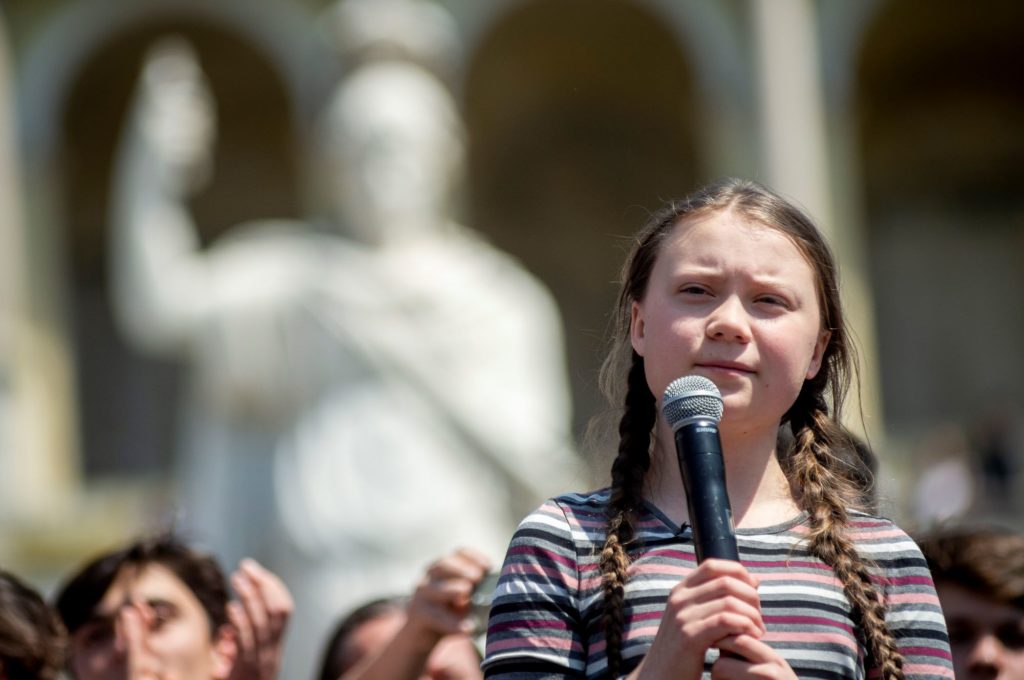
Swedish climate activist Greta Thunberg
makes a speech in Rome in April 2019. Photo Antonio Masiello/Getty
Images.
4. A major gallery announces a plan to go carbon-neutral by
2025.
Shifts in demographics and the
public consciousness aren’t just incentivizing nonprofits to take
progressive action. They’re doing the same to for-profit entities,
too. Welcome to the era of what marketing analyst Scott Galloway
has dubbed “Woke as a Business
Strategy,” an
operational trend visible in everything from Walmart ending
sales of assault-rifle ammunition in its stores
to Kering, the luxury-goods
syndicate that includes Gucci, Balenciaga, and Saint
Laurent, agreeing to offset
100 percent of its carbon emissions.
In the art market, Woke as a
Business Strategy also seems to be coalescing around combating
the in-progress
disaster of climate change. Art Basel already purchased carbon
offsets for each of its
traveling staff members, outside consultants, invited journalists,
and speakers to Art Basel Miami Beach 2019. (Disclosure: I was one
of those speakers.) In late December, Christie’s announced it would
reduce the number of physical catalogue pages and other printed
materials it would produce by 50
percent in 2020, and
international gallerist Thaddaeus Ropac rented a large amount of
additional storage space for the specific
purpose of reusing custom crates for
artworks.
Some dealer is going to take the
next logical step in this progression soon by pledging full carbon
neutrality, even if, like Kering, the crux of the plan is to simply
buy emissions offsets, which most climate activists regard as a
band-aid solution. It’s cheaper than
you probably realize.
And even if Boomer buyers mostly don’t care, studies show that the
next generation of wealth does, meaning there’s too much branding value to
ignore for a trade desperate
to attract new collectors. Non-binding hunch: keep your eye on
Pace, which is betting bigger on youth and
radical change than any of its competitors at the commercial
apex.
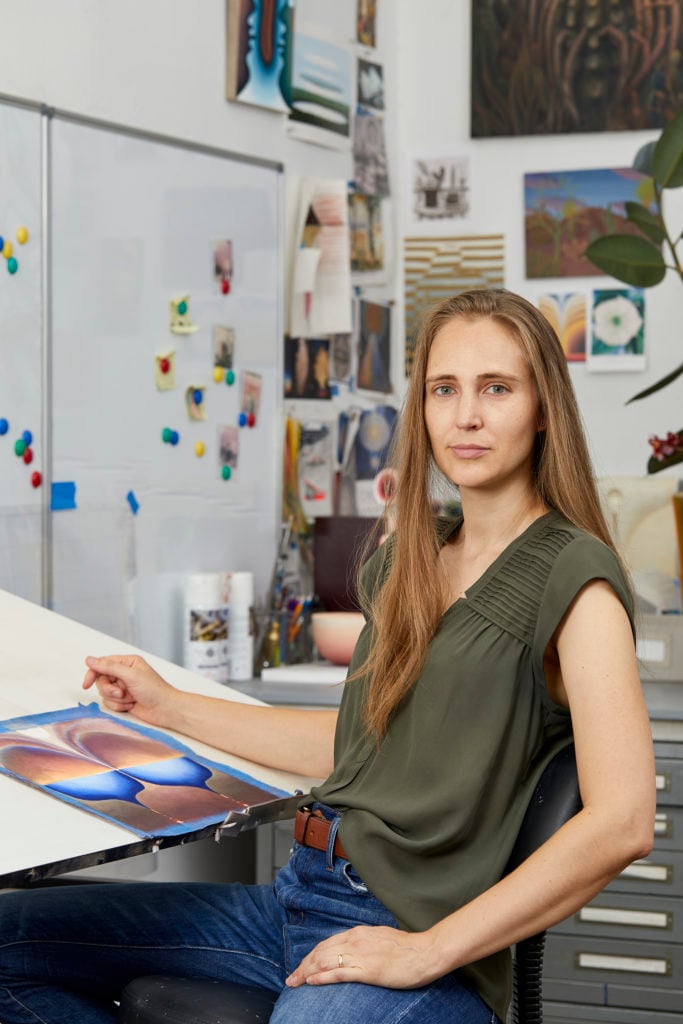
Loie Hollowell in the studio. © Loie
Hollowell, courtesy Pace Gallery. Photo: Melissa Goodwin
5. At least seven artists under age 40 will have their works
sell for over $1 million each in auction sales in the first half of
2020.
I’m increasingly convinced that
some of the strongest trade winds have shifted back from
underappreciated artists and estates to potential rising stars.
We’re seeing a growing body of evidence for it in both the primary
market (see: the clamor
for Nigerian figurative-painting
sensation Amoako Boafo and other young artists during Miami Art
Week) and the secondary market (see: the auction frenzy for works
by the likes of Loie Hollowell, Julie Curtiss, and Tschabalala
Self, each of whom had works go for at least $1.5 million under the
hammer in 2019, per the Artnet Price Database). This prediction is
an attempt to quantify that theory of momentum.
(Note: I’m pegging this to
auction results in the first half of 2020 only because the full
year’s numbers won’t arrive in time for my annual roundup of how my
predictions fared.)
6. Instagram makes no more than nominal changes to its
censorship policies, leaving intact the same structural problems
artists have been protesting for years.
I genuinely believe that
Instagram and its parent company, Facebook, would prefer to
implement content-moderation guidelines that would please artists
in every medium, as well as any users (justifiably) offended by
their inability to post harmless images that include the nonsense
concept “the female nipple.” I think the platforms’ leadership was
sincere when they met with a forum of
artists at Instagram’s
New York headquarters last October to discuss how to make their
current censorship policies more enlightened. I trust the
participants in that session when they say that they think Facebook
and Instagram are trying to do the right thing.
However, Facebook (and thus
Instagram) is a for-profit business primarily concerned
with ad revenue and growth—metrics that have been booming under the
existing content-moderation guidelines. Instagram advertising is projected to account
for as much as 70 percent of
Facebook’s new revenue starting in 2020, and that growth has helped
propel the company’s stock price from under $136 per share in early
January 2019 to over $208 per share by late December.
Could Instagram perform
even better
if it too adopted Woke as a
Business Strategy? Maybe. But when the numbers coming in are as
juicy as those above, leadership has almost no incentive to alter
what content Instagram should (and should not) allow, along with
what processes it should use to judge where to draw the
line.
This is especially true in light
of the cautionary tale
that was Tumblr, the
proto-social-media platform that Yahoo! bought in 2013 for $1.1
billion and then sold off, just last year, for less than $3
million. You read that right: a 98 percent drop in value in six
years, which largely resulted from consensus among investors
and advertisers that its permissive attitude toward nudity (no
matter how artsy) and adult content made Tumblr indistinguishable
from a porn site. Case in point: WordPress’s only
credible, reported competition to acquire Tumblr was
Pornhub.
According to a statement from the National Coalition Against
Censorship, “the only solid
commitment made by Facebook” after the aforementioned summit with
artists at Instagram HQ “was its intention to issue clarification
around its guidelines that regulate what appears in searches and
hashtags.” No details were provided on how or when, let alone if
larger structural changes would arise, too. Given how much money is
at stake, I expect those clarifications are all we’ll get this
year.
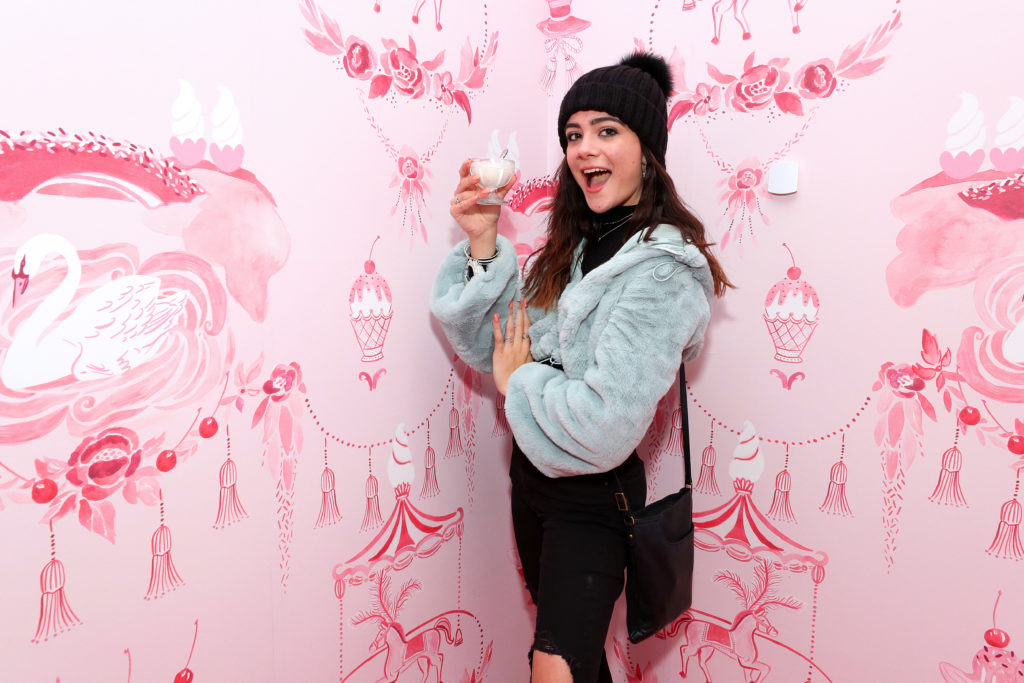
Luann Diez attends the Museum of Ice
Cream Soho Flagship Opening Party in December 2019. (Photo by Cindy
Ord/Getty Images for Museum of Ice Cream)
7. Total first-year attendance at New York’s permanent
Museum of Ice Cream surpasses that of the 20th most-visited museum
exhibition of 2019.
Let’s end with a reminder of
what the vaunted “democratization of art” can look like. Even
though, at $38, a ticket to the freshly opened MOIC in Soho
costs more than
every major art museum in America, the Instagram mecca to soft-serve would only
need to draw about 241,000 visitors to have cracked the top 20 of
the Art
Newspaper’s survey of
the most magnetic shows of 2018. (That is, if the Art
Newspaper suppressed its journalistic gag reflex
and warped the eligibility criteria.)
Last August, the Wall Street
Journal reported
that the MOIC had welcomed over 1.5 million visitors across its
various pop-ups and its permanent San Francisco location in about
three years. If visitorship to museum shows in 2019 stayed at
roughly 2018 levels, the MOIC’s New York flagship would need to
attract less than one-sixth of that total by mid-December 2020 to
make this prediction come true. Here’s betting it does… and in the
process, once again reframes our understanding of what the public
wants from its art (or “art”) experiences.
The post 7 Dramatic and Highly Specific Predictions for the
Art Industry in 2020 appeared first on artnet News.
Read more https://news.artnet.com/opinion/art-industry-predictions-2020-1743744
Further reading


Leave a comment