
Cree Artist Kent Monkman Takes Us on a Tour of the Met to Show How Not to Depict Indigenous People
When visitors enter the Great Hall of New York’s Metropolitan Museum of Art this month, they
will be greeted with something unusual: a pair of monumental
history paintings by Cree artist Kent Monkman. The massive canvases—almost 11
feet by 22 feet—seek to do nothing less than turn conventional
Western art history on its head.
The exhibition, titled “mistikosiwak (Wooden Boat
People),” comprises two massive paintings, Welcoming
the Newcomers and Resurgence of the People. The
show’s title—which comes from the Cree name for European settlers
arriving at what is now known as North America—offers a fitting
introduction to Monkman’s MO: to provide a view of history and art
that centers those who have long been viewed as “other.” Both
paintings star Monkman’s gender-fluid alter ego, Miss Chief Eagle
Testickle, a representation of indigenous Two Spirit
traditions.
The artist, who is 54 and from Canada, was commissioned to
create the two works as part of director Max Hollein’s new series of contemporary
“activations” responding to the Met collection, which to date
have included an immersive video
installation from Ragnar Kjartansson and the first-ever
exhibition on the
building’s facade, by Wangechi Mutu.
Monkman was surprised to get the call from the museum—“I didn’t
even know that I was on their radar,” the artist admitted to Artnet
News—but eager to create work inspired by the Met’s holdings, which
he was familiar with thanks to visiting regularly over the past 25
years. On a walk through the Met’s galleries with Artnet News, he
pointed out various works that inspired his own. But while the
works in the Met’s collection tend to present an image of Native
people as shrinking and doomed, while picturing North America
itself as a vast wilderness ripe for the taking, Monkman offers an
alternative story.
“I could pinpoint specific works in the Met’s collection and
say, ‘Here we have this theme that keeps recurring over and over
again in the 19th century which reinforces this idea of
extinction,’” Monkman explained. “That was a very useful theme in
that period of time, because the settlers wanted our lands, they
wanted us gone.”
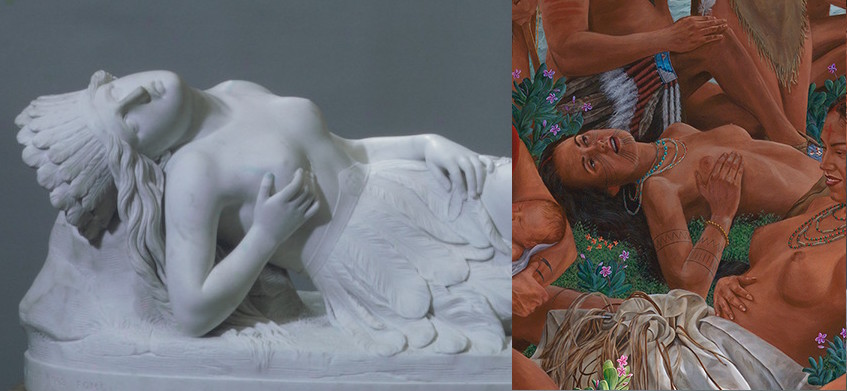
Thomas Crawford, Mexican Girl
Dying (1846–48) and the figure inspired by the sculpture in
Kent Monkman’s Welcoming the Newcomers (2019). Photo
courtesy of the Metropolitan Museum of Art.
An Alternative History
“To me, there’s a way to breathe life into these themes of
extinction and refute that erasure,” the artist said. Taking me to
the Met’s sunlit Engelhard Court, he pointed to Thomas Crawford’s
Mexican Girl
Dying (1846), a dramatic sculpture of a fallen young woman
clutching a wound under her right breast. It was the inspiration
for one of the figures in his new work—but Monkman chose to
translate her pain into pleasure. “When I saw that beautiful marble
sculpture, I was taken with how sensual and erotic that image is,”
he said. “In my painting, she’s ostensibly having an orgasm.”
The Met has plenty of examples of Native figures being either
brutalized or romanticized. Monkman calls attention to Augustus
Saint-Gaudens’s Hiawatha (1871–72, carved
1874), just a few feet away from Mexican Girl
Dying. “He looks like this Greek god in the way that his
body has been idealized,” he said. “I see of a fantasy of an
indigenous person.”
The work also calls attention to how often indigenous stories
are told by outsiders. “It’s a sculpture made by a settler artist
about a poem written by another non-indigenous person, so there are
levels of removal, taking it further and further away from real
indigenous people,” he said.
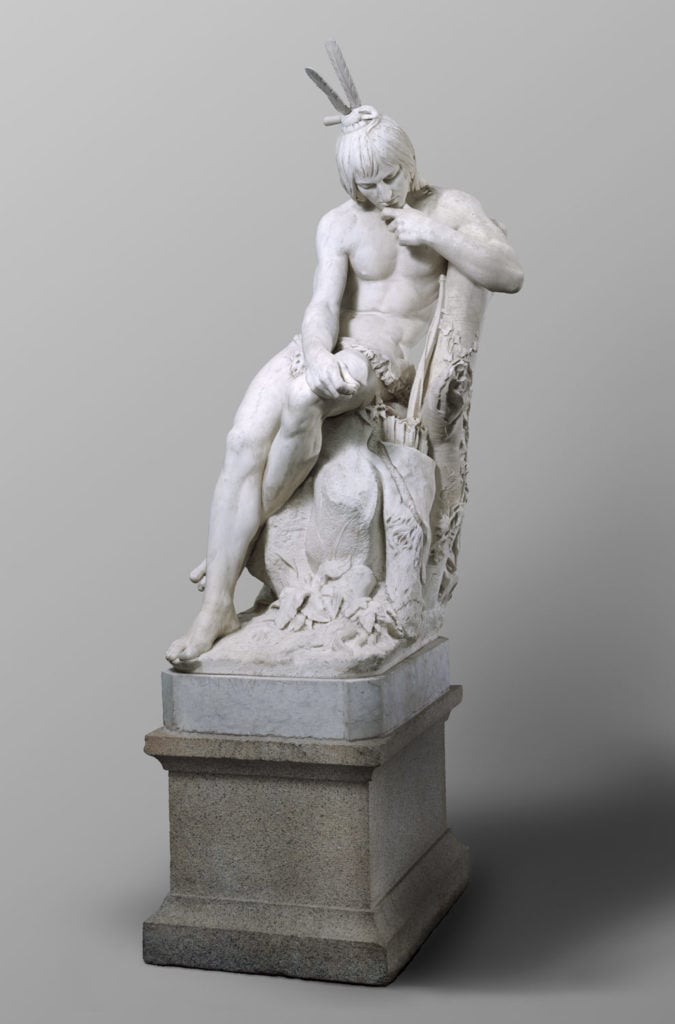
Augustus Saint-Gaudens, Hiawatha
(1871–72, carved 1874). Photo courtesy of the Metropolitan Museum
of Art.
To address this issue at an institution as important as the Met
is a big moment for Monkman. “Museums have been culpable in
reinforcing this disappearance, often segregating the indigenous
art and artifacts to their own wings which cuts them off from the
continuum of our living and vibrant contemporary cultural
expressions,” he said.
The Met has had its own history with this issue. The museum
announced it would hire its first full-time curator
of indigenous art for its American wing in September. But
nearly a year earlier, it was subject to
criticism from a Native American advocacy group, which claimed
it was not appropriate for the museum to display Native works as
art in its American wing.
At the press preview, Hollein acknowledged that institutions are
making up for lost time. Monkman’s work, he said, “fosters and
surfaces an important part of American history, maybe a history and
a story that has been suppressed for some time and that we have not
properly reflected on here at the museum.” Sheena Wagstaff, the
museum’s chairman of Modern and contemporary art, went further,
declaring that “museums can no longer maintain a position of
neutrality.”
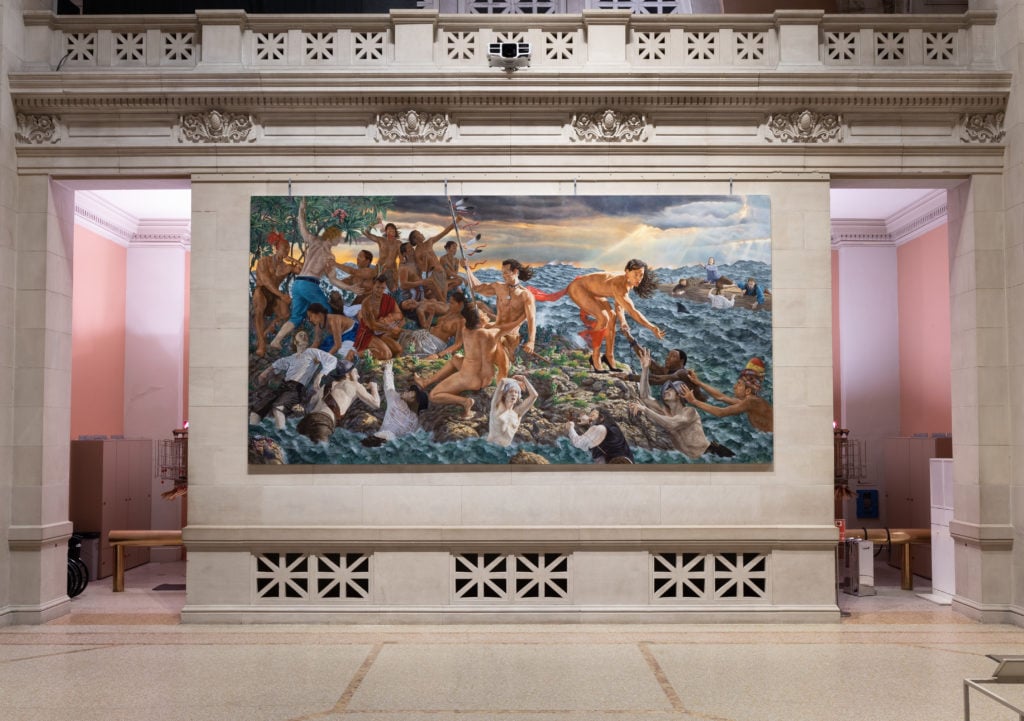
Intallation view of Kent Monkman’s
Resurgence of the People (2019). Photo by Anna Marie
Kellen, courtesy of the Metropolitan Museum of Art.
A Monumental Undertaking
Monkman’s paintings offer both a revision of the past and a look
into the future. Where Welcoming the Newcomers shows Miss
Chief Eagle Testickle reaching out to help various stranded figures
being washed ashore (a counter-narrative to the typical picture of
violent tribes attacking European settlers), the indigenous people
are the ones set adrift in Resurgence of the People, with
armed white nationalists laying claim to the only visible land.
“I took inspiration from those heartbreaking photographs of
migrants on these too small boats, hundreds of people crammed in
headed for some place better,” said Monkman. “This painting is kind
of set in the future. Rising sea levels will impact millions of
people around the world, so I wanted to think about migrating
populations will affect us all in the future.”
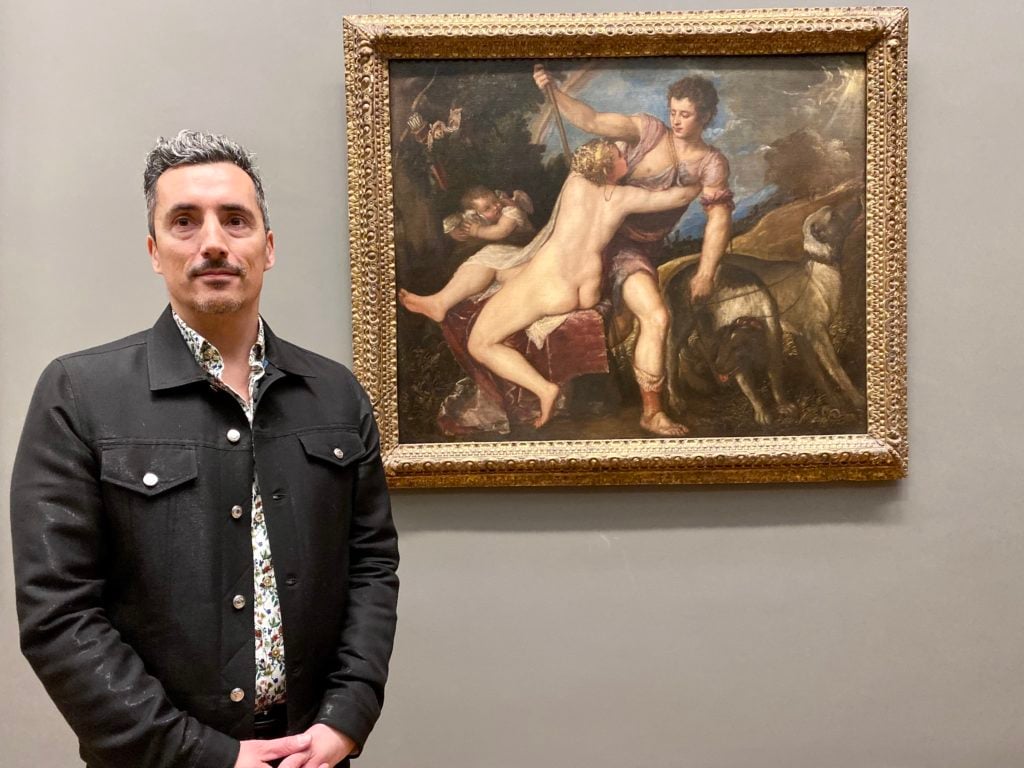
Kent Monkman with Titian’s Venus and
Adonis (1550s) at the Metropolitan Museum of Art. Photo by
Sarah Cascone.
A maritime painting in the Met’s collection is perhaps the most
prominent reference in Resurgence of the
People: Emanuel Leutze’s famed Washington Crossing the
Delaware (1851). “You come into this museum and you see
this massive history painting that really celebrates Washington,
who was a slave owner and committed atrocities against indigenous
people,” said Monkman. “I wanted to create a painting that equaled
the scale of that painting rivaled it in size.”
Nearly 11 feet by 22 feet, the paintings brushed against the
ceiling rafters of Monkman’s studio, where he worked with a team of
10 painters to complete the ambitious works. Each one began with a
sketch, before Monkman brought in models—and a real wooden boat—to
pose for the dynamic scenes.
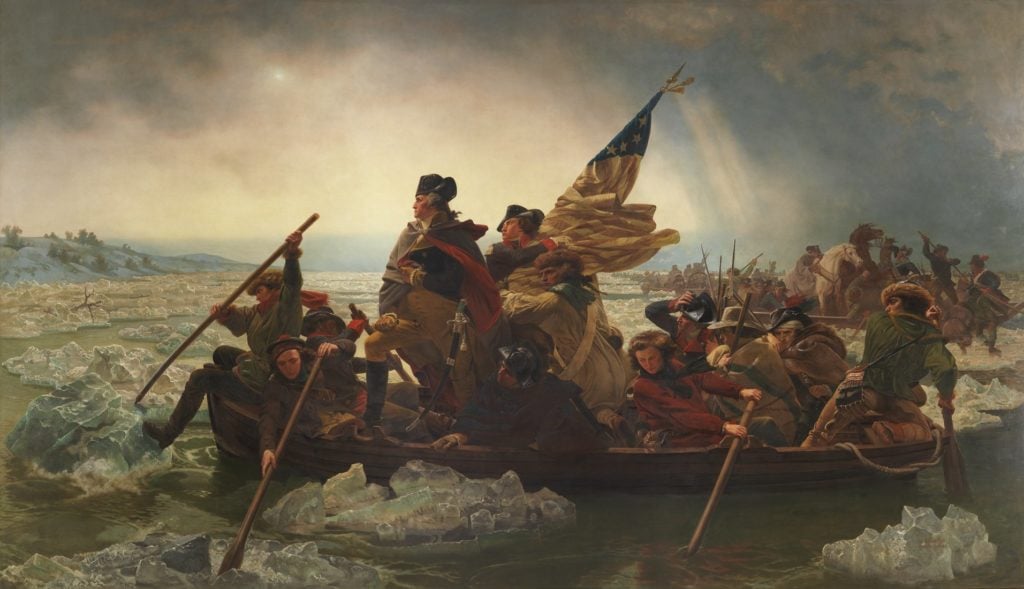
Emanuel Leutze, Washington Crossing
the Delaware (1851). Courtesy of the The Metropolitan Museum
of Art, gift of John Stewart Kennedy, 1897.
The artist turned to the Old Masters for inspiration when he
realized that the visual language of abstract painting was too
limited to address the themes that interested him. “All artists
throughout history learn from each other,” Monkman pointed out as
we moved to the European paintings wing, where a pair of Venus and Adonis
paintings, one by Titian, the other by Peter Paul Rubens, hang in
nearby galleries, the Italian artist clearly having influenced the
later painter.
“I wanted to riff on that idea of artists looking back and
taking inspiration from these traditions of painting and how that
can be reinterpreted over and over again in different ways,”
Monkman added. “I feel like I’m an outsider looking at this
trajectory of Western art going, ‘Wow, you had this great tradition
of painting, and you guys kind of discarded it.’”
Both Venus and Adonis
compositions are referenced in “mistikosiwak,” one with an
indigenous couple, the other with a male settler and an indigenous
woman. The original myth, in which Venus attempts to seduce Adonis,
who would rather be off hunting, resonated with Monkman. “When I
thought about the history of the continent,” he explained, “so much
was driven by the fur trade and the trapping of animals. The
Europeans were here to basically extract recourses.” He’s
represented that by replacing the small angel in the Rubens
painting with a beaver, which he describes as “the first currency
of this continent.”
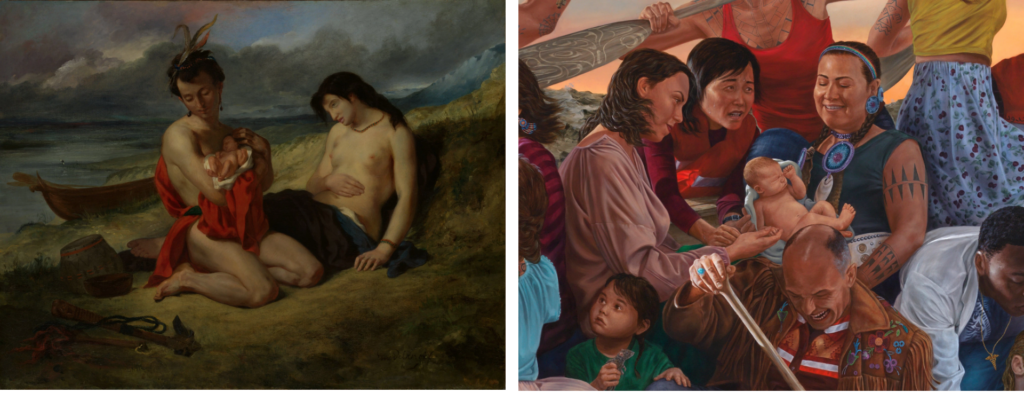
A detail from Eugène Delacroix’s The
Natchez (1823–24 and 1835) inspired this detail of Kent
Monkman’s Resurgence of the People (2019). Courtesy of the
Metropolitan Museum of Art.
The compositions also mirror one another in the repetition of
figures drawn from Eugène Delacroix’s The Natchez (1823–24
and 1835), of an indigenous couple giving birth on the roadside
while fleeing French soldiers. Amid the chaos of both of Monkman’s
paintings, the two birth scenes—one featuring a same-sex
couple—represent “the celebration of life and the continuum of our
culture,” the artist said.
Monkman is excited for visitors to the Met to encounter this
work, prominently displayed in the recently revamped Great Hall.
(The ticket booths were removed in October, and moved inside the
smaller lobby gift shop, creating a more open space.)
“I want people to be surprised that these are the works of an
indigenous artist. I think a lot of people’s perceptions of who an
indigenous artist is or the kind of work that an indigenous artist
make are probably very different from what you see here. But we’ve
been in contact with European artists for 500 years,” Monkman said.
“There’s a long history of exchange back and forth.”
“Kent Monkman: mistikosiwak (Wooden Boat People)” is on view
at the Metropolitan Museum of Art, 1000 Fifth Avenue, December 19,
2019–April 9, 2020.
The post Cree Artist Kent Monkman Takes Us on a Tour of the
Met to Show How Not to Depict Indigenous People appeared first
on artnet News.
Read more https://news.artnet.com/exhibitions/kent-monkman-metropolitan-museum-of-art-commission-1741602
Further reading


Leave a comment