
An Art Lover’s Guide to London: 5 Spots to Visit for an Offbeat Tour of British Art History
One fateful day in 1967, when the Young British Artists were
still in diapers, John Lennon met Yoko Ono in a small but
well-connected art gallery in London’s West End. The Japanese
artist handed the Beatle a card with the word “breathe” on it—and
from then on, art and pop culture would never be the same. That
meeting at Indica Gallery in Mayfair is one of many historical gems
recounted in a new guide to the London art scene.
Written by the art critic and artnet News contributor Hettie
Judah, Art London: A Guide to Places, Artists And
Events is an indispensable volume for both art-world
insiders familiar with the city and those who are new to it. As
Judah notes, the sheer volume of art, museums, and galleries in
London can feel overwhelming. But she has distilled a wealth of
knowledge into pithy entries about its leading commercial galleries
and non-profits, large and small.
“I love that you can stand in Mason’s Yard where White Cube now
is and know it is where Lennon and Ono first met,” Judah says. “I
wanted to capture London’s layers of history, which go back
hundreds of years.” There is a surprise around every corner: Who
knew, for example, that another Beatle, Paul McCartney, was an
early customer of Indica, and even helped set up the alternative
bookshop and art gallery?
These nuggets of history are interspersed with entries about
important works of public art and the many artists who call London
home, including Mike Nelson, Gillian Wearing, Tracey Emin, Anish
Kapoor, and Yinka Shonibare. There are also shout-outs to
unsung heroines, such as Laura Herford, the first female student at
the prestigious Royal Academy. The trailblazer was admitted by
accident in 1860 after submitting work signed only with her
initials.
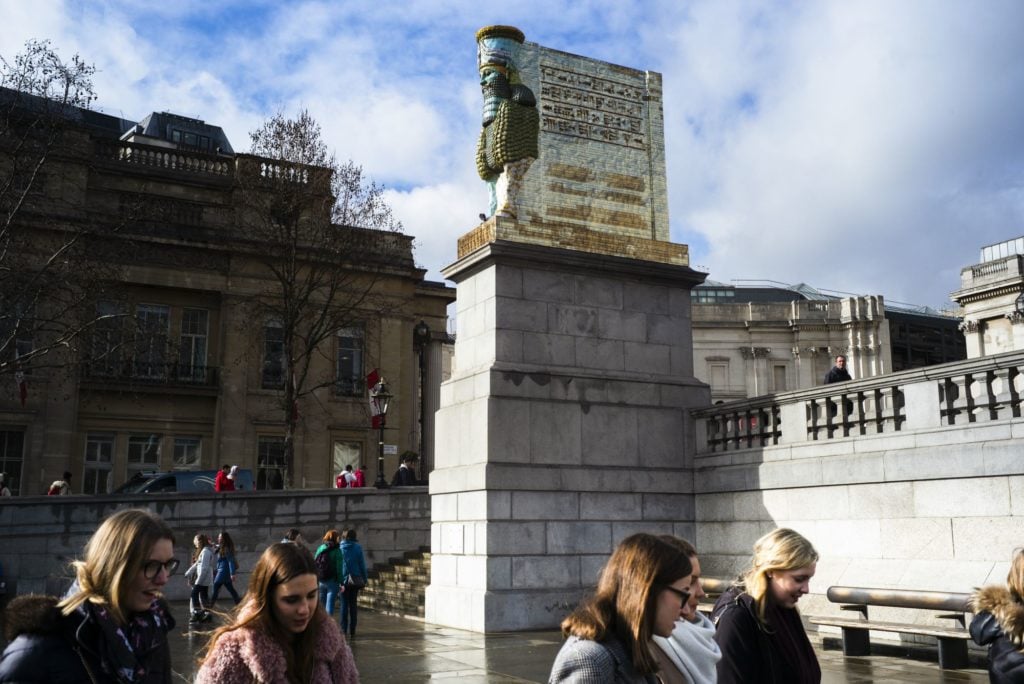
Michael Rakowitz, The Invisible
Enemy Should Not Exist (2018), The Fourth Plinth. Photo by
Alex Schneideman.
“There isn’t a book that brings together all of the art spaces
in London,” Judah says, adding that she was given pretty much
“carte blanche” by her publisher, ACC Art Books. It is an
impressive feat; reading the book, which has been published just in
time for Frieze Week, feels like being given a tour by an
exceedingly knowledgeable friend. To give you a taste of what’s
inside, we have selected five art-world landmarks that Judah
presents as you may never seen them before.
Where Phyllida Barlow Had
Her Big Break
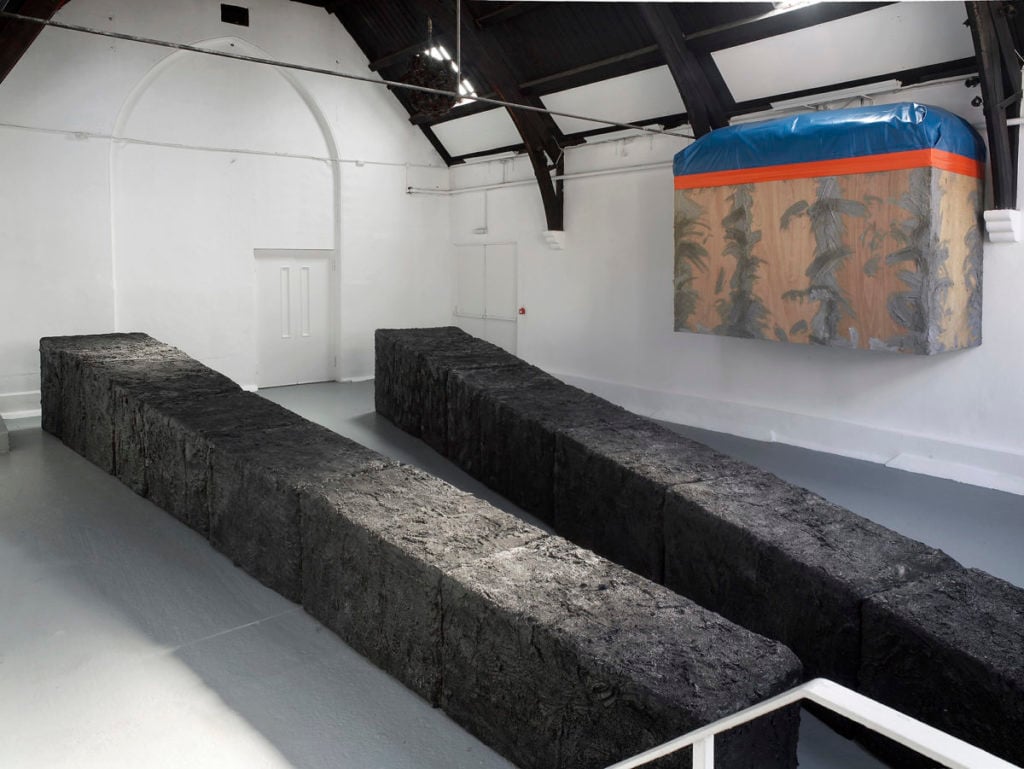
Phyllida Barlow, “Bluff” (2010) at
Studio Voltaire in South London. Photo: Andy Keate.
Where: Studio Voltaire, Clapham, South
London
The Backstory: British sculptor
Phyllida Barlow has spent most of her career teaching at the
Chelsea and Slade Schools of Art. It was only upon her retirement
as a professor in 2009 that she was able to devote herself full
time to sculpture. The following year, she had a solo show at
Studio Voltaire in 2010, one of London’s leading nonprofit spaces.
After that, her career took off: she became a Royal Academician,
earned representation by Hauser & Wirth, snagged a major commission
at Tate Britain, and was chosen to represent Britain at the 2017
Venice Biennale. “The ‘miracle’ that propelled Barlow’s ascent over
the last ten years was, finally, the active attention being paid to
the work of women artists of her generation,” Judah writes.
Why You Should Go: Take the opportunity to
discover the next Phyllida Barlow before the art world beats you to
it.
Where David Hockney Put
Secret Messages Into His Art
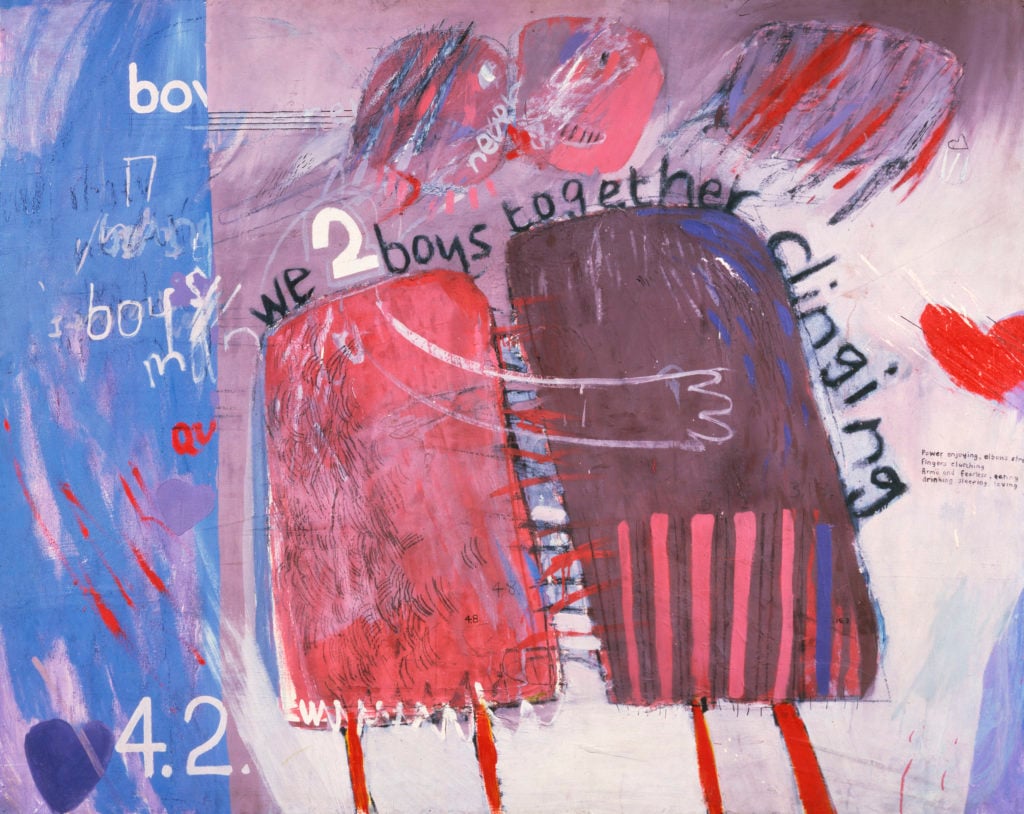
David Hockney’s We Two Boys Clinging
Together (1961). © David Hockney, courtesy of the Arts Council,
Southbank Centre London.
Where: The Royal College of Art, South
Kensington, West London
The Backstory: As a student at the Royal
College of Art in the early 1960s, Hockney was forced to sneak
coded messages into his paintings at a time when homosexuality was
still illegal. The title of the painting We Two Boys
Clinging Together (1961) was partly inspired by a newspaper
headline, “Two Boys Cling to Cliff All Night.” The article was, in
fact, about a climbing accident, but Hockney had a crush on the
singer Cliff Richard at the time, so the title could be read
multiple ways.
Why You Should Go: See where generations
of creatives—not only Hockney, but also architect David Adjaye and
painters Frank Bowling and Bridget Riley—found their voices. Maybe
you’ll absorb some inspiration, too.
Where a Guerrilla Artist
Installed Casts of His Own Nose

London knows noses. Image courtesy of
Wikimedia Commons.
Where: Admiralty Arch and various sites across
Soho
The Backstory: In 1997, the artist Rick Buckley
affixed casts of his nose under recently installed surveillance
cameras around London. Most were detected and swiftly removed, but
seven happily remain on view, one off Trafalgar Square and the
others in Soho. Buckley only claimed responsibility for The
Seven Noses of Soho in 2011, by which time, Judah writes,
“they had generated a whole sub-genre of mythology.”
Why You Should Go: Who doesn’t enjoy a
good old-fashioned nose scavenger hunt?
Where Jean Cocteau Painted
Racy Church Murals

Jean Cocteau’s murals, Lady
Chapel at Notre Dame de France Church. Courtesy of Wikimedia
Commons.
Where: Lady Chapel, Notre Dame de France,
Soho
The Backstory: Judah recalls clubbing in the
basement of the church of Notre Dame de France in Soho, unaware
that its Lady Chapel above had been painted by the French artist
Jean Cocteau. He painted the murals in 1959, but was forced to
modify some of the male figures because the priests thought them
too sensual. It wasn’t the first time Cocteau’s art had raised
eyebrows in London. His paintings of female nudes were seized as
obscene in 1938 at Croydon Airport ahead of his solo show at Peggy
Guggenheim’s short-lived London gallery.
Why You Should Go: The church murals were
restored in 2012, so they are looking extra spiffy these days.
Where Gillian Wearing
Installed a Monumental Public Sculpture
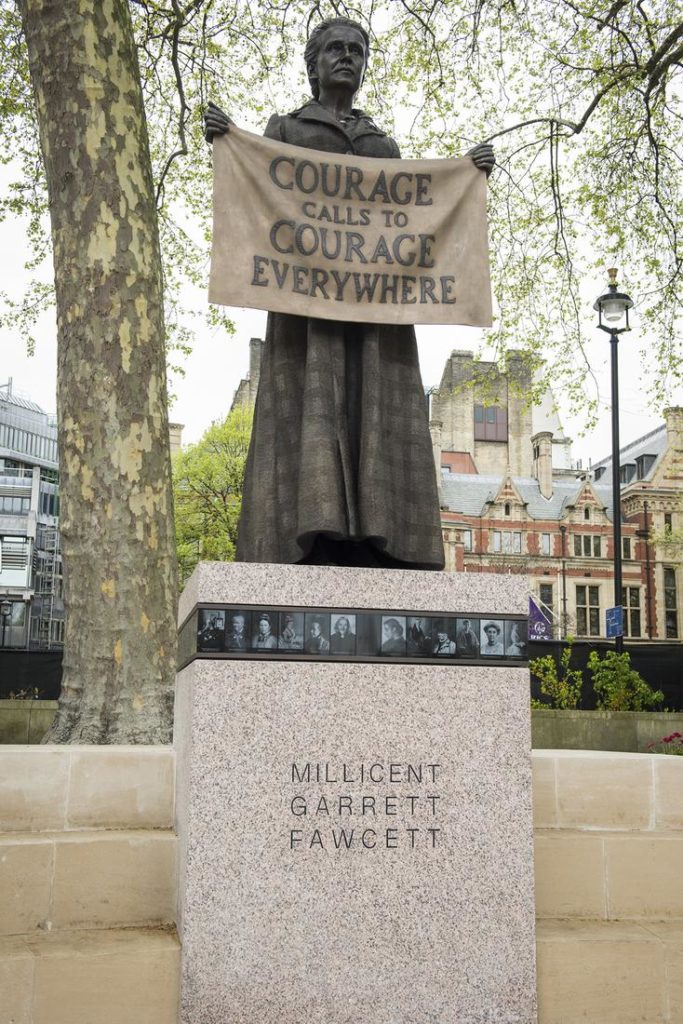
Gillian Wearing’s statue of Dame
Millicent Fawcett in Parliament Square, London. Courtesy of Tanya
Bonakdar Gallery.
Where: Parliament Square, Westminster
The Backstory: The artist’s statue of the
suffragist Millicent Fawcett was unveiled to mark the centenary of
some women getting the right to vote in Britain. The first statue
of a woman in Parliament Square, it shows Fawcett holding a banner
reading, “Courage Calls To Courage Everywhere.” Judah points out
that the figure recalls Wearing’s early work in the 1990s, when she
photographed ordinary people in a shopping mall in Peckham, South
London. They each held up a placard describing how they felt. Among
them was one man who wrote, “I’m Desperate.”
Why You Should Go: As the Brexit crisis
rages in Westminster beyond, Fawcett and the anonymous man’s words
resonate for good and ill.
Art London: A Guide to Places, Artists and Events by
Hettie Judah and photographs by Alex Schneideman is out now. It is
published by ACC Art Books.
The post An Art Lover’s Guide to London: 5 Spots to Visit
for an Offbeat Tour of British Art History appeared first on
artnet News.
Read more https://news.artnet.com/exhibitions/hettie-judah-guide-london-1661131
Further reading


Leave a comment