
William Powhida’s First Gallery Show in Years Is Taking Aim at Problematic Art World Patrons—and It Turns Out All Of Us Are Complicit
It’s not often you come across an artist who tells you who they
won’t sell their work to, but that’s exactly what William
Powhida does in the introduction to his first solo gallery show at
Postmasters Gallery in almost five years.
The press release for “Complicities,” open now through October
at the Tribeca-based gallery, reads frankly: “William Powhida has
no illusions that this work will change the systems he inhabits, or
save anyone, but he will not be selling any of this work to any of
the subjects depicted (sorry, Glenn Fuhrman!).”
The show features intricate, large-scale diagrams that map out
the links between (mostly) powerful men like Warren Kanders and
Mortimer Sackler, their businesses and foundations, and the arts
institutions they fund. The data is culled from reams of reports
and business statements that have come under public scrutiny in
recent months, as more and more scandals play out in the news. The
artworks have footnotes with sources.
This gamble of an exhibition shows off Powhida’s draughtsmanship
and graphic sense, infused with a sober institutional critique and
irascible commentary. In lends his art’s style to monumentalizing
the recent wave of scandals that have rocked the art world over
patronage and politics.
During the recent protests over the presence of Warren Kanders,
a weapons and teargas manufacturer, on the board of the Whitney,
Powhida was part of a group called the (De)Institutional Research
Team, or (D)IRT, which infiltrated the Whitney Biennial with an
alternative visitor’s guide that outlined criticisms of Kanders and
the museum.
At Postmasters, the drawing Powhida made about Kanders and his
tangled web of similarly well-heeled tycoons is laid out in a flow
chart, complete with watercolor portraits of Kanders alongside
other art-world heavyweights connected to him and his enterprises
through various social pathways.
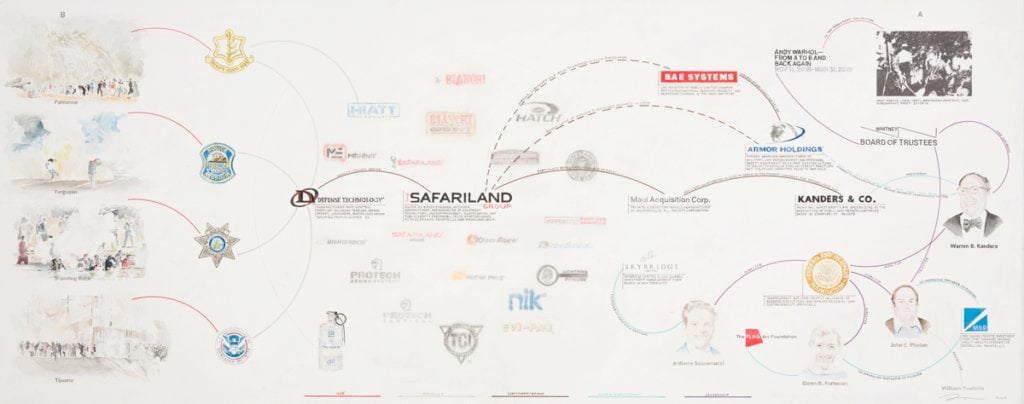
William Powhida, Safariland (Direct
Investment) (2019). Courtesy of the artist and Postmasters
Gallery.
This makes the drawing personal, in a way. Powhida explained
that some of those named in the Kanders drawing, including John C.
Phelan and Glenn R. Fuhrman, are people he’s had professional
relationships with in the past through sales of his work. “I was
surprised to find them on the same board as Warren Kanders, and
that I am connected to Kanders through their professional
associations,” he told artnet News.
Another large drawing, about the now well-publicized dealings of
the Sackler family, is laid out like a family tree, complete with
monetary accounts of their institutional gifts to the Whitney, the
Met, the Victoria & Albert Museum, Tate, the Dia Art Foundation,
and many other arts entities. Powhida includes the monetary amounts
each museum received, along with their current status in accepting
or rejecting further association. (All have now distanced
themselves with the exception of Dia, which still has not commented
on the multi-million dollar Sackler Wing endowment it received in
2016.)
Artist Nan Goldin makes a cameo appearance too, representing her
role as part of the protest group PAIN. She stands as a symbol for
successful critique leading to actual change, Powhida said. “Nan’s
work is an example of how this can work.”
Another drawing focuses on a place: Hudson Yards, the hulking
“city within a city” that, after years of construction, seemed to
bloom overnight at the terminus of the 7 train in New York this
year. Hudson Yards has been in the news lately too, on account of
the much-scrutinized role of mega-developer Stephen Ross in
fundraising for Donald Trump.
This work features an image of the complex of buildings on the
Hudson Yards site. All of the governmental proceeds, building
permits, investors, tenants, and other logistical minutiae related
to the site are meticulously laid out. It’s a startling amount of
information to take in—though, as Powhida points out, this is
actually just a part of the complexity of what the final luxury
complex will represent, since it is still expanding. “This is only
phase one of the project!”
Adding some levity to the data-heavy works on display are small
watercolor paintings in the style of memes, overlaying movie stills
from horror films (Don’t Look Now) and premium cable drama
series (Billions) with block text that capture the angst
of being an artist in 2019. One pictures Jamie Lee Curtis’s
character from Halloween squeezing her eyes shut as she
hides behind a door, her face twisted in a grimace as the masked
murderer Michael Meyers lurks in the black background. The overlaid
text reads: “When You Find Out how Your Collector Makes Money.”
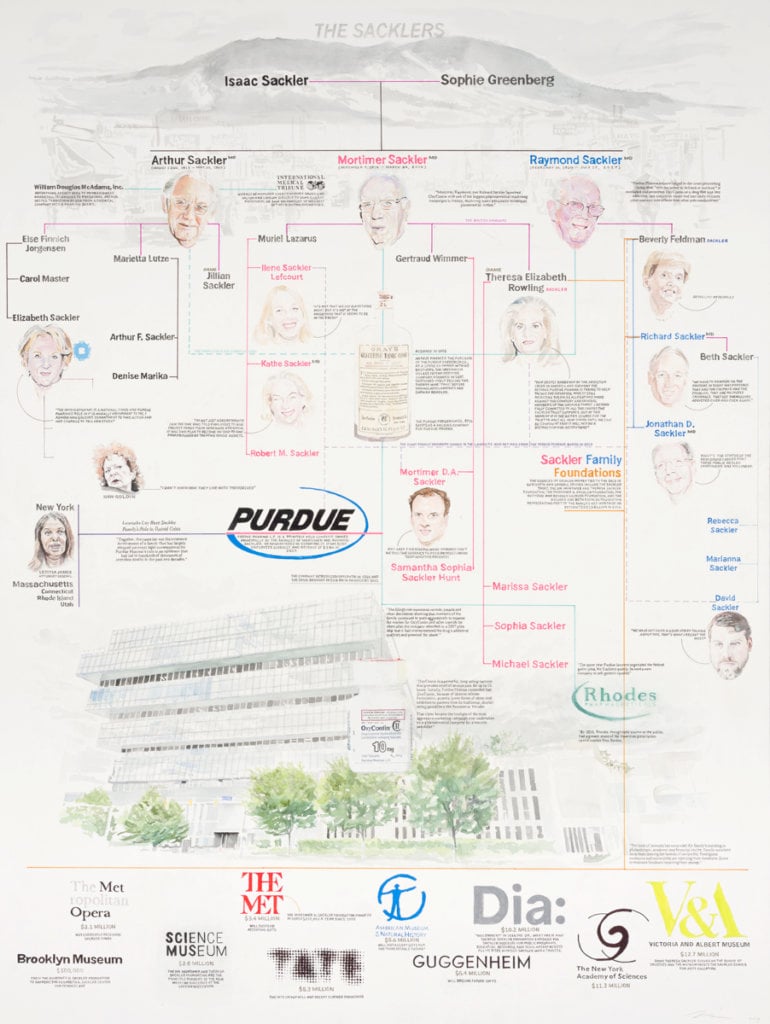
William Powhida, The Sacklers (Family
Tree) (2019). Courtesy of the artist and Postmasters
Gallery.
The idea—rendering a quick-fire internet joke as a carefully
rendered drawing—adds a dose of the artist’s self-depreciating
irony.
This brand of sly but serious satire is nothing new for Powhida,
who in 2009 indicted the museum world with a detailed,
caricature-filled work called How the New Museum Committed
Suicide with Banality, which called out the New York-based
museum—founded on the idealist, populist ethos of the late Marcia
Tucker—for turning over the space to mega-collector Dakis Joannou
(his favorite artist is Jeff Koons) to organize a show.
And, yes, he knows he’s a privileged white guy. He told artnet
News that he has taken some inspiration from Xaviera Simmons’s
piece in the Art Newspaper, “Whiteness must undo itself to
make way for the truly radical turn in contemporary culture,”
which, with Simmons’s permission, he quotes in the material for
this show. (Powhida had been set to speak at a workshop led by
Simmons on the subject as part of the New Museum’s IdeasCity Bronx,
before Simmons cancelled it in solidary
with Bronx art groups who pulled out of the festival after
protests from community members.)
In some small way, Powhida sees his maps of family wealth and
institutional power as part of the conversation Simmons was trying
to have. White supremacy, he says, is more than neo-Nazis in
Charlottesville; it’s a deeply ingrained “system of privilege and
accumulated advantages that can land a twenty-something on the
board of Dia.”
See more images from the show, below. “Complicities” is on view
at Postmasters Gallery through October 12.
![William Powhida, The Sacklers (Family Tree) (2019) [detail]. Photo: Caroline Goldstein, courtesy of Postmasters Gallery.](https://news.artnet.com/app/news-upload/2019/09/Image-from-iOS-6-1024x768.jpg)
William Powhida, The Sacklers (Family
Tree) (2019) [detail]. Photo: Caroline Goldstein, courtesy of
Postmasters Gallery.
![William Powhida, The Sacklers (Family Tree) (2019) [detail]. Photo: Caroline Goldstein, courtesy of Postmasters Gallery.](https://news.artnet.com/app/news-upload/2019/09/Image-from-iOS-5-768x1024.jpg)
William Powhida, The Sacklers (Family
Tree) (2019) [detail]. Photo: Caroline Goldstein, courtesy of
Postmasters Gallery.
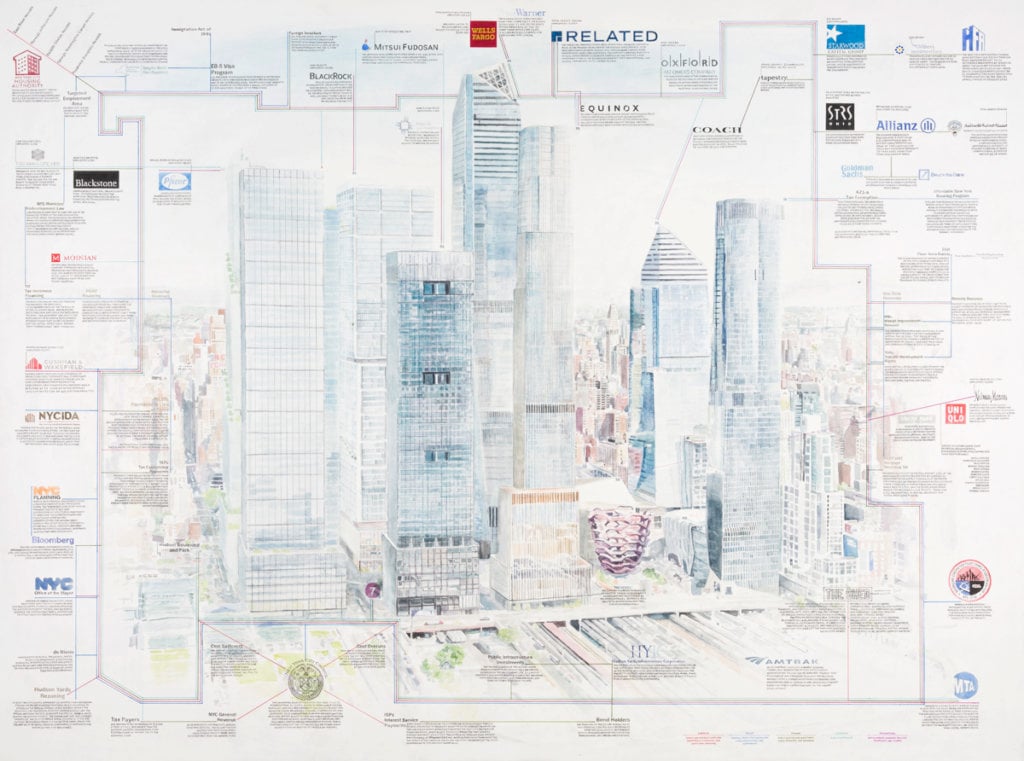
William Powhida, Hudson Yards Phase
I (2019). Courtesy of the artist and Postmasters Gallery.
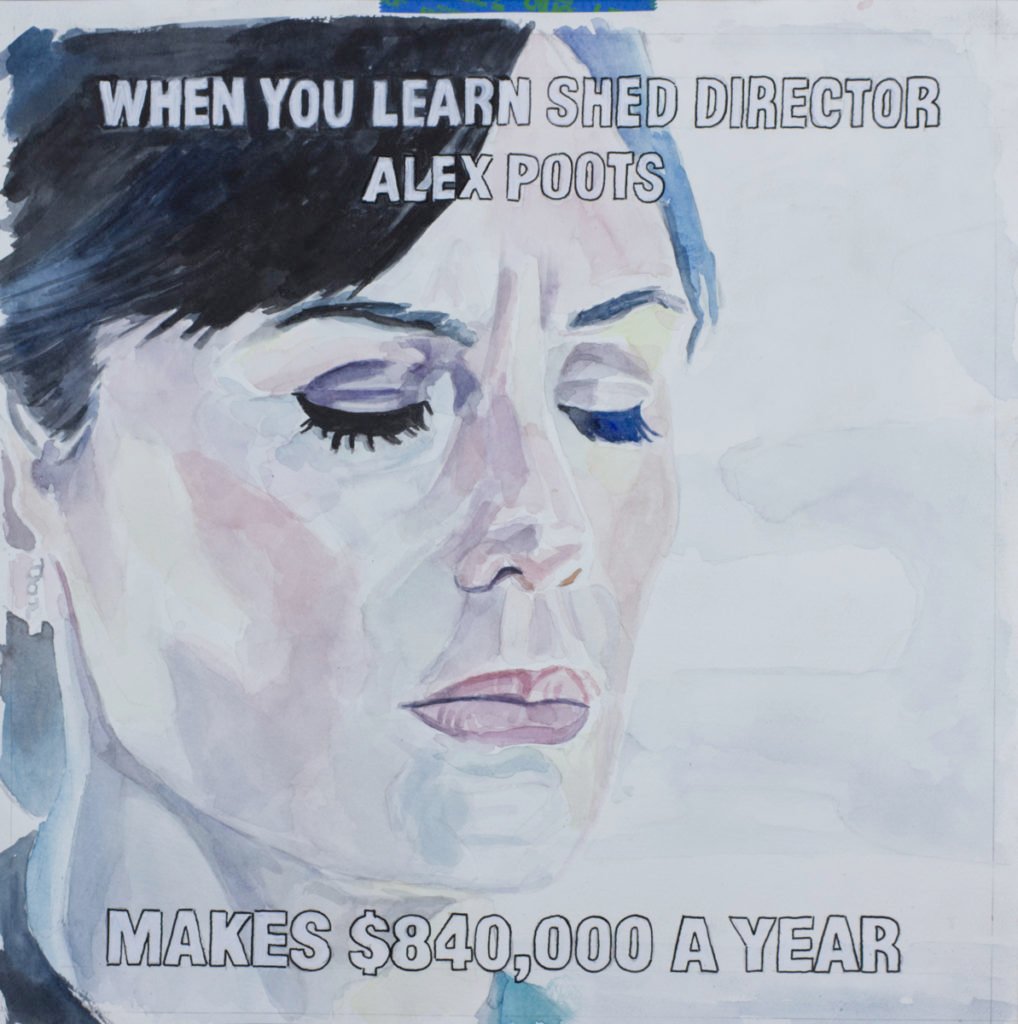
William Powhida, Alex Poots<
(Billions) (2019). Courtesy of the artist and Postmasters
Gallery.

William Powhida, Textron (Indirect
Investments) (2019). Courtesy of the artist and Postmasters
Gallery.
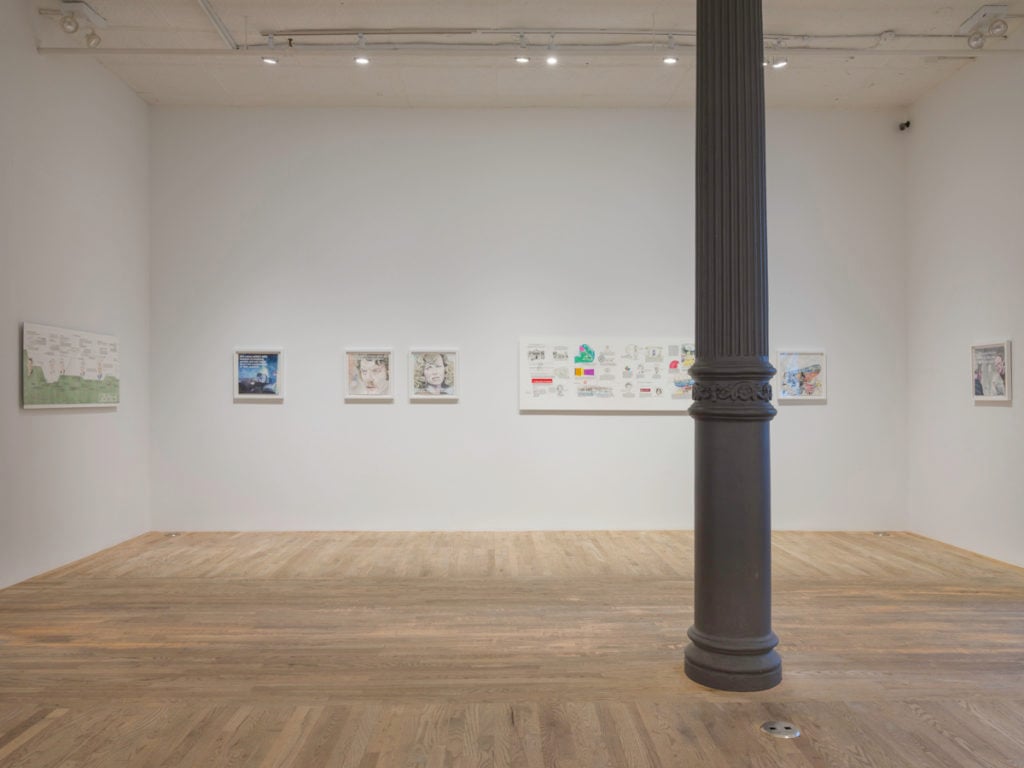
Installation view, “William Powhida:
Complicities.” Courtesy of Postmasters Gallery.
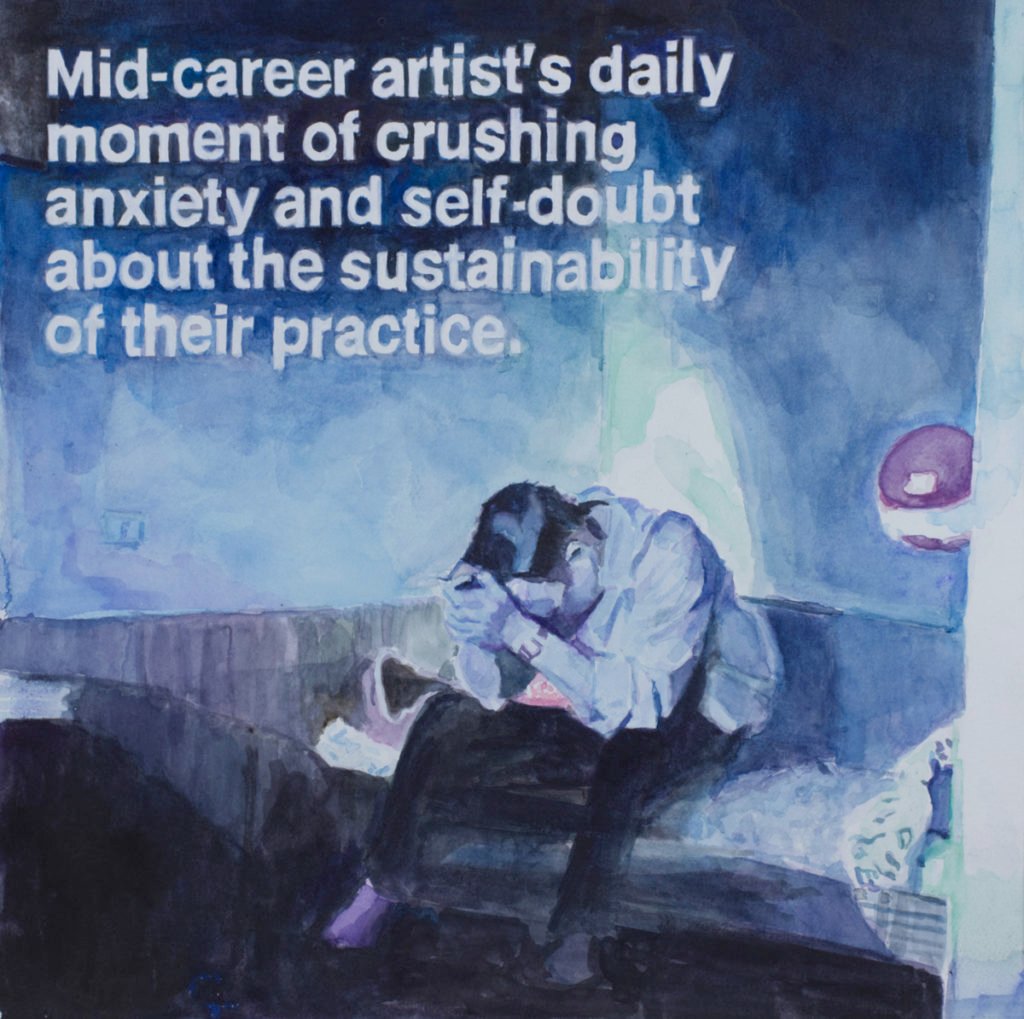
William Powhida, Crushing Anxiety
(Chernobyl) (2019). Courtesy of the artist and Postmasters.
The post William Powhida’s First Gallery Show in Years Is Taking
Aim at Problematic Art World Patrons—and It Turns Out All Of Us Are
Complicit appeared first on artnet News.
Read more https://news.artnet.com/exhibitions/1656127-1656127
Further reading


Leave a comment