
How Hans Ulrich Obrist and Other Super-Curators Transformed the Paradigm of Exhibition-Making—for Good and for Ill
The following is from an excerpt from Hal Foster’s book of
essays What Comes After
Farce?, published this month by Verso Books.
The Surrealists imagined that everyone who dreams is a poet, and
Joseph Beuys believed that everyone who creates is an artist. So
much for the utopian days of aesthetic egalitarianism; maybe the
best we can say today is that everyone who compiles is a curator.
Certainly, that includes a multitude of us: we curate news feeds,
song lists, and restaurant choices, among many other things, and
countless websites and applications do the same for us. In fact,
“curating” is so rampant that it is a regular item on annual lists
of worst words; already in 2014, it was put on probation along with
“skill set” and “takeaway.” Like these other terms, curating
promises a new kind of agency, but it might only deliver a
heightened level of administration: if people can be reduced to
skill sets and arguments to takeaways, then cultural interests can
be packaged as curated consumption. Often, this packaging is
automatic; the algorithms know what we want before we do. Such
curating suits the postindustrial aspects of an economy in which
the appointed task for many people is to consume. After all, when
we curate songs or restaurants, or Spotify or Eater does so for us,
what do we actually produce? We cognitive laborers manipulate
information, which is to say we curate the given, and this
compiling often involves a great deal of complying. How many of us
consider what is signed over when we click “I agree”?
Although many curators carry forward a degree of civic
responsibility and altruistic concern, we have come a long way from
the original avatars of curating (the root of which is
cura or care): the curatores, the civil servants
who oversaw public works like the aqueducts in ancient Rome, and
the curati, the priests who attended to private matters of
the soul in the medieval period. Any potted history of curating
would also include the assemblers of courtly Wunderkammers
(the cabinets of curiosities that were more natural history than
art history), the keepers of royal collections of art, the
décorateurs of paintings in the French Salons of the
eighteenth century, the organizers of museums like the Louvre (once
royal collections were nationalized), and the connoisseurs of
classical sculpture and Renaissance painting from Johann
Winckelmann to Bernard Berenson. Several of the scholars who
founded the modern discipline of art history were also important
curators. (In the late 19th century Alois Riegl oversaw the textile
collections at the Museum of Applied Arts in Vienna.)
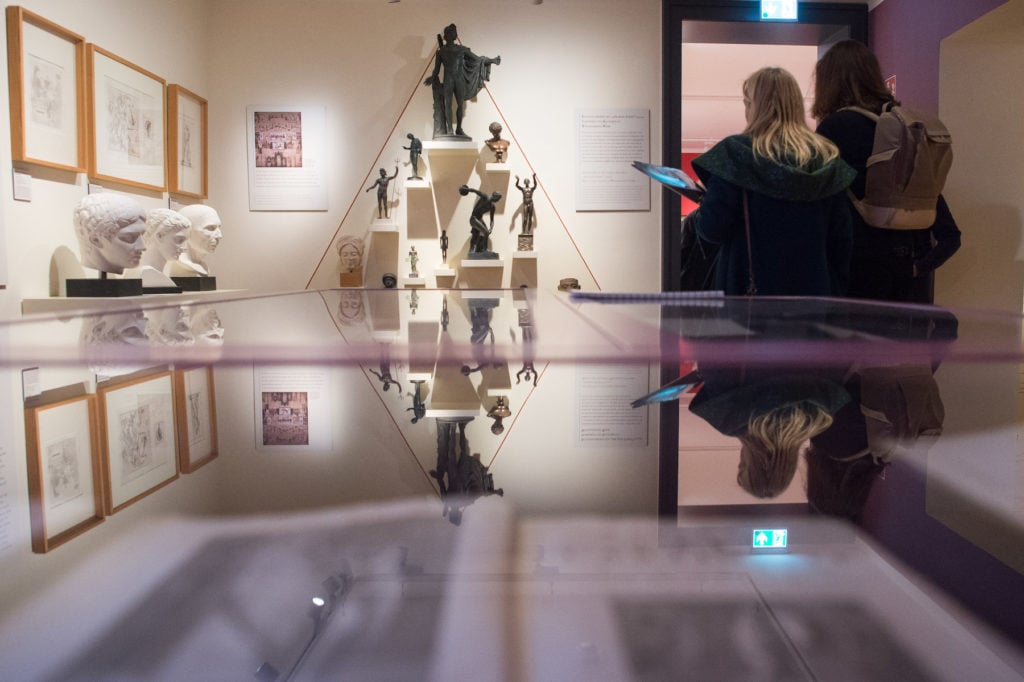
The 2018 reopening of the Winckelmann
Museum in Stendal, dedicated to the life and work of the scholar
and archaeologist Johann Joachim Winckelmann. Photo by
Klaus-Dietmar Gabbert/picture alliance via Getty Images.
Closer to our time, however, a divide developed between the
university and the museum, as some academics were drawn to critical
theory while most curators remained committed to connoisseurship.
This divide was less marked in premodern fields of study (the
Renaissance expert Michael Baxandall was much admired in both
worlds), and some prominent curators in the modern area are also
respected in the academy. (The Museum of Modern Art [MoMA] in New
York has had a good number of these switch-hitters). Today the more
relevant split is the more recent one between modern and
contemporary fields (the latter has no exact date of origin—1968,
1980, 1989?), which is a schism less between the university and the
museum than between scholarly curators and flashy
exhibition-makers. This split was opened up when the 20th-century
art museum was penetrated by the culture industry, and it was
deepened when the contemporary art world expanded into the global
business of art biennials and fairs. With the first development
came a demand for on-site entertainment, and with the second a need
for far-flung attractions. Although this is a reductive retrospect,
there was a marked turn to spectacular displays at this time.
In Ways of
Curating (2014) the Swiss curator Hans Ulrich Obrist
evidences this split between curator and impresario. Obrist picks
out unexpected precursors, such as Henry Cole, the producer of the
Crystal Palace that housed the international trade fair in London
in 1851, and Sergei Diaghilev, the animator of the Ballets Russes
in its glory days of the 1910s and 1920s. Cole assembled his famous
iron-and-glass structure in Hyde Park, not far from the Serpentine
Galleries where Obrist has staged many of his own shows, and Obrist
sees Diaghilev as a pioneer of the “modern form of
Gesamtkunstwerk” that he has sought to develop. At the
same time, Obrist pays homage to past curators who were not
primarily showmen. Among others he names the German Alexander
Dorner, who directed the Hannover Museum from 1925 until he was
ousted by the Nazis in 1937, commissioning modernists like the
Constructivist El Lissitzky to design radical exhibition
prototypes; the Dutchman Willem Sandberg, a member of the
Resistance who, as curator and director of the Stedelijk Museum in
Amsterdam from 1938 to 1962, championed avant-garde groups such as
Cobra; and the American Walter Hopps, who, along with organizing
the landmark Duchamp retrospective in Pasadena in 1963, advanced
the work of Robert Rauschenberg, Ed Kienholz, and others. However,
Obrist reserves his highest praise for his immediate godfathers:
the Swede Pontus Hultén, who, as head of the Moderna Museet in
Stockholm, arranged the first Warhol retrospective in 1968 (Hultén
became the founding director of both the Centre Pompidou in Paris
and the Museum of Contemporary Art in Los Angeles); the Swiss
Harald Szeeman, who put Conceptual and Post-Minimalist practices on
the map with his legendary exhibition “Live in Your Head: When
Attitudes Become Form in Bern and London in 1969”; and the German
Kasper König, who pioneered the display of site-sensitive
sculpture with his decadal show Skulptur Projekte Münster. That
Obrist singles out these three is telling, for they were all
concerned to expand the conventional exhibition by means of
capacious themes. At the same time, they can be seen as
transitional figures between the old school of modernist curators
and the new breed of contemporary exhibition-makers. Szeemann
actually preferred the label Ausstellungsmacher, and
Obrist rightly calls König “a cultural impresario.”
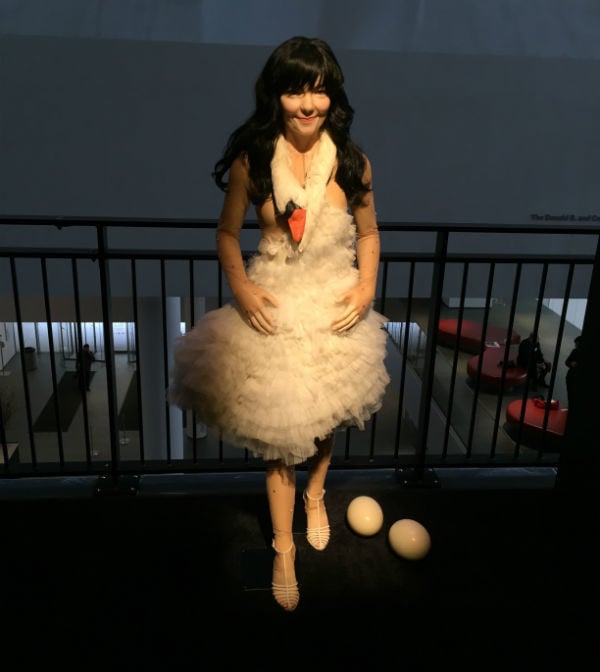
Marjan Pejoski’s Swan Dress in “Björk”
at MoMA
Photo by Ben Davis.
In our time, this line of exhibition-makers has itself split in
two. With an unlikely mix of criticality and charisma, serious
curators like Okwui Enwezor, the late director of the Haus der
Kunst in Munich, and Lynne Cooke, a senior curator at the National
Gallery in Washington, have produced ambitious theme shows à la
Hultén, Szeemann, and König. But a problem in this approach
emerged already in the 1990s: as some artists began to act as
curators, exhibiting objects that museums had kept from view (a key
instance was Mining the Museum [1992–93] by Fred Wilson),
some curators started to behave like artists, juxtaposing artworks
as so much material to manipulate. Obrist says, somewhat
disingenuously, that he shies away from this tendency (“I’ve never
thought of the curator as a creative rival of the artist”). At the
same time, pace his critics, Obrist does not quite fit the
category of flashy exhibition-maker either. The standout here is
Klaus Biesenbach, director of the Los Angeles Museum of
Contemporary Art, who, as chief curator at large at MoMA, arranged
overblown retrospectives of crossover stars such as Marina
Abramović and Björk. Life-styling of this sort is depressing:
such curating has little relation to scholarship, let alone
criticism, and little sense of public service that still guides
some curators in Europe and elsewhere. At the beginning of the
practice known as institution critique, Robert Smithson insisted
that the artist must understand the art apparatus that she is
“threaded through” in order to challenge its usual operation. Today
many artists are only too happy to be so threaded and many curators
only too eager to do the threading. Hultén, Szeemann, and König
came up against a rigid system that they worked to free up. Too
often the recent breed of exhibition-makers is content not only to
inhabit that loosened system but also to be the agents of its
exploitation by fashion, music, and entertainment industries.
Obrist has not taken undue advantage of his celebrity, and his
commitment to his artists is earnest, almost devout; he describes
his youthful pilgrimages to Peter Fischli and David Weiss,
Christian Boltanski, and Gerhard Richter as conversion experiences.
And his energy has not flagged over the years: a 2014 profile in the New
Yorker logged him at roughly 2,000 trips, 2,400 hours of taped
conversations, and 200 catalogues over the prior twenty years.
(Like many artists, he has assistants, but these numbers are still
extraordinary.) To this day, most of his life is spent on the road,
contacting collaborators and conceiving exhibitions as if there
were no tomorrow, and indeed the present is foremost in his sights.
Obrist reports a millennial epiphany during a January 2000
conversation with Matthew Barney about “a new hunger amongst
artists for live experience,” and like his curatorial colleagues in
relational aesthetics, Nicolas Bourriaud, former head of the École
des Beaux-Arts in Paris, and Daniel Birnbaum, current director of
the Moderna Museet, he is most devoted to time-based art,
especially performances and installations staged by artists of his
generation such as Rirkrit Tiravanija, Pierre Huyghe, Philippe
Parreno, and Dominique Gonzales-Foerster. For Obrist, curation
involves “infinite conversation” as well as extensive
collaboration. In 2006, with another mentor, Rem Koolhaas, he
launched “The Serpentine
Marathon,” a “24-hour polyphonic knowledge festival where all
kinds of disciplines meet,” and he has adapted this strategy of
accumulation to other forms, too, such as the manifesto. This is
not for everyone (if hell was other people for Sartre, it is
nonstop art talk for me), and certainly not enough attention is
given to the quality of the discourse involved or of the community
effected. For Obrist, the doing is all.
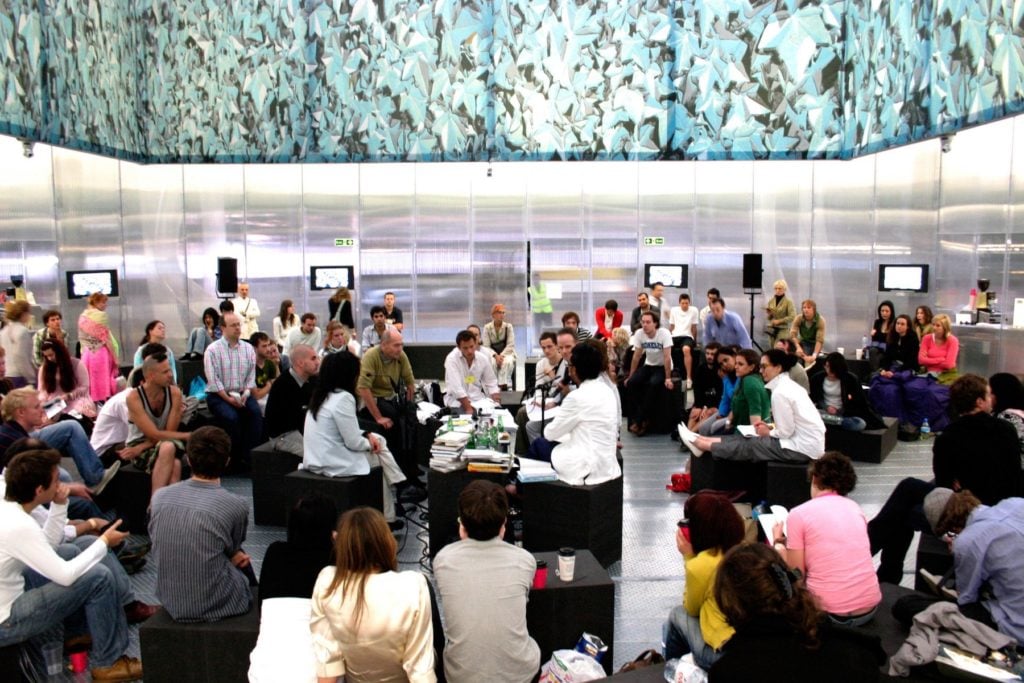
Interview marathon at the Serpentine
Galleries, London. Image courtesy Serpentine Galleries.
There were three preconditions for the recent shift in
exhibition-making, all of which should be grasped dialectically.
(They also line up, roughly, with the proposed start dates of “the
contemporary” noted above.) The first crux was Conceptual art of
the 1960s, especially as it prompted the poststudio and postmedium
practices of the 1970s and 1980s. As Obrist comments, Conceptualism
challenged “the idea of art as the production of material objects,”
permitting almost anything—a statement, a snapshot, the slightest
gesture—to qualify. Obviously, this opened up the field of art, as
is evident in the interdisciplinary terms that Obrist cites as
essential to contemporary production, such as the
Gesamtkunstwerk, the collection, the library, and the
archive. (He thinks in terms less of specific histories of genres,
mediums, and exhibitions than of one big “history of the format.”)
At the same time, this interdisciplinarity often came at the cost
of disciplinary rigor, and the expansion of art also meant an
extension of its academic administration. (Curatorial studies
programs are now plentiful, and they are often placed alongside MFA
programs.) Moreover, what art could better match an economy of
cognitive labor than one given over to immaterial knowledge? So,
too, Obrist champions “the creative self,” which is the very term
used by Luc Boltanski and Eve Chiapello in their analysis of “the
new spirit of capitalism.” And the Obristian motto “Don’t Stop”
perfectly suits a digital work regime that has become 24/7.
Second, the shift in exhibition-making with Hultén, Szeemann,
and König has had ambiguous consequences, which might be evoked
through a statement made by Jean-François Lyotard on the occasion
of his 1985 show “Les Immatériaux” at
the Centre Pompidou (which Obrist regards as another landmark):
“The exhibition is a postmodern dramaturgy.” On the one hand, this
dramaturgy suggests how the thematic show, taken up by philosophers
like Lyotard (not to mention Jacques Derrida and Bruno Latour), can
stage key questions of our time, as “Les Immatériaux” did in
relation to his theses about the end of modern master narratives
and the rise of postmodern knowledge protocols. On the other hand,
this staging can easily slip from inquiry into showmanship. There
is a further twist with Obrist, who may be more networker than
impresario, for, if we are to believe Boltanski and Chiapello,
networking is more important to the new spirit of capitalism than
spectacle is. In a sense, Obrist is a human aggregator, almost a
social media platform or a hive mind of one. This is implicit not
only in his hectic meeting-and-greeting but also in his
semi-anonymous prose, which sometimes suggests the language of a
collective Wiki-brain. Although Ways of Curating is a kind
of Bildungsroman, it does not display much personality.
Obrist is like Warhol in this regard, a cipher who is at once
iconic and spectral. (They also share a compulsion to record.)
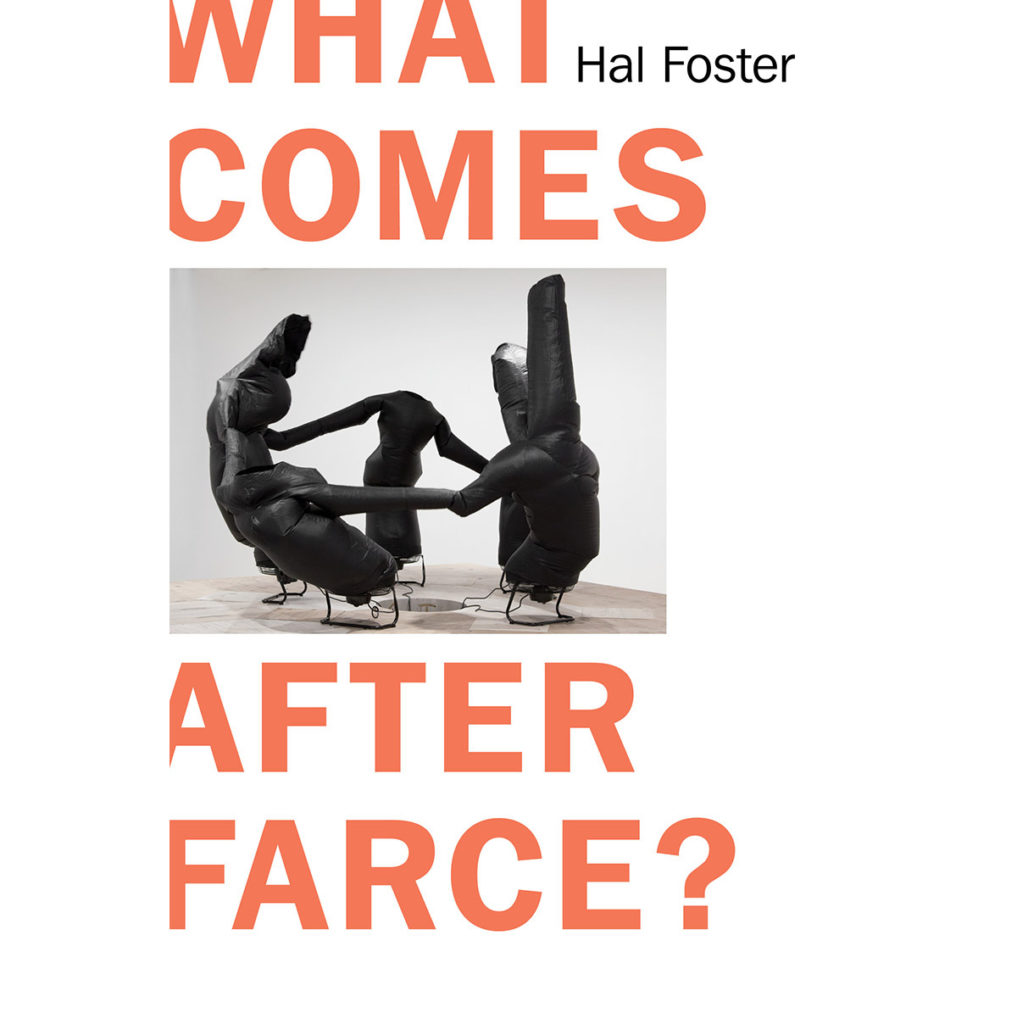
What Comes After Farce? by Hal
Foster (Verso Books, May 2020).
Third, as one might expect, 1989 is a hinge moment for this
generation of curators. Born in 1968, Obrist pinned his hopes on
the transformative years when he came of age, and, in many ways, he
is a product of the cultural interchange facilitated by “the new
Europe” (as it was optimistically called in the 1990s) permitted by
the breakup of the Soviet bloc. Inspired by the Martinican writer
Édouard Glissant, Obrist is also taken by notions of “artistic
creolization” and “archipelic thought,” and yet what Glissant and
Obrist see as a new “mondialité” that allows for cultural
differences, others might regard as a globalization that
homogenizes such differences brutally. (It is both, and that is
what must be thought.) At times, Obrist is too affirmative about
our neoliberal age—indeed, he is its creature—but then it would be
difficult to move as fast as he does if he were not powered by
positive thinking.
What about all those shows, conversations, and books, with the
prospect of many more to come? Obrist is not alone in this respect,
and it prompts the question for what present, let alone what
future, are such archives complied. What audience, now or later,
will be able to process it all? (Could it be that all this curating
needs … a curator?) Obrist presents his project, especially the
conversation marathons, as a “protest against forgetting” (a phrase
borrowed from the late historian Eric Hobsbawm, one of his many
interviewees). At the same time, his avant-gardism also commits him
to ceaseless change. One of his “guiding principles” is that an
exhibition “should always invent a new rule of the game” or at
least “a new display feature.” (The last lines in his credo concern
how “digital curating” will develop “new formats” for “our
future.”) All this flying around, inventing rules, and reformatting
might be a protest against forgetting; it might also be a fast
track to oblivion.
The post How Hans Ulrich Obrist and Other Super-Curators
Transformed the Paradigm of Exhibition-Making—for Good and for
Ill appeared first on artnet News.
Read more https://news.artnet.com/art-world/exhibitionists-what-comes-after-farce-1865298
Further reading


Leave a comment