
Is the Art Market Headed for Another Recession? 9 Tips From the Experts on How Galleries Can Survive the Fallout
Just over a decade ago, the high-flying art market seemed
unstoppable. Damien Hirst’s now-famous (or infamous?) evening sale
at Sotheby’s London, titled “Beautiful Inside My Head Forever,”
raked in just over $200 million on September 15, 2008. Even the
sudden collapse of storied investment bank Lehman Brothers
earlier the same day didn’t halt bids from dozens of eager buyers,
including one who shelled out the top price of $18.6 million
for Hirst’s formaldehyde-tank sculpture The Golden
Calf.
But just a few weeks later, the market looked radically
different. New York’s fall auction season experienced a precipitous
drop after many top works went unsold, and an extended downturn
followed. Though the US National Bureau of Economic Research marked
the official end to the recession in June 2009, it took far longer
for the art market—by its nature, a lagging indicator—to
rebound.
Today, eerie comparisons to the pre-recession economic landscape
of 2007 seem to be everywhere. Some economists have flagged a
slowdown in real GDP
growth, an inverted yield
curve, and a pair of recent Federal
Reserve interest-rate cuts as cause for concern. And with the
knowledge of how quickly and severely the financial landscape can
quake, some art-market veterans of the Great Recession are once
again bracing for the possibility of a shake-up.
So what lessons were learned from the previous market downturn?
And can they help cushion the blow of another bout of extended
turmoil in the art trade? We talked to several dealers about how to
weather the hard times.
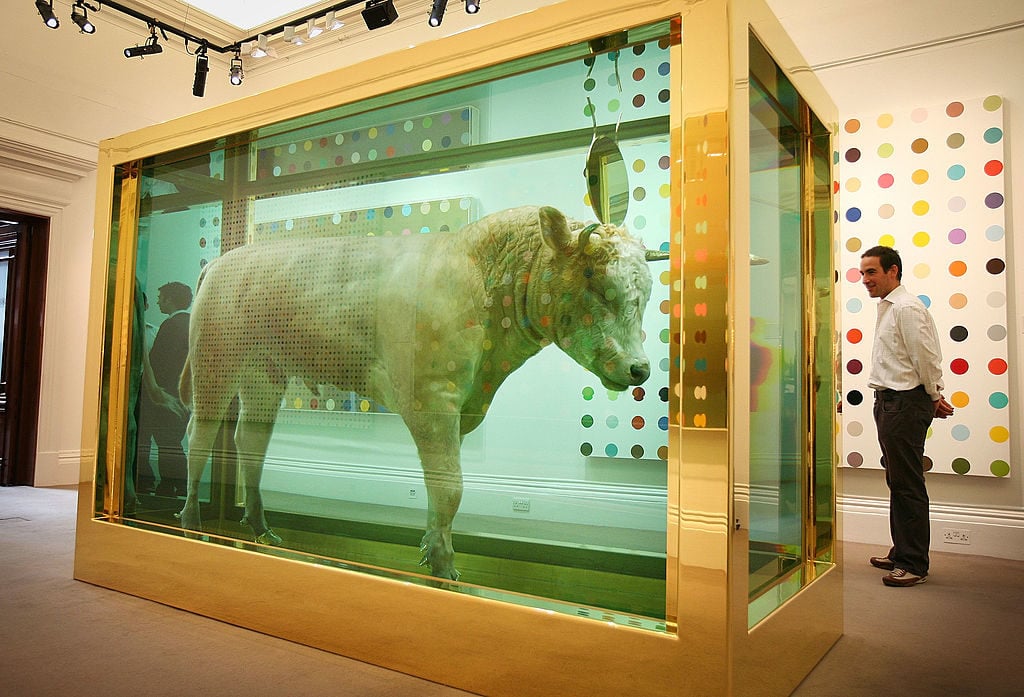
Damien Hirst’s The Golden Calf on
display before the “Beautiful Inside My Head Forever” Sale at
Sotheby’s in 2008. Photo courtesy of Peter Macdiarmid/Getty
Images.
1. Tighten Your Belt
Jay Gorney, who recently joined Marlborough Gallery as a senior
director, compared his experience during the 2001 downturn with the
more recent economic crisis just over a decade ago.
“In 1991, at the time of the
Gulf War, I had my own gallery, and we really felt the recession,”
he says. “I remember feeling it more than I did in 2008, when I was
a director at Mitchell-Innes & Nash.” In the earlier
downturn, it became a
case of “belt-tightening and
unfortunately needing to sell things from my inventory.” The best
advice he can give younger gallerists is “to be careful and
prudent, especially in how quickly they expand.”
artnet News columnist and art dealer Kenny Schachter concurs.
“Cut costs to the bare-bone minimum,” he says, advising a sharp
scale-back on art-fair participation—or, as he calls it “a fair pare.”
Another of his tips? “Band
together with friends and coordinate openings, brunches, whatever
to make it as easy as possible to facilitate and entice
gallery-goers.” Collaboration can even be a part of a “fair pare”
strategy, as creative partnerships with galleries in other cities
or countries can provide some of the same benefits at a fraction of
the costs.
2. Bargain Hard With Suppliers
One of the keys to negotiating
is that you should always ask for what you want, even if you don’t
think it’s realistic… because sometimes you get it
anyway.
Candice Madey put this lesson
into action immediately upon opening her Lower East Side gallery On
Stellar Rays in 2008. Less than a week after the gallery’s debut,
the storied investment bank Lehman Brothers collapsed, bringing the
long-gestating financial crisis into startling visibility.
Understanding the severity of the situation, Madey marched to her
landlord’s office the same day and bargained her way to a 40
percent discount on her rent.
Madey admits now that she was
“surprised” at how accommodating her landlord was. “I think he
understood [this situation] was serious and could affect the
business,” she says. But it’s likely that she would never have
known if she hadn’t been bold enough to test the boundaries of her
original five-month lease in the first place.
“He said, ‘We’re only going to
do this [discount] for a few months,’ and then he kept trying to
bring it back up to where it was supposed to be,” she says. “So
every month I was walking down to his office and haggling.” It paid
off, as the gallery survived the recession and continued on for
roughly a decade after. (Madey voluntarily closed the gallery and
shifted to a nomadic, project-based initiative called Stellar
Projects two years ago.)
She took a similarly tough
stance when it came to subscription-based services. For example,
she says she “negotiated really hard” to buy her
inventory-management software outright instead of paying a monthly
fee in perpetuity (which is always designed to benefit the provider
by locking in predictable income).
“When you’re open and making
sales, it’s easy to make those [monthly] commitments,” Madey says.
But there is no better time to negotiate than when you’re still
operating from a position of strength.
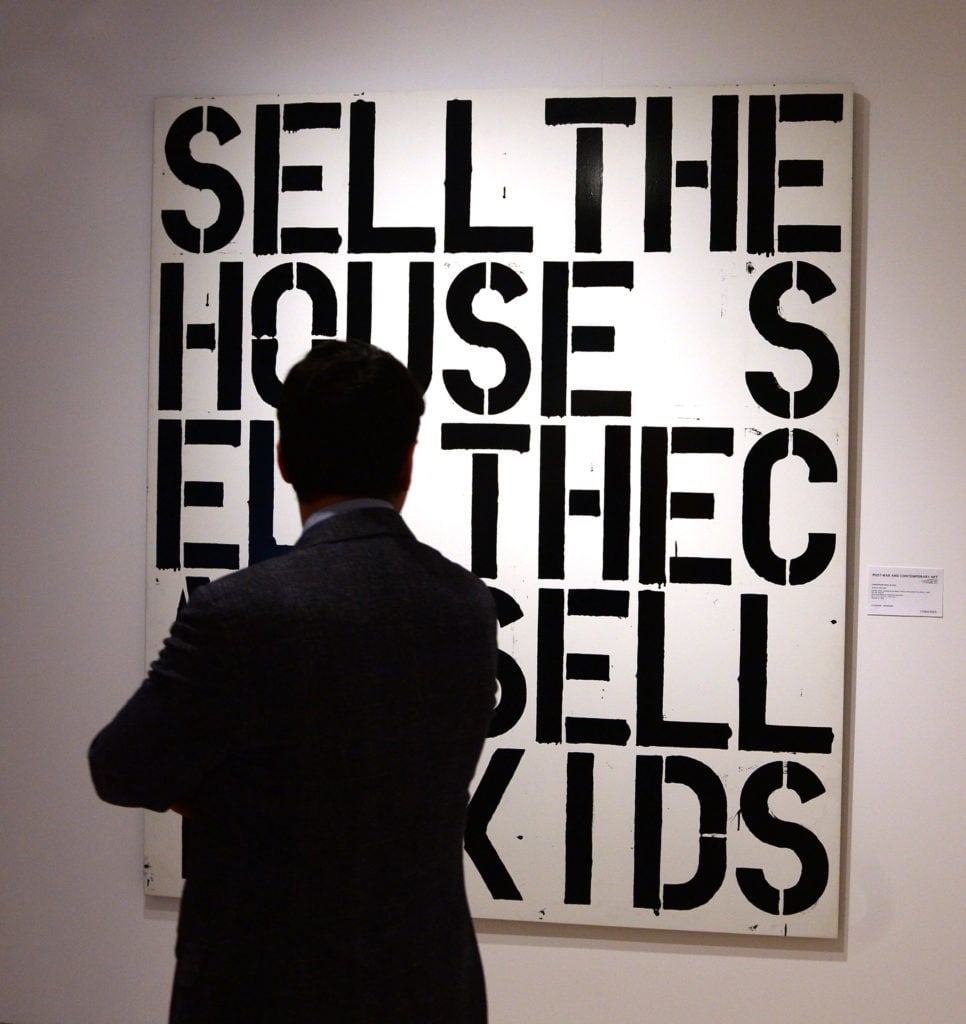
Christopher Wool’s Apocolypse Now
at Christie’s. Photo by rune hellestad/Corbis via Getty Images.
3. Buy Art If You Can (and Buy as Much as You
Can)
Joel Mesler, who ran a successful Lower East Side gallery for
years before closing and decamping to Eastern Long Island where he
organizes shows, including some of his own work, says: “What the
smart people do is buy lots of artwork. The people that really made
money [in the last recession] were the ones that bought at that
first auction [after the market fell] where works were selling at
35-to-45 percent under market. They just cleaned house.”
Gorney is also a proponent of always buying too: “Always collect—buy works if you possibly can.
So often, some of your greatest profits will come from the sale of
inventory work.”
4. Don’t Count on Loyalty
There are two sides to this
advice from Edward Winkleman, who co-founded Plus Ultra Gallery
with artist Joshua Stern in Brooklyn’s Williamsburg neighborhood in
2001, then converted the space to Winkleman Gallery in Chelsea from
2006 until mid-2014.
The first side concerns the
relationship between dealers and buyers. Winkleman emphasizes that
most major (or even semi-major) buyers simply collect too widely to
prop up every artist—or for that matter, every gallery—during lean
times.
“The biggest misconception is
that the collectors share the gallery’s concerns about [any]
artist’s long-term market,” explains Winkleman. “I’ve seen dealers
appeal to reluctant collectors with the argument, ‘But the artist
needs some sales,’ just to find the argument fall
flat.”
An equally important loyalty
lapse concerns the artist-gallery relationship. In his book
Selling
Contemporary Art: How to Navigate the Evolving
Market, Winkleman conducted an informal analysis of how
many artists moved between galleries or exited gallery rosters
completely in the years between 2008 and 2014.
He found that what he classified
as mid-level galleries—the ones most vulnerable to a financial
downturn—retained only about 54 percent of their artists on
average, while higher-level galleries retained nearly 70
percent.
Although Winkleman says he
attributes these results more to “a shift in expectations about
long-term relationships” in the 21st century gallery economy than
to the financial pressures of the Great Recession, he does offer an
important caveat.
“It seems highly probable to me
that artists or gallerists who were used to strong sales before
2008 concluded, ‘It’s you, not me’ when sales dipped after
2008″—leading to artists jumping ship or dealers cutting ties with
artists whose work sold poorly.
5. Consider Complementary Revenue Streams
Multiple dealers stressed the
value of capitalizing on a gallery’s existing resources to find new
sources of income in challenging times.
Winkleman weathered the Great
Recession partly by establishing an editions program within the
gallery. “That kept our artists’ names fresh in our collectors’
minds and helped bring in steady cash flow,” he
says. Madey began offering On Stellar Rays for film and
photo shoots at a rate of $1,000 per day, an even more sizable sum
a decade ago than it is today.
Don’t feel self-conscious about
making these kinds of moves, either. After all, Gavin Brown kept
the lights on in his former Chelsea space for roughly eight years
partly by running the beloved bar Passerby out of its front end.
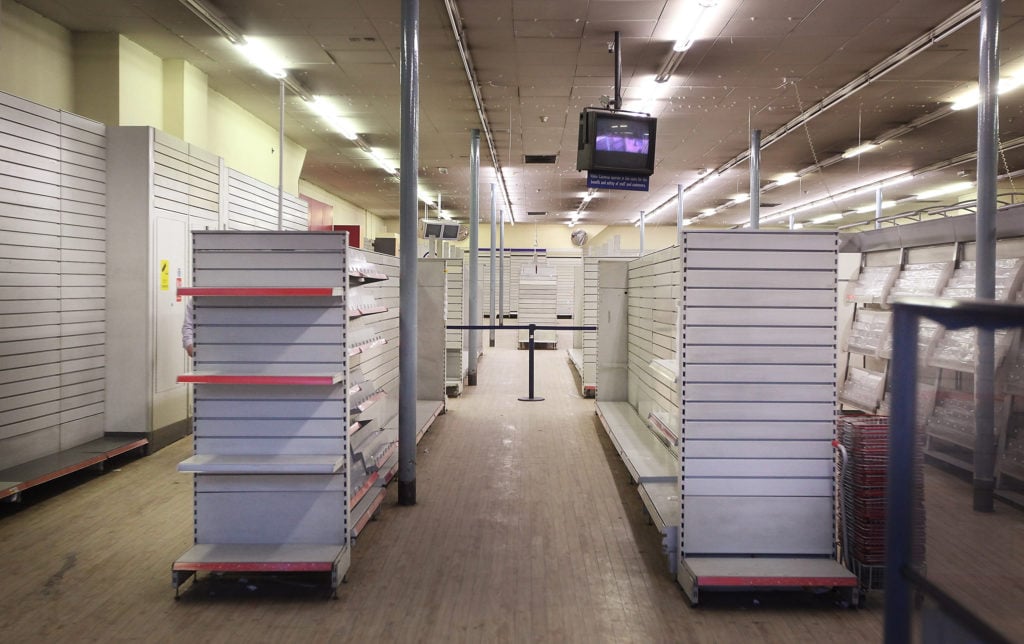
Empty shelves line a closed Woolworths
branch after the last day of business in London on January 6, 2009.
The retailer failed to find a buyer in administration, forcing the
closure of over 800 stores and the layoff of over 27,000 workers.
Photo by Peter Macdiarmid/Getty Images.
6. Yes, You Can Temporarily Reduce Prices
Winkleman rejects the art-market
myth that primary-market prices must only ever stay steady or rise,
even during a recession.
“A gallery is a business and of
course you can lower prices with care,” he says. “You’ll have to
endure some grumbling, but the logic in doing so is sound.” Again,
everything is negotiable. And remember: listed prices can even
technically stay intact if a dealer just removes the usual limits
on the size of the behind-the-scenes discount they’re willing to
offer.
7. Take Advantage of Cheap or Free
Technology
“Use Instagram, it’s free and it
works to promote artists and individual works,” Schachter
says. “I sold an expensive work in a recent show via
Instagram.”
Even anecdotal evidence from
buyers backs this up. Several years back, during a panel on
Instagram at Art Basel Miami Beach, Swizz Beatz, artist Daniel
Arsham, and dealer Simon de Pury stressed how integral Instagram
had become in their daily lives, from discovering new talent to
promoting work.
De Pury relayed a hilarious
story about the free service’s ability to shape perceptions of the
market: “So there is this fantastic restaurant in London
called Novikov. There’s a beautlful bar and the bar has such an
incredible pattern. So I made a close-up of that pattern and I just
put #Novikov [as the caption]. I had six or seven people call me up
asking: ‘How can I get a painting by Novikov? How can I acquire one
of his works?’ So it’s actually quite a powerful tool.”
8. Double Down on Your Program
Although it’s wise for galleries
to be ultra-conservative about their expenses during an economic
downturn, it can be just as wise for them to be adventurous with
their exhibitions.
“I think a lot of galleries get confused,
scared, and start showing what they think will sell,” Madey says.
But this approach tends to backfire in a recession, as it forces
dealers to market works that don’t excite them to a clientele
disinclined to buy anyway.
Instead, she argues that an
economic downturn is an opportunity to “set your gallery program
apart and present an authentic voice” that has a better chance of
connecting to an audience.
In short, every show is a risk
in a recession, so it’s better to at least take the risks that can
build your brand.
Just don’t think this mindset
will work in every context. Winkleman says he thought “statement”
booths at art fairs would generate as much press and positive
benefits as statement exhibitions in his gallery.
He was wrong.
“We often left a fair with
nothing close to breaking even, and that helped sink us in the
end.”
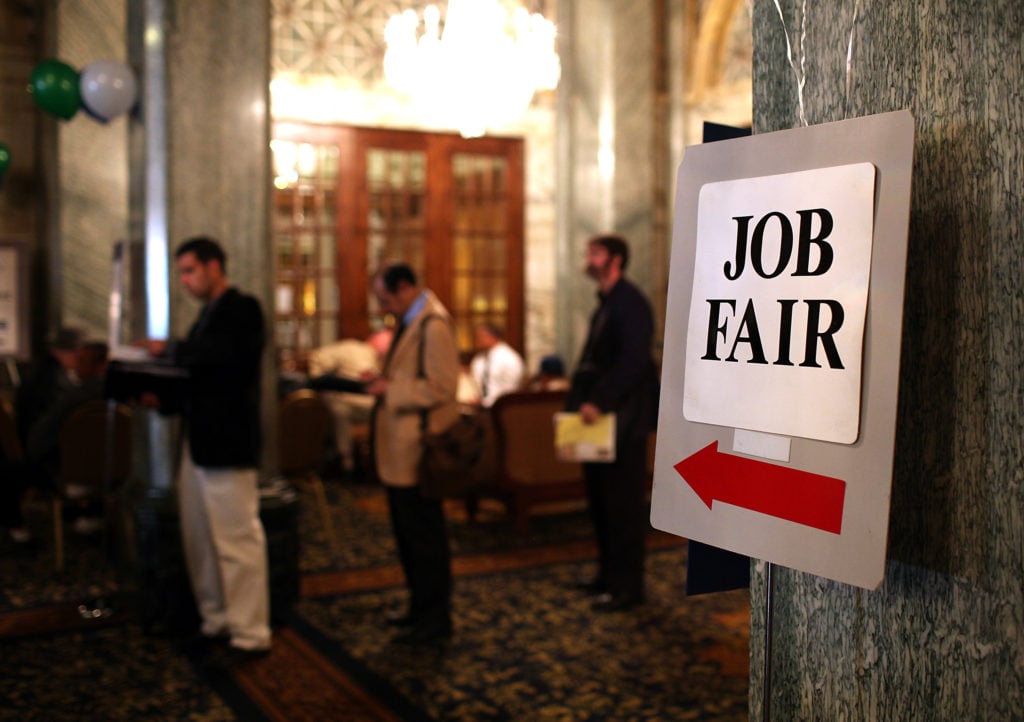
Job seekers wait in line to enter the
San Francisco Hire Event job fair on November 9, 2011. Photo by
Justin Sullivan/Getty Images.
9. Recognize That the Last Recession Is Still With
Us
“Never mind what’s coming down
the pike. we’re actually still dealing with effects of the 2008
economic crisis,” says veteran dealer Jane Kallir, director of
Galerie Saint Etienne.
“The rise of the one percent is something that
has happened gradually, over the 40 years or so that I’ve
been in the business. There was a time when that was good for the
art market because it created more people who had the wherewithal
to collect.”
But Kallir says that as the
money began to pool more and more at the top of the art market, and
auction houses and bigger dealers were chasing that limited pool,
“the middle market got
hollowed out, just like the middle class got hollowed out. That is
much more the fundamental problem that we’re dealing with
today.”
Kallir emphasizes that each situation is different and that it’s
tough to generalize, but she sees the pronounced trend of
middle-market gallery closures as a reflection of the 2008
fallout.
“We’re adjusting to the fact that there are no middle-class
collectors,” Kallir says. “The question is, how much art do you
need to sell, and at what price point, to maintain a gallery in a
major city and do the minimum number of art fairs in order to stay
in business? If galleries can
figure out a way to solve that, they’ll get through the next
recession.”
The post Is the Art Market Headed for Another Recession? 9
Tips From the Experts on How Galleries Can Survive the Fallout
appeared first on artnet News.
Read more https://news.artnet.com/market/art-market-recession-tips-1656103
Further reading


Leave a comment