
‘People Have Woken Up—to a Degree’: Artist Fred Wilson on Progress in the Art World and the Evolving Reception of His Work
For almost 20 years, conceptual artist Fred Wilson has been
working with the unforgiving material of black Murano glass,
creating large and exquisite chandeliers in the Venetian and
Ottoman traditions, woven through with his own particular research
interests.
In 2003, he showed a group of these works at the Venice
Biennale, where the chandeliers implicitly explored the history of
the city’s African population, who are often represented in
Venetian art—but almost always as an aside, and rarely as the main
focus of the work.
He expanded his interests when he presented another set of
chandeliers at the 2017 Istanbul Biennial, where the works—now
modeled on Ottoman design—elaborated the history of
Venetian–Ottoman relations.
A group of these exquisite and sometimes foreboding works are
now on view at Pace
gallery’s new location in New York, taking advantage of the space’s
19 foot ceilings. On the occasion of the show, we spoke with the
artist.
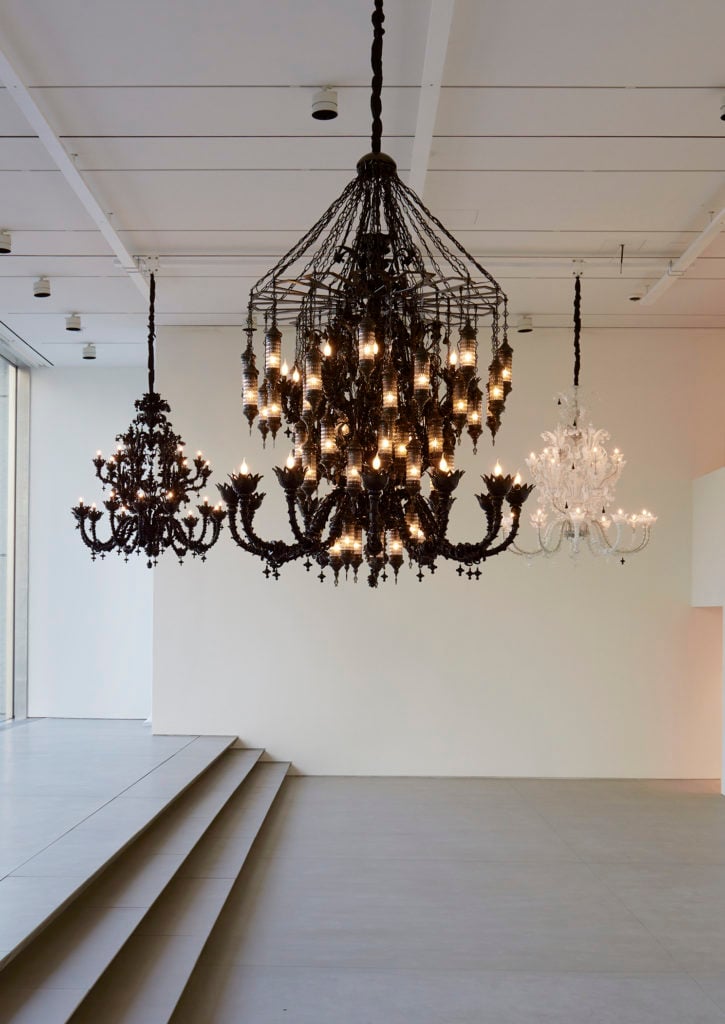
Installation view “Fred Wilson:
Chandeliers” at Pace, 524 West 25th Street. Photo: Guy Ben-Ari,
courtesy of Pace Gallery.
Your chandelier works first appeared at the 2003 Venice
Biennale at the US pavilion, and again more recently at the 2017
Istanbul Biennal. Can you talk a little bit about the genesis of
these works?
Well what happened was, in 2001, I had a residency at the
Pilchuck Glass School in a beautiful rural area just outside of
Seattle. I had never thought about glass before, but as a
conceptual artist I said, “Well alright, you invited me, why not?”
Lorna [Simpson] had done something there, Kiki [Smith] had done
something there, and it seemed to be good for them. So I said,
“alright, I’ll try it.” That’s really when I started working in
glass, and the first thing was this drip form that I would put on
walls. And I had this gaffer—the person who blows the glass—and
he’s a spectacular glass artist, who really enjoyed making these
shapes for me, and we got along and worked very well together.
That’s the backdrop of how I really thought about working with
glass and with other artists, or artisans or craftsmen. And on the
heels of that I got into the 2003 Venice Biennale. But you know,
the [chandelier works] come in a million parts. They’re really
heavy, and they’re never in one place. I’ve never had one in my
studio because they are so big. I go to Italy to work on them, and
then they come back here and go straight to Pace, they don’t come
to me. And that’s because they’re so laborious to put together. So
it will be nice to see them all together. That’s the exciting thing
for me.
And you went to Venice prior to this to do
research?
Oh, yeah. On the heels of this burgeoning glass thing, I go to
Venice and what do I see? Chandeliers. I see chandeliers
everywhere. And at time, I was thinking a lot about Venice, looking
at the paintings in the [Gallerie dell’Accademia] and elsewhere,
and there’s all these Africans in all these paintings. They knew
who everyone else was in the paintings, but they didn’t know who
these black people were, not a clue.
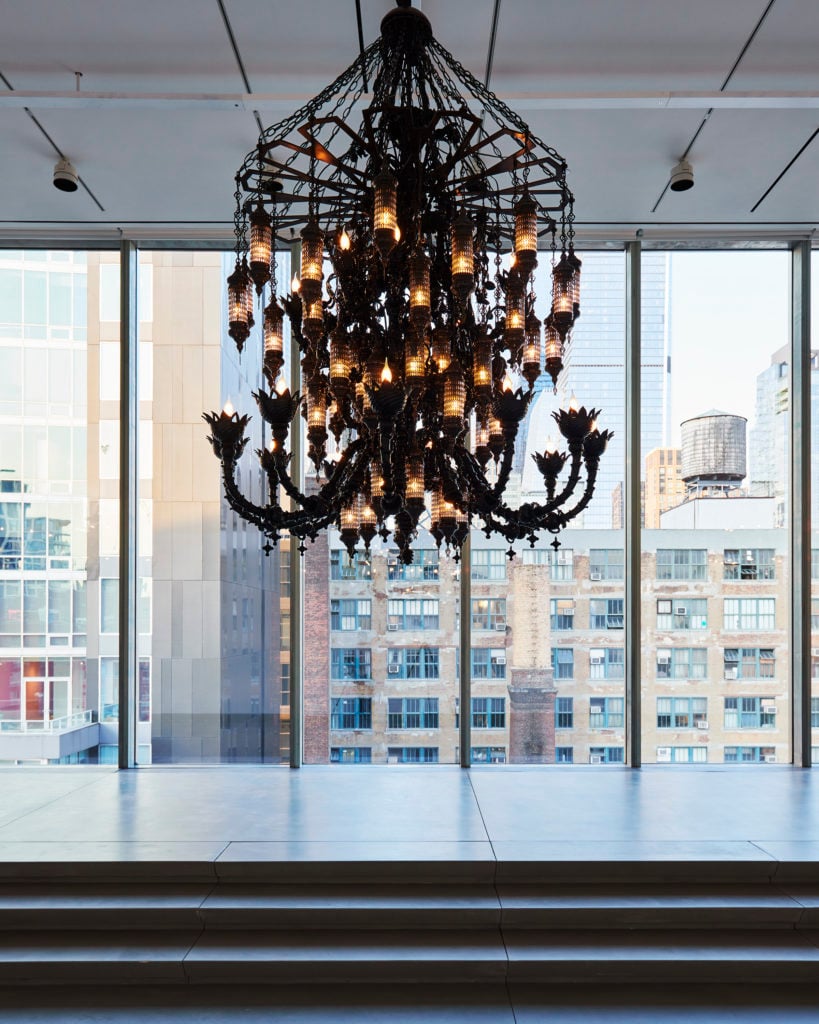
Installation view “Fred Wilson:
Chandeliers” at Pace, 524 West 25th Street. Photo: Guy Ben-Ari,
courtesy of Pace Gallery.
And you conducted a lot of research to find out the
identities of those black figures.
I did. I worked with an art historian and we went around and
counting all the blacks folks we saw in Venice. And there were a
lot of images of black figures on door knobs. It was just crazy. In
the midst of all this research, I saw these really beautiful
pastel-colored images of chandeliers, and it was kind of a
no-brainer for me from doing these black drips. And I use black for
obvious reasons. But I’m also interested in all the meanings that
are comprised in that color. And in Venice, black glass is
something you don’t see very often and certainly not in
chandeliers.
Do you want to continue making chandelier
works?
I do have this one idea and maybe it’ll go somewhere or maybe
this will be my Swan Song with chandeliers, I don’t know. We’ll
see. But you know, I don’t set out to make beautiful things. I mean
I like the Venetian chandelier form, and I like the Ottoman form,
but I’m more concerned about the history and meaning behind these
objects.
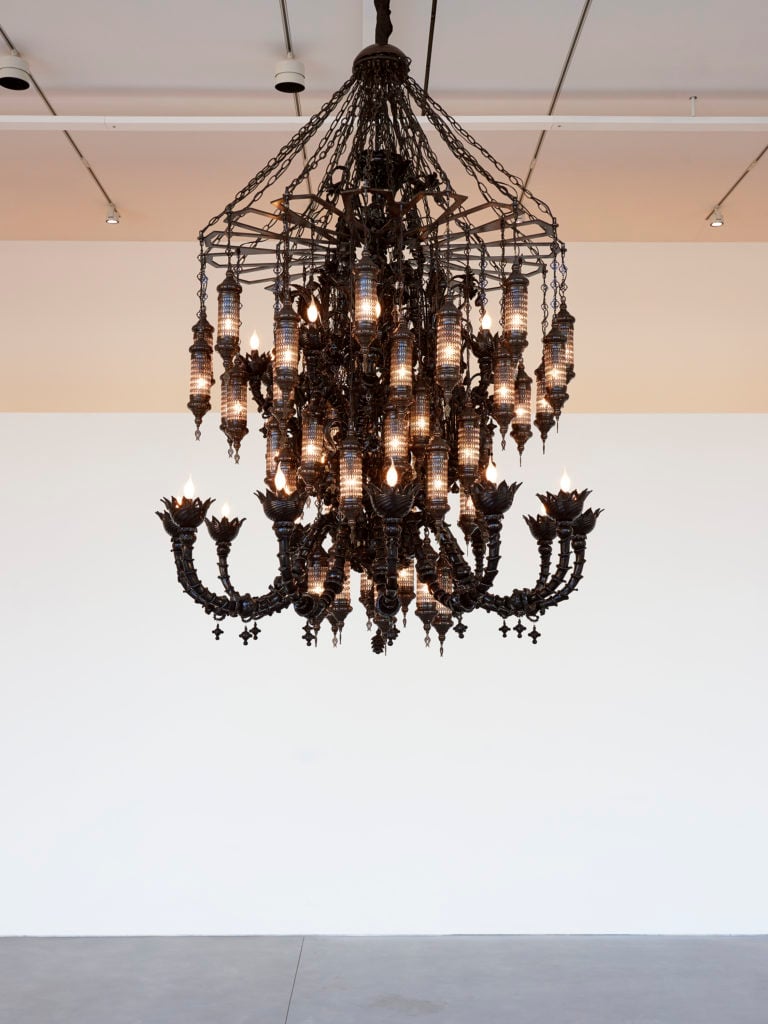
Installation view “Fred Wilson:
Chandeliers” at Pace, 524 West 25th Street. Photo: Guy Ben-Ari,
courtesy of Pace Gallery.
That’s interesting because you pay so much attention to
the materials and artistry of these works, even though I’ve always
considered you an artist who works with existing objects, rather
than one who makes new ones.
I think I’m getting less and less connected to materiality.
Working with hot glass, that is the high point. Whatever comes out
it is beautiful, it’s great, but it’s about the experience. And
it’s a very fast process. You’re manipulating it really fast,
depending on what you want to make. Because it’s this hot substance
that deals with gravity, and you have to keep moving it. I enjoy
understanding the qualities of the material and what it can and
can’t do. I’m not particularly interested in making it do something
it’s not supposed to do. I prefer to work with things, just like
with people, that do what they do best. I think I get a better
product that way, instead of trying to force it to be something
else.
I think when I was showing at galleries like Metro Pictures, I
was working with things that I found, not things that I would
consider I made. And I think that was largely because that’s what I
had access to. I enjoy things in the world that are around us, and
that we don’t really examine that much, or we don’t think
about.
The Venetian glass-blowing is the same thing. It’s there. You
don’t really examine it that much because it is what it is. It’s
not really considered high culture anymore, but it’s high culture
for some people. It is beautiful. But I always like, no matter what
it is, to look beneath what it is or what it represents. And
looking at the notion of luxury is also interesting to me. So
that’s the connection. It’s a conceptual connection. I don’t
particularly have a medium. So if I have the opportunity to do
something new, I’ll try it. It has to meet my interest. But I don’t
mind making art, and it wasn’t a difficult transition.
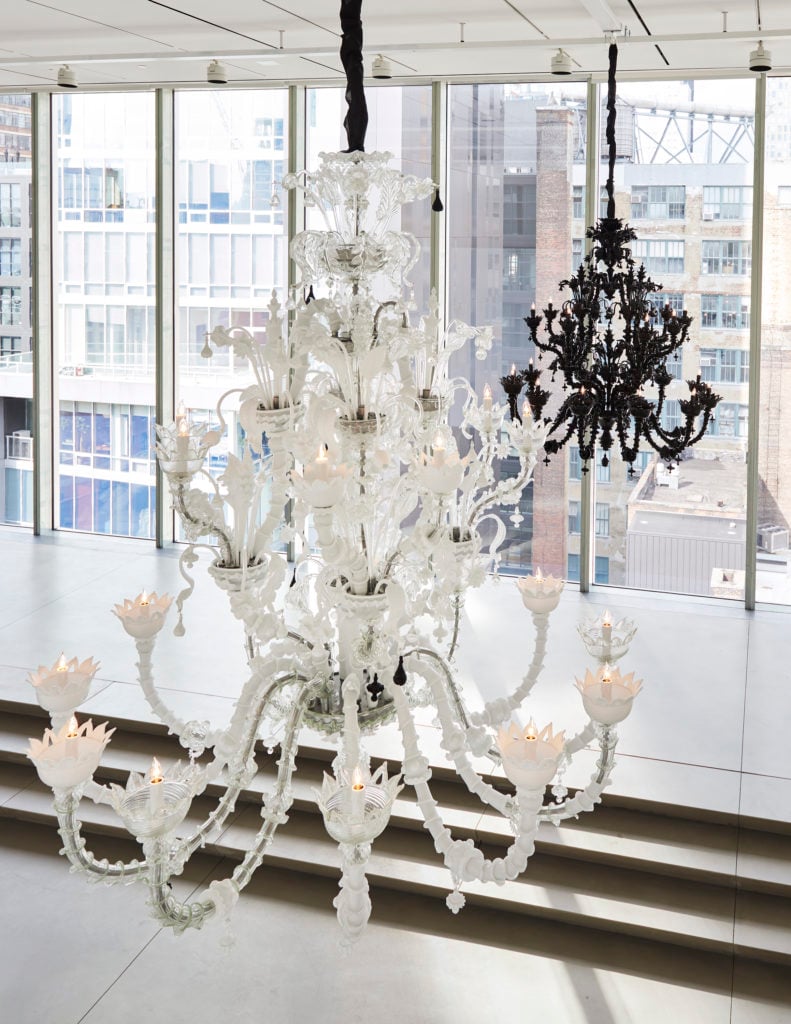
Installation view “Fred Wilson:
Chandeliers” at Pace, 524 West 25th Street. Photo: Guy Ben-Ari,
courtesy of Pace Gallery.
It’s funny you mention that you don’t really have a
medium, because you’re known as the artist whose medium is the
museum.
Yes, the museum is my medium, but I haven’t just done these
museum projects. The Istanbul Biennial was basically a museum
project. But the new thing I’m interested in is making objects
within the context of a museum, or introducing something I make
into a museum collection. But everything has to be right for
something like that to develop.
I want to pivot a little and talk about reactions to your
work. Some of my favorite aspects of “Mining the Museum,” your
1982 show at the Maryland Historical Society in Baltimore,
were there questionnaires you had visitors fill out about their
reactions to your unearthing of implicit museum biases and
racisms. How important are those reactions to you?
Those questionnaires were the curator’s idea, Lisa Corrin. She’s
now the director of the Block Museum at Northwestern University.
And I thought that was a really good idea because you know, this is
an unusual [exhibition] experience. Thinking about how people react
doesn’t really inform what I do, [but] it is important to me to
know the lay of the land before I do a project. In Baltimore, I did
my research and spoke to the community, and tried to understand the
place before committing to the project. In Istanbul, I went seven
times, like every month, and even afterwards I was concerned that I
made a misstep. But I wouldn’t have done it if I didn’t take the
time to understand certain aspects of the culture.
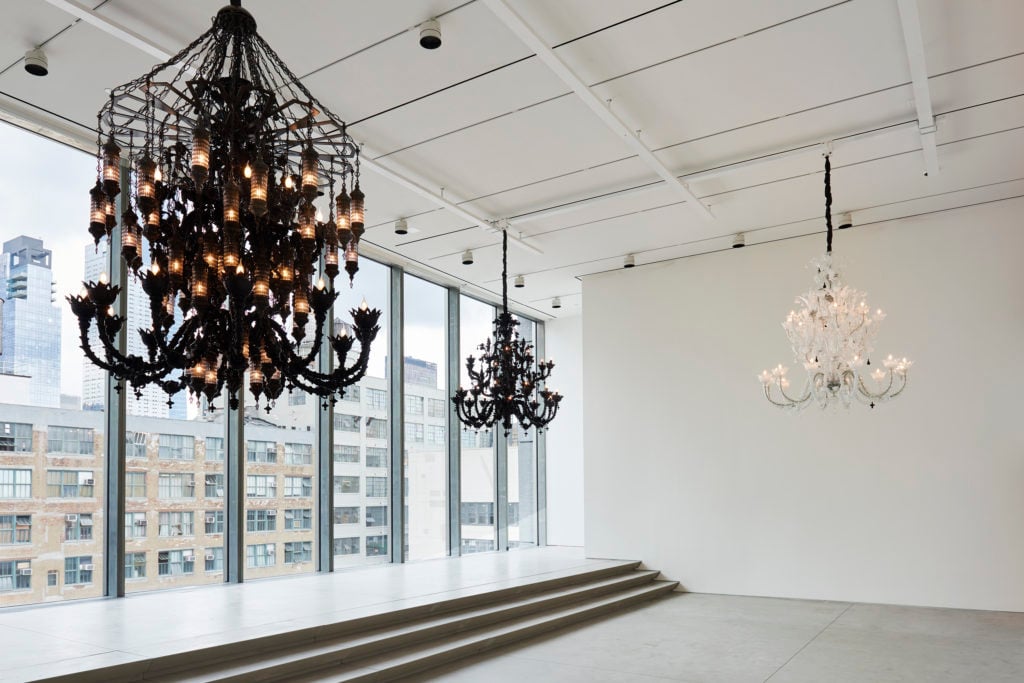
Installation view “Fred Wilson:
Chandeliers” at Pace, 524 West 25th Street. Photo: Guy Ben-Ari,
courtesy of Pace Gallery.
I know you’re interested in inserting objects into
museum collections, and there’s an element of trickery there, where
you’re surreptitiously giving off the impression that some of works
are existing artifacts. In fact, you’re fooling the audience. Do
you imagine yourself as a kind of provocateur in that
sense?
I don’t really think of myself that way. I see the denial and I
just reveal it because it’s there. There’s a very thin covering
over it, so the removal of one thing or the addition one thing can
really inform the experience. I want people to reflect—to be
self-reflective—more than anything else. I think sometimes the
reaction is shock. But what I’m looking for, more than anything, is
a kind of personal meditation on people’s view of the world.
A few years ago, I heard you speak at the Brooklyn
Museum, and you spoke candidly about working as a museum educator
and how, at the time, it was one of the only ways for African
Americans to get work in the art world. Have you noticed any
changes in museums or the art world since?
It was really different [and these two] very different
communities didn’t understand [one] another [back then. But] it’s
fantastic what’s happening now for younger black artists. I think
at one time, the inclusions of black artists in museum shows [led
to] knee jerk reactions. You know “ this just puts a Band-Aid on [a
bigger issue].” But now things are very different. I think there is
a lot more that needs to be done, but I feel generally people have
woken up—to a degree.
The post ‘People Have Woken Up—to a Degree’: Artist Fred
Wilson on Progress in the Art World and the Evolving Reception of
His Work appeared first on artnet News.
Read more https://news.artnet.com/art-world/fred-wilson-interview-1659739
Further reading


Leave a comment