
Museums Across the UK Are Making Doomsday Plans for Brexit. Here Are Their Biggest Fears
UK Museums are preparing for the worst as it looks
increasingly likely that Britain will abruptly leave the European
Union on October 31 without a divorce agreement, a fear fueled by
Boris Johnson, the new Prime Minister.
Johnson’s majority in Parliament is down to one member, which
has led to speculation that he may try to bypass the House of
Commons to force Brexit through. Another concern is that
his cabinet and special advisers have a new, avian-themed code
name—operation Black Swan—for
worst-case scenario planning.
Staff at UK’s leading museums, who are at the sharp end of
making sure high-profile exhibitions go ahead, have been quietly
charting for their own “Black Swan” plans for months, artnet News
has learned.
Since late 2018, UK museum registrars, who are responsible for
the safety of works of art traveling between British and
international institutions, have been working to minimize the
chances of rare and fragile loans being being delayed or damaged
while in transit in the days and weeks after a possible hard
Brexit.
Registrars are working on the assumption that the transportation
of cultural artifacts between the UK and Europe will be disrupted
after Brexit unless a last-minute transition deal is put in place.
Meanwhile, museum directors are watching the situation closely, and
preparing their institutions for possible long-term
consequences.
Logistical Nightmares
“Major loan exhibitions are expensive undertakings and their
financing is a constant challenge,” Alexander Sturgis, the director
of the Ashmolean Museum of Art, tells artnet News. “The additional
resources that will be required in the wake of Brexit will mean
fewer and less ambitious exhibitions for the UK public.”
The Ashmolean’s current exhibition, “Last Supper in Pompeii,” is
a collaboration with the National Archaeological Museum of
Naples and the Archaeological Park at Pompeii. Returning artifacts
to Italy when it closes in the new year could be far more
complicated than receiving them earlier this summer because of the
possible end of the free movement of goods and people between
Britain and Europe.
Another of the biggest short-term concerns of a hard Brexit is
the likelihood of delays at Britain’s ports. Some fear that customs
paperwork will quadruple.
“Brexit will inevitably have an impact on the bureaucracy, time,
and costs involved in receiving loans from EU museums and private
lenders, and so will make exhibitions such as ‘Last Supper at
Pompeii’ more expensive and difficult to mount,” Sturgis says.
A spokesperson for the National Gallery in London says it is
“planning for all of the eventualities of Brexit,” and has kept in
touch with the relevant government agencies. The museum is opening
a big exhibition of Gauguin’s portraits in early October, which is
a collaboration with the National Gallery of Canada in Ottawa. Next
year, the National Gallery is due to present a big Titian
presentation, followed by an exhibition of the Dutch Old Master,
Nicolaes Maes. A National Galleries of Scotland spokesperson
said it has also “considered a range of scenarios arising from
Brexit, and how our activities and operations may be impacted in
the coming period.”
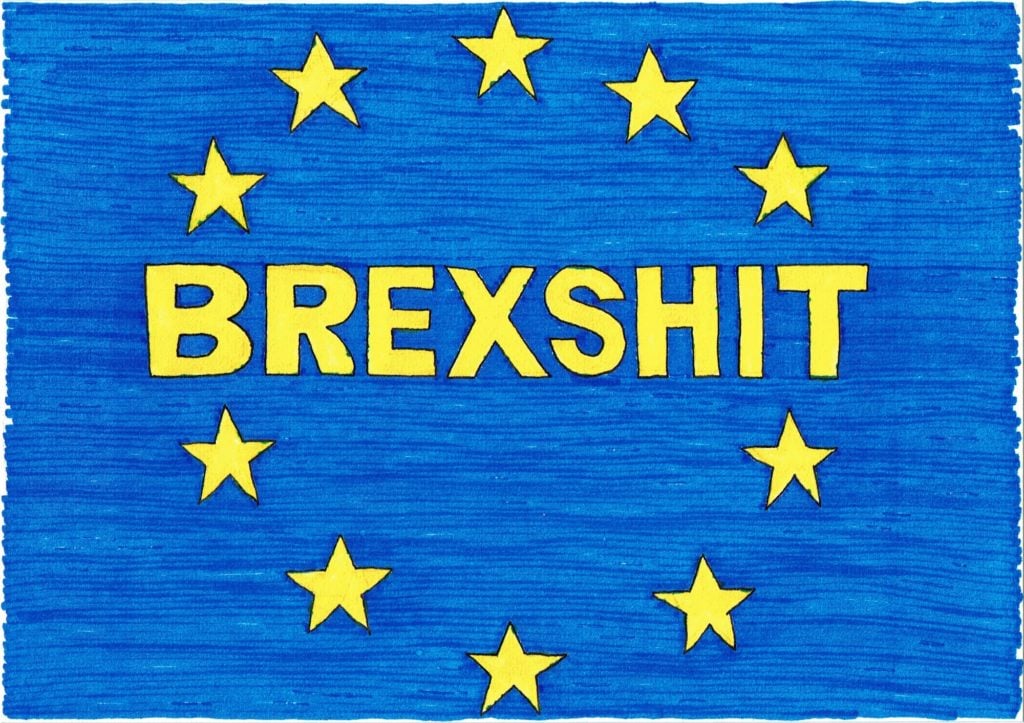
Michael Landy, Brexshit (2018).
© Michael Landy. Courtesy the artist, Thomas Dane Gallery, and the
Drawing Biennial.
Preparing for the Worst
In December, a group of UK registrars met to discuss Brexit
implications and to enumerate their greatest concerns. Their
report, illustrated by a work by Michael Landy
titled Brexshit (2018), emphasizes that transport
costs are likely to rise. And while Johnson has pledged money
for prisons and the health service, as well as to create freeports,
he has thus far said nothing to indicate that a decade of cuts to
national museum funding will be reversed.
Here are museum registrars’ main concerns:
Increased Costs
Registrars were told by a panel of experts, including a
representative from the UK government, to expect shipping delays
and potential currency fluctuations that will increase the cost of
loans. They were urged to build contingencies into budgets. The
pound is now trading at €1.08, its weakest since the 2016 EU
Referendum.
Transport Delays
Museums have been advised to avoid shipping works between the EU
and UK in the weeks immediately following a hard Brext. The port of
Dover in particular should be avoided, and registrars have also
planned for scenarios in which flights are grounded. Due to
increases in customs procedures and a lack of infrastructure, long
delays are expected at the border. If wait times are significant,
registrars fear, the likelihood of damage to objects will increase,
which could cause lenders to withdraws from sending artworks.
Export Licences Required
Works of art on loan that are due to return to the EU after a
no-deal Brexit may need an export licence. Registrars have be
advised to gather alternative evidence to satisfy customs that
goods were in free circulation to help obtain a licence.
Visas for Couriers and Curators
The end of free movement by British and EU nationals could
greatly complicate safeguarding works of art by curators and
conservators, who often act as couriers, if those couriers now need
travel documents. In a worst-case scenario, short-term visas
might be required, which could make even well-planned exhibitions
difficult to execute—and perhaps make last-minute
shipment changes impossible.
Funding Uncertainty
Another major headache is that while costs are likely to rise,
there is no indication so far that the UK national museums’ budgets
will be increased under Johnson. Due to Brexit, the government has
announced a one-year, rather than three-year, spending review,
which is due to be announced in September. The continued
uncertainty about government funding will complicate planning big
projects and shows.
In the meantime, museums will be closely watching the political
situation. While it is unlikely that a blockbuster show will
be a casualty of Brexit, the museums’ bottom line for exhibitions
looks bound to suffer, and bureaucracy seems bound to increase.
The post Museums Across the UK Are Making Doomsday Plans for
Brexit. Here Are Their Biggest Fears appeared first on artnet
News.
Read more https://news.artnet.com/art-world/uk-museums-brexit-plans-1621372
Further reading


Leave a comment