
Trump Official Rephrases Emma Lazarus’s Plaque on the Statue of Liberty to Justify a New Immigration Policy
A Trump Administration official has proposed an update to one of
the most famous statues in the world.
In an effort to justify a strict new immigration policy
targeting poor families and individuals to help restrict legal
immigration, Ken Cuccinelli has offered a less-than-poetic
rewrite of the plaque on the Statue of Liberty.
Where Emma Lazarus’s “The New Colossus” offered unconditional
welcome, proclaiming, “Give me your tired, your poor/Your huddled
masses yearning to breathe free/The wretched refuse of your teeming
shore,” Cuccinelli, the acting head of Citizenship and Immigration
Services, offered a revision when asked by NPR if the lines of the
poem were “part of the American ethos.”
“They certainly are—give me your tired and your poor who can
stand on their own two feet and who will not become a public
charge,” said Cuccinelli, who was on Morning
Edition to discuss a new “public charge” rule that would
make it more difficult for immigrants who have used public benefits
such as Medicaid, food stamps, and Section 8 housing to qualify for
a green card. The new regulation is slated to go into effect
60 days from Monday. (It does not appear that Cuccinelli was
actually proposing a rewrite to the physical plaque, but his words
quickly went viral.)
Lazarus wrote the poem in 1883 to help fundraising efforts to
build the Statue of Liberty’s base. Designed by French sculptor
Frédéric Auguste Bartholdi, with metal framework engineered by his
countryman Gustave Eiffel, the statue was a gift to the US from the
people of France, in honor of the country’s centenary.
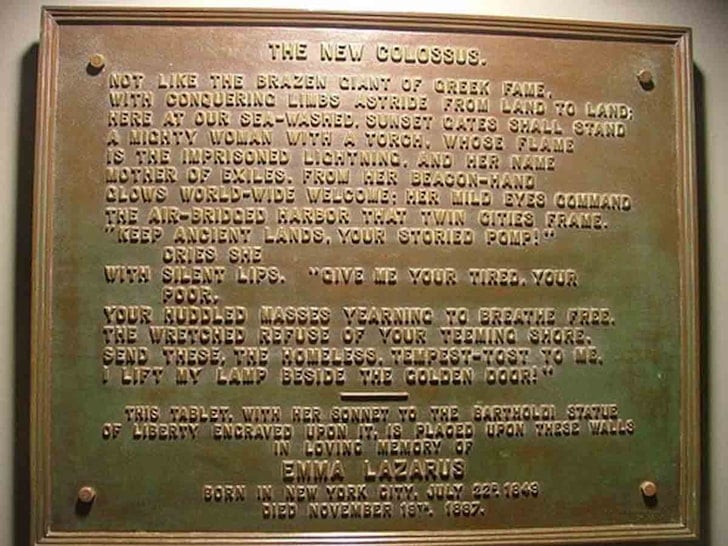
The plaque at the Statue of Liberty with
Emma Lazarus’s poem “The New Colossus.” Photo courtesy of the
National Park Service.
The statue was inaugurated in 1886, and the plaque featuring
Lazarus’s famous verse was mounted inside the pedestal in 1903.
Lady Liberty, with her illuminated torch offering a beacon above
immigrants arriving on Ellis Island, quickly became a symbol of the
US as a place of refuge for the world’s suffering masses.
“That plaque was put on the Statue of Liberty at almost the same
time as the first public charge law was passed—very interesting
timing,” Cuccinelli claimed, calling these types of regulations a
“140-year-old part of our legal immigration system.” (His history
lesson was a bit muddled; he was likely referring to the
Immigration Act of 1882, which allowed immigration authorities to
turn away immigrants suspected of being a “convict, lunatic, idiot,
or any person unable to take care of himself or herself without
becoming a public charge.”)
But the new public charge rule, the brainchild of Trump advisor
Stephen Miller, would mean that many migrants seeking a better life
in the US would no longer qualify for permanent residence, simply
because they had used public benefits. A November 2018 report from nonpartisan
think tank the Migration Policy Institute found that the rule would
probably “disproportionately affect women, children, and the
elderly.” The proposal has already drawn its first
lawsuit seeking to block it, brought by San Francisco
and the county of Santa Clara, California.
At a White House press briefing on Monday, Cuccinelli continued
to defend the new rule. But when asked point blank if the plaque
should be removed, he admitted that “I’m certainly not prepared to
take anything down off the Statue of Liberty.”
The post Trump Official Rephrases Emma Lazarus’s Plaque on
the Statue of Liberty to Justify a New Immigration Policy
appeared first on artnet News.
Further reading


Leave a comment